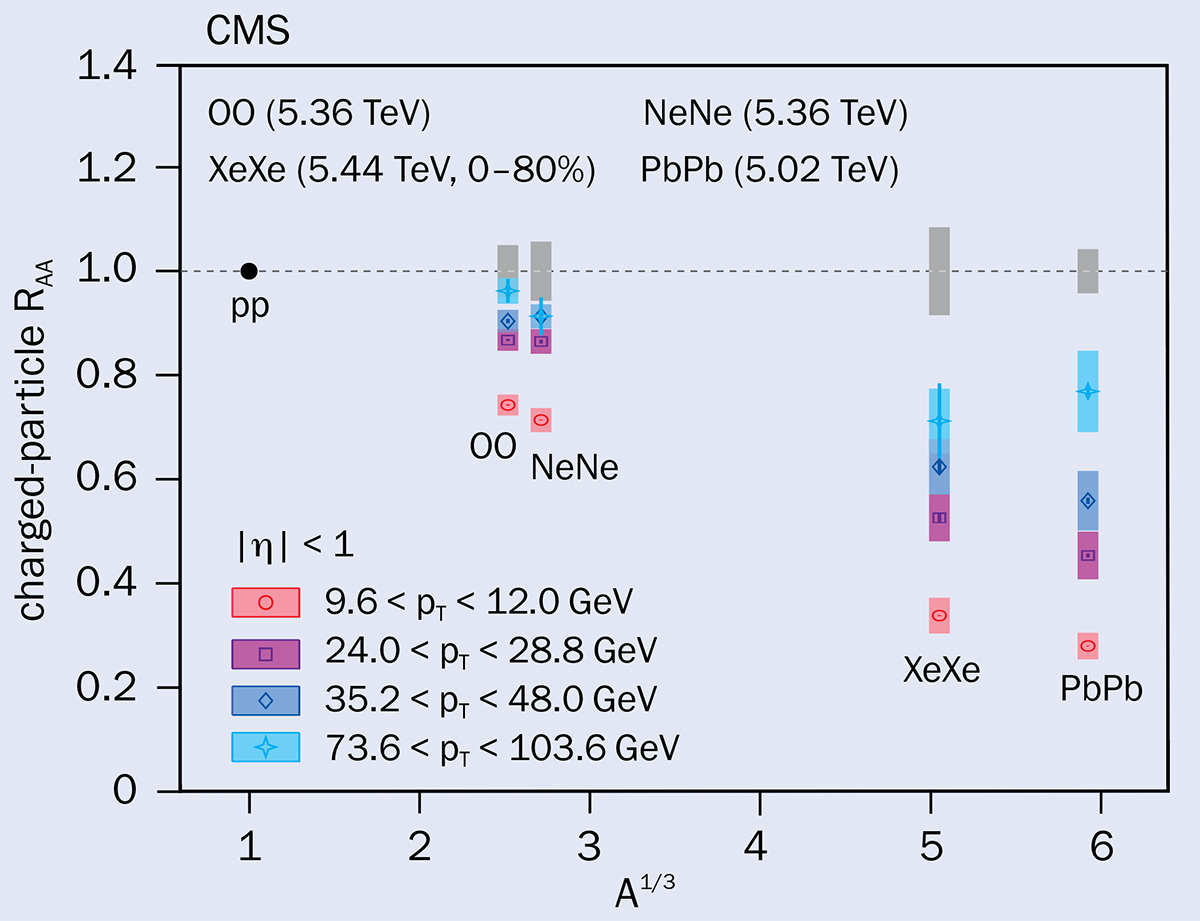
When atomic nuclei collide at the LHC, they produce tiny droplets of quark–gluon plasma (QGP) and energetic partons plough through it, slowing down in the process. In a new analysis, the CMS collaboration compared high transverse momentum (pT) particle yields in oxygen–oxygen, neon–neon, xenon–xenon and lead–lead collisions, with the nucleon numbers of the colliding particles increasing in the sequence 16 < 20 < 129 < 208. The results suggest a steady growth of parton energy loss with the size of the colliding system.
High-pT particles come from the fragmentation of quarks and gluons produced in the earliest hard scatterings of a collision. As these partons cross the QGP, they interact with the medium and radiate, losing energy in the process. This is one of the clearest signatures of QGP formation. How much energy partons lose depends on how far they travel inside the medium, which in turn grows with the size of the colliding nuclei. Although firmly established in xenon–xenon and lead–lead collisions, the precise way this quenching depends on the path length is not yet fully understood.
Light-ion collisions provide a controlled way to vary the system size and isolate this path-length dependence. In July 2025, the LHC delivered its first ever oxygen–oxygen and neon–neon collisions (CERN Courier November/December 2025 p8). The CMS collaboration analysed the data from this dedicated one-week run to perform a systematic study of high-pT charged-particle suppression across multiple collision systems.
The analysis combines existing measurements in oxygen–oxygen, xenon–xenon and lead–lead collisions with the first measurement of the charged-particle nuclear modification factor, RAA, in neon–neon collisions at a centre-of-mass energy of 5.36 TeV per nucleon pair. The observable RAA quantifies how particle yields deviate from expectations based on proton–proton collisions. The four systems were analysed using identical pT-intervals, enabling a consistent comparison across systems.
The results should help inform the choice of ion species
For smaller nuclei, such as oxygen and neon, many experimental uncertainties shared with the proton–proton reference largely cancel, for example, those related to tracking. This leads to particularly precise measurements of RAA across a wide pT range, which is difficult to achieve in larger systems. Combined with the wide span of nuclear sizes, this precision enables a more direct assessment of how parton energy loss depends on in-medium path length.
For a fixed transverse momentum interval, the suppression increases smoothly with system size, from light to heavy ion collisions (see figure 1). Conversely, for a given nuclear system, the suppression is stronger at lower transverse momenta and progressively weakens as it increases. Expressed in terms of the cube root of the nucleon number, which is proportional to the nuclear radius, the results follow a simple ordering with the size of the system, offering a natural framework to test the evolution of energy loss with system size.
The data indicate that nuclear suppression develops gradually as the nuclear system grows, consistent with a picture in which partons interact with QGP droplets whose extent and density evolve smoothly across collision systems. Calculations that omit energy loss show little variation with system size and do not describe the observed suppression, whereas models that include it qualitatively reproduce the observed trend within uncertainties. The data, presented this way, offer a guide for further improvements on their A-dependence.
This study places new quantitative constraints on parton-energy-loss mechanisms and on the emergence of QGP-like behaviour in small nuclear systems. The results should help guide future theoretical developments and inform the choice of ion species in upcoming heavy-ion studies at the LHC.
The 18th International Workshop on Top Quark Physics (TOP2025) brought the top-quark community to Seoul, South Korea, from 21 to 26 September 2025. Hosted at Hanyang University, the event offered 135 experimentalists and theorists a chance to exchange results, discuss open questions and explore the future of top-quark physics.
2025 marked the 30th anniversary of the top quark’s discovery by the DØ and CDF experiments at Fermilab. Three decades on, and despite ever-increasing experimental precision, the top quark’s properties remain only partially understood. While its mass is now known at the sub-GeV level and its production cross sections agree well with Standard Model predictions, questions persist about its electroweak couplings, its interactions with the Higgs boson, and the detailed structure of top–antitop production at high energies. Because of its large mass and correspondingly strong coupling to the electroweak sector, many in the community continue to view the top quark as a sensitive probe of physics beyond the Standard Model.
The conference opened with an inspiring keynote address by Juan Antonio Aguilar Saavedra (IFT Madrid), who explored the connections between top-quark physics and quantum science and technology. A notable example is the recent observation of quantum entanglement in top-quark pair production by the ATLAS and CMS experiments, which has opened a promising new line of research linking collider physics with concepts more familiar to quantum information researchers. Entanglement can be measured in the top–antitop system because top quarks decay before hadronisation takes place, allowing direct access to their spin correlations.
Top physics is currently enjoying a golden era. Last year, the CMS collaboration reported an excess near the top–antitop threshold (CERN Courier May/June 2025 p7), later confirmed by ATLAS with a significance of 7.7σ above the background predicted by perturbative quantum chromodynamics (CERN Courier September/October 2025 p9). This excess is consistent with expectations from non-relativistic quantum chromodynamics, an effective theory that describes the dynamics of heavy quark pairs near threshold and with simplified models involving a pseudoscalar “quasi-bound-state”, called toponium.
During a mini-workshop dedicated to toponium, Benjamin Fuks (LPTHE) presented an intriguing scenario in which the excess could be explained by two contributions: one from a top–antitop bound state and another from a beyond-the-Standard-Model signature, although the data are also compatible with Standard-Model-only components.
The next edition of the TOP conference will take place in Antalya, Turkey, from 5 to 9 October 2026.
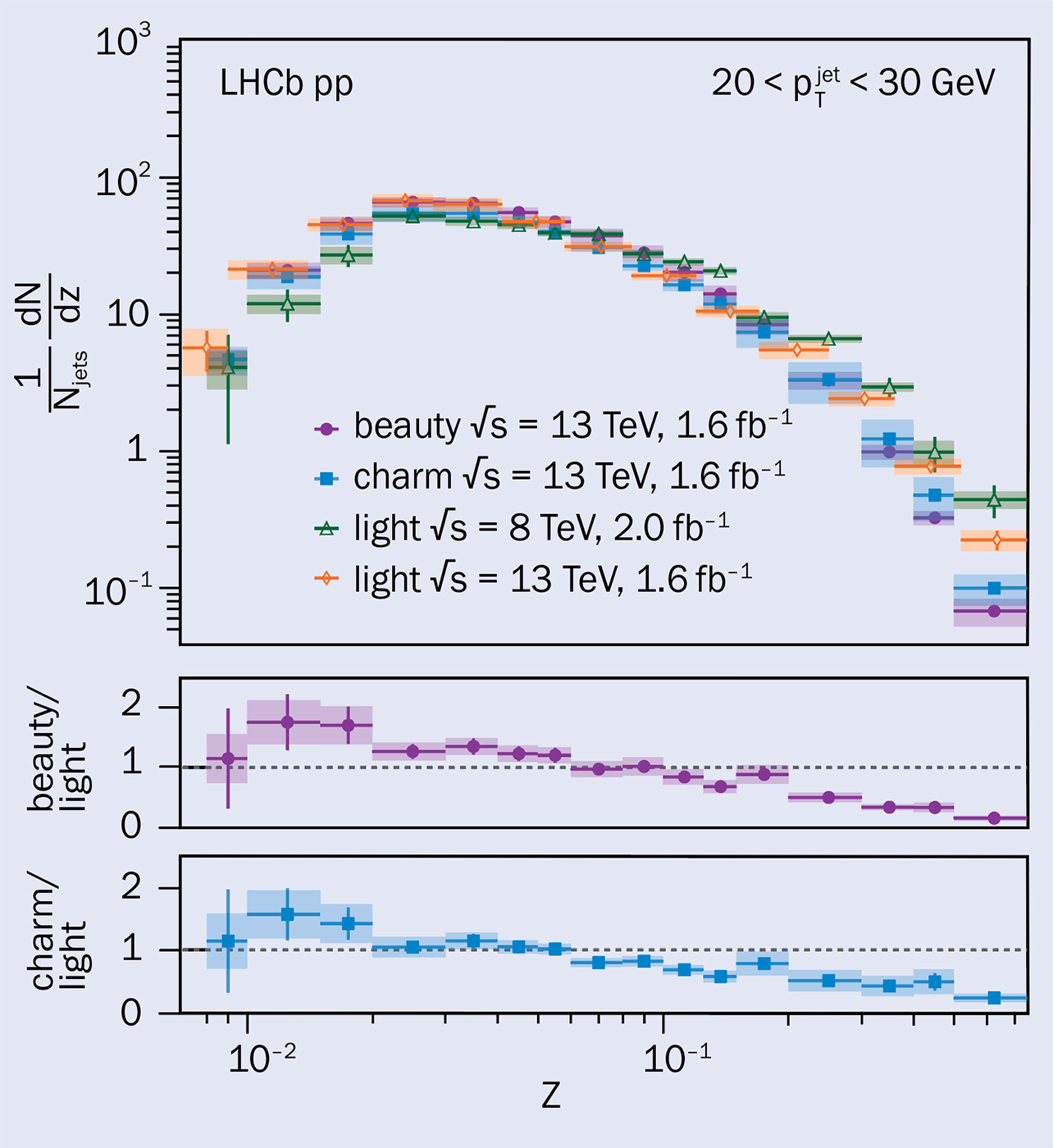
Proton–proton collisions at the LHC fling quarks and gluons out at massive energies. As they radiate and split into ever more partons, the strong force confines them into sprays of hadrons called jets. The total momentum of a jet, split among its components, approximates that of the initial quark or gluon, which cannot be accessed directly. By tracking how much of a jet’s momentum each hadron carries, the LHCb collaboration has now compared how charm, beauty and light quarks hadronise.
While the production and radiation of individual quarks and gluons can be treated perturbatively, their conversion into hadrons occurs in the non-perturbative regime and cannot be calculated from first principles. Instead, the transition is described using phenomenological probability distributions, called fragmentation functions, which encode how a quark of a given flavour produces specific hadrons. Measuring the content and structure of jets, as well as their kinematic properties, can help constrain these functions.
Previously, the LHCb collaboration measured observables sensitive to fragmentation functions in samples dominated by light-quark-initiated jets. The same measurements were recently carried out for charm- and beauty-quark-initiated jets, allowing a direct comparison of hadronisation across three different jet flavour categories at a single experiment. The light-quark sample was obtained by selecting jets produced nearly back-to-back with a Z boson. In such events, the single parton initiating the jet is typically a gluon or a light quark. In the forward kinematic region accessible to the LHCb detector, where one incoming parton often carries a large fraction of the proton momentum, the proportion of light-quark jets gets further enhanced. Samples of predominantly charm- and beauty-quark-initiated jets were instead obtained using a dedicated flavour-tagging algorithm, which makes use of LHCb’s excellent performance at heavy flavour identification and reconstruction.
The new measurements allow a direct comparison of hadronisation across three different jet flavour categories
A key observable for constraining fragmentation functions is the longitudinal momentum fraction z, defined as the share of jet momentum carried by a hadron along its axis. With respect to their light-quark analogues, heavy-quark-initiated jets appear suppressed at high z, consistent with the leading heavy-flavour hadron carrying most of the jet momentum (see figure 1).
Previous measurements of the hadronisation of a heavy quark into a single heavy-flavour hadron showed that this hadron carries most of the parent quark’s momentum. The new LHCb analysis extends this picture to the full multi-hadron structure of heavy-quark-initiated jets and is consistent with single-hadron measurements: relatively few charged hadrons possess a large fraction of the jet momentum – a result compatible with the heavy-flavour hadron carrying most of it. This result demonstrates the complementarity of single- and multi-hadron measurements, which are both necessary to fully understand high-energy hadronisation.
The analysis also measured the transverse momentum of the hadron with respect to the jet axis, which is sensitive to transverse-momentum-dependent fragmentation functions. Experimental constraints on these functions remain limited, yet they are crucial in reconstructing a three-dimensional description of hadronisation.
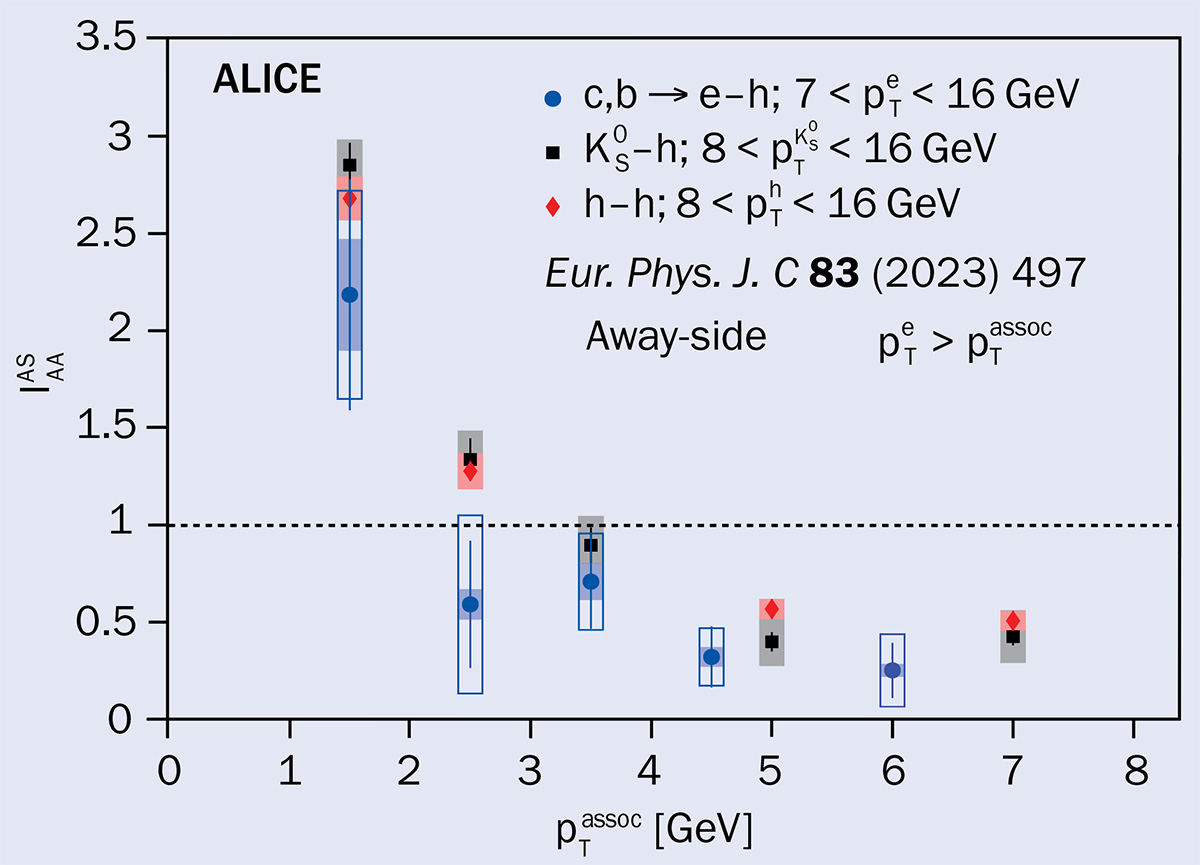
Partons produced in heavy-ion collisions at the LHC must push their way through a hot, dense quark–gluon plasma (QGP). In doing so, they experience medium-induced energy loss that depends on the parton’s mass. In a recent analysis, the ALICE collaboration compared the yields of charged particles associated with electrons from heavy-flavour hadron decays with those of the light hadrons. Both show a suppression of high-momentum particles emitted opposite to the tagged particle, with no significant difference between the two.
After a hard scattering, high-energy partons fragment into collimated sprays of hadrons known as jets. These are well described in proton–proton (pp) collisions, where their substructures provide stringent tests of perturbative QCD. In heavy-ion collisions, instead, they propagate through the QGP and emerge modified – a phenomenon known as jet quenching. Previous measurements (CERN Courier March/April 2025 p13) suggest that jets initiated by charm and beauty quarks lose less energy than those from light quarks and gluons, owing to their larger mass. This difference is commonly attributed to the dead-cone effect, which suppresses gluon emission by heavy quarks at small angles. Jet-quenching effects can be further characterised by measuring the transverse-momentum distribution of particles within jets, providing insight into the redistribution of the quenched energy.
To study this, the ALICE collaboration employs azimuthal-correlation measurements. This technique measures the angular correlation between a heavy-flavour hadron or its decay daughter (“trigger” particle) and other associated charged particles in the same event. The resulting distribution features two correlation peaks: a near-side peak from particles produced alongside the trigger and an away-side one from the recoiling jet, particularly sensitive to jet-medium interactions. Jet quenching is then quantified by the per-trigger nuclear modification factor IAA, which is the ratio of away-side charged-particle yield in heavy-ion collisions to pp collisions. Values of IAA deviating from unity indicate QGP-induced modifications of the jet.
The ALICE collaboration now reports the measurements of jet-like structures in the heavy-flavour sector of lead-lead collisions at a centre-of-mass energy of 5.02 TeV per nucleon pair. The analysis, based on LHC Run 2 data, uses electrons from semi-leptonic decays of charm and beauty hadrons as trigger particles. Electron identification relies on a combination of energy-loss measurements in the time-projection chamber, energy-momentum matching in the calorimeter and selection of shower shapes. Invariant-mass tagging techniques allowed for the subtraction of the large backgrounds from photon conversions and light-meson decays to electron-positron pairs.
The measurement is challenging due to the high multiplicity of lead-lead collisions and the need to extract jet-like correlations from large combinatorial and collective-motion backgrounds. A corresponding analysis of pp collisions at the same energy provides the reference needed to compare jet evolution in the presence of the QGP.
The away-side shows a suppression for associated particles with transverse momenta between 4 and 7 GeV/c (see figure 1), indicating relevant jet quenching with a 2.5σ significance. Conversely, a hint of an enhancement is observed below 2 GeV/c, possibly signalling the redistribution of lost energy into the medium and the subsequent formation of additional low-momentum particles.
These results are consistent with corresponding measurements using light-flavour triggers across all measured intervals. While this suggests that the QGP modifies jets consistently regardless of the initiating parton’s mass, important caveats remain. Variations in parton-to-hadron momentum scaling, as well as the fact that the heavy flavour is tagged via decay electrons, could introduce kinematic differences that complicate a direct comparison. Whether QCD predicts a deviation remains an open question for future modelling of mass-dependent parton-medium interactions.
LHC Run 3 will provide an order of magnitude more heavy-ion events. This increased luminosity will enable higher-precision analyses, offering a deeper understanding of how QGP modifies heavy- and light-flavour jets.
The Higgs boson is uniquely simple – the only Standard Model particle with no spin. Paradoxically, this allows its behaviour to be uniquely complex, notably due to the “scalar potential” built from the strength of its own field. Shaped like a Mexican hat, the Higgs potential has a local maximum of potential energy at zero field, and a ring of minima surrounding it.
In the past, the Higgs field settled into this ring, where it still dwells today. Since then, the field has been permanently “switched on” – a directionless field with a nonzero “vacuum expectation value” that is ubiquitous throughout the universe. Its interactions with a number of other fundamental particles give them mass. What remains unclear is how the Higgs field behaves once pushed from this familiar minimum. Where will it go next, how did it get there in the first place and might new physics modify this picture?
The LHC alone has shed experimental light on this physics. Further progress on this compelling frontier of fundamental science requires upgrades and new colliders. The next step along this path is the High-Luminosity LHC (HL-LHC), which is scheduled to begin operations in 2030. The HL-LHC is set to outperform the LHC by far, with a total dataset of 380 million Higgs bosons created inside the ATLAS and CMS experiments – a sample more than 10 times larger than any studied so far (see “A leap in technology” panel). We still need to unlock the full reach of the HL-LHC, but three scientific questions may serve to illustrate what can be studied with 380 million Higgs bosons.
What is the fate of the universe?
The stability of our universe hangs in a delicate balance. Quantum corrections could make the Higgs potential bend downward again at high values of the Higgs field, creating a lower-energy state beneath our own (see “The Higgs potential” panel). Through quantum tunnelling, tiny regions of space could spontaneously make the transition, releasing energy as the Higgs field settles into a new minimum of the Higgs potential. Bubbles of the new vacuum would expand at the speed of light, changing the vacuum state of the regions they encounter.
Details matter. The Higgs potential is modified by the effect of virtual loops from all particles interacting with the Higgs field. Bosons push the Higgs potential upwards at high field values, and fermions pull it downwards. If the Standard Model remains valid up to high field values, perhaps as high as the Planck scale where quantum gravity is expected to become relevant, these corrections may determine the ultimate fate of the vacuum. As the most massive Standard Model particle yet discovered, the top quark makes a dominant negative contribution at high energies and field strengths. Together with a smaller effect from the mass of the Higgs boson itself, the top-quark mass defines three possible regimes.
In the stable case, the Higgs potential remains above the current minimum up to high field values, and no deeper minimum is present.
If a second, lower minimum forms at high field values, but is shielded by a large energy barrier, the vacuum can be “metastable”. In that case, quantum tunnelling could in principle occur, but on timescales exceeding the age of the universe.
In the unstable regime, the barrier is low enough for decay to have already occurred.
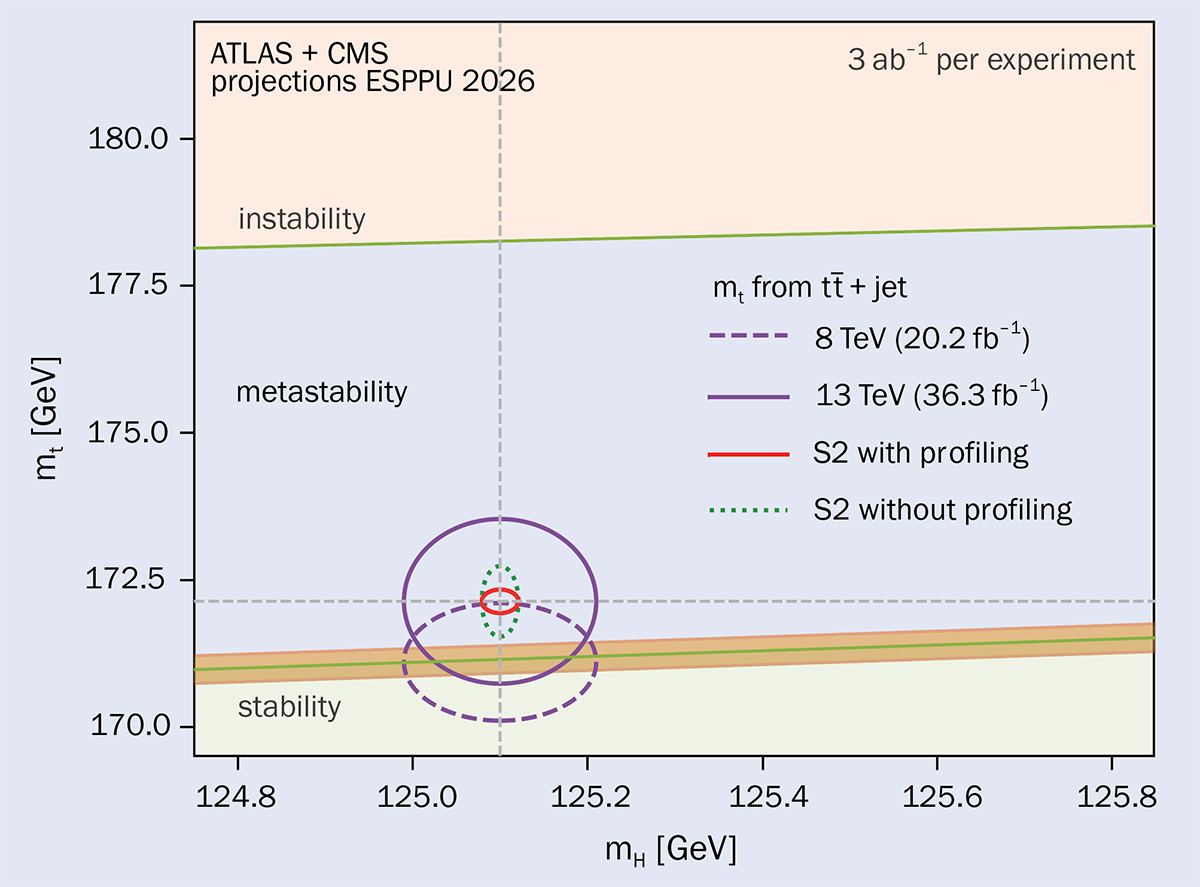
Current observations place our universe safely within the metastable zone, far from any immediate change (see “A second minimum?” figure). Yet the precision of the latest LHC measurements, based on independent determinations of the top-quark mass (purple ellipses), leaves unresolved whether the universe is stable or metastable. Other uncertainties, such as that on the strength of nature’s strong coupling, also affect the distinction between the two regimes, shifting the boundary between stability and metastability (orange band).
The HL-LHC will be well placed to help resolve the question of the stability of the vacuum thanks to improvements in the measurements of the top quark and Higgs-boson masses (red ellipse). This will rely on combining the HL-LHC’s large dataset, the ingenuity of expected analysis improvements and theoretical progress in the fundamental interpretation of these measurements.
The Higgs potential
The Higgs boson is the only Standard Model particle with no spin – a quantum number that behaves as if fundamental particles were spinning, but which cannot correspond to a physical rotation without violating relativity theory.
This allows the Higgs field to experience a scalar potential – energy penalties that depend on the strength of the Higgs field itself. This is forbidden for fermions
(spin ½) and massless bosons (spin 1) by Lorentz symmetry and gauge invariance.
In the Standard Model, the Higgs field is subject to the Higgs potential, shaped like a Mexican hat, with a maximum of potential energy at zero field, and a minimum at a ring in the complex plane of values of the Higgs field. Its polynomial form is restricted by gauge symmetry. Experimentally, it can be inferred by measuring properties of the Higgs boson such as its self-coupling λ3.
Two effects then modify the Mexican-hat shape in ways that are difficult to predict but have important consequences for particle physics and cosmology. These are due to the interactions of the Higgs field with virtual particles and real thermal excitations. Quantum fluctuations modify the energy penalty of exciting the Higgs field due to virtual loops from all Standard Model particles. Changes in the temperature of the universe also generate changes in the shape of the Higgs potential due to the interaction of the Higgs field with real thermal excitations in the hot early universe. Properties such as λ3 are also affected by these effects.
The Higgs potential wasn’t always a Mexican hat. If the early universe got hot enough, interactions between the Higgs field and a hot plasma of particles shaped the Higgs potential into a steep bowl with a minimum at zero field, yielding no vacuum expectation value. As the universe cooled, this potential drooped into its familiar Mexican-hat shape, with a central peak surrounded by a ring of minima, where the Higgs field sits today. But did the Higgs field pass through an intermediate stage, with a “bump” separating the inner minimum from the ring?
The answer depends on the strength of the Higgs self-coupling, λ3, which governs the trilinear coupling where three Higgs-boson lines meet at a single vertex in a Feynman diagram. But λ3 is not yet measured. The most recent joint ATLAS and CMS analysis excludes values outside of –0.71 to 6.1 times its expected value in the Standard Model with 95% confidence.
In the Standard Model, the vacuum smoothly rolled from zero Higgs field to its new minimum in the outer ring. But if λ3 were at least 50% stronger than in the Standard Model, this smooth “crossover” phase transition may have been prevented by an intermediate bump. The vacuum would then have experienced a strong first-order phase transition (FOPT), like ice melting or water boiling at everyday pressures. As the universe cooled, regions of space would have tunnelled into the new vacuum, forming bubbles that expanded and merged. These bubble-wall collisions, combined with additional processes beyond the Standard Model that violate the conservation of both charge and parity together, could have contributed to the observed excess of matter over antimatter – one of the deepest mysteries of modern physics, wherein there appears to have been an excess of baryons over antibaryons in the early universe of roughly one part in a billion, resulting in the surplus we observe today after the annihilation of the others into photons.
The most direct probe of λ3 comes from Higgs-boson pair production (HH). HH production happens most often by the fusion of gluons from the colliding protons to create a top-quark loop that emits either two Higgs bosons or one Higgs boson splitting into two, yielding sensitivity to λ3.
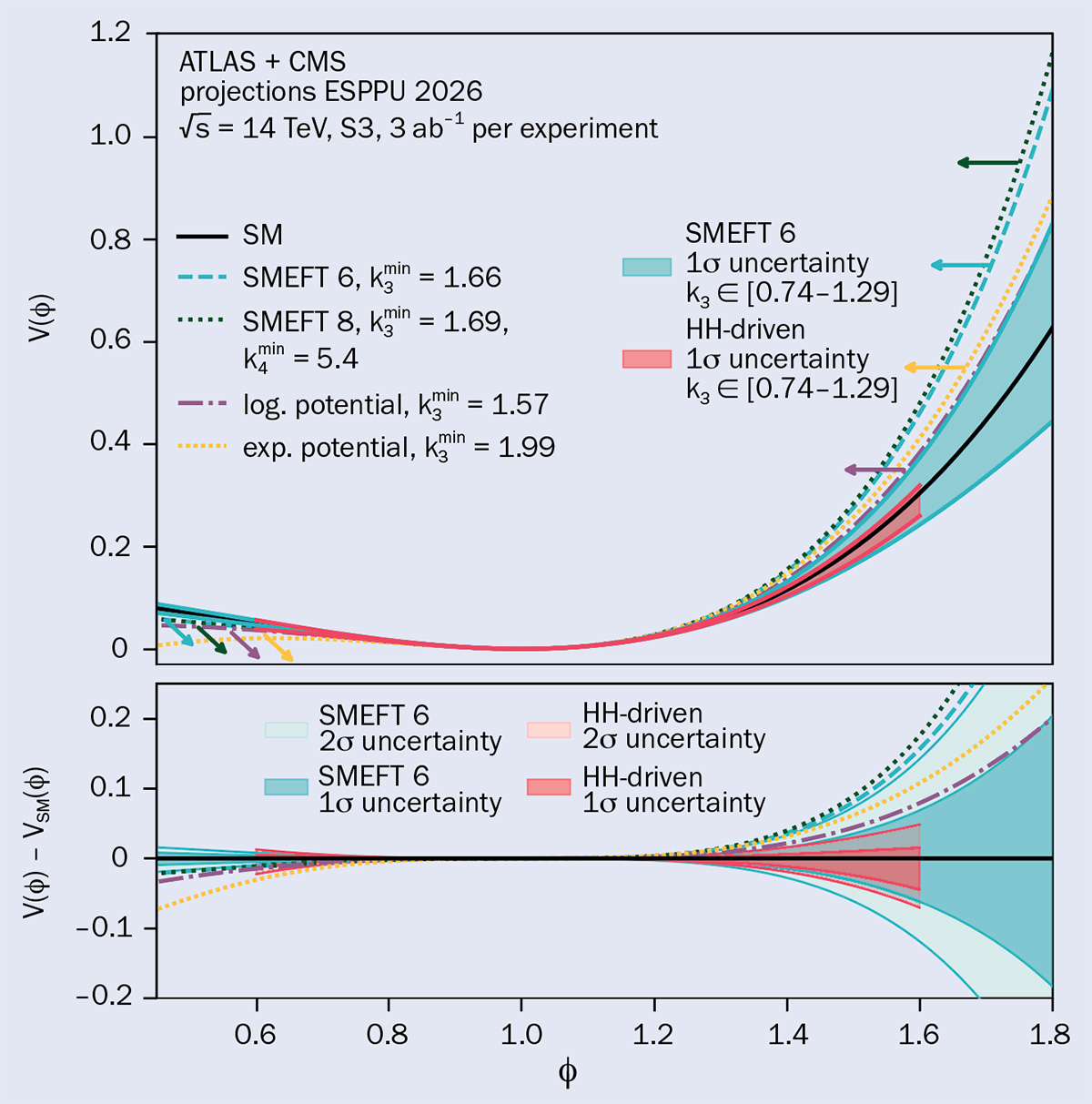
HH production happens only once for every thousand Higgs bosons produced in the LHC. Searches for this process are already underway, with analyses of the Run 2 dataset by the ATLAS and CMS collaborations showing that a signal 2.5 times larger than the Standard Model expectation is already excluded. This progress far exceeds early expectations, suggesting that the HL-LHC may finally bring λ3 within experimental reach, clarifying the shape of the Higgs potential near its current minimum (see “Constraining the Higgs potential” figure).
Measuring λ3 at the HL-LHC would shed light on whether the Higgs potential follows the Standard Model prediction (black line) or alternative shapes (dashed lines), which may arise from physics beyond the Standard Model (BSM). The corresponding sensitivity can be illustrated through two complementary approaches: one based on HH production, assuming no effects beyond λ3 and providing a largely model-independent view near the potential’s minimum (red bands); and an approach that incorporates higher-order effects, which extend the reach over a broader range of the Higgs field (blue bands).
Since the previous update of the European Strategy for Particle Physics, the projected sensitivity has vastly improved. The combined ATLAS and CMS results are now expected to yield a discovery significance exceeding 7σ, should HH production occur at the Standard Model rate. By the end of the HL-LHC programme, the two experiments are expected to determine λ3 with a 1σ uncertainty of about 30% – enough to exclude the considered BSM potentials at the 95% confidence level if the self-coupling matches the Standard Model prediction.
What lurks beyond the Standard Model?
Puzzles such as the origin of dark matter and the nature of neutrino masses suggest that new physics must lie beyond the Standard Model. With greatly expanded data sets at the HL-LHC, new phenomena may become detectable as resonant peaks from undiscovered particles or deviations in precision observables.
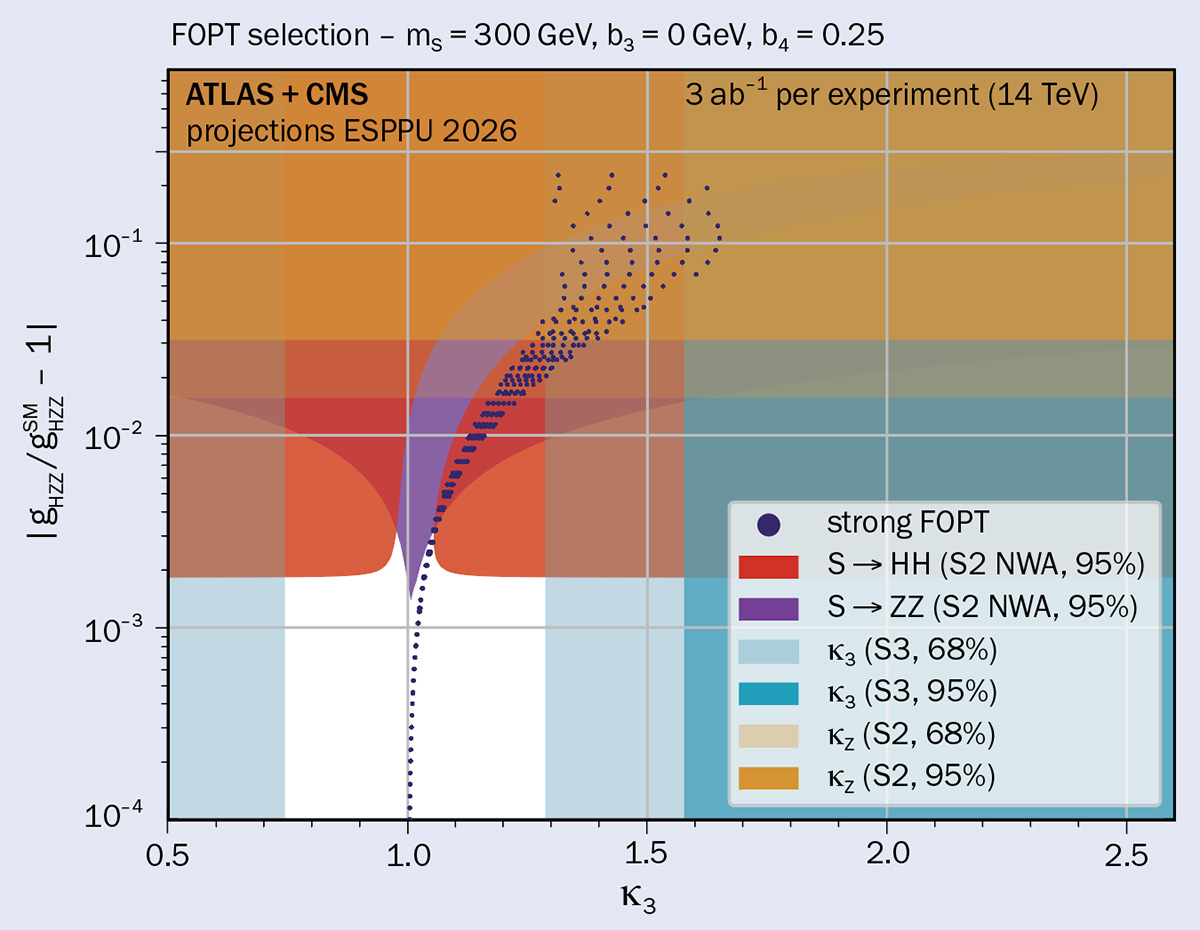
As an example, consider a BSM scenario that includes an additional scalar boson “S” that mixes with the Higgs boson but remains blind to other Standard Model fields (see “Spotting a new scalar” figure). S could induce observable differences in λ3 (horizontal axis) and the coupling of the Higgs boson to the Z boson, gHZZ (vertical axis). Both couplings are plotted as a factor of their expected Standard Model values. The figure explores scenarios where the coupling deviates from its Standard Model value by as little as a tenth of a permille, and where the trilinear self-coupling may be between 0.5 and 2.5 times the value. Such models could prove to be the underlying cause of deviations from the Standard Model such as contributing to the matter–antimatter asymmetry in the universe. Combinations of model parameters that could allow for a strong FOPT in the early universe are plotted as black dots.
This example analysis serves to illustrate the complementarity of precision measurements and direct searches at the HL-LHC. The parameter space can be narrowed by measuring the axis variables λ3 and gHZZ (blue and orange bands). Direct searches for S → HH and S → ZZ will be able to probe or exclude many of the remaining models (red and purple regions), leaving room for scenarios in which new physics is almost entirely decoupled from the Standard Model.
What’s next?
What once might have seemed like science fiction has become a milestone in our understanding of nature. When Ursula von der Leyen, president of the European Commission, last visited CERN, she reflected on recent progress in the field.
“When you designed a 27 km underground tunnel where particles would clash at almost the speed of light, many thought you were daydreaming. And when you started looking for the Higgs boson, the chances of success seemed incredibly low, but you always proved the sceptics wrong. Your story is one of progress against all odds.”
Today, at a pivotal moment for particle physics, we are redefining what we believe is possible. Plucked from the ATLAS and CMS collaborations’ inputs to the 2026 update to the European Strategy for Particle Physics (CERN Courier November/December 2025 p23), the analyses described in this article are just a snapshot of what will be possible at the HL-LHC. In close collaboration with the theory community, experimentalists will use the unmatched datasets and detector capabilities of the HL-LHC and allow the field to explore a rich landscape of anticipated phenomena, including many signatures yet to be imagined.
The HL-LHC will deliver proton–proton collisions at least five times more intensely than the LHC’s original design. By the end of its lifetime, the HL-LHC is expected to accumulate an integrated dataset of around 3 ab–1 of proton–proton collisions – about six times the data collected during the LHC era.
ATLAS and CMS are undergoing extensive upgrades to cope with the intense environment created by a “pileup” of up to 200 simultaneous proton–proton interactions per bunch crossing. For this, researchers are building ever more precise particle detectors and developing faster, more intelligent software.
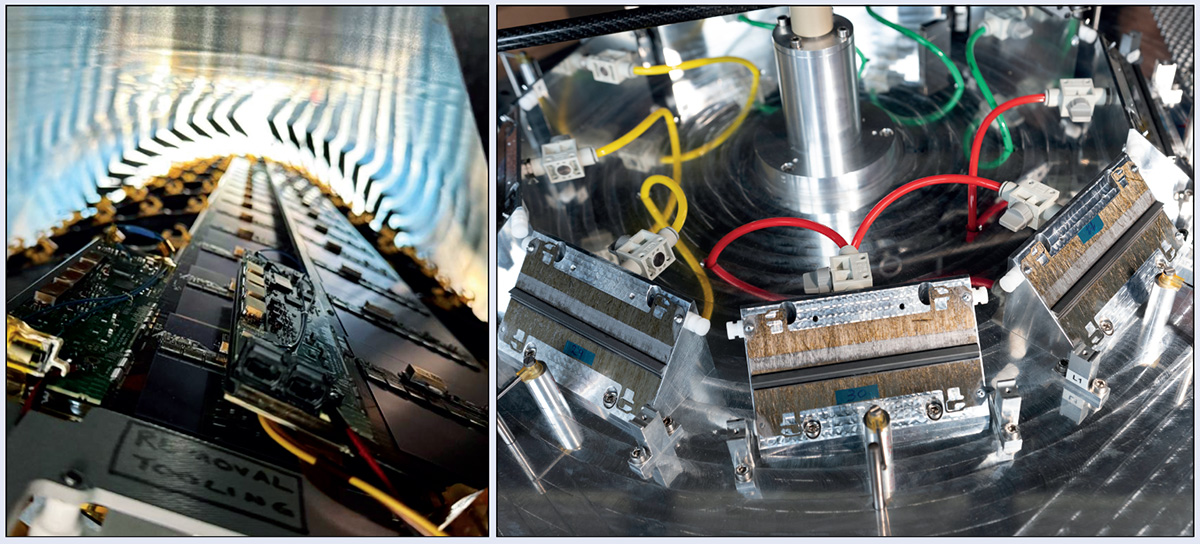
The ATLAS and CMS collaborations will implement a full upgrade of their tracking systems, providing extended detector coverage and improved spatial resolution (see “Tracking upgrades” figure). New capabilities are added to either or both experiments, such as precision timing layers outside the tracker, a more performant high-granularity forward calorimeter, new muon detectors designed to handle the increased particle flux, and modernised front- and back-end electronics across the calorimeter and muon systems, among other improvements.
Major advances are also being made in data readout, particle reconstruction and event selection. These include track reconstruction capabilities in the trigger and a significantly increased latency, allowing for more advanced decisions about which collisions to keep for offline analysis. Novel selection techniques are also emerging to handle very high event rates with minimal event content, along with AI-assisted methods for identifying anomalous events already in the first stages of the trigger chain.
Finally, detector advancements go hand-in-hand with innovation in algorithms. The reconstruction of physics objects is being revolutionised by higher detector granularity, precise timing, and the integration of machine learning and hardware accelerators such as modern GPUs. These developments will significantly enhance the identification of charged-particle tracks, interaction vertices, b-quark-initiated jets, tau leptons and other signatures – far surpassing the capabilities foreseen when the HL-LHC was first conceived.
There is an overwhelming amount of evidence for the existence of dark matter in our universe. This type of matter is approximately five times more abundant than the matter that makes up everything we observe: ourselves, the Earth, the Milky Way, all galaxies, neutron stars, black holes and any other imaginable structure.
We call it dark because it has not yet been probed through electroweak or strong interactions. We know it exists because it experiences and exerts gravity. That gravity may be the only bridge between dark matter and our own “baryonic” matter, is a scenario that is as plausible as it is intimidating, since gravitational interactions are too weak to produce detectable signals in laboratory-scale experiments, all of which are made of baryonic matter.
However, dark matter may interact with ordinary matter through non-gravitational forces as well, possibly mediated by new particles. Our optimism is rooted in the need for new physics. We also require new mechanisms to generate neutrino masses and the matter–antimatter asymmetry of the universe, and these new mechanisms may be intimately connected to the physics of dark matter. This view is reinforced by a surprising coincidence: the abundances of baryonic and dark matter are of the same order of magnitude, a fact that is difficult to explain without invoking a non-gravitational connection between the two sectors.
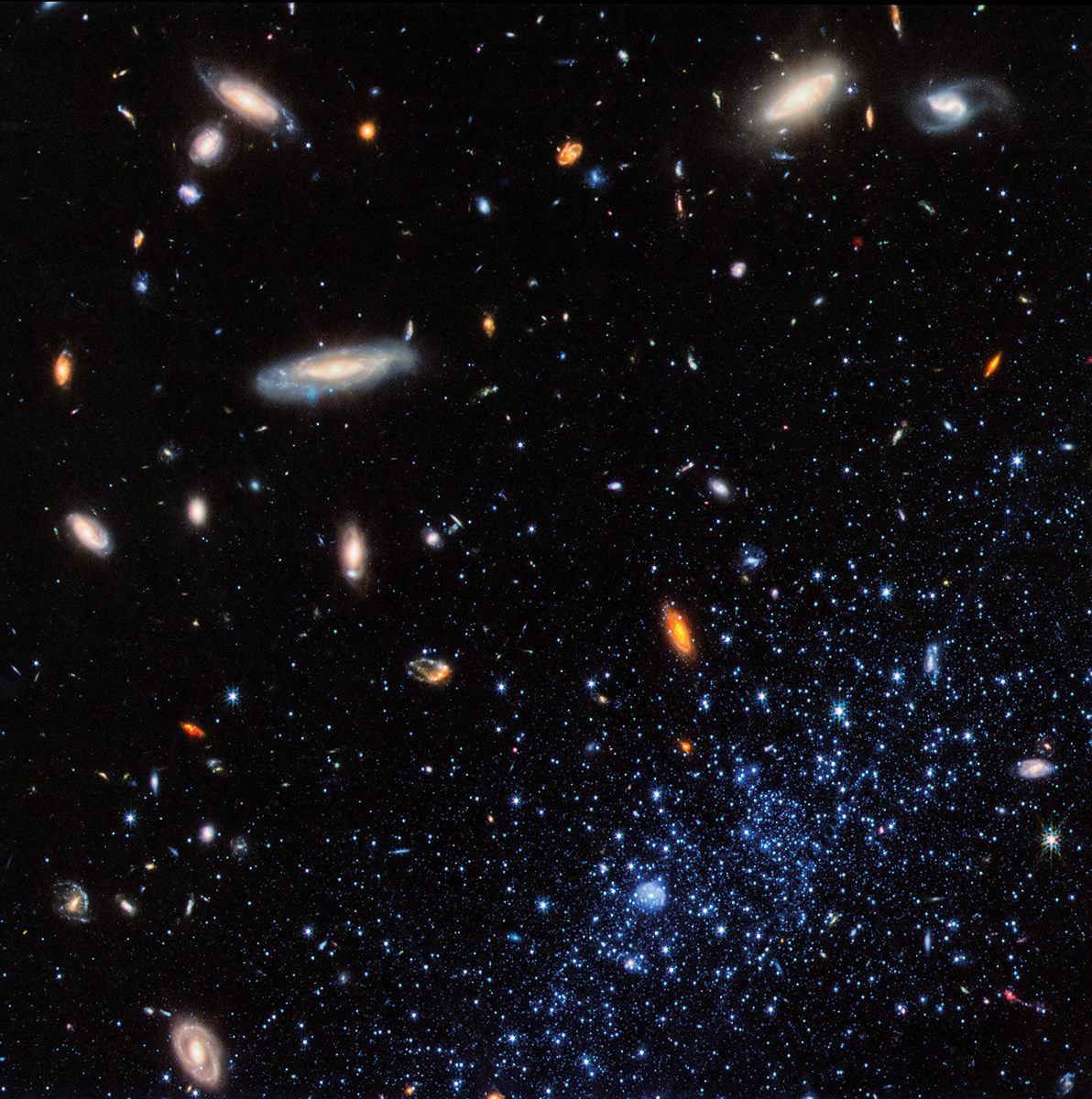
It may be that we have not yet detected dark matter simply because we are not looking in the right place. Like good sailors, the first question we ask is how far the boundaries of the territory to be explored extend. Cosmological and astrophysical observations allow dark-matter masses ranging from ultralight values of order 10–22 eV up to masses of the order of thousands of solar masses. The lower bound arises from the requirement that the dark-matter de Broglie wavelength not exceed the size of the smallest gravitationally bound structures, dwarf galaxies, such that quantum pressure does not suppress their formation (see “Leo P” image). The upper limit can be understood from the requirement that dark matter behave as a smooth, effectively collision-less medium on these small astrophysical structures. This leaves us with a range of possibilities spanning about 90 orders of magnitude, a truly overwhelming landscape. Given that our resources, and our own lifetimes, are finite, we guide our expedition both by theoretical motivation and the capabilities of our experiments to explore this vast territory.
Dark matter could be connected to the Standard Model in alternative ways
The canonical dark-matter candidate where theoretical motivation and experimental capability coincides is the weakly interacting massive particle. “WIMPs” are among the most theoretically economical dark-matter candidates, as they naturally arise in theories with new physics at the electroweak scale and can achieve the observed relic abundance through weak-scale interactions. The latter requirement implies that the mass of thermal WIMPs must lie above the GeV scale – approximately a nucleon mass. This “Lee–Weinberg” bound arises because lighter particles would not have annihilated fast enough in the early universe, leaving behind far more dark matter than we observe today.
WIMPs can be probed using a wide range of experimental strategies. At high-energy colliders, searches rely on missing transverse energy, providing sensitivity to the production of dark-matter particles or to the mediators that connect the dark and visible sectors. Beam dump and fixed-target experiments offer complementary sensitivity to light mediators and portal states. Direct-detection experiments measure nuclear recoils of heavy and stable targets, such as noble liquids like xenon or argon, which are sensitive to energy depositions at the keV scale, allowing us to probe dark-matter masses in the light end of the typical WIMP range with extraordinary sensitivity.
Light dark matter
So far, no conclusive signal has been observed, and the simplest realisations of the WIMP paradigm are becoming increasingly constrained. However, dark matter could be connected to the Standard Model in alternative ways, for example through new force carriers, allowing its mass to fall below the Lee–Weinberg bound. This sub-GeV dark matter, also referred to as light dark matter, appears in highly motivated theoretical frameworks such as asymmetric dark matter, in which an asymmetry between dark-matter particles and antiparticles sets the relic abundance, analogously to the baryon asymmetry that determines the visible matter abundance. In some of the best motivated realisations of this scenario, the dark-matter candidate resides in a confining “hidden sector” (see, for example, “Soft clouds probe dark QCD”). A dark-baryon symmetry may guarantee the stability of such composite dark-matter states, with the baryonic and dark asymmetries being generated by related mechanisms.
Dark matter could be even lighter and behave as a wave. This occurs when its mass is below the eV-to-10 eV scale, comparable to the ionisation energy of hydrogen. In this case, its de Broglie wavelength exceeds the typical separation between particles, allowing it to be described as a coherent, classical field. In the ultralight dark-matter regime, the leading candidate is the axion. This particle is a prediction of theories beyond the Standard Model that provide a solution to the strong charge–parity (CP) problem.
In the Standard Model, there is no fundamental reason for CP to be conserved by strong interactions. In fact, two terms in the Lagrangian, of very different origin, contribute to an effective CP-violating angle, which would generically induce an electric dipole moment of hadrons, corresponding phenomenologically to a misalignment of their electromagnetic charge distributions. But remarkably – and this is at the heart of the puzzle – high-precision experiments measuring the neutron electric dipole moment show that this angle cannot be larger than 10–10 radians.
Why is this? To quote Murray Gell-Mann, what is not forbidden tends to occur. This unnaturally precise alignment in the strong sector strongly suggests the presence of a symmetry that forces this angle to vanish.
One of the most elegant and widely studied solutions, proposed by Roberto Peccei and Helen Quinn, consists of extending the Standard Model with a new global symmetry that appears at very high energies and is later broken as the universe cools. Whenever such a symmetry breaks, the theory predicts the appearance of one or more new, extremely light particles. If the symmetry is not perfect, but is slightly disturbed by other effects, this particle is no longer exactly massless and instead acquires a small mass controlled by the symmetry-breaking effects. A familiar example comes from ordinary nuclear physics: pions are light particles because the symmetry that would make them massless is slightly broken by the tiny masses of its constituent quarks.
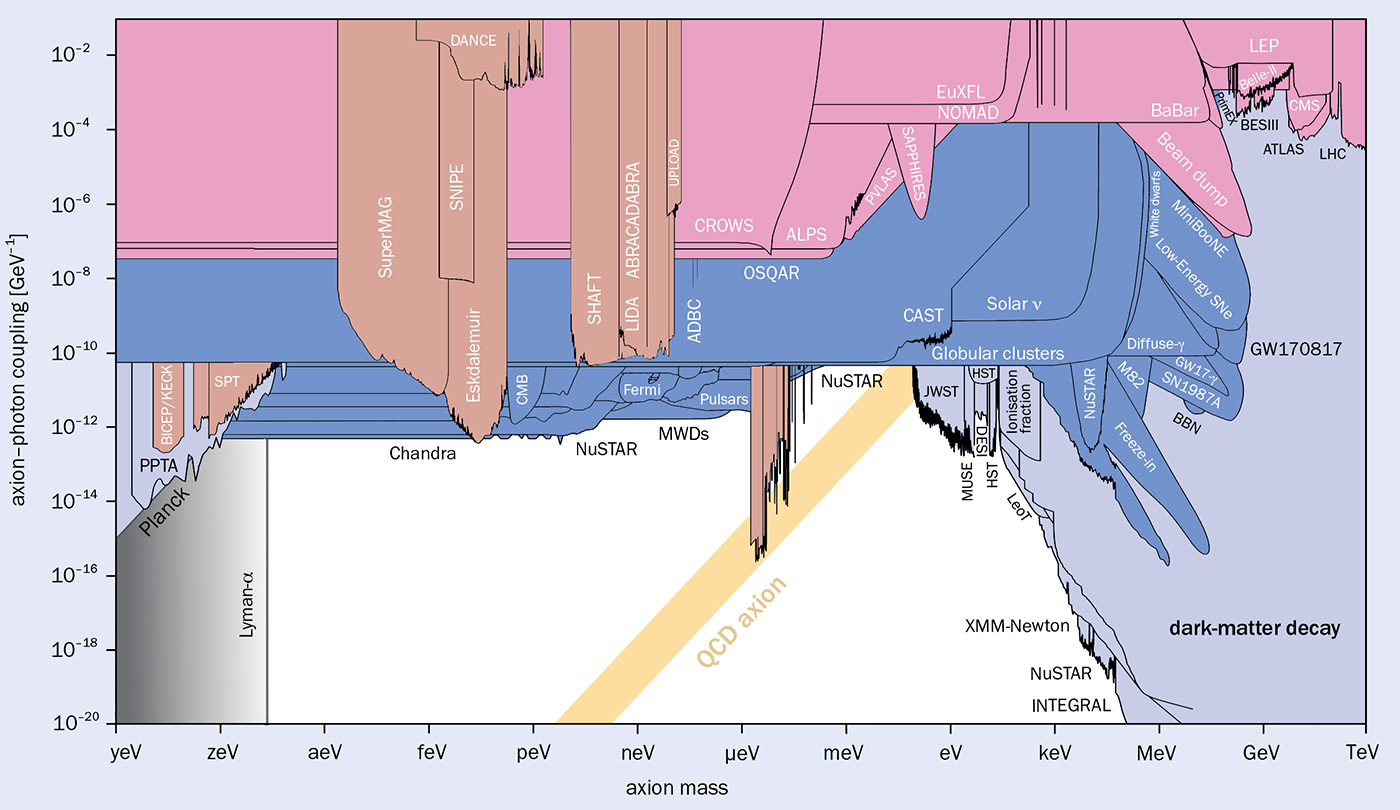
In this framework, the new light particle is called the axion, independently proposed by Steven Weinberg and Frank Wilczek. The axion has remarkable properties: it naturally drives the unwanted CP-violating angle to zero, and its interactions with ordinary matter are not arbitrary but tightly controlled by the same underlying physics that gives it its tiny mass. Strong-interaction effects predict a narrow, well-defined “target band” relating how heavy the axion is to how strongly it interacts with matter, providing a clear roadmap for current experimental searches (the yellow band in the “In pursuit of the QCD axion” figure).
An excellent candidate
Axions also emerge as excellent dark-matter candidates. They can account for the observed cosmic dark matter through a purely dynamical mechanism in which the axion field begins to oscillate around the minimum of its potential in the early universe, and the resulting oscillations redshift as non-relativistic dark matter. Inflation is a little understood rapid expansion of the early universe by more than 26 orders of magnitude in scale factor that cosmologists invoke to explain large-scale correlations in the cosmic microwave background and cosmic structure. If the Peccei–Quinn symmetry was broken after inflation, the axion field would take random initial values in different regions of space, leading to domains with uncorrelated phases and the formation of cosmic strings. Averaging over these regions removes the freedom to tune the initial angle and makes the axion relic density highly predictive. When the additional axions from cosmic strings and domain walls are included, this scenario points to a well defined axion mass in the tens to few-hundreds of μeV range.
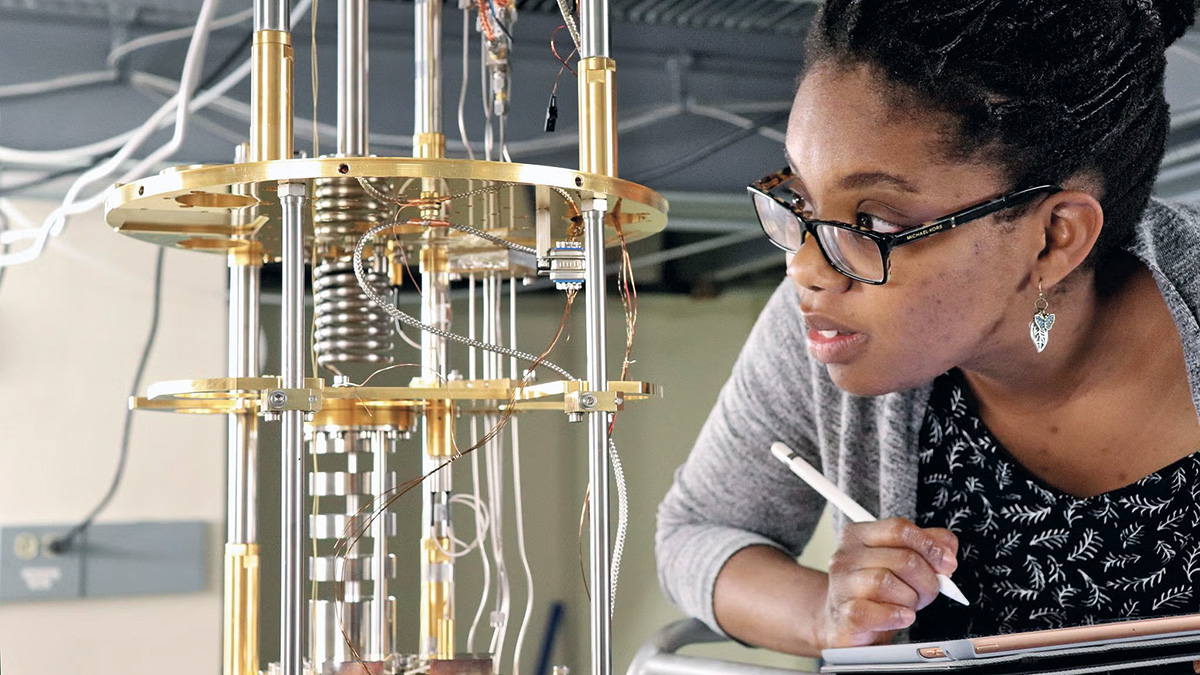
There is now a wide array of ingenious experiments, the result of the work of large international collaborations and decades of technological development, that aim to probe the QCD-axion band in parameter space. Despite the many experimental proposals, so far only ADMX, CAPP and HAYSTAC have reached sensitivities close to this target (see “Cavity haloscope” image). These experiments, known as haloscopes, operate under the assumption that axions constitute the dark matter in our universe. In these setups, a high–quality-factor electromagnetic cavity is placed inside a strong magnetic field in which axions from the dark-matter halo of the Milky Way are expected to convert into photons. The resonant frequency of the cavity is tuned like a radio scanning axion masses. This technique allows experiments to probe couplings many orders of magnitude weaker than typical Standard Model interactions. However, scaling these resonant experiments to significantly different axion masses is challenging as a cavity’s resonant frequency is tied to its size. Moving away from its optimal axion-mass range either forces the cavity volume to become very small, reducing the signal power, or requires geometries that are difficult to realise in a laboratory environment.
Other experimental approaches, such as helioscopes, focus on searching for axions produced in the Sun. These experiments mainly probe the higher-mass region of the QCD-axion band and also place strong constraints on axion-like particles (ALPs). ALPs are also light fields that arise from the breaking of an almost exact global symmetry, but unlike the QCD axion, the symmetry is not explicitly broken by strong-interaction effects, so their masses and couplings are not fixedly related. While such particles do not solve the strong CP problem, they can be viable dark-matter candidates that naturally arise in many extensions of the Standard Model, especially in theories with additional global symmetries and in quantum-gravity frameworks.
Among the proposed experimental efforts to observe post-inflation QCD axions, two stand out as especially promising: MADMAX and ALPHA. Both are haloscopes, designed to detect QCD axions in the galactic dark-matter halo. Neither is traditional. Each uses a novel detector concept to target higher axion masses – a regime that is especially well motivated if the Peccei–Quinn symmetry is broken after inflation (see “In pursuit of the post-inflation axion”).
We are living in an exciting era for dark-matter research. Experimental efforts continue and remain highly promising. A large and well-motivated region of parameter space is likely to become accessible in the near future, and upcoming experiments are projected to probe a significant fraction of the QCD axion parameter space over the coming decades. Clear communication, creativity, open-mindedness in exploring new ideas, and strong coordination and sharing of expertise across different physics communities, will be more important than ever.
In the 1990s, the GALLEX and SAGE experiments studied solar electron neutrinos using large tanks of gallium. Every few days a neutrino would transform a neutron into a proton, and every few weeks the experimenters would count the resulting germanium atoms using radiochemical techniques. To control systematic uncertainties in these difficult experiments, they also exposed the detectors to well-understood radioactive sources of electron neutrinos. But both experiments reported 20% fewer electron neutrinos from radioactive decay than expected.
Thus was born the gallium anomaly, which was carefully checked and confirmed by SAGE’s successor, the BEST experiment, as recently as 2022. The most tempting explanation is the existence of a new particle: a “sterile” neutrino flavour that doesn’t interact via any Standard Model interaction. Neutrino oscillations would transform the missing 20% of electron neutrinos into undetectable sterile neutrinos. It would nevertheless have remained invisible to LEP’s famous measurement of the number of neutrino flavours as it would not couple to the Z boson.
Out the window
This interpretation has been in tension with neutrino-oscillation fits for some time, but a new measurement at the KATRIN experiment likely excludes a sterile-neutrino explanation of the gallium anomaly, says Patrick Huber (Virginia Tech). “There was a strong hint of that from solar neutrinos, but the KATRIN result really nails this window shut. That is not to say the gallium anomaly went away; the experimental evidence here is firm and stands at more than five sigma significance, even under the most conservative assumptions about nuclear cross sections and systematics. So this still requires an explanation, but due to KATRIN we now know for sure it can’t be a vanilla sterile neutrino.”
KATRIN’s main objective is to measure the mass of the electron neutrino (CERN CourierJanuary/February 2020 p28). Though neutrino oscillations imply that the particle is massive, its mass has thus far proved to be below the sensitivity of experiments. The KATRIN experiment, based at the Karlsruhe Institute of Technology in Germany, seeks to remedy this with precise observations of the beta decay of tritium. The heavier the electron neutrino, the lower the maximum energy of the beta-decay electrons. Though KATRIN has not yet been able to uncover evidence for the tiny mass of the electron neutrino, the much larger mass of any sterile neutrino able to explain the gallium anomaly would have made itself felt in precise observations of the endpoint of the energy spectrum of beta-decay electrons thanks to mixing between the neutrino flavours.
After the new KATRIN analysis, the best fit of the sterile neutrino from the gallium anomaly is excluded at 96.6% confidence
“A sterile neutrino would manifest itself as a model-independent kink-like distortion in the beta-decay spectrum, rather than as a deficit in the event rate,” explains lead analyst Thierry Lasserre of the Max-Planck-Institut für Kernphysik, in Heidelberg, Germany. “After the new KATRIN analysis, including 36 million electrons in the last 40 electron volts below the endpoint, the best fit of the sterile neutrino from the gallium anomaly is excluded at 96.6% confidence.”
Though heavy sterile neutrinos remain a well motivated completion of the Standard Model of particle physics with the potential to solve problems in cosmology, light sterile neutrinos struck out a second time in the same volume of Nature last month, thanks to a new measurement at the MicroBooNE experiment at Fermilab, near Chicago.
The MicroBooNE collaboration was following up on a persistent anomaly uncovered by their sister experiment, MiniBooNE, which was itself following up on the infamous LSND anomaly of 2001 (CERN Courier July/August 2020 p32). Both experiments had reported an excess of electron neutrinos in a beam of muon neutrinos generated using a particle accelerator. Here, the sterile-neutrino explanation would be more subtle: muon neutrinos would have to oscillate twice, once into sterile neutrinos and then into electron neutrinos. Using a bespoke liquid-argon time projection chamber, the MicroBooNE collaboration excludes the single-light-sterile-neutrino interpretation of the LSND and MiniBooNE anomalies at 95% confidence.
“The MicroBooNE result is just confirming what we knew from global fits for a long time,” clarifies Huber. “We cannot treat the appearance of electron neutrinos in a muon neutrino beam as a two-flavour problem if a sterile neutrino is involved – if we accept this simple fact of quantum mechanics then LSND and MiniBooNE’s excess of electron neutrinos cannot be due to mixing with a sterile neutrino since the corresponding disappearance of electron and muon neutrinos has not been observed.”
One sterile-neutrino anomaly remains unmentioned, the reactor anomaly, but it has already evaporated into statistical insignificance thanks to new experiments and careful modelling of the flux of electron antineutrinos from nuclear reactors. The promise of experiments with reactor neutrinos is now exemplified by the rapid progress of the Jiangmen Underground Neutrino Observatory (JUNO) in China, which started data taking on 26 August last year (CERN Courier November/December 2025 p9).
Back to the standard paradigm
While the recent KATRIN and MicroBooNE analyses sought evidence for a hypothetical sterile neutrino beyond the standard scenario, JUNO operates within the standard three-flavour framework. Using just 59 days of data, the experiment independently exceeded the precision of previous global fits on two out of six of the parameters governing neutrino oscillations. These are the same mixing angle and mass splitting that govern the oscillations of solar electron neutrinos into other flavours – the very effect that GALLEX and SAGE were initially designed to study in the 1990s. As JUNO gathers data, it will resolve a fine-toothed comb that modulates this oscillation spectrum – the effect of a smaller mass splitting between the three neutrinos. JUNO is designed to resolve these tiny oscillations, revealing a fundamental aspect of nature’s design: the hierarchy of the small and large mass splittings.
“The JUNO result is very exciting,” says Huber, “not so much because of its immediate impact, but because it marks the very successful start of an experiment that will deeply change neutrino physics.”
The JUNO result is exciting because it marks the successful start of an experiment that will deeply change neutrino physics
JUNO is the first of a trio of a new generation of large-scale neutrino-oscillation experiments using controlled sources. Concluding a busy two-month period for neutrinos since the previous edition of CERN Courier was published, the launch of the nuSCOPE collaboration now dangles the promise of a valuable boost to the other two. One hundred physicists attended its kick-off workshop at CERN from 13 to 15 October 2025. The collaboration seeks to implement a concept first proposed 50 years ago by Bruno Pontecorvo: nuSCOPE will eliminate systematic uncertainties related to neutrino flux by measuring the energy and flavour of neutrinos as they are created as well as when they interact with a target.
If approved, nuSCOPE will study neutrino–nucleus interactions with a level of accuracy comparable to that in electron–nucleus scattering, and control the sources of uncertainty projected to be dominant in the DUNE experiment under construction in the US and at the Hyper-Kamiokande experiment under construction in Japan. DUNE and Hyper-Kamiokande both plan to study the oscillations of accelerator-produced beams of muon neutrinos. Their most specialised design goal is to observe another fundamental aspect of physics: whether the weak interaction treats neutrinos and antineutrinos symmetrically.
With three ambitious and sharply divergent experimental concepts, DUNE, Hyper-Kamiokande and JUNO promise substantial progress in neutrino physics in the coming decade. But KATRIN and MicroBooNE now leave precious little merit for the once compelling phenomenology of the single light sterile neutrino.
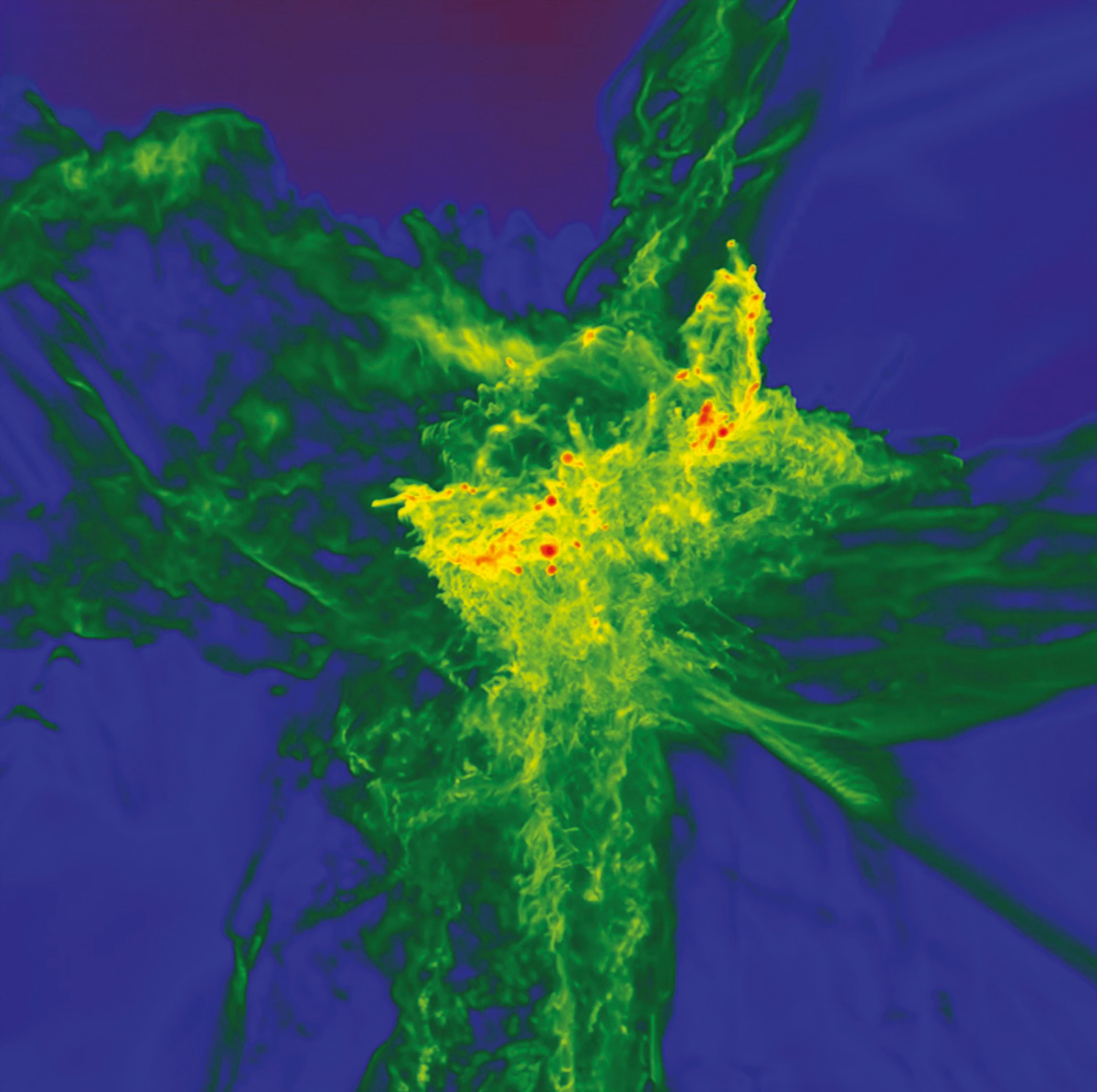
Cosmology has long predicted that the first generation of stars should differ strongly from those forming today. Born out of pristine gas of only hydrogen and helium, they could have reached masses between a thousand and ten thousand times that of the Sun, before collapsing after only a few million years. Such “primordial monsters” have been proposed as the seeds of the first quasars (see “Collapsing monster” image), but clear observations had until now been lacking.
An analysis of the galaxy GS 3073 using the James Webb Space Telescope (JWST) now carries an unexpectedly loud message from the first generation of stars: there is far too much nitrogen to be explained by known stellar populations. This mismatch suggests a different kind of stellar ancestor, one no longer present in our universe. It is the first indirect evidence for the long-sought primordial monsters, first proposed in the early 1960s by Fred Hoyle and William Fowler in the US, and independently by Yakov Zel’dovich and Igor Novikov in the Soviet Union, in attempts to explain the newly discovered quasars.
Black-hole powered
JWST’s near-infrared spectroscopy of GS 3073 reveals the highest nitrogen-to-oxygen ratio yet measured while surveying the universe’s first billion years. Its dense central gas contains almost as many nitrogen atoms as oxygen, while carbon and neon are comparatively modest. In addition, the galaxy has an active nucleus powered by a black hole that is already millions to hundreds of millions of times the mass of the Sun, despite the galaxy’s low metallicity.
Could a primordial monster explain GS 3073? The answer lies in how these huge stars mix and burn their fuel.
GS 3073 could offer the first chemical evidence for the largest stars the universe ever formed and to the early production of massive black holes
Simulations reveal that after an initial phase of hydrogen burning in the core, these stars ignite helium, producing large amounts of carbon and oxygen. Because the stars are so luminous and extended, their interiors are strongly convective. Hot material rises, cool material sinks and chemical elements are constantly stirred. Freshly made carbon from the helium-burning core leaks outward into a surrounding shell where hydrogen is still burning. There, a sequence of reactions known as the CNO cycle converts hydrogen into helium while steadily turning carbon into nitrogen. Over time, this process loads the outer parts of the star with nitrogen, while also moderately enhancing oxygen and neon. The heaviest elements produced in the final burning stages remain trapped in the core and never reach the surface before the star collapses.
Mass loss from such primordial stars is uncertain. Without metals, they cannot generate the strong line-driven winds familiar from massive stars today. Instead, mass may be lost through pulsations, eruptions or interactions in dense environments. But simulations allow a robust conclusion: supermassive primordial stars between roughly one thousand and ten thousand solar masses naturally produce gas with nitrogen-to-oxygen, carbon-to-oxygen and neon-to-oxygen ratios that match those measured in the dense regions of GS 3073. Stars significantly lighter or heavier than this range cannot reproduce the extreme nitrogen-to-oxygen ratio, even before carbon and neon are taken into account.
Under pressure
Radiation pressure could have supported these primordial monsters for no more than a few million years. As their cores contract and heat, photons become energetic enough to convert into electron–positron pairs, reducing the radiation pressure. For classical massive stars with masses in the range of nine to 120 times the mass of the sun, this instability leads to a thermonuclear explosion that we refer to as a supernova. By contrast, supermassive stars are so dominated by gravity due to their much larger mass that they collapse directly into black holes, without undergoing a supernova explosion.
This provides a natural path from supermassive primordial stars to the over-massive black hole now seen in GS 3073’s nucleus. In this scenario, one or a few such giants enrich the surrounding gas with nitrogen-rich material through mass loss during their lives, and leave behind black-hole seeds that later grow by accretion. If this picture is correct, GS 3073 offers the first chemical evidence for the largest stars the universe ever formed and ties them directly to the early production of massive black holes. Future JWST observations, together with next-generation ground-based telescopes, will search for more nitrogen-loud galaxies and map their chemical structures in greater detail.
On 2 July 2025, NASA’s Fermi Gamma-ray Space Telescope observed a gamma-ray burst (GRB 250702B) of a record seven hours in duration. Intriguingly, high-resolution images from the Hubble Space Telescope (HST) and the James Webb Space Telescope (JWST) revealed that the burst emerged nearly 1900 light-years from the centre of its host galaxy, near the edge of its disc. But its most unusual feature is that it was seen in X-rays a full day before any gamma rays arrived.
The high-energy transient sky is filled with a cacophony of exotic explosions produced by stellar death. Short GRBs of less than two seconds are produced by the merging of compact objects such as black holes and neutron stars. Longer GRBs are produced by the death of massive stars, with “ultralong” GRBs most often hypothesised to originate in the collapse of massive blue supergiants, as they would allow for accretion onto their central black-hole engines over a period from tens of minutes to hours.
Peculiar observations
GRB 250702B lasted for at least 25,000 seconds (7 hours), superseding the previous longest GRB 111209A by over 10,000 seconds. However, the duration alone was not enough to identify this event as a different class of GRB or as an extreme outlier. Two other observations immediately marked GRB 250702B as peculiar: the multiple gamma-ray episodes seen by Fermi and other high-energy satellites; and the soft X-rays from 0.5 to 4 keV seen by China’s Einstein Probe over a period extending a full day before gamma rays were detected.
No previous GRB is known to have been preceded by X-ray emission over such a period. Nor is it an expectation of standard GRB models, even those invoking a blue supergiant. Instead, these X-rays suggest a relativistic tidal disruption event (TDE) – the shredding of a star by a massive black hole, launching a jet that moves near the speed of light. All known relativistic TDE systems are produced by supermassive black holes weighing a million times the mass of our Sun, or more. Such black holes are found at the centre of their host galaxies, but the HST and JWST observations revealed that the transient had occurred near the edge of its host galaxy’s disc (see “Not from the nucleus” image).
This peripheral origin opens the door to a more exotic scenario involving an intermediate-mass black hole (IMBH) weighing hundreds to thousands of solar masses. IMBHs are a missing link in black-hole evolution between the stellar-mass black holes that gravitational-wave detectors frequently see merging and the supermassive black holes found at the centre of most galaxies. Alternative scenarios reduce the black-hole mass even further, and include a micro-TDE, where a star is shredded by a stellar-mass black hole, or a helium star being eaten by a stellar-mass black hole.
There is little consensus on the origin of GRB 250702B, beyond that it involved an accreting black hole
The rapid gamma-ray variability observed by Fermi and other high-energy satellites is an important clue. The time variability of relativistic jets is thought to be orders of magnitude slower than the characteristic scale set by a black hole’s Schwarzschild radius. While an intermediate-mass black hole of a few hundred solar masses is not incompatible, the observed variability is nearly 100 times faster than that seen in relativistic TDEs. By contrast, with characteristic physical scales smaller in proportion to the smaller masses of their black holes, micro-TDEs and helium-star black-hole mergers have no difficulty accommodating such short-timescale variability.
The environment of the transient also provides crucial clues into its origin. JWST spectroscopy revealed that the light from the transient and its host galaxy was emitted 8 billion years ago, when the universe was just a teenager. The galaxy is among the largest and most massive at that age in the universe, and – unusually for galaxies hosting GRBs – a massive dust lane splits its disc in half. Ongoing star formation at the transient’s location suggests a stellar-mass progenitor, as opposed to an IMBH.
Despite numerous studies, there is little consensus on the origin of GRB 250702B, beyond that it involved an accreting black hole. Its exceptional duration and early X-ray emission initially suggested a supermassive black hole, but its rapid variability and location in its host galaxy instead point to a stellar-mass black hole, with a far rarer IMBH potentially splitting the difference. Given that it is a notably rare once-every-50-years event, the wait for the next ultralong GRB may be long, but astrophysicists are optimistic that theoretical advances will disentangle the different progenitor scenarios and reveal the origin of this extraordinary transient.
Over the past decade, many theoretical and experimental landscapes have shifted substantially. Traditional paradigms such as supersymmetry and extra dimensions – once the dominant drivers of LHC search strategies – have gradually given way to a more flexible, signature-oriented approach. The modern search programme is increasingly motivated by signals rather than full theories, providing an interesting backdrop for the return of the SEARCH conference series, which last took place in 2016. The larger and more ambitious 2025 edition attracted hundreds of participants to CERN from 20 to 24 October.
The workshop highlighted how much progress ATLAS and CMS have made in searches for long-lived particles, hidden-valley scenarios (see “Soft cloud” figure) and a host of other unconventional possibilities that now occupy centre stage. Although these ideas were once considered exotic, they have become natural extensions of models connected to cosmology, dark matter and electroweak symmetry breaking. Their experimental signatures are equally rich: displaced vertices, delayed showers, emerging jets or unusual track topologies that demand a rethinking of reconstruction strategies from the ground up.
Deep learning
The most transformative change since previous editions of SEARCH is the integration of AI-based algorithms into every layer of analysis. Deep-learning-driven b-tagging has dramatically increased sensitivity to final states involving heavy flavour, while machine learning is being embedded directly into hardware trigger systems to identify complex event features in real time. This is not technological novelty for its own sake: these tools directly expand the discovery reach of the experiments.
Novel ideas in reconstruction also stood out. Talks showcased how muon detectors can be repurposed as calorimeters to detect late-developing showers, and how tracking frameworks can be adapted to capture extremely displaced tracks that were once discarded as outliers. Such techniques illustrate a broader cultural shift: expanding the search frontier now often comes from reinterpreting detector capabilities in creative ways.
The most transformative change since previous editions of SEARCH is the integration of AI-based algorithms into every layer of analysis
Anomaly detection – the use of unsupervised or semi-supervised deep-learning models to identify data that deviate from learned patterns – was another major focus. These methods, used both offline and in level-one triggers, enable model-agnostic searches that do not rely on an explicit beyond-the-Standard-Model target. Participants noted that this is especially valuable for scenarios like quirks in dark-sector models, where realistic event-generation tools still do not exist. In these cases, anomaly detection may be the only feasible path to discovery.
The rising importance of precision was another theme threading through the discussions. The detailed understanding of detector performance achieved in recent years is unprecedented for a hadron collider. CMS’s muon calibration, which is crucial for its W-mass analysis, and ATLAS’s record-breaking jet-calibration accuracy exemplify the progress. This maturity opens the possibility that new physics could first appear as subtle deviations rather than as striking anomalies. As the era of the High-Luminosity LHC approaches, the upcoming additions of precision timing layers and advanced early-tracking capabilities will further strengthen this dimension of the search programme.
The workshop also provided a platform to explore connections between collider searches and other experimental efforts across particle physics. Strong first-order phase transitions, relevant to electroweak baryogenesis, motivated renewed interest in an additional scalar that would modify the Higgs potential. Such a particle could lie anywhere from the MeV scale up to hundreds of GeV – often below the mass ranges targeted by standard resonance searches. Alternative data-taking strategies such as data scouting and data parking offer new opportunities to probe this wide mass window systematically.
Complementarity with flavour physics at LHCb, long-lived particle searches at FASER, and precision experiments seeking electric dipole moments, axion-like particles and other ultralight states, was also highlighted. In a moment without an obvious theoretical favourite, this diversification of experimental approaches is a key strategic strength.
New directions in science are launched by new tools much more often than by new concepts
A recurring sentiment was that the LHC remains a formidable discovery machine, but the community must continue pushing its tools beyond their traditional boundaries. Many discussions at SEARCH 2025 echoed a famous remark by Freeman Dyson: “New directions in science are launched by new tools much more often than by new concepts.” The upcoming upgrades to ATLAS and CMS – precision timing, enhanced tracking earlier in the trigger chain and high-granularity readout – exemplify the kinds of new tools that can reshape the search landscape.
If SEARCH 2025 underscored the need to explore new signatures, technologies and experimental ideas, it also highlighted an equally important message: we must not lose sight of the physics questions that originally motivated the LHC programme. The hierarchy problem, the apparent fine tuning of quantum corrections to the Higgs mass that prevent it rising to the Planck scale, remains unresolved, and supersymmetry continues to offer its most compelling and robust solution by stabilising it through partner particles. With the dramatic advances in reconstruction, triggering and analysis techniques, and with the enormous increase in recorded data from Run 1 through Run 3, the time is ripe to revitalise the inclusive SUSY search programme. A comprehensive, modernised SUSY effort should be a defining element of the combined ATLAS and CMS legacy physics programme, ensuring that the field fully exploits the discovery potential of the LHC dataset accumulated so far.
To provide the best experiences, we use technologies like cookies to store and/or access device information. Consenting to these technologies will allow us to process data such as browsing behavior or unique IDs on this site. Not consenting or withdrawing consent, may adversely affect certain features and functions.
Functional
Always active
The technical storage or access is strictly necessary for the legitimate purpose of enabling the use of a specific service explicitly requested by the subscriber or user, or for the sole purpose of carrying out the transmission of a communication over an electronic communications network.
Preferences
The technical storage or access is necessary for the legitimate purpose of storing preferences that are not requested by the subscriber or user.
Statistics
The technical storage or access that is used exclusively for statistical purposes.The technical storage or access that is used exclusively for anonymous statistical purposes. Without a subpoena, voluntary compliance on the part of your Internet Service Provider, or additional records from a third party, information stored or retrieved for this purpose alone cannot usually be used to identify you.
Marketing
The technical storage or access is required to create user profiles to send advertising, or to track the user on a website or across several websites for similar marketing purposes.