Comsol -leaderboard other pages

Topics

Odessa conference surveys new trends

Maciej Trzebinski

The 2019 edition of New Trends in High Energy Physics took place in Odessa, Ukraine, from 12 to 18 May, with 84 participants attending from 21 countries. Initiated by the Bogolyubov Institute for Theoretical Physics at the National Academy of Sciences in the Ukraine and the Joint Institute for Nuclear Research (JINR) in Dubna, the series focuses on new ideas and hot problems in theory and experiment. The series started in 1992 in Kiev under the name HADRONS, changed its title to “New Trends in High-Energy Physics” at the turn of the millennium, took place for a decade in the Crimea, then moved to Natal (Brazil) and Becici (Montenegro), before coming back to Ukraine this year.

This year’s conference had an emphasis on heavy-ion physics and strong interactions, with aspects of the QCD phase diagram such as signatures of the transition from quark–gluon plasma to hadrons highlighted in several talks. The interpretation of recent experimental results on collectivity (the bulk motion of nuclear matter at high temperatures) in terms of the formation of a “perfect liquid” was also discussed. Future searches for glueballs and other exotic hadronic states will contribute to an improved understanding of non-perturbative aspects of QCD.

Many problems of low and intermediate energy physics are still unresolved

Parallel to the quest for the highest possible energies, many problems of low- and intermediate-energy physics are still unresolved, such as the critical behaviour of excited baryonic matter, the nature of exotic resonances and puzzles relating to spin. The construction of new facilities will help answer these questions, with high-luminosity collisions of particles ranging from polarised protons to gold ions at JINR–Dubna’s NICA facility, complemented by fixed-target antiproton and ion studies with unprecedented collision rates at FAIR, the new international accelerator complex at GSI Darmstadt.

Talks on general relativity and cosmology, dark matter and black holes explored the many facets of modern astrophysical observations. Future multi-messenger observations, combining the measurements of the electromagnetic radiation spectrum and neutrinos with gravitational wave signals, are expected to contribute significantly to an improved understanding of the dynamics of binary black-hole and neutron-star mergers. Such measurements are of great significance for a variety of open issues, for example, nuclear physics at densities far beyond the regime accessible in laboratory experiments.

The next edition of the conference will be held in Kiev from 27 June to 3 July 2021.
Λ-hyperon anomaly confirmed

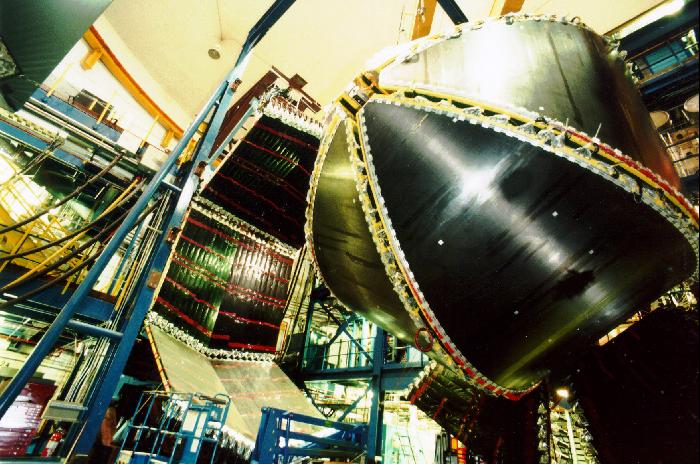
CLAS detector

A team of researchers from the UK, Germany and the US has used data from the CLAS experiment at Jefferson Laboratory to confirm an anomalous measurement of ⍺– — a key parameter in the theoretical description of the non-leptonic decays of Λ hyperons. ⍺– describes the interference of parity-conserving and parity-violating amplitudes in the matrix element of the decay Λ → pπ–, and its Particle Data Group listing had remained unchanged for over 40 years. The new value will have consequences for heavy-ion physics, measurements of the transverse polarisation of Λ hyperons, the decays of heavier strange baryons, and kaon production.

Prior to this year, the best measurement of ⍺– was derived from π−p→ΛK0 interactions using liquid-hydrogen targets dating from the early 1970s. In May, however, the BESIII collaboration in Beijing published a new measurement ⍺– = 0.750 ± 0.009 (stat) ± 0.004 (syst) based on observations of the decays of ΛΛ pairs from electron-positron collisions at the J/ψ resonance. The collaboration also reported a measurement of the corresponding parameter ⍺+ = −0.758 ± 0.010 (stat) ± 0.007 (syst) for the charge-conjugate decay Λ → p̄π+, consistent with the conservation of CP symmetry — the most sensitive test with Λ baryons so far. The BESIII value is 17% (corresponding to more than five standard deviations) above the previously accepted value, ⍺– = 0.642 ± 0.013. “We suspect previous experiments underestimated some systematic biases in their analyses,” says BESIII spokesperson Yuan Changzheng, of the Institute for High-Energy Physics in Beijing.

David Ireland of the University of Glasgow, and colleagues at George Washington University, the University of Bonn and Forschungszentrum Jülich, have now confirmed the BESIII measurement using kaon photo-production (γp→KΛ) data from the CLAS detector, which operated from 1998 to 2012. Their analysis exploited CLAS measurements of polarisation observables that describe the decay of the recoiling Λ→ pπ– to infer the value of α– using a theoretical tool known as Fierz identities. The value found, α– = 0.721 ± 0.006 (stat) ± 0.005 (syst), is near to, but noticeably below, the BESIII value.

Any experiment that has used this value as part of their analysis should look again

David Ireland

“These data were not measured specifically to evaluate ⍺–,” said Ireland, a former spokesperson of CLAS, “but when the BES result was reported, we realised that they represented a unique opportunity to make an independent estimate of the decay parameter.” Any experiment that has used this value as part of their analysis should look again, he continued. “It would be sensible for the time being to use both the BES and CLAS results to give a range of possible systematic uncertainty.”

The new analysis confirms the BESIII result “very nicely”, concurs Yuan, given that it is based on completely different data and a different technique. “BESIII has now accumulated another 8.7 billion J/ψ events, and the same process will be analysed to
further improve the precision, both statistical and systematic.”

Exotic hadrons take centre stage in Guilin

The 18th International Conference on Hadron Spectroscopy and Structure, HADRON2019, took place in Guilin, China, from 16 to 21 August, co-hosted by the Guangxi Normal University and the Institute of Theoretical Physics of the Chinese Academy of Sciences. The conference brought together more than 330 experimental and theoretical physicists from more than 20 countries to discuss topics ranging from meson and baryon spectroscopy to nucleon structure and hypernuclei. The central issue was exotic hadrons: the strongly interacting particles that deviate from the textbook definitions of mesons and baryons. Searches for exotic hadrons and studies of their properties have been a focus for many high-energy physics experiments, and many fascinating results have been reported since 2003 when the first particles of this sort were discovered: the hidden-charm X(3872) and the open-charm Ds*0 (2317) observed by Belle and BaBar, respectively. The most cited physics papers of Belle and BESIII and the second most cited of BaBar and LHCb are reports of the discoveries of exotic hadron candidates.

The conference began with a report on LHCb measurements of the doubly charmed Ξ++cc baryon, and the discovery of pentaquark particles called Pc. The higher statistics of the LHC Run-2 data have resolved the Pc(4450) reported by LHCb in 2015 into two narrower structures, Pc(4440) and Pc(4457). In addition, a third hidden-charm pentaquark, Pc(4312), with a smaller mass, was observed for the first time. These Pc structures are very likely exotic baryons consisting of at least five quarks, including a charm quark–antiquark pair. Many theorists believe that these pentaquarks can be described as hadronic molecules of a charmed meson and a charmed baryon, analogous to the deuteron, which is a bound state of a neutron and a proton. A series of parallel talks described theoretical predictions that will be useful in motivating further measurements, such as searches for the decay to a charmed baryon and a charmed meson, and searches for the various new pentaquarks predicted by theoretical models.

The X(3872) discovered by Belle 16 years ago is still the subject of intensive investigations

Illustrating the difficulty of understanding the inner structure of hadrons, the X(3872) discovered by Belle 16 years ago is still the subject of intensive investigations. Its mass is extremely close to the sum of the masses of two charmed mesons, D0 and D*0, and its decay width (< 1.2 MeV) is anomalously small for a hadron of such a mass. New results on its decays into lighter particles were reported by BESIII. Alongside proposals for precise measurements of its mass, width and polarisation at Belle-II, PANDA and the LHC experiments, a deeper understanding of the X(3872) may be just around the corner. A close collaboration between experimentalists and theorists is required, and this conference provided a valuable opportunity to exchange ideas. Interesting discussions will continue at the next HADRON conference, to be held in Mexico in 2021.

Last stop for the Higgs Couplings workshop

Higgs-boson measurements are entering the precision regime, with Higgs couplings to gauge bosons now measured to better than 10% precision, and its decays to third-generation fermions measured to better than 20%. These and other recent experimental and theoretical results were the focus of discussions at the eighth international Higgs Couplings workshop, held in Oxford from 30 September to 4 October 2019. Making its final appearance with this moniker (next year it will be rebranded as Higgs 2020), the conference programme comprised 38 plenary and 46 parallel talks attended by 120 participants.

The first two days of the conference reviewed Higgs measurements, including a new ATLAS measurement of ttH production using Higgs boson decays to leptons, and a differential measurement of Higgs boson production in its decays to W-boson pairs using all of the CMS data from Run 2. These measurements showed continuing progress in coupling measurements, but the highlight of the precision presentations was a new determination of the Higgs boson mass from CMS using its decays to two photons. Combining this result with previous CMS measurements gives a Higgs boson mass of 125.35 ± 0.15 GeV/c2, corresponding to an impressive relative precision of 0.12%. From the theory side, the challenges of keeping up with experimental precision were discussed. For example, the Higgs boson production cross section is calculated to the highest order of any observable in perturbative QCD, and yet it must be predicted even more precisely to match the expected experimental precision of the HL-LHC.

ATLAS presented an updated self-coupling constraint

One of the highest priority targets of the HL-LHC is the measurement of the self-coupling of the Higgs boson, which is expected to be determined to 50% precision. This determination is based on double-Higgs production, to which the self-coupling contributes when a virtual Higgs boson splits into two Higgs bosons. ATLAS and CMS have performed extensive searches for two-Higgs production using data from 2016, and at the conference ATLAS presented an updated self-coupling constraint using a combination of single- and double-Higgs measurements and searches.  Allowing only the self-coupling to be modified by a factor ?λ in the loop corrections yields a constraint on the Higgs self-coupling of –2.3 < ?λ < 10.3 times the Standard Model prediction at 95% confidence.

The theoretical programme of the conference included an overview of the broader context for Higgs physics, covering the possibility of generating the observed matter-antimatter asymmetry through a first- order electroweak phase transition, as well as possibilities for generating the Yukawa coupling matrices. In the so-called electroweak baryogenesis scenario, the cooling universe developed bubbles of broken electroweak symmetry with asymmetric matter-antimatter interactions at the boundaries, with sphalerons in the electroweak-symmetric space converting the resulting matter asymmetry into a baryon asymmetry. The matter-asymmetric interactions could have arisen through Higgs boson couplings to fermions or gauge bosons, or through its self-couplings. In the latter case the source could be an additional electroweak singlet or doublet modifying the Higgs potential.

The broader interpretation of Higgs boson measurements and searches was discussed both in the case of specific models and in the Standard Model effective field theory, where new particles appear at significantly higher masses (~1 TeV/c2 or more). The calculations in the effective field theory continue to advance, adding higher orders in QCD to more electroweak processes, and an analytical determination of the dependence of the Higgs decay width on the theory parameters. Constraints on the number and values of these parameters also continue to improve through an expanded use of input measurements.

The conference wrapped up with a look into the crystal ball of future detectors and colliders, with a sobering yet inspirational account of detector requirements at the next generation of colliders. To solve the daunting challenges, the audience was encouraged to be creative and explore new technologies, which will likely be needed to succeed. Various collider scenarios were also presented in the context of the European Strategy update, which will wrap up early next year.

The newly minted Higgs conference will be held in late October or early November of 2020 in Stonybrook, New York.

Redeeming the role of mathematics

A currently popular sentiment in some quarters is that theoretical physics has dived too deeply into mathematics, and lost contact with the real world. Perhaps, it is surmised, the edifice of quantum gravity and string theory is in fact a contrived Rube-Goldberg machine, or a house of cards which is about to collapse – especially given that one of the supporting pillars, namely supersymmetry, has not been discovered at the LHC. Graham Farmelo’s new book sheds light on this issue.

The universe speaks in numbers, reads Farmelo’s title. With hindsight this allows a double interpretation: first, that it is primarily mathematical structure which underlies nature. On the other hand, one can read it as a caution that the universe speaks to us purely via measured numbers, and theorists should pay attention to that. The majority of physicists would likely support both interpretations, and agree that there is no real tension between them.

The author, who was a theoretical physicist before becoming an award-winning science writer, does not embark on a detailed scientific discussion of these matters, but provides a historical tour de force of the relationship between mathematics and physics, and their tightly correlated evolution. At the time of ancient Greeks there was no distinction between these fields, and it was only from about the 19th century onwards that they were viewed as separate. Evidently, a major factor was the growing role of experiments, which provided a firmer grounding in the physical world than what had previously been called natural philosophy.

Theoretical physicists should not allow themselves to be distracted by every surprising experimental finding

Paul Dirac

The book follows the mutual fertilisation of mathematics and physics through the last few centuries, as the disciplines gained momentum with Newton, and exploded in the 20th century. Along the way it peeks into the thinking of notable mathematicians and physicists, often with strong opinions. For example, Dirac, a favourite of the author, is quoted as reflecting both that “Einstein failed because his mathematical basis… was not broad enough” and that “theoretical physicists should not allow themselves to be distracted by every surprising experimental finding.” The belief that mathematical structure is at the heart of physics and that experimental results ought to have secondary importance holds sway in this section of the book. Such thinking is perhaps the result of selection bias, however, as only scientists with successful theories are remembered.

The detailed exposition makes the reader vividly aware that the relationship between mathematics and physics is a roller-coaster loaded with mutual admiration, contempt, misunderstandings, split-ups and re-marriages. Which brings us, towards the end of the book, to the current state of affairs in theoretical high-energy physics, which most of us in the profession would agree is characterised by extreme mathematical and intellectual sophistication, paired with a stunning lack of experimental support. After many decades of flourishing interplay, which provided, for example, the group-theoretical underpinning of the quark model, the geometry of gauge theories, the algebraic geometry of supersymmetric theories and finally strings, is there a new divorce ahead? It appears that some not only desire, but relish the lack of supporting experimental evidence. This concern is also expressed by the author, who criticises self-declared experts who “write with a confidence that belies the evident slightness of their understanding of the subject they are attacking”.

The last part of the book is the least readable. Based on personal interactions with physicists, the exposition becomes too detailed to be of use to the casual, or lay reader. While there is nothing wrong with the content, which is exciting, it will only be meaningful to people who are already familiar with the subject. On the positive side, however, it gives a lively and accurate snapshot of today’s sociology in theoretical particle physics, and of influential but less well known characters in the field.

The Universe Speaks in Numbers illuminates the role of mathematics in physics in an easy-to-grasp way, exhibiting in detail their interactive co-evolution until today. A worthwhile read for anybody, the book is best suited for particle physicists who are close to the field.

KATRIN sets first limit on neutrino mass

Based on just four weeks of running, researchers at the Karlsruhe Tritium Neutrino (KATRIN) experiment in Germany have set a new model-independent bound on the mass of the neutrino. At a colloquium today, the collaboration reported an upper limit of 1.1 eV at 90% confidence, almost halving the previous bound.

Neutrinos are among the least well understood particles in the Standard Model. Their three known mass eigenstates do not match up with the better-known flavour eigenstates, but mix according to the PMNS matrix, resulting in the flavour transmutations seen by neutrino-oscillation experiments. Despite their success in constraining neutrino mixing, such experiments are sensitive only to squared mass differences between the eigenstates, and not to the neutrino masses themselves.

Physicists have pursued direct mass measurements since Reines and Cowan observed electron antineutrinos in inverse beta decays in 1956. The direct mass measurement method hinges on precisely measuring the energy spectrum of beta-decay electrons, and is considered model independent as the extracted neutrino mass depends only on the kinematics of the decay. KATRIN is now the most precise experiment of this kind. It builds on the invention of gaseous molecular tritium sources and spectrometers based on the principle of magnetic adiabatic collimation with electrostatic filtering. The combination of these methods culminated in the previous best limits of 2.3 eV at 95% confidence in 2005, and 2.05 eV at 95% confidence in 2011, by physicists working in Mainz, Germany and Troitsk, Russia, respectively. The KATRIN analysis improves on these experimental results, with systematic uncertainties reduced by a factor of six and statistical uncertainties reduced by a factor of two.

These are exciting times for the collaboration

Guido Drexlin

“These are exciting times for the collaboration,” said KATRIN co-spokesperson Guido Drexlin. “The first KATRIN result is based on a measurement campaign of only four weeks at reduced source activity, equivalent to five days at nominal activity.” To reach its final sensitivity, KATRIN will collect data for 1000 days, and systematic errors will be reduced. “This will allow us to probe neutrino masses down to 0.2 eV,” continued Drexlin, “as well as many other interesting searches for beyond-the-Standard-Model physics, such as for admixtures of sterile neutrinos from the eV up to the keV scale.”

The KATRIN beamline

Conceived almost two decades ago, KATRIN operates using a high-resolution, large-acceptance and low-background measurement of the decay spectrum of tritium 3H → 3He e– ν̄e. Electrons are transported to the spectrometer via a beamline that was completed in autumn 2016, allowing experimenters to search for distortions in the tail of the electron energy distribution that depend on the absolute mass of the neutrino. KATRIN collaborators are now looking forward to a two-month measurement campaign, which will start in a few days. It will feature a signal-to-background ratio that is expected to be about one order of magnitude better than the initial measurements, due to an increase in source activity, and a decrease in background due to hardware upgrades. The goal is to achieve an activity of 1011 beta-decay electrons per second, while reducing the current background level by about a factor of two.

Direct measurements are not the only handle on neutrino masses available to physicists, though they are certainly the most model independent. Experiments searching for neutrinoless double beta-decay offer a complementary limit, but must assume that the neutrino is a Majorana fermion.

The tightest limit on neutrino masses comes from cosmology. Comparing data from the Planck satellite with simulations of the development of structure in the early universe yields an upper limit on the sum of all three neutrino masses of 0.17 eV at 95% confidence.

The Planck limit is fairly robust, and one would have to go to great lengths to avoid it

Joachim Kopp

“The Planck limit is fairly robust, and one would have to go to great lengths to avoid it – but it’s not impossible to do so,” says CERN theorist Joachim Kopp. For example, it would be invalidated by a scenario where as-yet-undiscovered right-handed neutrinos couple to a new scalar field with a vacuum expectation value that evolves over cosmological timescales. “Planck data tell us what neutrinos were like in the early universe,” says Kopp. “The value of KATRIN lies in testing neutrinos now.”

Black-hole image constrains ultra-light dark matter

EHT black hole

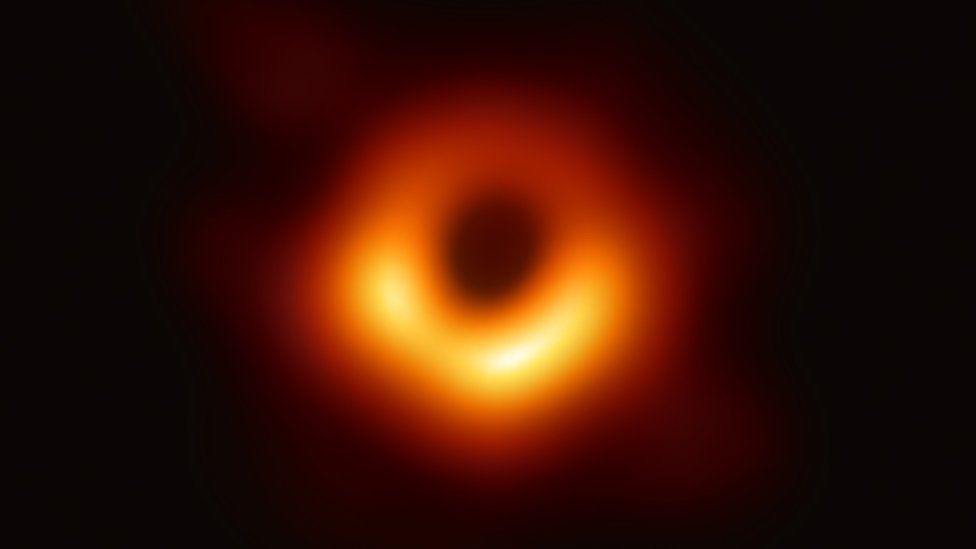
Hooman Davoudiasl and Peter Denton of Brookhaven National Laboratory have used the recent Event Horizon Telescope image of supermassive black hole M87* to disfavour “fuzzy” models of ultra-light boson dark matter with masses of the order of a few 10-21 eV (Phys. Rev. Lett. 123 021102). The inferred mass, spin and age of the black hole are incompatible with the existence of such fuzzy dark matter given the principle of superradiance, whereby quantum fluctuations deplete the angular momentum of a rotating black hole by populating a cloud of bosons around it. The effect depends only on the bosons’ mass, and does not presuppose any non-gravitational interactions. Future measurements of M87* and other spinning supermassive black holes have the potential to exclude the entire parameter space for fuzzy dark matter.

An intriguing alternative to cold dark matter, fuzzy dark matter could address the “core-cusp problem”, wherein observations of an approximately constant dark matter density in the inner parts of galaxies conflict with the steep power-law-like behaviour of cosmological simulations. The particles’ long de Broglie wavelengths, of the order of a kiloparsec, would suppress structure at this scale.

A new centre for astroparticle theory

Gian Giudice, Teresa Montaruli, Eckhard Elsen and Job de Kleuver

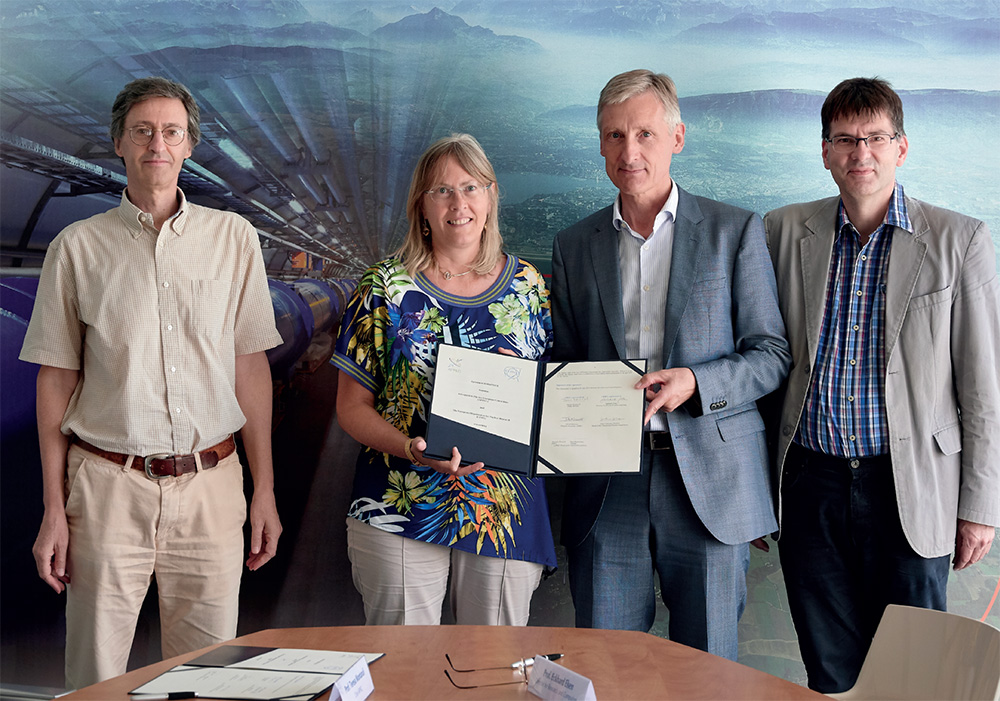
On 10 July, CERN and the Astroparticle Physics European Consortium (APPEC) founded a new research centre for astroparticle physics theory called EuCAPT. Led by an international steering committee comprising 12 theorists from institutes in France, Portugal, Spain, Sweden, Germany, the Netherlands, Italy, Switzerland and the UK, and from CERN, EuCAPT aims to coordinate and promote theoretical physics in the fields of astroparticle physics and cosmology in Europe.

Astroparticle physics is undergoing a phase of profound transformation, explains inaugural EuCAPT director Gianfranco Bertone, who is spokesperson of the Centre for Gravitation and Astroparticle Physics at the University of Amsterdam. “We have recently obtained extraordinary results such as the discovery of high-energy cosmic neutrinos with IceCube, the direct detection of gravitational waves with LIGO and Virgo, and we have witnessed the birth of multi-messenger astrophysics. Yet we have formidable challenges ahead of us: understanding the nature of dark matter and dark energy, elucidating the origin of cosmic rays, understanding the matter-antimatter asymmetry problem, and so on. These are highly interdisciplinary problems that have ramifications in cosmology, particle, and astroparticle physics, and that are best addressed by a strong and diverse community of scientists.”

The construction of experimental astroparticle facilities is coordinated by APPEC, but until now there was no Europe-wide coordination of theoretical activities, says Bertone. “We want to be open and inclusive, and we hope that all interested scientists will feel welcome to join this new initiative.” On a practical level, EuCAPT aims to coordinate scientific and training activities, help researchers attract adequate resources for their projects, and promote a stimulating and open environment in which young scientists can thrive. CERN will act as the central hub of the consortium for the first five years.

It is not a coincidence that CERN has been chosen as the central hub of EuCAPT, says Gian Giudice, head of CERN’s theory department. “The research that we are doing at CERN-TH is an exploration of the possible links between physics at the smallest and largest scales. Creating a collaborative network among European research centres in astroparticle physics and cosmology will boost activities in these fields and foster dialogue with particle physics,” he says. “Dark matter, dark energy, inflation and the origin of large-scale structures are big questions regarding the universe. But there are good hints that suggest that their explanation has to be looked for in the domain of particle physics.”

CMS revisits rare and beautiful decays

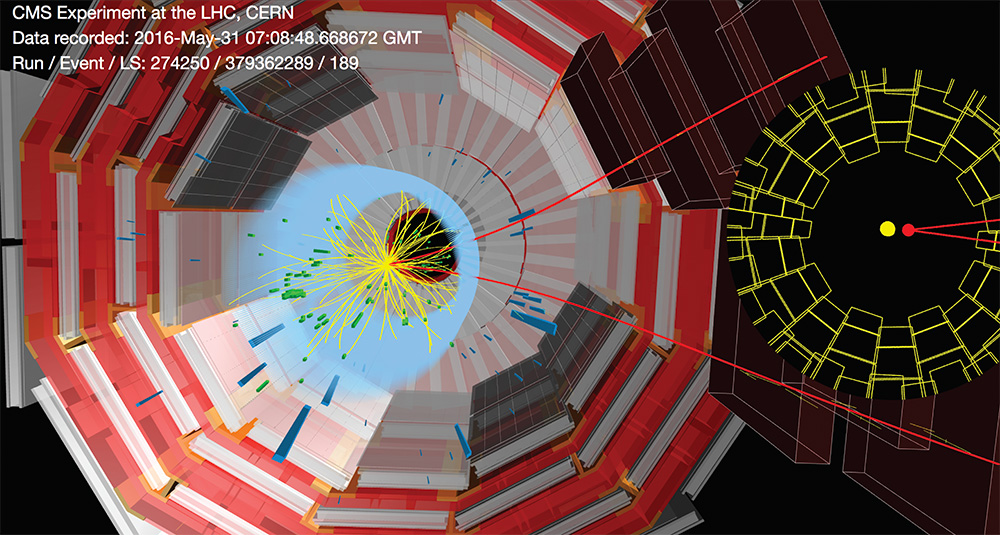
Two muons emerge from a Bs → μμ decay candidate

The Bs meson is a bound state of a strange quark and a beauty antiquark – as such it possesses both beauty and strangeness. For many years the search for its extremely rare decay to a μ+μ– pair was a holy grail of particle physics, because of its sensitivity to theories that extend the Standard Model (SM). The SM predicts the decay rate for Bs → μ+μ– to be only about 3.6 parts per billion (ppb). Its lighter cousin, the B0, which is made from a down quark and a beauty antiquark, has an even lower predicted branching fraction for decays to a μ+μ– pair of 0.1 ppb. If beyond-the-SM particles exist, however, the predictions could be modified by their presence, giving the decays sensitivity to new physics that rivals and might even exceed that of direct searches.

It took more than a quarter of a century of extensive effort to establish Bs → μ+μ–, and the first observation was presented in 2013, in a joint publication by the CMS and LHCb collaborations based on LHC Run 1 data. The same paper reported evidence for B0 → μ+μ– with a significance of three standard deviations, however, this signal has not subsequently been confirmed by CMS, LHCb or ATLAS analyses. A new CMS Run 2 analysis now looks set to bolster interest in these intriguing decays.

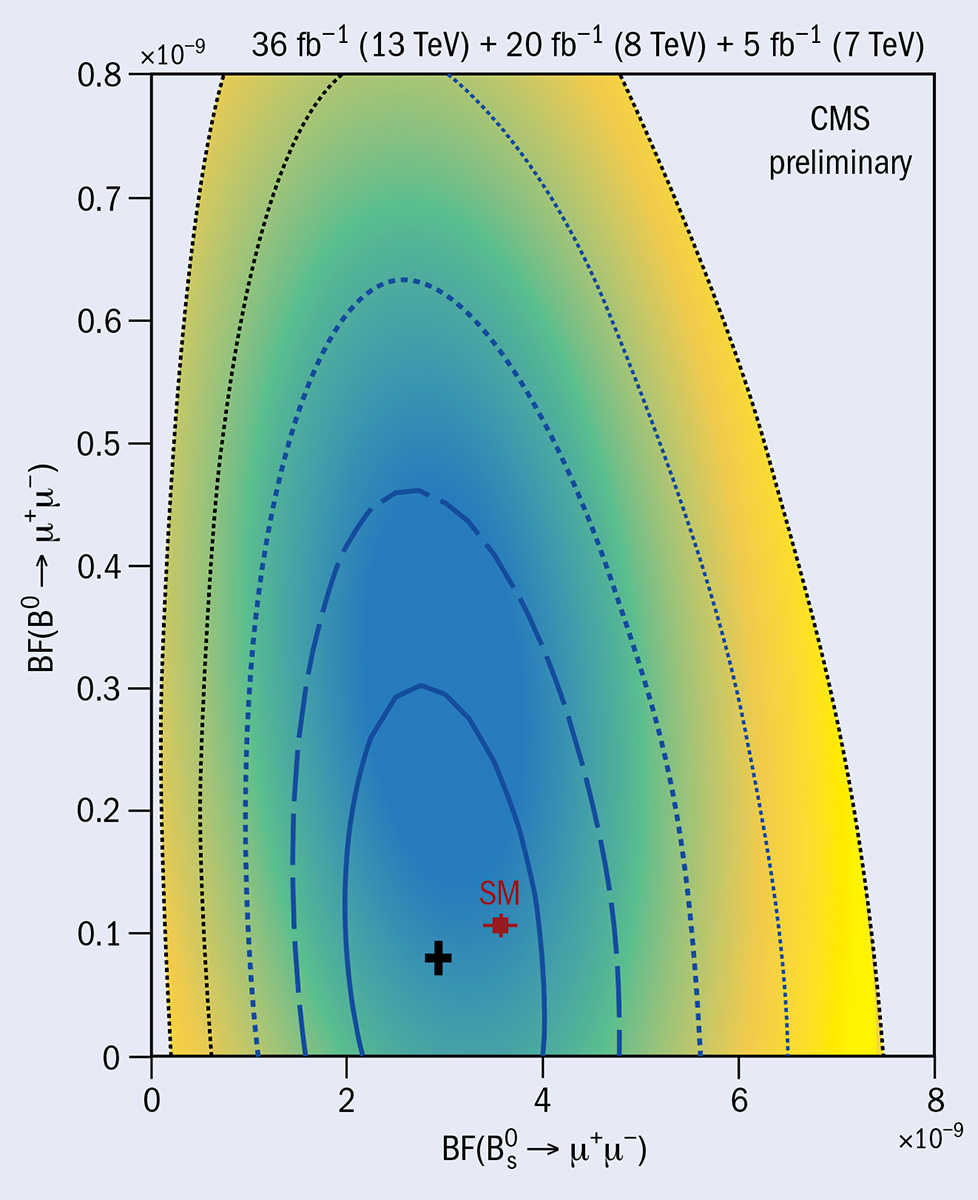
Diagram of probability contours

The CMS collaboration has updated its 2013 analysis with higher centre-of-mass-energy Run 2 data from 2016, permitting an observation of Bs → μ+μ– with a significance of 5.6 standard deviations (figure 1). The results are consistent with the latest results from ATLAS and LHCb, and while no significant deviation from the SM is observed by any of the experiments, all three decay rates are found to lie slightly below the SM prediction. The slight deficit is not significant, but the trend is intriguing because it could be related to so-called flavour anomalies recently observed by the LHCb experiment in other rare decays of B mesons (CERN Courier May/June p9). This makes the new CMS measurement even more exciting. The new analysis showed no sign of B0 → μ+μ–, and a stringent 95% confidence limit of less than 0.36 ppb was set on its rate.

CMS also managed to measure the effective lifetime of the Bs meson using the several dozen Bs → μ+μ– decay events that were observed. The interest in measuring this lifetime is that, just as for the branching fraction, new physics might alter its value from the SM expectation. This measurement yielded a lifetime of about 1.7 ps, consistent with the SM. The measured CMS value is also consistent with the only other such lifetime measurement, performed by LHCb.

With three times more Run 2 data yet to be analysed by CMS, the next update – based on the full Run 1 and Run 2 datasets – may shed more light on this fascinating corner of physics, and move us closer to the ultimate goal, which is the observation of the B0 → μ+μ– decays.

Run 2 data set pins down Higgs-boson properties

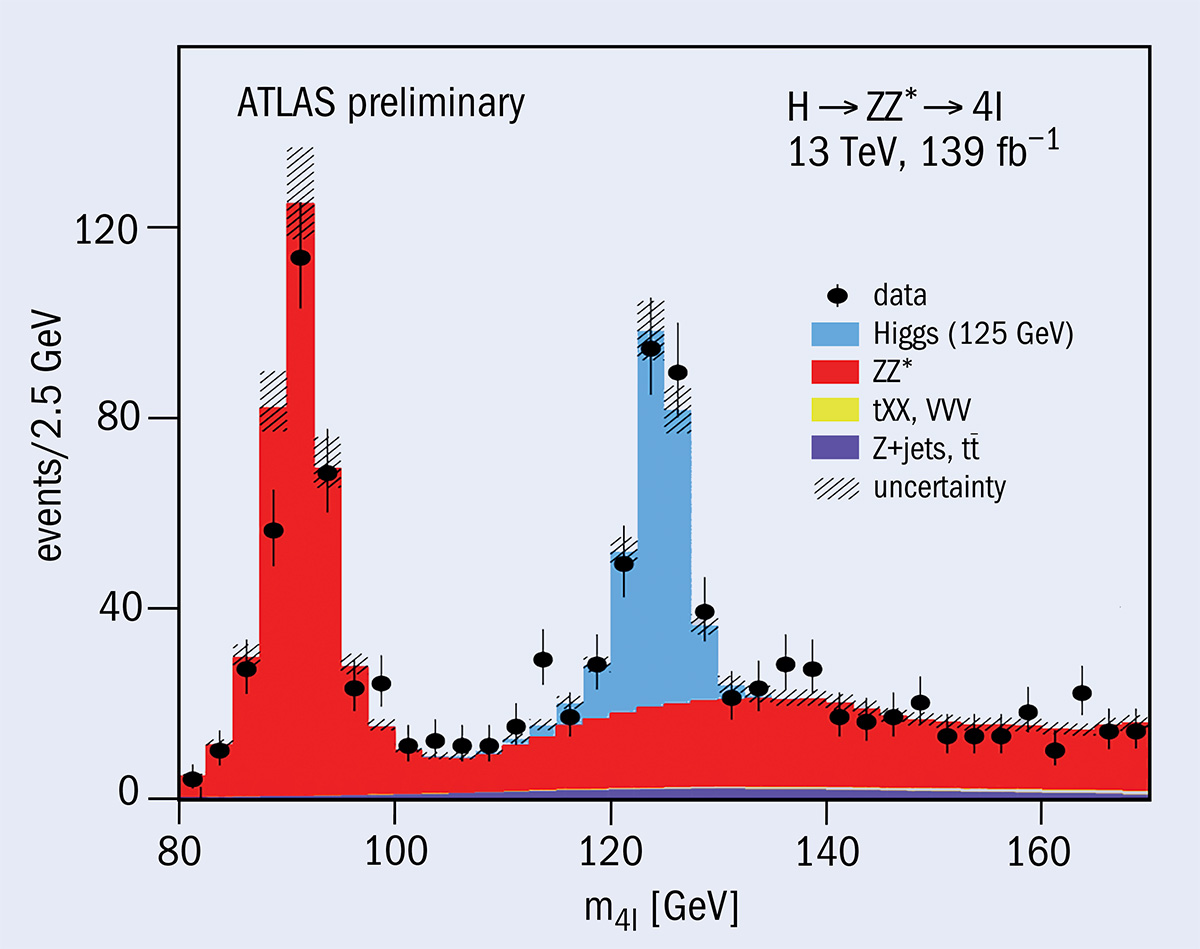
Diagram of the distribution of the invariant mass of four leptons

The LHC completed its Run 2 operations in December 2018, delivering a large dataset of proton–proton collisions at a centre-of-mass energy of 13 TeV. The ATLAS detector maintained a high level of readiness and performance throughout Run 2, resulting in 139 fb–1 of data for physics analyses.

An increasingly consistent picture of the properties of the Higgs boson is being drawn in light of the Run 2 data. This is thanks to a wide range of measurements, and particularly through the establishment of its couplings with third-generation quarks following the observation of the H → bb decay and associated ttH production.

The H → γγ and H → ZZ* → 4ℓ final states, where 4ℓ denotes 4e, 2e2μ or 4μ, provide clean experimental signatures that played a leading role in the discovery of the Higgs boson, and are ideal for precision measurements that could reveal subtle effects from new physics. ATLAS presented updated results for these two channels using the full Run 2 dataset at the 2019 summer conferences.

Using improved identification and energy calibration of leptons, photons and jets, and new analysis techniques, a sample of about 210 H → ZZ* → 4ℓ signal events (figure 1) and 6550 H → γγ signal events were selected to perform a series of measurements. The properties of the Higgs boson are investigated by measuring inclusive, differential and per-production-mode cross sections that are sensitive to different modelling aspects.

In the 4ℓ channel, differential cross-section measurements are performed as a function of the transverse momentum of the Higgs boson and the number of jets produced in association with it. The different production mechanisms of the Higgs boson are measured inclusively and in various regions of kinematic phase space, which are cleanly separated by neural networks.

In the high-statistics γγ channel, differential cross sections are measured for a set of variables related to the Higgs boson kinematics, as well as the kinematics and multiplicity of jets produced in association with the Higgs boson. The measured distributions are used to constrain modified interactions of the Higgs boson with SM particles.

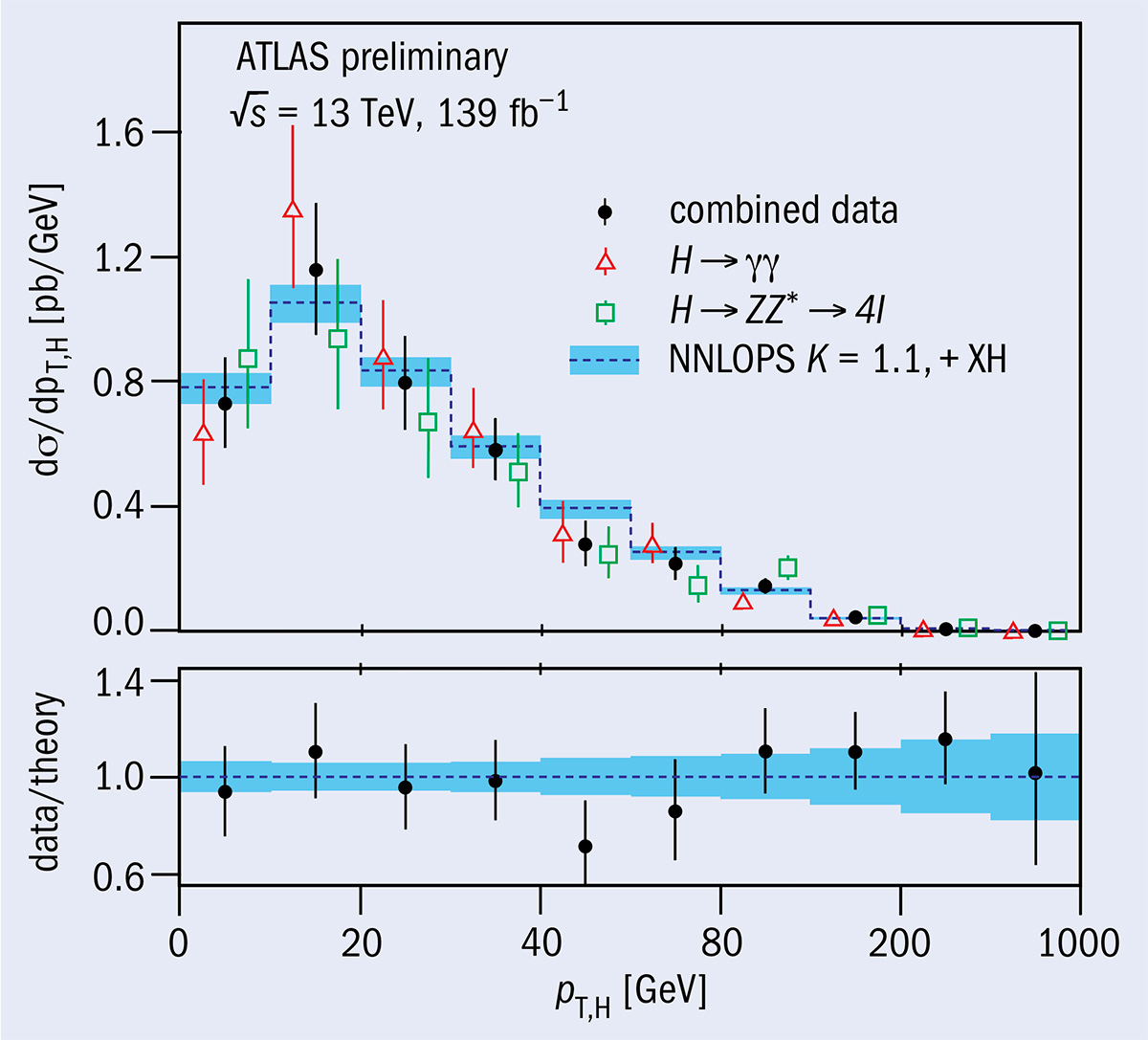
Diagram of the differential cross section for the transverse momentum of the Higgs boson

The measurements in both channels are found to be well described by the SM predictions. Their combination yields a total Higgs-production cross section of 55.4 ± 4.3 pb, in agreement with the SM prediction of 55.6 ± 2.5 pb. The combined measurement of the transverse-momentum differential cross section (figure 2) has significantly improved in precision compared to earlier results. It is sensitive to the virtual processes governing the dominant Higgs-boson production through gluon fusion and to direct contributions from new physics.

Achieving 8% precision on the Higgs cross section is a significant step towards studying the electroweak symmetry breaking mechanism. Numerous additional measurements are being pursued by ATLAS in the Higgs-boson sector with the full Run 2 dataset to perform detailed tests of SM predictions and hunt for new phenomena.

bright-rec iop pub iop-science physcis connect