As the heaviest known particle, the top quark plays a unique role in the Standard Model (SM), making its presence felt in corrections to the masses of the W and Higgs bosons, and also, perhaps, in as-yet unseen physics beyond the SM. During Run 2 of the Large Hadron Collider (LHC), high-luminosity proton beams were collided at a centre-of-mass energy of 13 TeV. This allowed ATLAS to record and study an unprecedented number of collisions producing top–antitop pairs, providing ATLAS physicists with a unique opportunity to gain insights into the top quark’s properties.
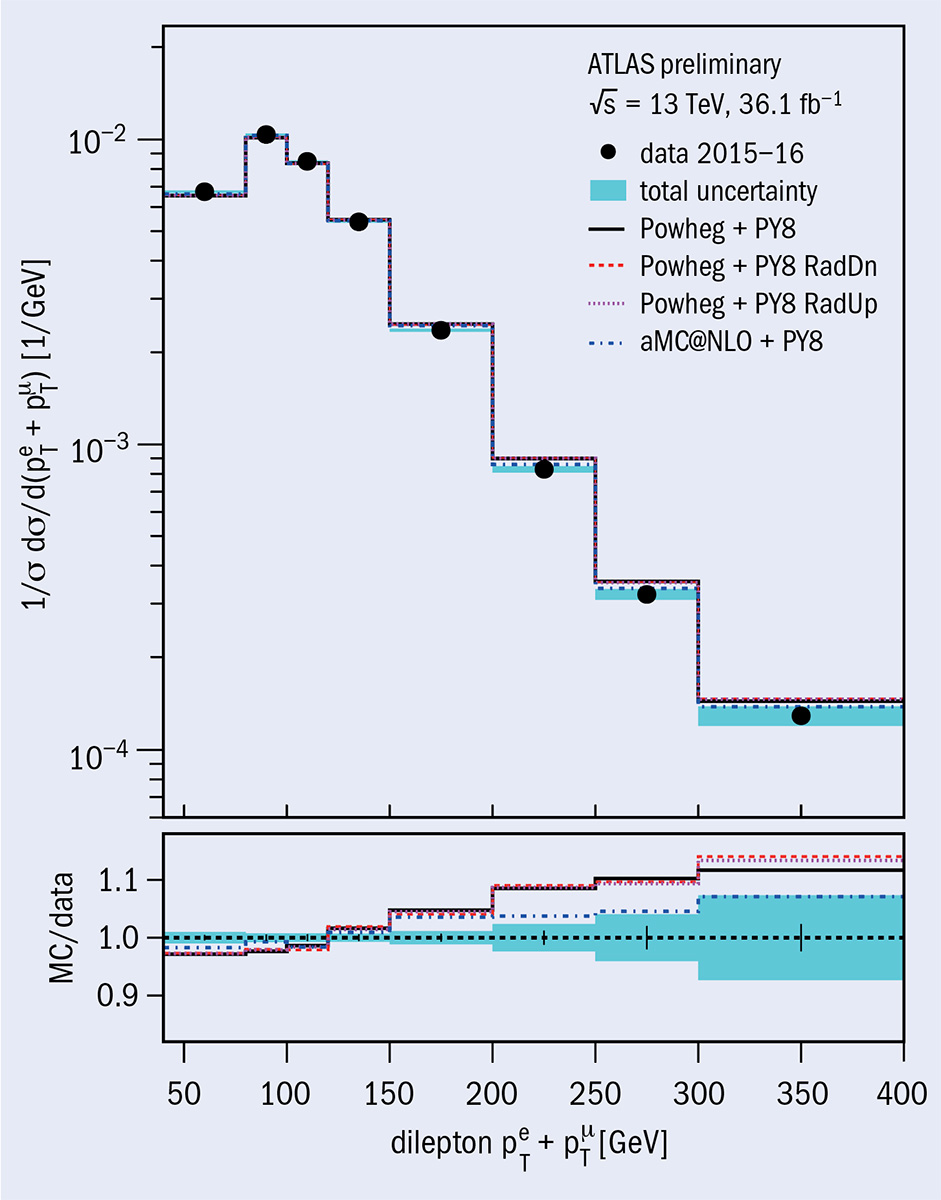
ATLAS has measured the top–antitop production cross-section using events where one top quark decays to an electron, a neutrino and a bottom quark, and the other to a muon, a neutrino and a bottom quark. The striking eμ signature gives a clean and almost background-free sample, leading to a result with an uncertainty of only 2.4%, which is the most precise top-quark pair-production measurement to date. The measurement provides information on the top quark’s mass, and can be used to improve our knowledge of the parton distribution functions describing the internal structure of the proton. The kinematic distributions of the leptons produced in top-quark decays have also been precisely measured, providing a benchmark to test programs that model top-quark production and decay at the LHC (figure 1).
The mass of the top quark is a fundamental parameter of the SM, which impacts precision calculations of certain quantum corrections. It can be measured kinematically through the reconstruction of the top quark’s decay products. The top quark decays via the weak interaction as a free particle, but the resulting bottom quark interacts with other particles produced in the collision and eventually emerges as a collimated “b-jet” of hadrons. Modelling this process and calibrating the jet measurement in the detector limits the precision in many top-quark mass measurements, however, 20% of the b-jets contain a muon that carries information relating to the parent bottom quark. By combining this muon with an isolated lepton from a W-boson originating from the same top-quark decay, ATLAS has made a new measurement of the top quark mass with a much-reduced dependence on jet modelling and calibration. The result is ATLAS’s most precise individual top-quark mass measurement to date: 174.48 ± 0.78 GeV.
Higher order QCD diagrams translate this imbalance into the charge asymmetry
At the LHC, top and antitop quarks are not produced fully symmetrically with respect to the proton-beam direction, with top antiquarks produced slightly more often at large angles to the beam, and top quarks, which receive more momentum from the colliding proton, emerging closer to the axis. Higher order QCD diagrams translate this imbalance into the so-called charge asymmetry, which the SM predicts to be small (~0.6%), but which could be enhanced, or even suppressed, by new physics processes interfering with the known production modes. Using its full Run-2 data sample, ATLAS finds evidence of charge asymmetry in top-quark pair events with a significance of four standard deviations, confidently showing that the asymmetry is indeed non-zero. The measured charge asymmetry of 0.0060 ± 0.0015 is compatible with the latest SM predictions. ATLAS also measured the charge asymmetry versus the mass of the top–antitop system, further probing the SM (figure 2).
When two lead nuclei collide in the LHC at an energy of a few TeV per nucleon, an extremely strong magnetic field of the order 1014 –1015 T is generated by the spectator protons, which pass by the collision zone without breaking apart in inelastic collisions. The strongest yet probed by scientists, this magnetic field, and in particular the rate at which it decays, is interesting to study since it probes unexplored properties of the quark–gluon plasma (QGP), such as its electric conductivity. In addition, chiral phenomena such as the chiral magnetic effect are expected to be induced by the strong fields. Left–right asymmetry in the production of negatively and positively charged particles relative to the collision reaction plane is one of the observables that is directly sensitive to electromagnetic fields. This asymmetry, called directed flow (v1), is sensitive to two main competing effects: the Lorentz force experienced by charged particles (quarks) propagating in the magnetic field, and the Faraday effect – the quark current that is induced by the rapidly decreasing magnetic field. Charm quarks are produced in the early stages of heavy-ion collisions and are therefore more strongly affected by the electromagnetic fields than lighter quarks.
An extremely strong magnetic field of the order 1014 –1015 T is generated
The ALICE collaboration has recently probed this effect by measuring the directed flow, v1, for charged hadrons and D0/D0 mesons as a function of pseudorapidity (η) in mid-central lead–lead collisions at √sNN = 5.02 TeV. Head-on (most central) collisions were excluded from the analyses because in those collisions there are very few spectator nucleons (almost all nucleons interact inelastically), which leads to a weaker magnetic field.
The top-left panel of the figure shows the η dependence of v1 for charged hadrons (centrality class 5–40%). The difference Δv1 between positively and negatively charged hadrons is shown in the bottom-left panel. The η slope is found to be dΔv1/dη = 1.68 ± 0.49 (stat) ± 0.41 (syst) × 10–4 – positive at 2.6σ significance. This measurement has a similar order of magnitude to recent model calculations of the expected effect for charged pions, but with the opposite sign.
The right-hand panels show the same analysis for the neutral charmed mesons D0 (cū) and D0 (c̄u) (centrality class 10–40%). The measured directed flows are found to be about three orders of magnitude larger than for the charged hadrons, reflecting the stronger fields experienced immediately after the collision when the charm quarks are created. The slopes, which are seen to be positive for D0 and negative for D0, are opposite and larger than in the model calculations. The slope of the differences in the directed flows is dΔv1/dη = 4.9 ± 1.7 (stat) ± 0.6 (syst) × 10–1 – positive at 2.7σ significance (lower-right panel). Also, in this case, the sign of the observed slope is opposite with respect to model calculations, suggesting that the relative contributions of the Lorentz and Faraday effects in those calculations are not correct.
Together with recent observations at RHIC, these LHC measurements provide an intriguing first sign of the effect of the large magnetic fields experienced in heavy-ion collisions on final-state particles. Measurements with larger data samples in Run 3 will have a precision sufficient to allow the contributions of the Lorentz force and the Faraday effect to be separated.
One of the best strategies for searching for new physics in the TeV regime is to look for the decays of new particles. The CMS collaboration has searched in the dilepton channel for particles with masses above a few hundred GeV since the start of LHC data taking. Thanks to newly developed triggers, the searches are now being extended to the more difficult lower range of masses. A promising possible addition to the Standard Model (SM) that could exist in this mass range is the dark photon (ZD). Its coupling with SM particles and production rate depend on the value of a kinetic mixing coefficient ε, and the resulting strength of the interaction of the ZD with ordinary matter may be several orders of magnitude weaker than the electroweak interaction.
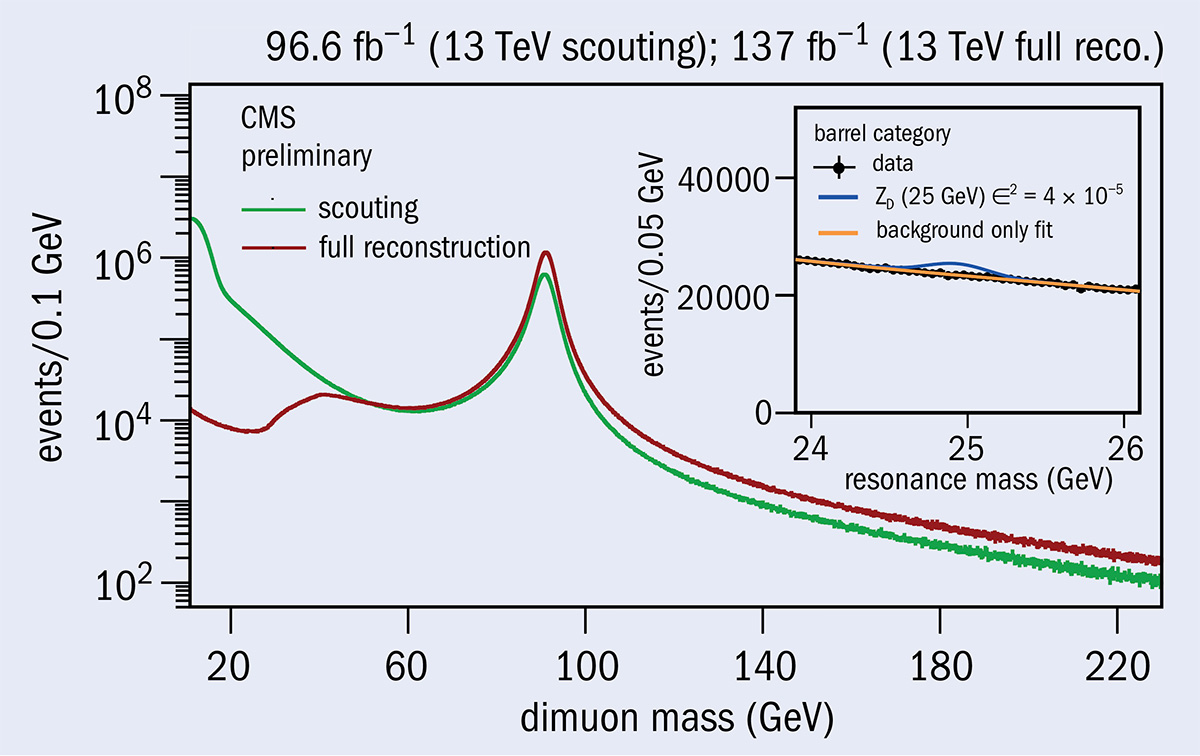
The CMS collaboration has recently presented results of a search for a narrow resonance decaying to a pair of muons in the mass range from 11.5 to 200 GeV. This search looks for a strikingly sharp peak on top of a smooth dimuon mass spectrum that arises mainly from the Drell–Yan process. At masses below approximately 40 GeV, conventional triggers are the main limitation for this analysis as the thresholds on the muon transverse momenta (pT), which are applied online to reduce the rate of events saved for offline analysis, introduce a significant kinematic acceptance loss, as evident from the red curve in figure 1.
A dedicated set of high-rate dimuon “scouting” triggers, with some additional kinematic constraints on the dimuon system and significantly lower muon pT thresholds, was deployed during Run 2 to overcome this limitation. Only a minimal amount of high-level information from the online reconstruction is stored for the selected events. The reduced event size allows significantly higher trigger rates, up to two orders of magnitude higher than the standard muon triggers. The green curve in figure 1 shows the dimuon invariant mass distribution obtained from data collected with the scouting triggers. The increase in kinematic acceptance for low masses can be well appreciated.
The full data sets collected with the muon scouting and standard dimuon triggers during Run 2 are used to probe masses below 45 GeV, and between 45 and 200 GeV, respectively, excluding the mass range from 75 to 110 GeV where Z-boson production dominates. No significant resonant peaks are observed, and limits are set on ε2 at 90% confidence as a function of the ZD mass (figure 2). These are among the world’s most stringent constraints on dark photons in this mass range.
For every trillion K0S, only five are expected to decay to two muons. Like the better known Bs → μ+μ– decay, which was first observed jointly by LHCb and CMS in 2013, the decay rate is very sensitive to possible contributions from yet-to-be discovered particles that are too heavy to be observed directly at the LHC, such as leptoquarks or supersymmetric partners. These particles could significantly enhance the decay rate, up to existing experimental limits, but could also suppress it via quantum interference with the Standard Model (SM) amplitude.
Despite the unprecedented K0S production rate at the LHC, searching for K0S → μ+μ– is challenging due to the low transverse momentum of the two muons, typically of a few hundred MeV/c. Though primarily designed for the study of heavy-flavour particles, LHCb’s unique ability to select low transverse-momentum muons in real time makes the search feasible. According to SM predictions, just two signal events are expected in the Run-2 data, potentially making this the rarest decay ever recorded.
The analysis uses two machine-learning tools: one to discriminate muons from pions, and another to discriminate signal candidates from the so-called combinatorial background that arises from coincidental decays. Additionally, a detailed and data-driven map of the detector material around the interaction point helps to reduce the “fixed-target” background caused by particles interacting with the detector material. A background of K0S → π+π– decays dominates the selection, and in the absence of a compelling signal, an upper limit to the branching fraction of 2.1 × 10⁻¹⁰ has been set at 90% confidence. This is approximately four times more stringent than the previous world-best limit, set by LHCb with Run-1 data. This result has implications for physics models with leptoquarks and some fine-tuned regions of the Minimal Supersymmetric SM.
The upgraded LHCb detector, scheduled to begin operating in 2021 after the present long shutdown of the LHC, will offer excellent opportunities to improve the precision of this search and eventually find a signal. In addition to the increased luminosity, the LHCb upgrade will have a full software trigger, which is expected to significantly improve the signal efficiency for K0S → μ+μ– and other decays with very soft final-state particles.
Gamma-ray bursts (GRBs) are the brightest electromagnetic events in the universe since the Big Bang. First detected in 1967, GRBs have been observed about once per day using a range of instruments, allowing astrophysicists to gain a deeper understanding of their origin. As often happens, 14 January 2019 saw the detection of three GRBs. While the first two were not of particular interest, the unprecedented energy of photons emitted by the third – measured by the MAGIC telescopes — provides a new insight into these mysterious phenomena.
The study of GRBs is unique, both because GRBs occur at random locations and times and because each GRB has different time characteristics and energy spectra. GRBs consist of two phases: a prompt phase, lasting from hundreds of milliseconds to hundreds of seconds, which consists of one or several bright bursts of hard X-rays and gamma-rays; followed by a significantly weaker “afterglow” phase which can be observed at lower energies ranging from radio to X-rays and lasts for periods up to months.
The recent detection adds yet another messenger: TeV photons
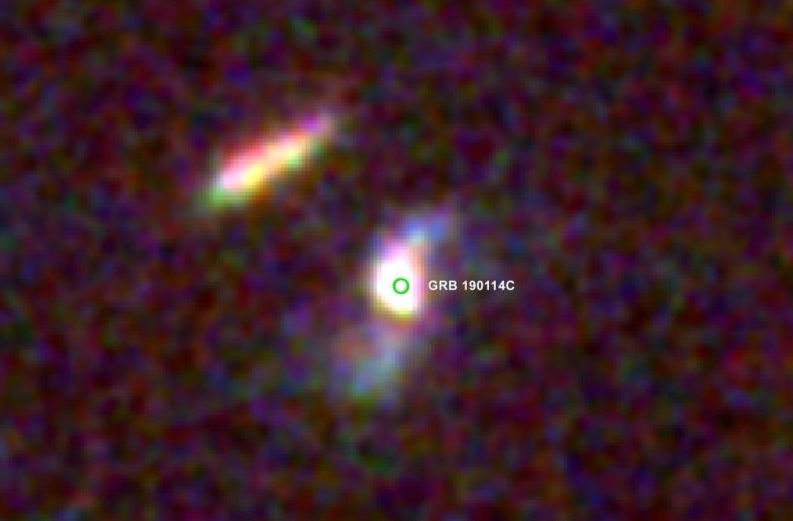
Since the late 1990, optical observations have confirmed both that GRBs happen in other galaxies and that longer duration GRBs tend to be associated with supernovae, strongly hinting that they result from the death of massive stars. Shorter GRBs, meanwhile, have recently been shown to be the result of neutron-star mergers thanks to the first joint observations of a GRB with a gravitational wave event in 2017. While this event is often regarded as the start of multi-messenger astrophysics, the recent detection of GRB190114C lying 4.5 billion light years from Earth adds yet another messenger to the field of GRB astrophysics: TeV photons.
The MAGIC telescopes on the island of La Palma measure Cherenkov radiation produced when TeV photons induce electromagnetic showers after interacting with the Earth’s atmosphere. During the past 15 years, MAGIC has discovered a range of astrophysical sources via their emission at these extreme energies. However, detecting the emission from GRBs, despite over 100 attempts, remained elusive despite theoretical predictions that such emission could exist.
On 14 January, based on an alert provided by space-based gamma-ray detectors, the MAGIC telescopes started repointing within a few tens of seconds of the onset of the GRB. Within the next half hour, the telescopes had observed around a 1000 high energy photons from the source. This emission, which has long been predicted by theorists, is shown by the collaboration to be the result of the “synchrotron self-Compton” process, whereby high-energy electrons accelerated in the initial violent explosion interact with magnetic fields produced by the collision between these ejecta and interstellar matter. The synchrotron emission from this interaction produces the afterglow observed at X-ray, optical and radio energies. However, some of these synchrotron photons subsequently undergo inverse Compton scattering with the same electrons, allowing them to reach TeV energies. These measurements by MAGIC show for the first time that indeed this mechanism does occur. Given the many observations in the past where it wasn’t observed, it appears to be yet another feature which differs between GRBs.
The MAGIC results were published in an issue of Nature which also reported a discovery of similar emission in a different GRB by another Cherenkov telescope: the High Energy Stereoscopic System (H.E.S.S) in Namibia. While the measurements are consistent, it is interesting to note that the measurements by H.E.S.S were made ten hours after that particular GRB, showing that this type of emission can occur also at much later time scales. With two new large-scale Cherenkov observatories – the Large High Altitude Air Shower Observatory in China and the global Cherenkov Telescope Array — about to commence data taking, the field of GRB astrophysics can now expect a range of new discoveries.
Loop Quantum Gravity and Twistor Theory have a lot in common. They both have quantum gravity as a main objective, they both discard conventional spacetime as the cornerstone of physics, and they have both taken major inspiration from renowned British mathematician Roger Penrose. Interaction between the two communities has been minimal so far, however, due to their distinct research styles: mathematically oriented in Twistor Theory, but focused on empirical support in Loop Gravity. This separation was addressed in the first week of September at a conference held at the Centre for Mathematical Researches (CIRM) at the Campus of Luminy in Marseille, where about a hundred researchers converged for lively debates designed to encouraged cross-fertilisation between the two research lines.
Both Twistor Theory and Loop Gravity regard conventional smooth general-relativistic spacetime as an approximate and emerging notion. Twistor theory was proposed by Roger Penrose as a general geometric framework for physics, with the long-term aim of unifying general relativity and quantum mechanics. The main idea of the theory is to work on the null rays, namely the space of the possible path that a light ray can follow in spacetime, instead of the manifold of the points of physical spacetime. Spacetime points, or events, are then seen as derived objects: they are given by compact holomorphic curves in a complex three-fold: twistor space. It is remarkable how much the main equations of fundamental physics simplify when formulated in these terms. The mathematics of twistors has roots in the 19th century Klein correspondence in projective geometry, and modern Twistor Theory has had a strong impact on pure mathematics, from differential geometry and representation theory to gauge theories and integrable systems.
Could allying twistors and loops be dangerous?
Loop gravity, on the other hand, is a background-independent theory of quantum gravity. That is, it does not treat spacetime as the background on which physics happens, but rather as a dynamical entity itself satisfying quantum theory. The conventional smooth general relativistic spacetime emerges in the classical (ℏ→0) limit, in the same manner as a smooth electromagnetic field satisfying the Maxwell equations emerges from the Fock space of the photons in the classical limit of quantum electrodynamics. Similarly, the full dynamics of classical general relativity is recovered from the quantum dynamics of Loop gravity in the suitable limit. The transitions amplitudes of the theory are finite in the ultraviolet and are expressed as multiple integrals over non compact groups. The theory provides a compelling picture of quantum spacetime. A basis in the Hilbert space of the theory is described by the mathematics of the spin networks: graphs with links labelled by SU(2) irreducible representations, independently introduced by Roger Penrose in the early 1970s in an attempt to a fully discrete combinatorial picture of quantum physical space. Current applications of Loop Gravity include early cosmology, where the possibility of a bounce replacing the Big Bang has been extensively studied using Loop gravity methods, and black holes, where the theory’s amplitudes can be used to study the non-perturbative transition at the end of the Hawking evaporation.
The communities working in Twistors and Loops share technical tools and conceptual pillars, but have evolved independently for many years, with different methods and different intermediate goals. But recent developments discussed at the Marseille conference saw twistors appearing in formulations of the loop gravity amplitudes, confirming the fertility and the versatility of the twistor idea, and raising intriguing questions about possible deeper relations between the two theories.
The conference was a remarkable success. It is not easy to communicate across research programs in contemporary fundamental physics, because a good part of the field is stalled in communities blocked by conflicting assumptions, ingrained prejudices and seldom questioned judgments, making understanding one another difficult. The vibrant atmosphere of the Marseille conference cut through this.
The best moment came during Roger Penrose’s talk. Towards the end of a long and dense presentation of new ideas towards understanding the full space of the solutions of Einstein’s theory using twistors, Roger said rather dramatically that now he was going to present a new big idea that might lead to the twistor version of the full Einstein equations – but at that precise moment the slide projector exploded in a cloud of smoke, with sparks flying. We all thought for a moment that a secret power of the Universe, worried about being unmasked, had interfered. Could allying twistors and loops be dangerous?
The paper conjectured a relation between certain quantum field theories and gravity theories. The idea was that a strongly coupled quantum system can generate complex quantum states that have an equivalent description in terms of a gravity theory (or a string theory) in a higher dimensional space. The paper considered special theories that have lots of symmetries, including scale invariance, conformal invariance and supersymmetry, and the fact that those symmetries were present on both sides of the relationship was one of the pieces of evidence for the conjecture. The main argument relating the two descriptions involved objects that appear in string theory called D-branes, which are a type of soliton. Polchinski had previously given a very precise description for the dynamics of D-branes. At low energies a soliton can be described by its centre-of-mass position: if you have N solitons you will have N positions. With D-branes it is the same, except that when they coincide there is a non-Abelian SU(N) gauge symmetry that relates these positions. So this low-energy theory resembles the theory of quantum chromodynamics, except that with N colours and special matter content.
On the other hand, these D-brane solitons also have a gravitational description, found earlier by Horowitz and Strominger, in which they look like “black branes” – objects similar to black holes but extended along certain spatial directions. The conjecture was simply that these two descriptions should be equivalent. The gravitational description becomes simple when N and the effective coupling are very large.
Did you stumble across the duality, or had you set out to find it?
It was based on previous work on the connection between D-branes and black holes. The first major result in this direction was the computation of Strominger and Vafa, who considered an extremal black hole and compared it to a collection of D-branes. By computing the number of states into which these D-branes can be arranged, they found that it matched the Bekenstein–Hawking black-hole entropy given in terms of the area of the horizon. Such black holes have zero temperature. By slightly exciting these black holes some of us were attempting to extend such results to non-zero temperatures, which allowed us to probe the dynamics of those nearly extremal black holes. Some computations gave similar answers, sometimes exactly, sometimes up to coefficients. It was clear that there was a deep relation between the two, but it was unclear what the concrete relation was. The gravity–gauge (AdS/CFT) conjecture clarified the relationship.
Are you surprised by its lasting impact?
Yes. At the time I thought that it was going to be interesting for people thinking about quantum gravity and black holes. But the applications that people found to other areas of physics continue to surprise me. It is important for understanding quantum aspects of black holes. It was also useful for understanding very strongly coupled quantum theories. Most of our intuition for quantum field theory is for weakly coupled theories, but interesting new phenomena can arise at strong coupling. These examples of strongly coupled theories can be viewed as useful calculable toy models. The art lies in extracting the right lessons from them. Some of the lessons include possible bounds on transport, a bound on chaos, etc. These applications involved a great deal of ingenuity since one has to extract the right lessons from the examples we have in order to apply them to real-world systems.
What does the gravity–gauge duality tell us about nature, given that it relates two pictures (e.g. involving different dimensionalities of space) that have not yet been shown to correspond to the physical world?
It suggests that the quantum description of spacetime can be in terms of degrees of freedom that are not localised in space. It also says that black holes are consistent with quantum mechanics, when we look at them from the outside. More recently, it was understood that when we try to describe the black-hole interior, then we find surprises. What we encounter in the interior of a black hole seems to depend on what the black hole is entangled with. At first this looks inconsistent with quantum mechanics, since we cannot influence a system through entanglement. But it is not. Standard quantum mechanics applies to the black hole as seen from the outside. But to explore the interior you have to jump in, and you cannot tell the outside observer what you encountered inside.
One of the most interesting recent lessons is the important role that entanglement plays in constructing the geometry of spacetime. This is particularly important for the black-hole interior.
I suspect that with the advent of quantum computers, it will become increasingly possible to simulate these complex quantum systems that have some features similar to gravity. This will likely lead to more surprises.
In what sense does AdS/CFT allow us to discuss the interior of a black hole?
It gives us directly a view of a black hole from the outside, more precisely a view of the black hole from very far away. In principle, from this description we should be able to understand what goes on in the interior. While there has been some progress on understanding some aspects of the interior, a full understanding is still lacking. It is important to understand that there are lots of weird possibilities for black-hole interiors. Those we get from gravitational collapse are relatively simple, but there are solutions, such as the full two-sided Schwarzschild solution, where the interior is shared between two black holes that are very far away. The full Schwarzschild solution can therefore be viewed as two entangled black holes in a particular state called the thermofield double, a suggestion made by Werner Israel in the 1970s. The idea is that by entangling two black holes we can create a geometric connection through their interiors: the black holes can be very far away, but the distance through the interior could be very short. However, the geometry is time-dependent and signals cannot go from one side to the other. The geometry inside is like a collapsing wormhole that closes off before a signal can go through. In fact, this is a necessary condition for the interpretation of these geometries as entangled states, since we cannot send signals using entanglement. Susskind and myself have emphasised this connection via the “ER=EPR” slogan. This says that EPR correlations (or entanglement) should generally give rise to some sort of “geometric” connection, or Einstein–Rosen bridge, between the two systems. The Einstein–Rosen bridge is the geometric connection between two black holes present in the full Schwarzschild solution.
Are there potential implications of this relationship for intergalactic travel?
Gao, Jafferis and Wall have shown that an interesting new feature appears when one brings two entangled black holes close to each other. Now there can be a direct interaction between the two black holes and the thermofield double state can be close to the ground state of the combined system. In this case, the geometry changes and the wormhole becomes traversable.
One can find solutions of the Standard Model plus gravity that look like two microscopic magnetically charged black holes joined by a wormhole
In fact, as shown by Milekhin, Popov and myself, one can find solutions of the Standard Model plus gravity that look like two microscopic magnetically charged black holes joined by a wormhole. We could construct a controllable solution only for small black holes because we needed to approximate the fermions as being massless.
If one wanted a big macroscopic wormhole where a human could travel, then it would be possible with suitable assumptions about the dark sector. We’d need a dark U(1) gauge field and a very large number of massless fermions charged under U(1). In that case, a pair of magnetically charged black holes would enable one to travel between distant places. There is one catch: the time it would take to travel, as seen by somebody who stays outside the system, would be longer than the time it takes light to go between the two mouths of the wormhole. This is good, since we expect that causality should be respected. On the other hand, due to the large warping of the spacetime in the wormhole, the time the traveller experiences could be much shorter. So it seems similar to what would be experienced by an observer that accelerates to a very high velocity and then decelerates. Here, however, the force of gravity within the wormhole is doing the acceleration and deceleration. So, in theory, you can travel with no energy cost.
How does AdS/CFT relate to broader ideas in quantum information theory and holography?
Quantum information has been playing an important role in understanding how holography (or AdS/CFT) works. One important development is a formula, due to Ryu and Takayanagi, for the fine-grained entropy of gravitational systems, such as a black hole. It is well known that the area of the horizon gives the coarse-grained, or thermodynamic, entropy of a black hole. The fine-grained entropy, by contrast, is the actual entropy of the full quantum density matrix describing the system. Surprisingly, this entropy can also be computed in terms of the area of the surface. But it is not the horizon, it is typically a surface that lies in the interior and has a minimal area.
If you could pick any experiment to be funded and built, what would it be?
Well, I would build a higher energy collider, of say 100 TeV, to understand better the nature of the Higgs potential and look for hints of new physics. As for smaller scale experiments, I am excited about the current prospects to manipulate quantum matter and create highly entangled states that would have some of the properties that black holes are supposed to have, such as being maximally chaotic and allowing the kind of traversable wormholes described earlier.
How close are we to a unified theory of nature’s interactions?
String theory gives us a framework that can describe all the known interactions. It does not give a unique prediction, and the accommodation of a small cosmological constant is possible thanks to the large number of configurations that the internal dimensions can acquire. This whole framework is based on Kaluza–Klein compactifications of 10D string theories. It is possible that a deeper understanding of quantum gravity for cosmological solutions will give rise to a probability measure on this large set of solutions that will allow us to make more concrete predictions.Matth
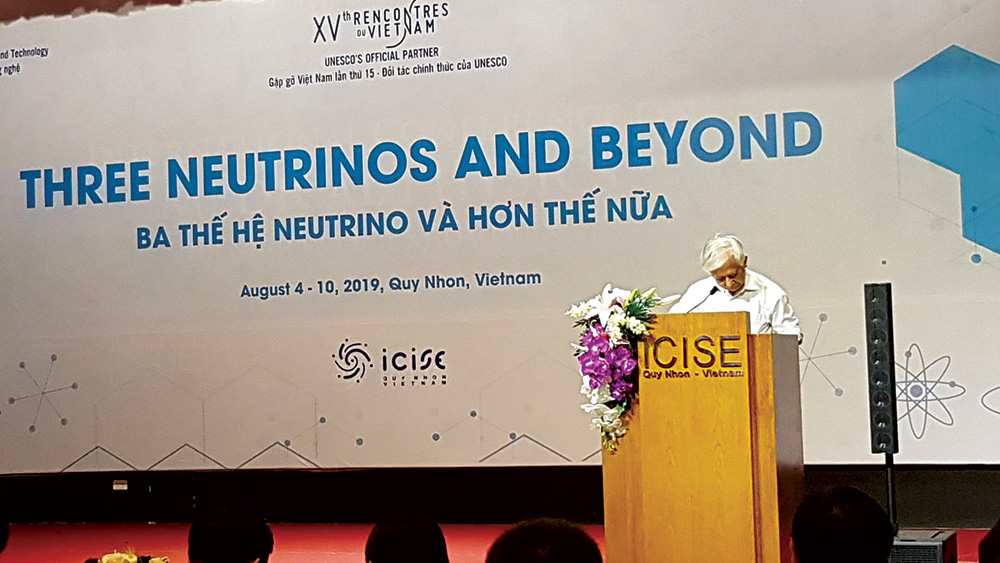
Since 1993 the Rencontres du Vietnam have fostered exchanges between scientists in the Asia-Pacific region and colleagues from other parts of the world. The 15th edition, which brought together more than 50 physicists in Quy Nhon, Vietnam from 4–10 August, celebrated the 30th anniversary of the start of the Large Electron Positron collider (LEP) in 1989, which within a mere three weeks of running had established that the number of species of light active neutrinos is three (CERN Courier September/October 2019 p32). This was a great opportunity to emphasise the important role that colliders have played and will continue to play in neutrino physics. Before the three-neutrino measurement of LEP, the tau neutrino had been established in the years 1975–1986 by a combination of e+e–-collider observations of tau decays, pp collisions (the W → τντ decay was observed at CERN in 1985) and neutrino-beam experiments, where it was observed that taus are never produced by electron– or muon–neutrino beams (for example Fermilab’s E531 experiment in 1986).
A neutrino-oscillation industry then sprang into being, following the discovery that neutrinos have mass. An abundance of recent results on oscillation parameters were presented from accelerator-neutrino beams, nuclear reactors, and atmospheric and astrophysical neutrinos. Interestingly, the data now seem to indicate at > 3σ that neutrinos follow the natural (rather than inverted) mass ordering, in which the most electron-like neutrino has a mass smaller than that of the muon and tau neutrinos. The next 10 years should see this question resolved, as well as a determination of the CP-violating phase of the neutrino-mixing matrix, with a precision of 5–10 degrees.
The fact that neutrinos have mass requires an addition to the Standard Model (SM), wherein neutrinos are massless by definition. There are several solutions, of which a minimal modification is to introduce right-handed neutrinos in addition to the normal ones, which have left-handed chirality. The properties of these heavy neutral leptons would be very well predicted were it not that their mass can lie anywhere from less than an eV to 1010 GeV or more. Being sterile they only couple to SM particles via mixing with normal neutrinos. Consequently, they should be very rare and have long lifetimes, perhaps allowing a spectacular observation in either fixed-target or high-luminosity colliders at the electroweak scale. One possible low-energy indication could be the existence of neutrinoless double-beta decay. Such decays, currently being searched for directly in dedicated experiments worldwide, violate lepton–number conservation in the case where neutrinos possess a Majorana mass term that transforms neutrinos into antineutrinos.
For a fortunate combination of parameters, this could lead to a spectacular signature
The meeting reviewed the status of all aspects of massive neutrinos, from direct mass measurements of the sort successfully executed shortly after the conference by the KATRIN experiment (see KATRIN sets first limit on neutrino mass) to the search for heavy sterile neutrinos in ATLAS and CMS. A new feature of the field is the abundance of experimental projects searching for very weakly, or, to use the newly coined parlance, “feebly”, interacting particles. These range from CERN’s SHiP experiment to future LHC projects such as FASER and Mathusla (for masses from the pion to the B meson); proposed high-luminosity and high-energy colliders such as the Future Circular Collider would extend the search up to the Z mass for mixings between the heavy and light neutrinos down to 10–11. Until recently classified as exotic, these experiments could yield the long-sought-after explanation for the matter–antimatter asymmetry of the universe by combining CP violation with an interaction that transforms particles into antiparticles. For a fortunate combination of parameters, this could lead to a spectacular signature: the production of a heavy neutrino in a W decay, tagged by an associated charged lepton, and followed by its transformation into its antineutrino, which could then be identified by its decay into a lepton of the same sign as that initially tagged (and possibly of a different flavour).
The meeting was thus concluded in continuity with its initial commemoration: could the physics of neutrinos be one of the highlights of future high-energy colliders?
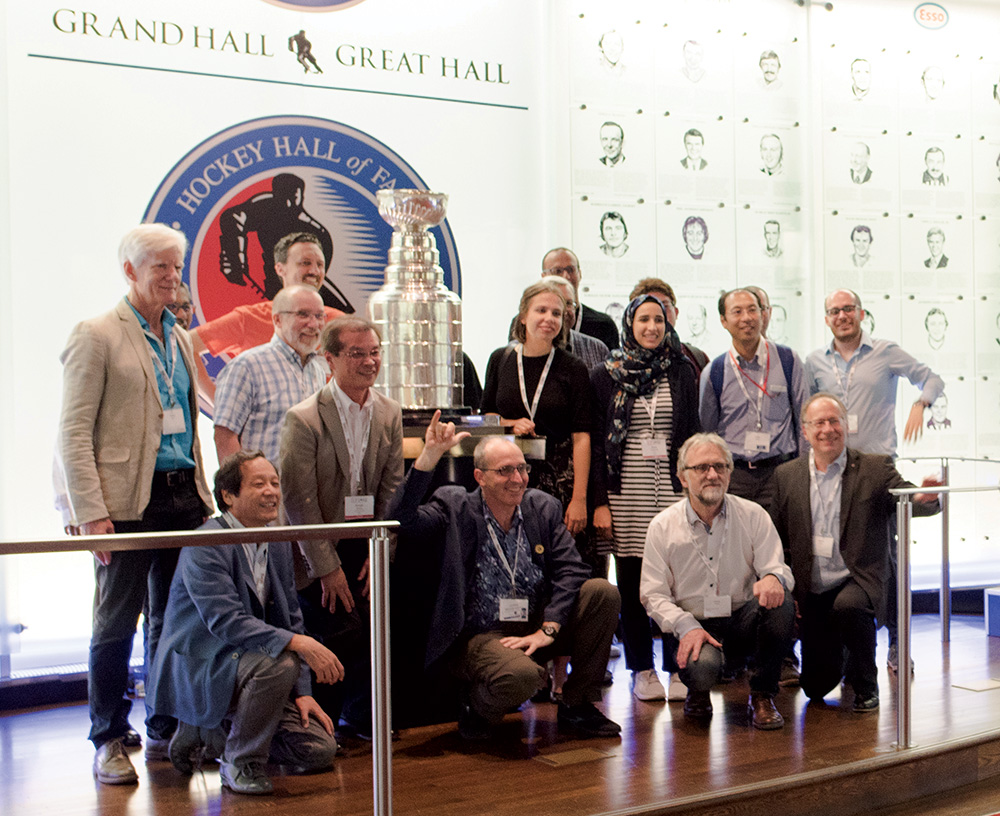
The 29th International Symposium on Lepton–Photon Interactions at High Energies was held in Canada from 5–10 August at the Westin Harbour Castle hotel, right on the Lake Ontario waterfront in downtown Toronto. Almost 300 delegates provided a snapshot of the entire field of particle physics and, for the first time, parallel sessions were convened from abstracts submitted by collaborations and individuals.
The symposium opened with a welcome from Chief Laforme of the Mississauga First Nation. It was followed by highlights from the LHC experiments and updates on plans for the CERN accelerator complex, the CEPC project in China and the recently inaugurated Belle II programme in Japan. The Belle-II collaboration showed early results from their first 6.5 fb–1 of SuperKEKb data, including measurements of previously studied Standard Model (SM) phenomena and a new limit on dark-photon production near 10 GeV. Further plenary sessions covered dark-matter searches, multi-messenger astronomy, Higgs, electroweak and top-quark physics, heavy-ion physics, QCD, exotic-particle searches, flavour physics and neutrino physics.
Tatsuya Nakada offered his views on flavour factories
The symposium ended with a progress report on the European strategy for particle physics and summaries on advances in particle detection and instrumentation, followed by a presentation on outreach and education initiatives from Kétévi Assamagan (Witwatersrand and BNL), and perspectives on future facilities. In the discussion on future flavour facilities, Tatsuya Nakada (EPFL) offered his views on flavour factories, emphasising their important role in guiding future experiments. He stressed the fact that yesterday’s discoveries (most recently the Higgs boson) become today’s workhorses, providing stringent tests of the SM. In the coming decades we are likely to have W and Higgs factories that will further illuminate the remaining shadows in the SM.
A packed public lecture by 2015 Nobel-Prize winner Art McDonald demonstrated the keen interest of the broader public in the continued developments in particle physics, including those in Canada at the SNOLAB underground laboratory, which now hosts several experiments engaged in neutrino physics and dark-matter searches, following the seminal results from the SNO experiment.
The 16th International Conference on Topics in Astroparticle and Underground Physics (TAUP 2019) was held in Japan from 9–13 September, attracting a record 540 physicists from around 30 countries. The 2019 edition of the series, which covered recent experimental and theoretical developments in astroparticle physics, was hosted by the Institute for Cosmic Ray Research of the University of Tokyo, and held in Toyama – the gateway city to the Kamioka experimental site.
Discussions first focused on gravitational-wave observations. During their first two observing runs, reported Patricia Schmidt from Radboud University, LIGO and Virgo confidently detected gravitational waves from 10 binary black-hole coalescenses and one binary neutron star inspiral, seeing one gravitational-wave event every 15 days of observation. It was also reported that, during the ongoing third observing run, LIGO and Virgo have already observed 26 candidate events. Among them is the first signal from a black hole–neutron star merger.
Guido Drexlin revealed the first measurement results on the upper limit of the neutrino mass
The programme continued with presentations from various research fields, a highlight being a report on the first result of the KATRIN experiment (KATRIN sets first limit on neutrino mass). Co-spokesperson Guido Drexlin revealed the first measurement results on the upper limit of the neutrino mass: < 1.1 eV at 90% confidence. This world-leading direct limit – which measures the neutrino mass by precisely measuring the kinematics of the electrons emitted from tritium beta decays – was obtained based on only four weeks of data. With the continuation of the experiment, it is expected that the limit will be reduced further, or even – if the neutrino mass is sufficiently large – the actual mass will be determined. Due to their oscillatory nature, it has been known since 1998 that neutrinos have tiny, but non-zero, masses. However, their absolute values have not yet been measured.
Diversity is a key feature of the TAUP conference. Topics discussed included cosmology, dark matter, neutrinos, underground laboratories, new technologies, gravitational waves, high-energy astrophysics and cosmic rays. Multi-messenger astronomy – which combines information from gravitational-wave observation, optical astronomy, neutrino detection and other electromagnetic signals – is quickly becoming established and is expected to play an even more important role in the future in gaining a deeper understanding of the universe.
The next TAUP conference will be held in Valencia, Spain, from 30 August to 3 September 2021.
To provide the best experiences, we use technologies like cookies to store and/or access device information. Consenting to these technologies will allow us to process data such as browsing behavior or unique IDs on this site. Not consenting or withdrawing consent, may adversely affect certain features and functions.
Functional
Always active
The technical storage or access is strictly necessary for the legitimate purpose of enabling the use of a specific service explicitly requested by the subscriber or user, or for the sole purpose of carrying out the transmission of a communication over an electronic communications network.
Preferences
The technical storage or access is necessary for the legitimate purpose of storing preferences that are not requested by the subscriber or user.
Statistics
The technical storage or access that is used exclusively for statistical purposes.The technical storage or access that is used exclusively for anonymous statistical purposes. Without a subpoena, voluntary compliance on the part of your Internet Service Provider, or additional records from a third party, information stored or retrieved for this purpose alone cannot usually be used to identify you.
Marketing
The technical storage or access is required to create user profiles to send advertising, or to track the user on a website or across several websites for similar marketing purposes.