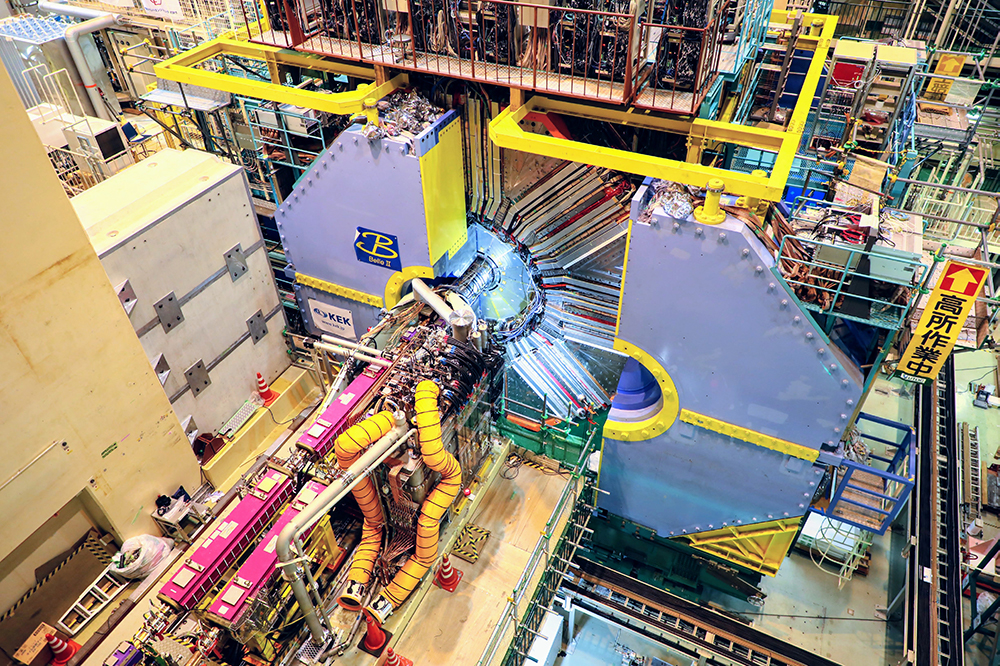
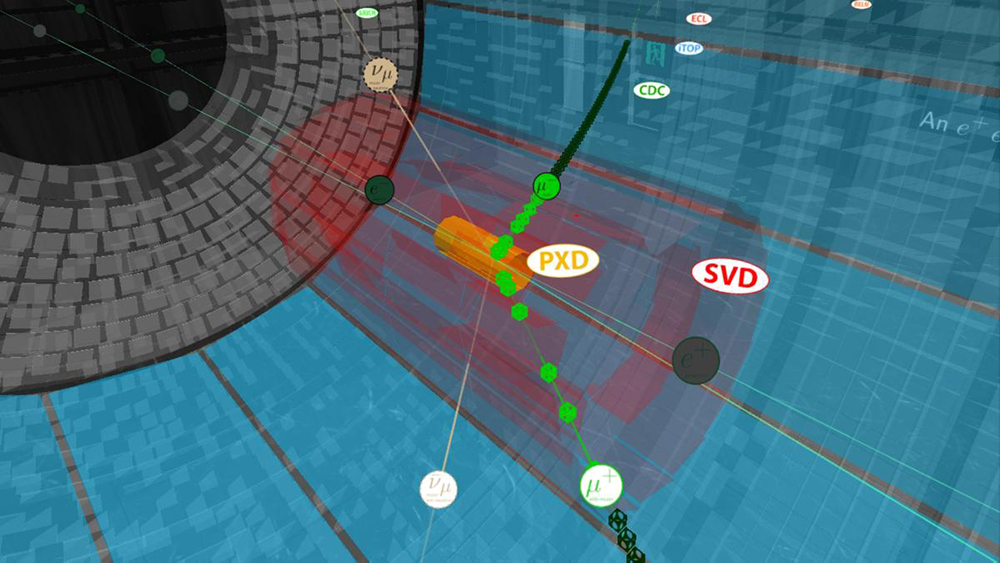
The Belle II collaboration at the SuperKEKB collider in Japan has published its first physics analysis: a search for Z′ bosons, which are hypothesised to couple the Standard Model (SM) with the dark sector. The team scoured four months of data from a pilot run in 2018 for evidence of invisibly decaying Z′ bosons in the process e+e−→μ+μ−Z′, and for lepton-flavour violating Z′ bosons in e+e−→e±μ∓Z′, by looking for missing energy recoiling against two clean lepton tracks. “This is the first ever search for the process e+e−→μ+μ−Z′ where the Z′ decays invisibly,” says Belle II spokesperson Toru Iijima of Nagoya University.
The team did not find any excess of events, yielding preliminary sensitivity to the coupling g′ in the so-called Lμ−Lτ extension of the SM, wherein the Z′ couples only to muon and tau-lepton flavoured SM particles and the dark sector. This model also has the potential to explain anomalies in b → sμ+μ− decays reported by LHCb and the longstanding muon g-2 anomaly, claims the team.
The results come a little over a year since the first collisions were recorded in the fully instrumented Belle II detector on 25 March 2019. Following in the footsteps of Belle at the KEKB facility, the new SuperKEKB b-factory plans to achieve a 40-fold increase on the luminosity of its predecessor, which ran from 1999 to 2010. First turns were achieved in February 2016, and first collisions between its asymmetric-energy electron and positron beams were achieved in April 2018. The machine has now reached a luminosity of 1.4 × 1034 cm-2 s-1 and is currently integrating around 0.7 fb-1 each day, exceeding the peak luminosity of the former PEP-II/BaBar facility at SLAC, notes Iijima.
By summer the team aims to exceed the Belle/KEKB record of 2.1 × 1034 cm-2 s-1by implementing a nonlinear “crab waist” focusing scheme. First used at the electron-positron collider DAΦNE at INFN Frascati, and not to be confused with the crab-crossing technology used to boost the luminosity at KEKB and planned for the high-luminosity LHC, the scheme stabilises e+e– beam-beam blowup using carefully tuned sextupole magnets located symmetrically on either side of the interaction point. “The 100 fb-1 sample which we plan to integrate by summer will allow us to provide our first interesting results in B physics,” says Tom Browder of the University of Hawaii, who was Belle II spokesperson until last year.
We will then look for the star attraction of the dark sector, the dark photon
Tom Browder
As well as updating searches for invisible decays of the Z′ with one to two orders of magnitude more data, Belle II will now conduct further dark-sector studies including a search for axion-like particles decaying to two photons, the Z′ decaying to visible final states and dark-Higgstrahlung with a μ+μ– pair and missing energy, explains Browder. “We will then look for the star attraction of the dark sector, the dark photon, with the difficult signature of e+e– to a photon and nothing else.”
On 25 January, European Space Agency astronaut Luca Parmitano stepped outside a half-million-kilogramme structure travelling at tens of thousands of kilometres per hour, hundreds of kilometres above Earth, and, tethered by a thin cord, ventured into the vacuum of space to check for a leak.
It was the fourth such extravehicular activity (EVA) he’d been on in two months. All things considered, the task ahead was relatively straightforward: to make sure that a newly installed cooling system for the Alpha Magnetic Spectrometer (AMS), the cosmic-ray detector that has been attached to the International Space Station (ISS) since 2011, had been properly plumbed in.
Heart-stopping spacewalks
The first EVA on 15 November saw Parmitano and fellow astronaut, NASA’s Drew Morgan, remove and jettison the AMS debris shield, which is currently still spiralling its way to Earth, to allow access to the experiment’s cooling system. The CO2 pumps, needed to keep the 200,000-channel tracker electronics at a temperature of 10 ± 3 °C, had started to fail in 2014 – which was no surprise, as AMS was initially only supposed to operate for three years. During the second EVA on 22 November, the astronauts cut through the cooling system’s eight stainless-steel lines to isolate and prepare it for removal, and a critical EVA3 on 2 December saw Morgan and Parmitano successfully connect the new pump system, which had been transported to the ISS by an Antares rocket the previous month. Then came a long wait until January to find out if the repair had been successful.
“EVA4 was the heart-stopping EVA because that’s where we did the leak tests on all those tubes,” says Ken Bollweg, NASA’s AMS project manager. The success of the previous EVAs suggested that the connections were going to be fine. But Parmitano arrived at the first tube, attached one of 29 bespoke tools developed specially for the AMS repair, and saw that the instrument had issued a warning signal. “I see red,” he reported to anxious teams at NASA’s Johnson Space Center’s Mission Control Center and the AMS Payload Operations Control Centre (POCC) at CERN’s Prévessin site, from where spokesperson Sam Ting and his colleagues were monitoring proceedings closely. Though not huge, the leak was serious enough not to guarantee that the system would work, jeopardising four years of preparation involving hundreds of astronauts, engineers and scientists. Following procedures put in place to deal with such a situation, Parmitano tightened the connection and waited for about an hour before checking the tube again. A leak was still present. Then, after re-tightening the troublesome connection again, while the team was preparing a risky “jumper” manoeuvre to bypass the leak and make a new connection, he checked a third time: “No red!” Happy faces lit up the POCC.
NASA has learned a lot of new things from this
Ken Bollweg
AMS was never designed to be serviceable, and the repair, unprecedented in complexity for a space intervention, required the avoidance of sharp edges and other hazards in order to bring it back to full operational capacity. The chances of something going wrong were high, says Bollweg. “NASA has learned a lot of new things from this. We really pushed the envelope. It showed that we have the capabilities to do even more than we have done in the past.” EVA4 lasted almost six hours. Five hours and two minutes into it, Parmitano, who returned safely to Earth on 6 February, broke the European record for the most time spent spacewalking (33 hours and nine minutes). It’s not a job for the fainthearted. During a spacewalk in 2013, while wedged into a confined space outside the ISS, a malfunction in Parmitano’s spacesuit caused his helmet to start filling with water and he almost drowned.
“Building and operating AMS in space has been an incredible journey through engineering and physics, but today it is thanks to the NASA group that in AMS we can continue this journey and this is amazing. An enormous thanks to the EVA crew,” said AMS integration engineer Corrado Gargiulo of CERN. The day after EVA4, the POCC team spent about 10 hours refilling the new AMS cooling system with 1.3 kg of CO2 and started to power up the detector. At noon on 27 January, all the detector’s subsystems were sending data back, marking a new chapter for AMS that will see it operate for the lifetime of the ISS.
Into the unknown
The 7.5 tonne AMS apparatus has so far recorded almost 150 billion charged cosmic rays with energies up to the multi-TeV range, and its percent-level results show clear and unexpected behaviour of cosmic-ray events at high energies. A further 10 years of operation will allow AMS to make conclusive statements on the origin of these unexpected observations, says Ting. “NASA is to be congratulated on seeing this difficult project through over a period of many years. AMS has observed unique features in cosmic-ray spectra that defy traditional explanations. We’re entering into a region where nobody has been before.”
AMS has observed unique features in cosmic-ray spectra that defy traditional explanations
Sam Ting
The first major result from AMS came in 2013, when measurements of the cosmic positron fraction (the ratio of the positron flux to the flux of electrons and positrons) up to an energy of 350 GeV showed that the spectrum fits well to dark-matter models. The following year, AMS published the positron and electron fluxes, which showed that neither can be fitted with the single-power-law assumption underpinning the traditional understanding of cosmic rays. The collaboration has continued to find previously unobserved features in the measured fluxes and flux ratio of electrons and positrons, publishing the results in several high-profile papers during the past couple of years.
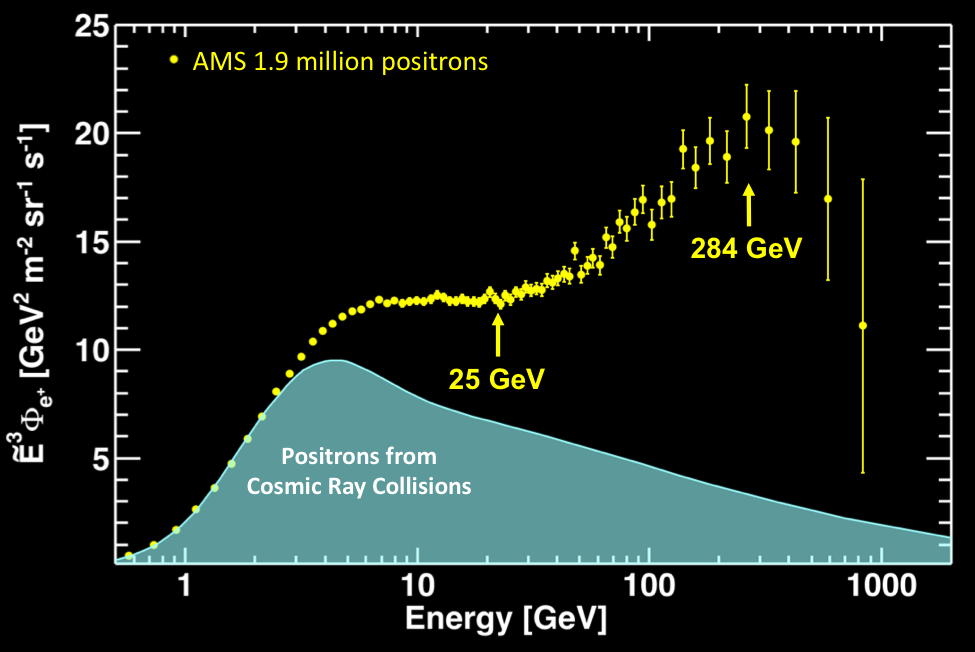
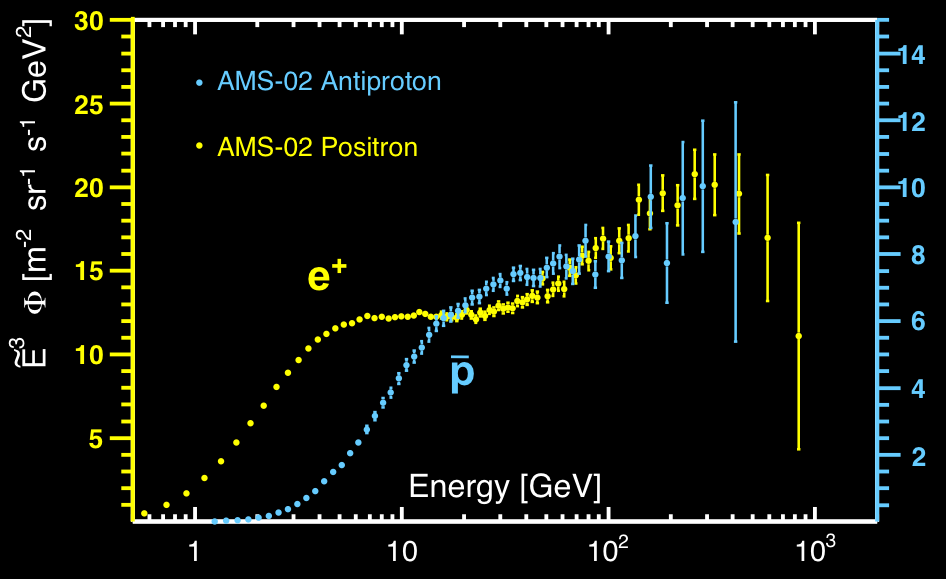
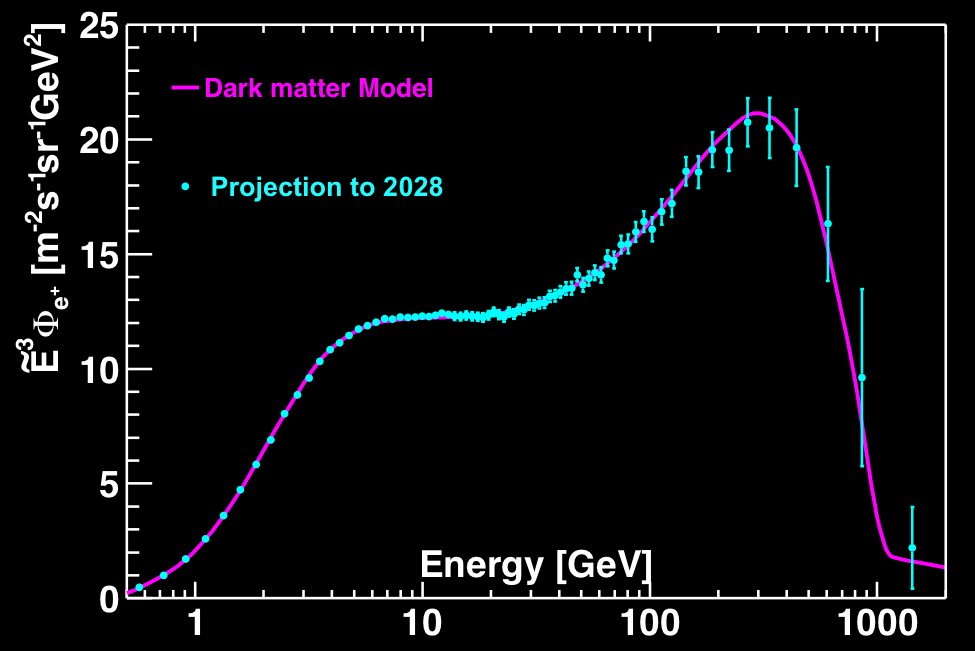
Last year, AMS reaffirmed the complex energy dependence exhibited by the positron flux: a significant excess starting from 25 GeV, a sharp drop-off above 284 GeV and a finite energy cutoff at 810 GeV (figure 1). “In the entire energy range the positron flux is well described by the sum of a term associated with the positrons produced in the collision of cosmic rays, which dominates at low energies, and a new source term of positrons, which dominates at high energies,” says Ting. “These experimental data on cosmic-ray positrons show that, at high energies, they predominantly originate either from dark-matter annihilation or from other astrophysical sources.” Although dark-matter models predict such a cut off, the AMS data cannot yet rule out astrophysical sources, in particular pulsars. Further intrigue comes from the latest, to-be-published, AMS result on antiprotons, which, although rare at high energies, exhibit similar functional behaviour as the positron spectrum (figure 2). “This indicates that the excess of positrons may not come from pulsars due to the similarity of the two spectra and the high mass of antiprotons,” says Ting.
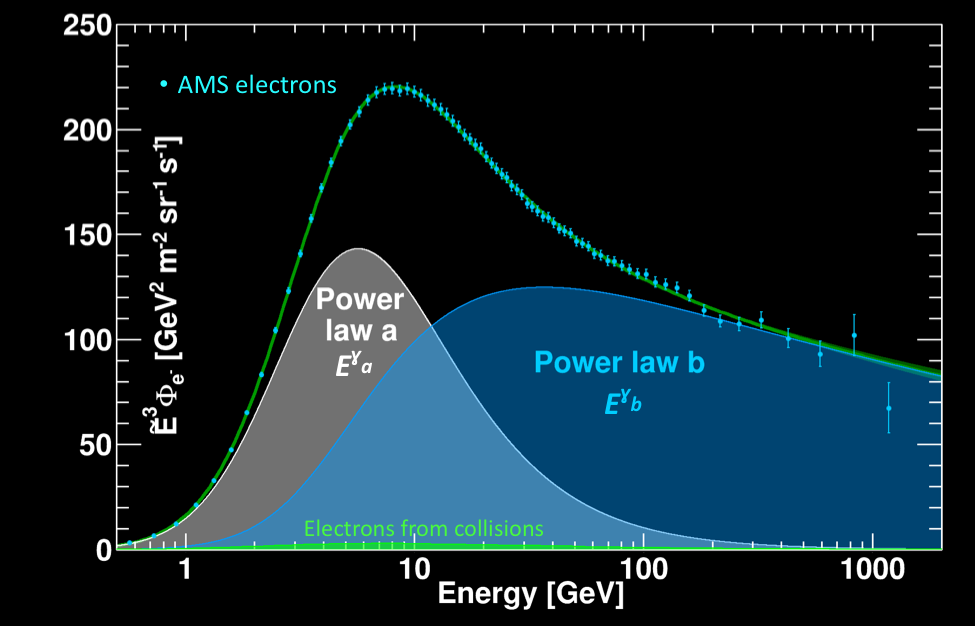
Thanks to the successful installation of the new AMS cooling system, the expected positron spectrum by 2028, in particular the high-energy data points, should enable an accurate comparison with dark-matter models (figure 3). High-energy (>TeV) events are also expected to provide insights into the origins of cosmic electrons, the latest results on which show that the electron flux exhibits a significant excess starting from 42 GeV.
Unlike the positron flux, which has an exponential energy cutoff at 810 GeV, the electron flux does not have a cutoff (at least not below 1.9 TeV). Also: in the entire energy range the electron flux is well described by the sum of two power law components (figure 4), providing “clear evidence”, says Ting, that most high energy electrons originate from different sources than high energy positrons.
Novelties in nuclei
Unexpected results continue to appear in data from cosmic nuclei, which make up the bulk of cosmic rays travelling through space. Helium, carbon and oxygen nuclei are thought to be mainly produced and accelerated in astrophysical sources and are known as primary cosmic rays, while lithium, beryllium and boron nuclei are produced by the collision of heavier nuclei with nuclei of the interstellar matter and are known as secondary cosmic rays.
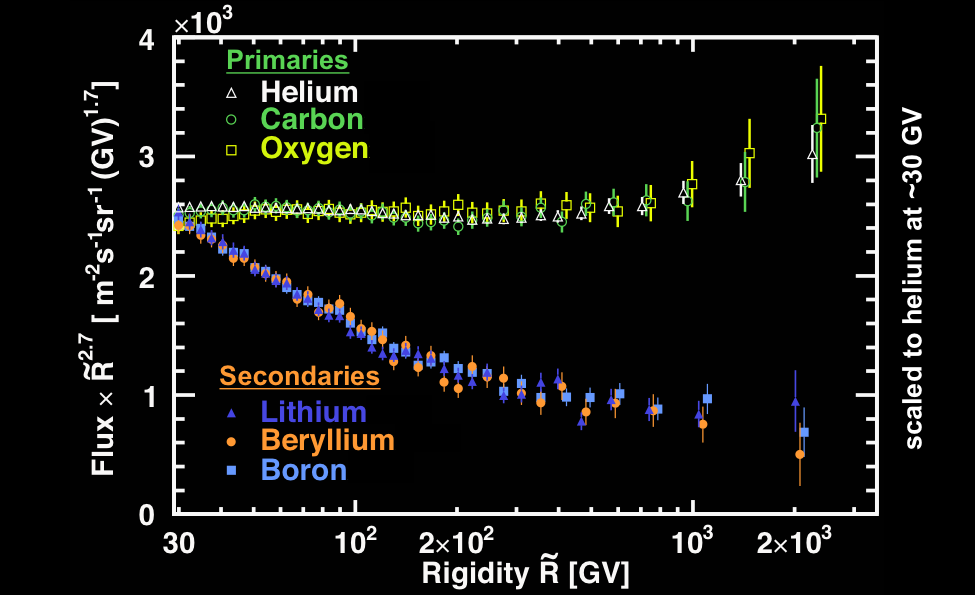
New properties of primary cosmic rays – helium, carbon and oxygen – have been observed in the rigidity range 2 GV to 3 TV; at high energies these three spectra also have identical rigidity dependence, all deviating from a single power law above 200 GV. Similar oddities have appeared in measurements of secondary cosmic rays – lithium, beryllium and boron – in the range 1.9 GV to 3.3 TV (figure 5). The lithium and boron fluxes have an identical rigidity dependence above 7 GV, all three fluxes have an identical rigidity dependence above 30 GV, and, unexpectedly, above 30 GV the Li/Be flux ratio is approximately equal to two.
The ratio of secondary fluxes to primary fluxes is particularly interesting because it directly measures the amount and properties of the interstellar medium. Before AMS, only the B/C ratio was measured and was assumed to be proportional to RΔ with Δ a constant for R > 60 GV. The latest AMS results on secondary (Li, Be, B) to primary (C, O) flux ratios show that Δ is not a constant, but changes by more than 5σ between the two rigidity ranges, 60 < R < 200 GV and 200 < R < 3300 GV. As with electron and positron fluxes, none of the current AMS results can be explained by existing theoretical models. By 2028, says Ting, AMS will extend its measurements of cosmic nuclei up to Z=30 (zinc) with sufficient statistics to get to the bottom of these and other mysteries. “We have measured many particles, electrons, positrons, antiprotons and many nuclei, and they all have distributions and none agree with current theoretical models. So we will begin to create a new field.”
Spin-orbit coupling causes fine structure in atomic physics and shell structure in nuclear physics, and is a key ingredient in the field of spintronics in materials sciences. It is also expected to affect the development of the quickly rotating quark–gluon plasma (QGP) created in non-central collisions of lead nuclei at LHC energies. As such plasmas are created by the collisions of lead nuclei that almost miss each other, they have very high angular momenta of the order of 107ħ – equivalent to the order of 1021 revolutions per second. While the extreme magnetic fields generated by spectating nucleons (of the order of 1014 T, CERN Courier Jan/Feb 2020 p17) quickly decay as the spectator nucleons pass by, the plasma’s angular momentum is sustained throughout the evolution of the system as it is a conserved quantity. These extreme angular momenta are expected to lead to spin-orbit interactions that polarise the quarks in the plasma along the direction of the angular momentum of the plasma’s rotation. This should in turn cause the spins of vector (spin-1) mesons to align if hadronisation proceeds via the recombination of partons or by fragmentation. To study this effect, the ALICE collaboration recently measured the spin alignment of the decay products of neutral K* and φ vector mesons produced in non-central Pb–Pb collisions.
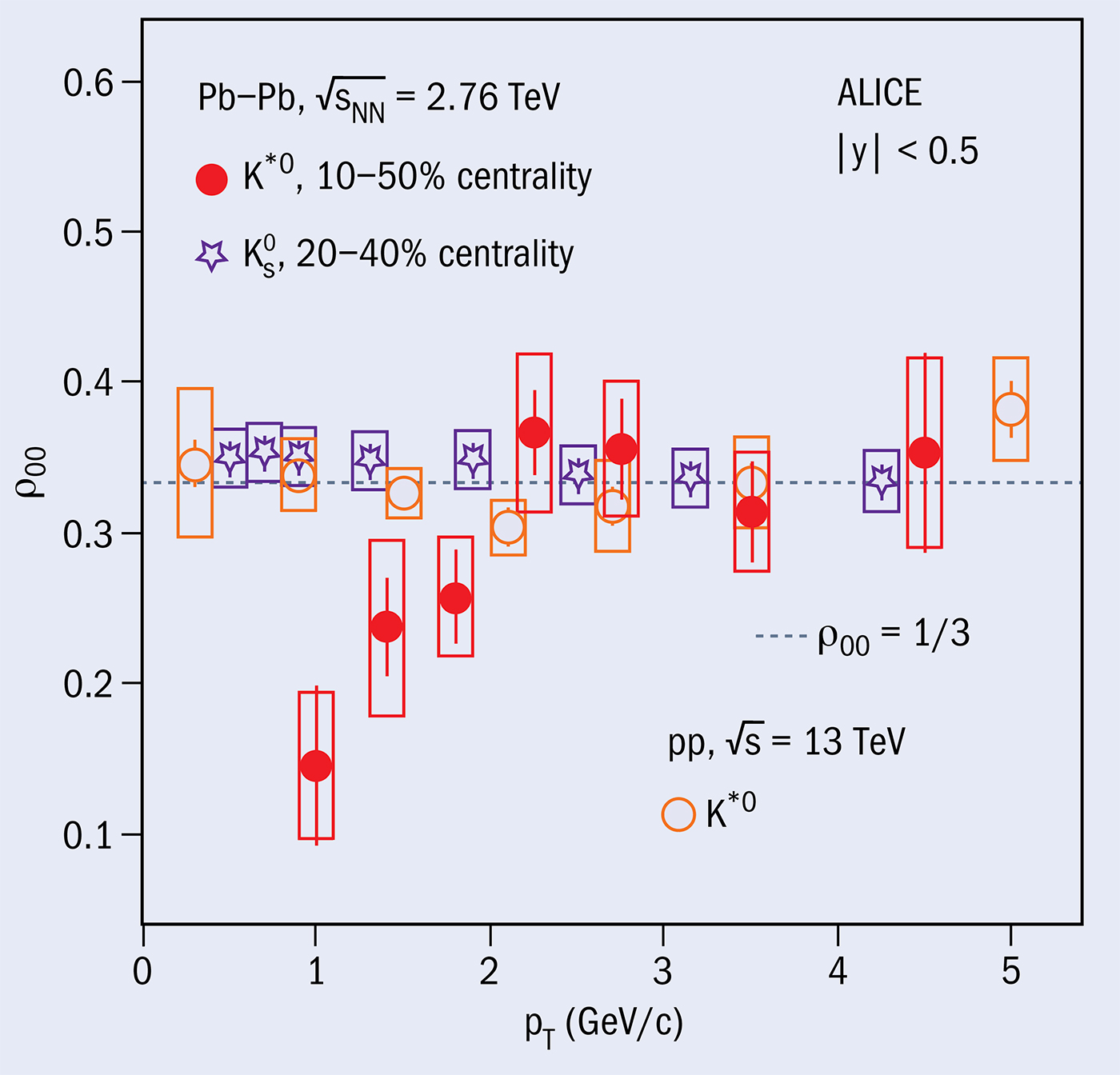
Spin alignment can be studied by measuring the angular distribution of the decay products of the vector mesons. It is quantified by the probability ρ00 of finding a vector meson in a spin state 0 with respect to the direction of the angular momentum of the rotating QGP, which is approximately perpendicular to the plane of the beam direction and the impact parameter of the two colliding nuclei. In the absence of spin-alignment effects, the probability of finding a vector meson in any of the three spin states (–1, 0, 1) should be equal, with ρ00 = 1/3.
The ALICE collaboration measured the angular distributions of neutral K* and φ vector mesons via their hadronic decays to Kπ and KK pairs, respectively. ρ00 was found to deviate from 1/3 for low-pT and mid-central collisions at a level of 3σ (figure 1). The corresponding results for φ mesons show a deviation of ρ00 values from 1/3 at a level of 2σ. The observed pT dependence of ρ00 is expected if quark polarisation via spin-orbit coupling is subsequently transferred to the vector mesons by hadronisation, via the recombination of a quark and an anti-quark from the quark–gluon plasma. The data are also consistent with the initial angular momentum of the hot and dense matter being highest for mid-central collisions and decreasing towards zero for central and peripheral collisions.
The results are surprising as studies with Λ hyperons are compatible with zero
The results are surprising, however, as corresponding quark-polarisation values obtained from studies with Λ hyperons are compatible with zero. A number of systematic tests have been carried out to verify these surprising results. K0S mesons do indeed yield ρ00 = 1/3, indicating no spin alignment, as must be true for a spin-zero particle. For proton–proton collisions, the absence of initial angular momentum also leads to ρ00 = 1/3, consistent with the observed neutral K* spin alignment being the result of spin-orbit coupling.
The present measurements are a step towards experimentally establishing possible spin-orbit interactions in the relativistic-QCD matter of the quark–gluon plasma. In the future, higher statistics measurements in Run 3 will significantly improve the precision, and studies with the charged K*, which has a magnetic moment seven times larger than neutral K*, may even allow a direct observation of the effect of the strong magnetic fields initially experienced by the quark–gluon plasma.
The 28th International Conference on Ultrarelativistic Nucleus-Nucleus Collisions, also known as “Quark Matter”, took place in Wuhan, China, in November. More than 800 participants discussed the latest results of the heavy-ion programmes at the Large Hadron Collider and at Brookhaven’s Relativistic Heavy-Ion Collider (RHIC), as well as the most recent theoretical developments. The focus of these studies is the fundamental understanding of strongly interacting matter at extremes of temperature and density. In these conditions, which also characterise the early universe, matter is a quark-gluon plasma (QGP), in which quarks and gluons are not confined within hadrons. In the recent editions of Quark Matter, much attention has also been devoted to the study of emergent QCD phenomena in high-multiplicity proton-proton and proton-nucleus collisions, which resemble the collective effects seen in nucleus-nucleus collisions and pose the intriguing question of whether a QGP can also form in “small-system” collisions.
The LHC and RHIC together cover a broad range of quark-gluon-plasma temperatures
The large data sample from the Pb-Pb period of LHC Run 2 in 2018 allowed ALICE, ATLAS, CMS and LHCb to study rare probes of the QGP, such as jets and heavy quarks, with unprecedented precision. New constraints on the energy loss of partons when traversing the high-density medium were presented, pushing the limits of jet measurements to lower transverse momenta and larger radii: jet modifications are now measured in the transverse momentum range from 40 to 1000 GeV/c and in the jet radius (resolution parameter) range 0.2 to 1. The internal structure of jets was studied not only by the LHC experiments, but also by the PHENIX and STAR collaborations at the 25-times lower RHIC collision energy. LHC and RHIC measurements are complementary as they cover a broad range of QGP temperatures and differ in the balance of quark- and gluon-initiated jets, with the former dominating at RHIC and the latter dominating at the LHC.
New probes
Measurements in the sectors of heavy quarks and rarely-produced light nuclei (such as deuterons, 3He and hypertriton, a pnΛ bound state) also strongly benefitted from the large recent samples recorded at the LHC. In particular, their degree of collective behaviour could be studied in much greater detail. The family of QGP probes in the heavy-quark sector has been extended with new members at the LHC by first observations of the X(3872) exotic hadron and of top-antitop quark production. In the sector of electromagnetic processes, new experimental observations were presented for the first time at the conference, including the photo-production of dileptons in collisions with and without hadronic overlap, and light-by-light scattering. These effects are induced by the interaction of the strong electromagnetic fields of the two Pb nuclei (Z=82) passing close to each other (CERN Courier January/February 2020, p17).
In nuclear collisions the fluid-dynamical flow of the QGP leaves an imprint in the azimuthal distribution of soft particles, as the initial geometry of the collision is translated to flow through pressure gradients. Its experimental trace is multi-particle angular correlations between low-momentum particles, even at large rapidity separations. In non-central nucleus-nucleus collisions that have an elliptical initial geometry, the resulting azimuthal modulation of particles momentum distribution is called elliptic flow. New information on collective behaviour and on the dynamics of heavy-quark interactions in the QGP was added by a first measurement of the D-meson momentum distribution down to zero momentum in Pb-Pb collisions at the LHC, and by new measurements of the elliptic flow of D mesons, muons from charm and beauty decays as well as bound states of heavy quarks (charmonia and bottomonia). These measurements suggest a stronger degree of collective behaviour for light than heavy quarks, and further constrain estimates of the QGP viscosity. Such estimates also require understanding of heavy-quark hadronisation, which was discussed in the light of new results at RHIC and the LHC which indicate an increased production of charmed baryons with respect to mesons, at low momentum in both pp and nucleus-nucleus collisions, when compared to expectations from electron-positron collisions.
The situation is much less clear in the collisions of small systems
While there is strong evidence for the production of QGP in nuclear collisions, the situation is much less clear in the collisions of small systems. The momentum correlations and azimuthal modulation that characterise the large nuclear collisions were also observed in smaller collision systems, such as p-Pb at the LHC, p-Au, d-Au and 3He-Au at RHIC, and even pp. The persistence of these correlations in smaller collision systems, down to pp collisions where it is unlikely that an equilibrated system could be created, may offer an inroad to understand how the collective behaviour of the QGP arises from the microscopic interaction of its individual constituents. New measurements on multi-particle correlations were presented and the dynamical origin of the collectivity in small systems was discussed. Small expanding QGP droplets, colour connections of overlapping QCD strings, and final-state rescattering at partonic or hadronic level are among the possible mechanisms that are proposed to describe these observations. While many signs characteristic of the QGP are seen in the small-system collisions, parton energy loss (in the form of jet or large-momentum hadron modifications) remains absent in the measurements carried out to date.
The future
Beyond Quark Matter 2019, the field is now looking forward to the future programmes at the LHC and at RHIC, which were extensively reviewed at the conference. At the LHC, the heavy-ion injectors and the experiments are currently being upgraded. In particular, the heavy-ion-dedicated ALICE detector is undergoing major improvements, with readout and tracker upgrades that will provide larger samples and better performance for heavy-flavour selection.Run 3 of the LHC, which is scheduled to start in 2021, will provide integrated luminosity increases ranging from one order of magnitude for the data samples based on rare triggers to two orders of magnitude for the minimum-bias (non-triggered) samples. At RHIC, the second beam-energy-scan programme is now providing the STAR experiment with higher precision data to search for the energy evolution of QGP effects, and the new sPHENIX experiment aims at improved measurements of jets and heavy quarks from 2023. Low-energy programmes at the CERN SPS, NICA, FAIR, HIAF and J-PARC, which target a systematic exploration of heavy-ion collisions with high baryon density to search for the onset of deconfinement and the predicted QCD critical point, were also discussed in Wuhan, and the updated plans for the US-based Electron-Ion Collider (EIC), which is foreseen to be constructed at Brookhaven National Laboratory, were presented. With ep and e-nucleus interactions, the EIC will provide unprecedented insights into the structure of the proton and the modification of parton densities in nuclei, which will benefit our understanding of the initial conditions for nucleus-nucleus collisions.
The LHCb collaboration has confirmed previous hints of odd behaviour in the way B mesons decay into a K*and a pair of muons, bringing fresh intrigue to the pattern of flavour anomalies that has emerged during the past few years. At a seminar at CERN on 10 March, Eluned Smith of RWTH Aachen University presented an updated analysis of the angular distributions of B0→K*0μ+μ– decays based on around twice as many events than were used for the collaboration’s previous measurement reported in 2015. The result reveals a mild increase in the overall tension with the Standard Model (SM) prediction, though, at 3.3σ, more data are needed to determine the source of the effect.
The B0→K*0μ+μ– decay is a promising system with which to explore physics beyond the SM. A flavour-changing neutral-current process, it involves a quark transition (b→s) which is forbidden at the lowest perturbative order in the SM, and therefore occurs only around once for every million B decays. The decay proceeds instead via higher-order penguin and box processes, which are sensitive to the presence of new, heavy particles. Such particles would enter in competing processes and could significantly change the B0→K*0μ+μ– decay rate and the angular distribution of its final-state particles. Measuring angular distributions as a function of the invariant mass squared (q2) of the muon pair is of particular interest because it is possible to construct variables that depend less on hadronic modelling uncertainties.
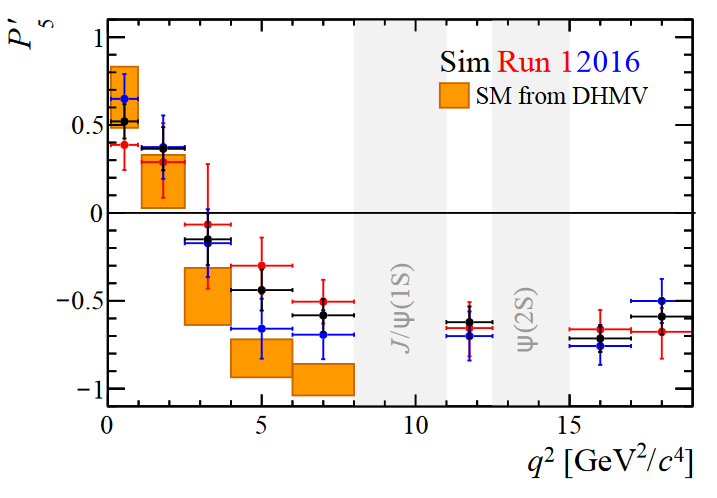
Potentially anomalous behaviour in an angular variable called P5′ came to light in 2013, when LHCb reported a 3.7σ local deviation with respect to the SM in one q2 bin, based on 1fb-1 of data. In 2015, a global fit of different angular distributions of the B0→K*0μ+μ– decays using the total Run 1 data sample of 3 fb-1 reaffirmed the puzzle, showing discrepancies of 3.4σ (later reduced to 3.0σ when using new theory calculations with an updated description of potentially large hadronic effects). In 2016, the Belle experiment at KEK in Japan performed its own angular analysis of B0→K*0μ+μ– using data from electron—positron collisions and found a 2.1σ deviation in the same direction and in the same q2 region as the LHCb anomaly.
We as a community have been eagerly waiting for this measurement and LHCb has not disappointed
Jure Zupan
The latest LHCb result includes additional Run 2 data collected during 2016, corresponding to a total integrated luminosity of 4.7fb-1. It shows that the local tension of P5′ in two q2 bins between 4 and 8 GeV2/c4 reduces from 2.8 and 3.0σ, as observed in the previous analysis, to 2.5 and 2.9σ. However, a global fit to several angular observables shows that the overall tension with the SM increases from 3.0 to 3.3σ. The results of the fit also find a better overall agreement with predictions of new-physics models that contain additional vector or axial-vector contributions. However, the collaboration also makes it clear that the discrepancy could be explained by an unexpectedly large hadronic effect that is not accounted for in the SM predictions.
“We as a community have been eagerly waiting for this measurement and LHCb has not disappointed,” says theorist Jure Zupan of the University of Cincinnati. “The new measurements have moved closer to the SM predictions in the angular observables so that the combined significance of the excess remained essentially the same. It is thus becoming even more important to understand well and scrutinise the SM predictions and the claimed theory errors.”
Flavour puzzle The latest result makes LHCb’s continued measurements of lepton-flavour universality even more important, he says. In recent years, LHCb has also found that the ratio of the rates of muonic and electronic B decays departs from the SM prediction, suggesting a violation of the key SM principle of lepton-flavour universality. Though not individually statistically significant, the measurements are theoretically very clean, and the most striking departure – in the variable known as RK — concerns B decays that proceed via the same b→s transition as B0→K*0μ+μ–. This has led physicists to speculate that the two effects could be caused by the same new physics, with models involving leptoquarks or new gauge bosons in principle able to accommodate both sets of anomalies.
An update on RK based on additional Run 2 data is hotly anticipated, and the collaboration is also planning to add data from 2017-18 to the B0→K*0μ+μ– angular analysis, as well as working on further analyses with b-quark transitions in mesons. LHCb also recently brought the decays of beauty baryons, which also depend on b→s transitions, to bear on the subject. Departures from the norm have also been spotted in B decays to D mesons, which involve tree-level b→c quark transitions. Such decays probe lepton-flavour universality via comparisons between tau leptons and muons and electrons but, as with RK, the individual measurements are not highly significant.
“We have not seen evidence of new physics, but neither were the B physics anomalies ruled out,” says Zupan of the LHCb result. “The wait for the clear evidence of new physics continues.”
The sixth Cosmology and the Quantum Vacuum conference attracted about 60 theoreticians to the Institute of Space Sciences in Barcelona from 5 to 7 March. This year the conference marked Spanish theorist Emilio Elizalde’s 70th birthday. He is a well known specialist in mathematical physics, field theory and gravity, with over 300 publications and three monographs on the Casimir effect and zeta regularisation. He has co-authored remarkable works on viable theories of modified gravity which unify inflation with dark energy.
These meetings bring together researchers who study theoretical cosmology and various aspects of the quantum vacuum such as the Casimir effect. This quantum effect manifests itself as an attractive force which appears between plates which are extremely close to each other. As it is related to the quantum vacuum, it is expected to be important in cosmology as well, giving a kind of effective induced cosmological constant. Manuel Asorey (Zaragoza), Mike Bordag (Leipzig) and Aram Saharian (Erevan) discussed various aspects of the Casimir effect for scalars and for gauge theories. Joseph Buchbinder gave a review of one-loop effective action in supersymmetric gauge theories. Conformal quantum gravity and quantum electrodynamics in de Sitter space were presented by Enrique Alvarez (Madrid) and Drazen Glavan (Brussels), respectively.
Enrique Gaztanaga argued for two early inflationary periods
Even more attention was paid to theoretical cosmology. The evolution of the early and/or late universe in different theories of modified gravity was discussed by several delegates, with Enrique Gaztanaga (Barcelona) expressing an interesting point of view on the inflationary universe, arguing for two early inflationary periods.
Martiros Khurshyadyan and I discussed modified-gravity cosmology with the unification of inflation and dark energy, and wormholes, building on work with Emilio Elizalde. Wormholes are usually related with exotic matter, however they may in alternative gravity be caused by modifications to the gravitational equations of motion. Iver Brevik (Trondheim) gave an excellent introduction to viscosity in cosmology. Rather exotic wormholes were presented by Sergey Sushkov (Kazan), while black holes in modified gravity were discussed by Gamal Nashed (Cairo). A fluid approach to the dark-energy epoch and the addition of four forms (antisymmetric tensor fields with four indices) to late universe evolution was given by Diego Saez (Vallodolid) and Mariam Bouhmadi-Lopez (Bilbao), respectively. Novel aspects of non-standard quintessential inflation were presented by Jaime Haro (Barcelona).
Many interesting talks were given by young participants at this meeting. The exchange of ideas between cosmologists on the one side and quantum-field-theory specialists on the other will surely help in the further development of rigorous approaches to the construction of quantum gravity. It also opens the window onto a much better account of quantum effects in the history of the universe.
Ten years have passed since the first high-energy proton–proton collisions took place at the Large Hadron Collider (LHC). Almost 20 more are foreseen for the completion of the full LHC programme. The data collected so far, from approximately 150 fb–1 of integrated luminosity over two runs (Run 1 at a centre-of-mass energy of 7 and 8 TeV, and Run 2 at 13 TeV), represent a mere 5% of the anticipated 3000 fb–1 that will eventually be recorded. But already their impact has been monumental.
Three major conclusions can be drawn frofm these first 10 years. First and foremost, Run 1 has shown that the Higgs boson – the previously missing, last ingredient of the Standard Model (SM) – exists. Secondly, the exploration of energy scales as high as several TeV has further consolidated the robustness of the SM, providing no compelling evidence for phenomena beyond the SM (BSM). Nevertheless, several discoveries of new phenomena within the SM have emerged, underscoring the power of the LHC to extend and deepen our understanding of the SM dynamics, and showing the unparalleled diversity of phenomena that the LHC can probe with unprecedented precision.
Exceeding expectations
Last but not least, we note that 10 years of LHC operations, data taking and data interpretation, have overwhelmingly surpassed all of our most optimistic expectations. The accelerator has delivered a larger than expected luminosity, and the experiments have been able to operate at the top of their ideal performance and efficiency. Computing, in particular via the Worldwide LHC Computing Grid, has been another crucial driver of the LHC’s success. Key ingredients of precision measurements, such as the determination of the LHC luminosity, or of detection efficiencies and of backgrounds using data-driven techniques beyond anyone’s expectations, have been obtained thanks to novel and powerful techniques. The LHC has also successfully provided a variety of beam and optics configurations, matching the needs of different experiments and supporting a broad research programme. In addition to the core high-energy goals of the ATLAS and CMS experiments, this has enabled new studies of flavour physics and of hadron spectroscopy, of forward-particle production and total hadronic cross sections. The operations with beams of heavy nuclei have reached a degree of virtuosity that made it possible to collide not only the anticipated lead beams, but also beams of xenon, as well as combined proton–lead, photon–lead and photon-photon collisions, opening the way to a new generation of studies of matter at high density.
Theoretical calculations have evolved in parallel to the experimental progress. Calculations that were deemed of impossible complexity before the start of the LHC have matured and become reality. Next-to-leading-order (NLO) theoretical predictions are routinely used by the experiments, thanks to a new generation of automatic tools. The next frontier, next-to-next-to-leading order (NNLO), has been attained for many important processes, reaching, in a few cases, the next-to-next-to-next-to-leading order (N3LO), and more is coming.
Aside from having made these first 10 years an unconditional success, all these ingredients are the premise for confident extrapolations of the physics reach of the LHC programme to come.
To date, more than 2700 peer-reviewed physics papers have been published by the seven running LHC experiments (ALICE, ATLAS, CMS, LHCb, LHCf, MoEDAL and TOTEM). Approximately 10% of these are related to the Higgs boson, and 30% to searches for BSM phenomena. The remaining 1600 or so report measurements of SM particles and interactions, enriching our knowledge of the proton structure and of the dynamics of strong interactions, of electroweak (EW) interactions, of flavour properties, and more. In most cases, the variety, depth and precision of these measurements surpass those obtained by previous experiments using dedicated facilities. The multi-purpose nature of the LHC complex is unique, and encompasses scores of independent research directions. Here it is only possible to highlight a fraction of the milestone results from the LHC’s expedition so far.
Entering the Higgs world
The discovery by ATLAS and CMS of a new scalar boson in July 2012, just two years into LHC physics operations, was a crowning early success. Not only did it mark the end of a decades-long search, but it opened a new vista of exploration. At the time of the discovery, very little was known about the properties and interactions of the new boson. Eight years on, the picture has come into much sharper focus.
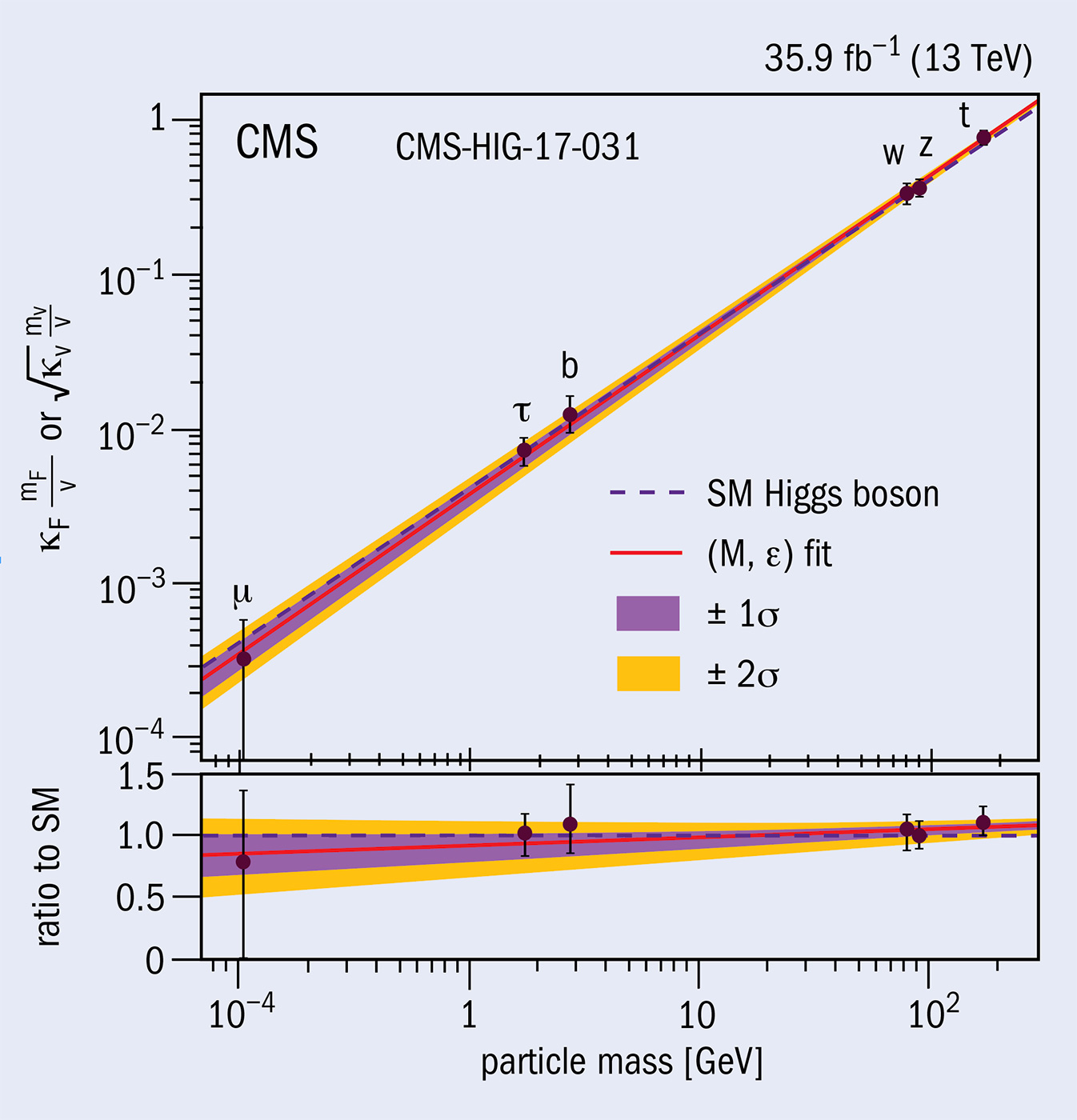
The structure of the Higgs-boson interactions revealed by the LHC experiments is still incomplete. Its couplings to the gauge bosons (W, Z, photon and gluons) and to the heavy third-generation fermions (bottom and top quarks, and tau leptons) have been detected, and the precision of these measurements is at best in the range of 5–10%. But the LHC findings so far have been key to establish that this new particle correctly embodies the main observational properties of the Higgs boson, as specified by the Brout–Englert–Guralnik–Hagen–Higgs–Kibble EW-symmetry breaking mechanism, referred hereafter as “BEH”, a cornerstone of the SM. To start with, the measured couplings to the W and Z bosons reflect the Higgs’ EW charges and are proportional to the W and Z masses, consistently with the properties of a scalar field breaking the SM EW symmetry. The mass dependence of the Higgs interactions with the SM fermions is confirmed by the recent ATLAS and CMS observations of the H → bb and H → ττ decays, and of the associated production of a Higgs boson together with a tt quark pair (see figure 1).
These measurements, which during Run 2 of the LHC have surpassed the five-sigma confidence level, provide the second critical confirmation that the Higgs fulfills the role envisaged by the BEH mechanism. The Higgs couplings to the photon and the gluon (g), which the LHC experiments have probed via the H → γγ decay and the gg → H production, provide a third, subtler test. These couplings arise from a combination of loop-level interactions with several SM particles, whose interplay could be modified by the presence of BSM particles, or interactions. The current agreement with data provides a strong validation of the SM scenario, while leaving open the possibility that small deviations could emerge from future higher statistics.
The process of firmly establishing the identification of the particle discovered in 2012 with the Higgs boson goes hand-in-hand with two research directions pioneered by the LHC: seeking the deep origin of the Higgs field and using the Higgs boson as a probe of BSM phenomena.
The breaking of the EW symmetry is a fact of nature, requiring the existence of a mechanism like BEH. But, if we aim beyond a merely anthropic justification for this mechanism (i.e. that, without it, physicists wouldn’t be here to ask why), there is no reason to assume that nature chose its minimal implementation, namely the SM Higgs field. In other words: where does the Higgs boson detected at the LHC come from? This summarises many questions raised by the possibility that the Higgs boson is not just “put in by hand” in the SM, but emerges from a larger sector of new particles, whose dynamics induces the breaking of the EW symmetry. Is the Higgs elementary, or a composite state resulting from new confining forces? What generates its mass and self-interaction? More generally, is the existence of the Higgs boson related to other mysteries, such as the origin of dark matter (DM), of neutrino masses or of flavour phenomena?
The Higgs boson is becoming an increasingly powerful exploratory tool to probe the origin of the Higgs itself
Ever since the Higgs-boson discovery, the LHC experiments have been searching for clues to address these questions, exploring a large number of observables. All of the dominant production channels (gg fusion, associated production with vector bosons and with top quarks, and vector-boson fusion) have been discovered, and decay rates to WW, ZZ, γγ, bb and ττ were measured. A theoretical framework (effective field theory, EFT) has been developed to interpret in a global fashion all these measurements, setting strong constraints on possible deviations from the SM. With the larger data set accumulated during Run 2, the production properties of the Higgs have been studied with greater detail, simultaneously testing the accuracy of theoretical calculations, and the resilience of SM predictions.
To explore the nature of the Higgs boson, what has not been seen as yet can be as important as what was seen. For example, lack of evidence for Higgs decays to the fermions of the first and second generation is consistent with the SM prediction that these should be very rare. The H → μμ decay rate is expected to be about 3 × 10⁻³ times smaller than that of H → ττ; the current sensitivity is two times below, and ATLAS and CMS hope to first observe this decay during the forthcoming Run 3, testing for the first time the couplings of the Higgs boson to second-generation fermions. The SM Higgs boson is expected to conserve flavour, making decays such as H → μτ, H → eτ or t → Hc too small to be seen. Their observation would be a major revolution in physics, but no evidence has shown up in the data so far. Decays of the Higgs to invisible particles could be a signal of DM candidates, and constraints set by the LHC experiments are complementary to those from standard DM searches. Several BSM theories predict the existence of heavy particles decaying to a Higgs boson. For example, heavy top partners, T, could decay as T → Ht, and heavy bosons X decay as X → HV (V = W, Z). Heavy scalar partners of the Higgs, such as charged Higgs states, are expected in theories such as supersymmetry. Extensive and thorough searches of all these phenomena have been carried out, setting strong constraints on SM extensions.
As the programme of characterising the Higgs properties continues, with new challenging goals such as the measurement of the Higgs self-coupling through the observation of Higgs pair production, the Higgs boson is becoming an increasingly powerful exploratory tool to probe the origin of the Higgs itself, as well as a variety of solutions to other mysteries of particle physics.
Interactions weak and strong
The vast majority of LHC processes are controlled by strong interactions, described by the quantum-chromodynamics (QCD) sector of the SM. The predictions of production rates for particles like the Higgs or gauge bosons, top quarks or BSM states, rely on our understanding of the proton structure, in particular of the energy distribution of its quark and gluon components (the parton distribution functions, PDFs). The evolution of the final states, the internal structure of the jets emerging from quark and gluons, the kinematical correlations between different objects, are all governed by QCD. LHC measurements have been critical, not only to consolidate our understanding of QCD in all its dynamical domains, but also to improve the precision of the theoretical interpretation of data, and to increase the sensitivity to new phenomena and to the production of BSM particles.
Collisions galore
Approximately 109 proton–proton (pp) collisions take place each second inside the LHC detectors. Most of them bear no obvious direct interest for the search of BSM phenomena, but even simple elastic collisions, pp → pp, which account for about 30% of this rate, have so far failed to be fully understood with first-principle QCD calculations. The ATLAS ALFA spectrometer and the TOTEM detector have studied these high-rate processes, measuring the total and elastic pp cross sections, at the various beam energies provided by the LHC. The energy dependence of the relation between the real and imaginary part of the pp forward scattering amplitude has revealed new features, possibly described by the exchange of the so-called odderon, a coherent state of three gluons predicted in the 1970s.
The structure of the final states in generic pp collisions, aside from defining the large background of particles that are superimposed on the rarer LHC processes, is of potential interest to understand cosmic-ray (CR) interactions in the atmosphere. The LHCf detector measured the forward production of the most energetic particles from the collision, those driving the development of the CR air showers. These data are a unique benchmark to tune the CR event generators, reducing the systematics in the determination of the nature of the highest-energy CR constituents (protons or heavy nuclei?), a step towards solving the puzzle of their origin.
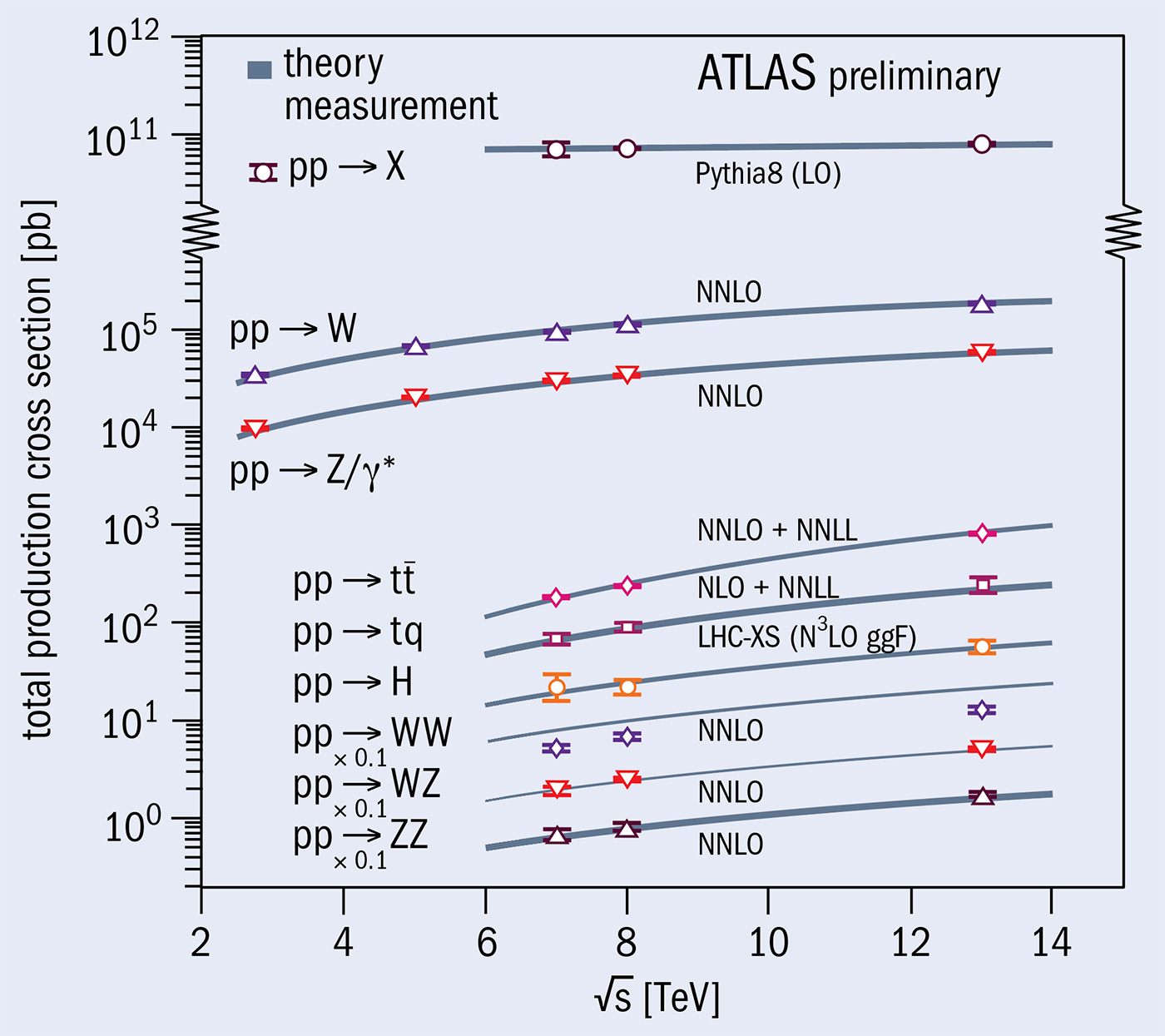
On the opposite end of the spectrum, rare events with dijet pairs of mass up to 9 TeV have been observed by ATLAS and CMS. The study of their angular distribution, a Rutherford-like scattering experiment, has confirmed the point-like nature of quarks, down to 10–18 cm. The overall set of production studies, including gauge bosons, jets and top quarks, underpins countless analyses. Huge samples of top quark pairs, produced at 15 Hz, enable the surgical scrutiny of this mysteriously heavy quark, through its production and decays. New reactions, unobservable before the LHC, were first detected. Gauge-boson scattering (e.g. W+ W+→ W+ W+), a key probe of electroweak symmetry breaking proposed in the 1970s, is just one example. By and large, all data show an extraordinary agreement with theoretical predictions resulting from decades of innovative work (figure 2). Global fits to these data refine the proton PDFs, improving the predictions for the production of Higgs bosons or BSM particles.
The cross sections σ of W and Z bosons provide the most precise QCD measurements, reaching a 2% systematic uncertainty, dominated by the luminosity uncertainty. Ratios such as σ(W+)/σ(W–) or σ(W)/σ(Z), and the shapes of differential distributions, are known to a few parts in 1000. These data challenge the theoretical calculations’ accuracy, and require caution to assess whether small discrepancies are due to PDF effects, new physics or yet imprecise QCD calculations.
Precision is the keystone to consolidate our description of nature
As already mentioned, the success of the LHC owes a lot to its variety of beam and experimental conditions. In this context, the data at the different centre-of-mass energies provided in the two runs are a huge bonus, since the theoretical prediction for the energy-dependence of rates can be used to improve the PDF extraction, or to assess possible BSM interpretations. The LHCb data, furthermore, cover a forward kinematical region complementary to that of ATLAS and CMS, adding precious information.
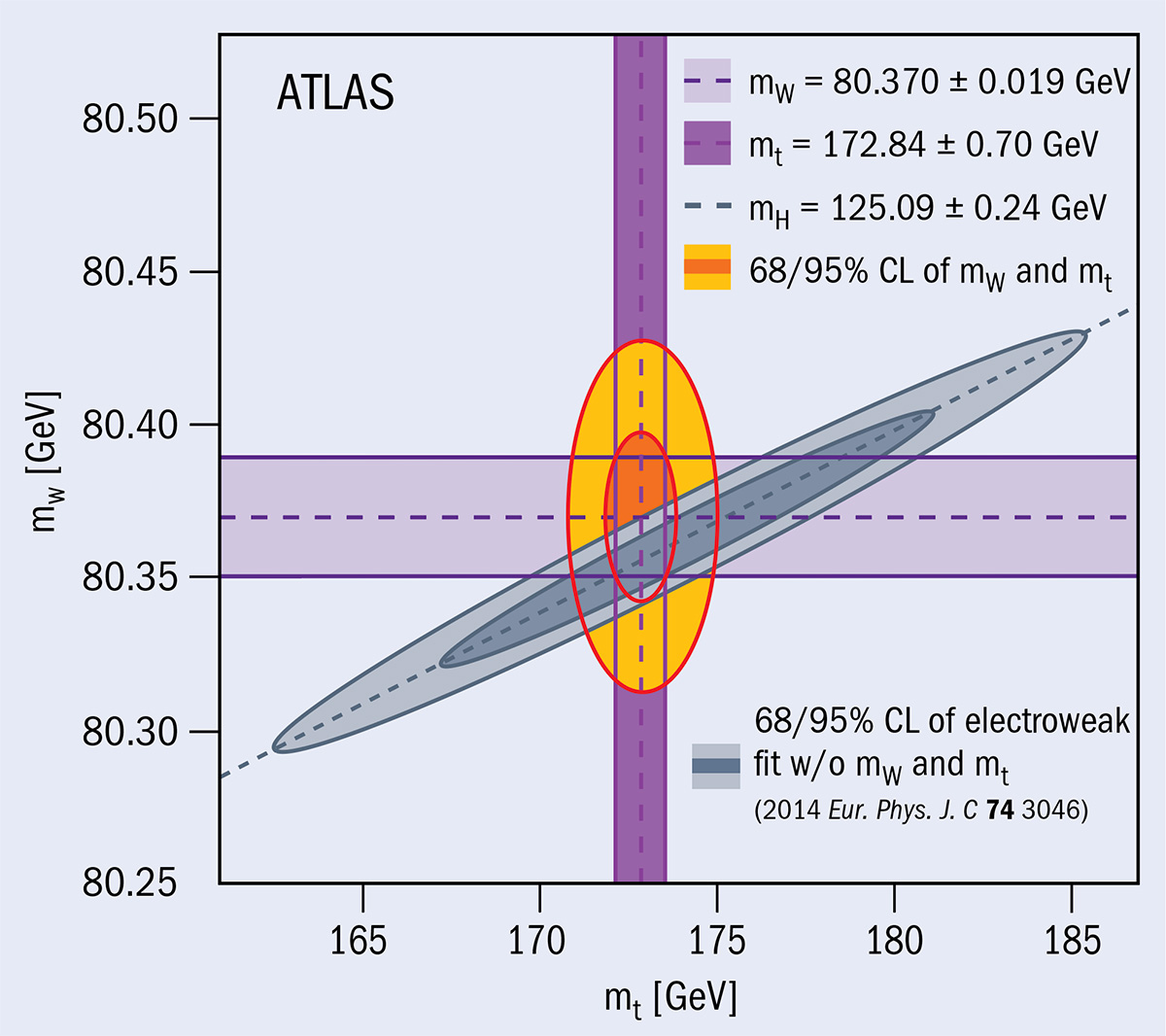
The precise determination of the W and Z production and decay kinematics has also allowed new measurements of fundamental parameters of the weak interaction: the W mass (mW) and the weak mixing angle (sinθW). The measurement of sinθW is now approaching the precision inherited from the LEP experiments and SLD, and will soon improve to shed light on the outstanding discrepancy between those two measurements. The mW precision obtained by the ATLAS experiment, ΔmW = 19 MeV, is the best worldwide, and further improvements are certain. The combination with the ATLAS and CMS measurements of the Higgs boson mass (ΔmH ≅ 200 MeV) and of the top quark mass (Δmtop ≲ 500 MeV), provides a strong validation of the SM predictions (see figure 3). For both mW and sinθW the limiting source of systematic uncertainty is the knowledge of the PDFs, which future data will improve, underscoring the profound interplay among the different components of the LHC programme.
QCD matters
The understanding of the forms and phases that QCD matter can acquire is a fascinating, broad and theoretically challenging research topic, which has witnessed great progress in recent years. Exotic multi-quark bound states, beyond the usual mesons (qq) and baryons (qqq), were initially discovered at e+e– colliders. The LHCb experiment, with its large rates of identified charm and bottom final states, is at the forefront of these studies, notably with the first discovery of heavy pentaquarks (qqqcc) and with discoveries of tetraquark candidates in the charm sector (qccq), accompanied by determinations of their quantum numbers and properties. These findings have opened a new playground for theoretical research, stimulating work in lattice QCD, and forcing a rethinking of established lore.
The study of QCD matter at high density is the core task of the heavy-ion programme. While initially tailored to the ALICE experiment, all active LHC experiments have since joined the effort. The creation of a quark–gluon plasma (QGP) led to astonishing visual evidence for jet quenching, with 1 TeV jets shattered into fragments as they struggle their way out of the dense QGP volume. The thermodynamics and fluctuations of the QGP have been probed in multiple ways, indicating that the QGP behaves as an almost perfect fluid, the least viscous fluid known in nature. The ability to explore the plasma interactions of charm and bottom quarks is a unique asset of the LHC, thanks to the large production rates, which unveiled new phenomena such asthe recombination of charm quarks, and the sequential melting of bb bound states.
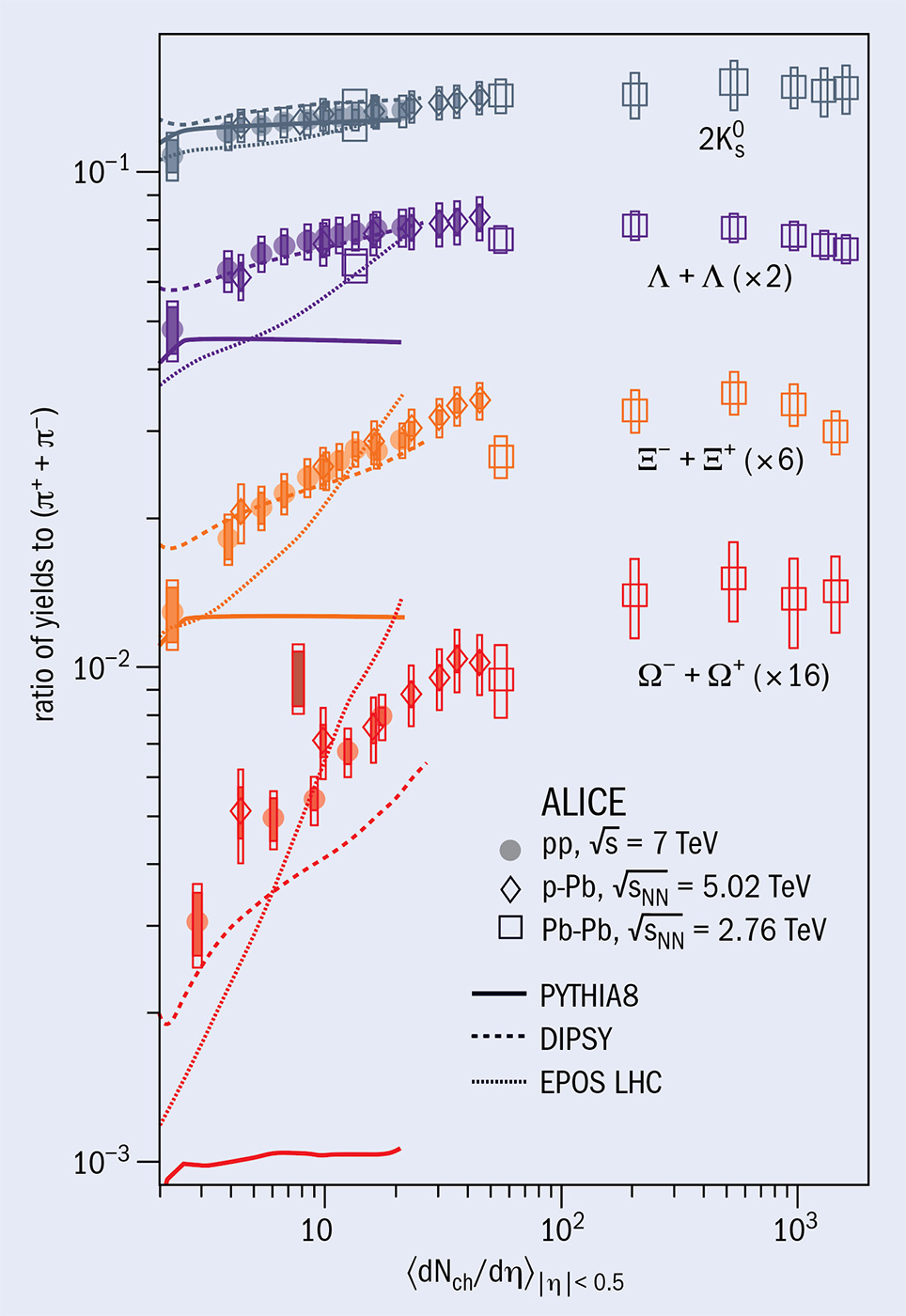
While several of the qualitative features of high-density QCD were anticipated, the quantitative accuracy, multitude and range of the LHC measurements have no match. Examples include ALICE’s precise determination of dynamical parameters such as the QGP shear-viscosity-to-entropy-density ratio, or the higher harmonics of particles’ azimuthal correlations. A revolution ensued in the sophistication of the required theoretical modelling. Unexpected surprises were also discovered, particularly in the comparison of high-density states in PbPb collisions with those occasionally generated by smaller systems such as pp and pPb. The presence in the latter of long-range correlations, various collective phenomena and an increased strange baryon abundance (figure 4), resemble behaviour typical of the QGP. Their deep origin is a mysterious property of QCD, still lacking an explanation. The number of new challenging questions raised by the LHC data is almost as large as the number of new answers obtained!
Flavour physics
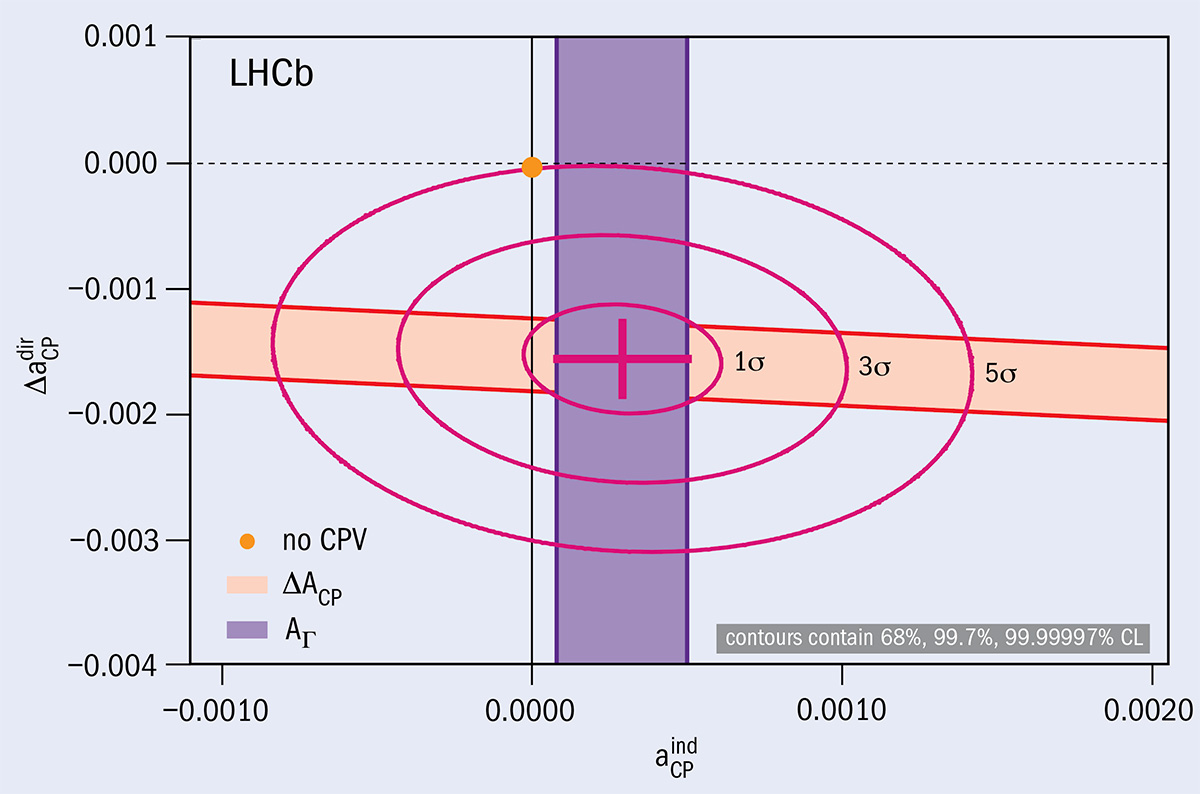
Understanding the structure and the origin of flavour phenomena in the quark sector is one of the big open challenges of particle physics. The search for new sources of CP violation, beyond those present in the CKM mixing matrix, underlies the efforts to explain the baryon asymmetry of the universe. In addition to flavour studies with Higgs bosons and top quarks, more than 1014 charm and bottom quarks have been produced so far by the LHC, and the recorded subset has led to landmark discoveries and measurements. The rare Bs→ μμ decay, with a minuscule rate of approximately 3 × 10⁻⁹, has been discovered by the LHCb, CMS and ATLAS experiments. The rarer Bd→ μμ decay is still unobserved, but its expected ~10–10 rate is within reach. These two results alone had a big impact on constraining the parameter space of several BSM theories, notably supersymmetry, and their precision and BSM sensitivity will continue improving. LHCb has discovered DD mixing and the long-elusive CP violation in D-meson decays, a first for up-type quarks (figure 5). Large hadronic non-perturbative uncertainties make the interpretation of these results particularly challenging, leaving under debate whether the measured properties are consistent with the SM, or signal new physics. But the experimental findings are a textbook milestone in the worldwide flavour physics programme.
LHCb produced hundreds more measurements of heavy-hadron properties and flavour-mixing parameters. Examples include the most precise measurement of the CKM angle γ = (74.0+5.0–5.8)oand, with ATLAS and CMS, the first measurement of φs, the tiny CP-violation phase of Bs → J/ψϕ, whose precisely predicted SM value is very sensitive to new physics. With a few notable exceptions, all results confirm the CKM picture of flavour phenomena. Those exceptions, however, underscore the power of LHC data to expose new unexpected phenomena: B → D(*) ℓν (ℓ = μ,τ) and B → K(*)ℓ+ℓ– (ℓ = e,μ) decays hint at possible deviations from the expected lepton flavour universality. The community is eagerly waiting for further developments.
Beyond the Standard Model
Years of model building, stimulated before and after the LHC start-up by the conceptual and experimental shortcomings of the SM (e.g. the hierarchy problem and the existence of DM), have generated scores of BSM scenarios to be tested by the LHC. Evidence has so far escaped hundreds of dedicated searches, setting limits on new particles up to several TeV (figure 6). Nevertheless, much was learned. While none of the proposed BSM scenarios can be conclusively ruled out, for many of them survival is only guaranteed at the cost of greater fine-tuning of the parameters, reducing their appeal. In turn, this led to rethinking the principles that implicitly guided model building. Simplicity, or the ability to explain at once several open problems, have lost some drive. The simplest realisations of BSM models relying on supersymmetry, for example, were candidates to at once solve the hierarchy problem, provide DM candidates and set the stage for the grand unification of all forces. If true, the LHC should have piled up evidence by now. Supersymmetry remains a preferred candidate to achieve that, but at the price of more Byzantine constructions. Solving the hierarchy problem remains the outstanding theoretical challenge. New ideas have come to the forefront, ranging from the Higgs potential being determined by the early-universe evolution of an axion field, to dark sectors connected to the SM via a Higgs portal. These latter scenarios could also provide DM candidates alternative to the weakly-interacting massive particles, which so far have eluded searches at the LHC and elsewhere.
With such rapid evolution of theoretical ideas taking place as the LHC data runs progressed, the experimental analyses underwent a major shift, relying on “simplified models”: a novel model-independent way to represent the results of searches, allowing published results to be later reinterpreted in view of new BSM models. This amplified the impact of experimental searches, with a surge of phenomenological activity and the proliferation of new ideas. The cooperation and synergy between experiments and theorists have never been so intense.
Having explored the more obvious search channels, the LHC experiments refocused on more elusive signatures. Great efforts are now invested in searching corners of parameter space, extracting possible subtle signals from large backgrounds, thanks to data-driven techniques, and to the more reliable theoretical modelling that has emerged from new calculations and many SM measurements. The possible existence of new long-lived particles opened a new frontier of search techniques and of BSM models, triggering proposals for new dedicated detectors (Mathusla, CODEX-b and FASER, the last of which was recently approved for construction and operation in Run 3). Exotic BSM states, like the milli-charged particles present in some theories of dark sectors, could be revealed by MilliQan, a recently proposed detector. Highly ionising particles, like the esoteric magnetic monopoles, have been searched for by the MoEDAL detector, which places plastic tracking films cleverly in the LHCb detector hall.
While new physics is still eluding the LHC, the immense progress of the past 10 years has changed forever our perspective on searches and on BSM model building.
Final considerations
Most of the results only parenthetically cited, like the precision on the mass of the top quark, and others not even quoted, are the outcome of hundreds of years of person-power work, and would have certainly deserved more attention here. Their intrinsic value goes well beyond what was outlined, and they will remain long-lasting textbook material, until future work at the LHC and beyond improves them.
Theoretical progress has played a key role in the LHC’s progress, enhancing the scope and reliability of the data interpretation. Further to the developments already mentioned, a deeper understanding of jet structure has spawned techniques to tag high-pT gauge and Higgs bosons, or top quarks, now indispensable in many BSM searches. Innovative machine-learning ideas have become powerful and ubiquitous. This article has concentrated only on what has already been achieved, but the LHC and its experiments have a long journey of exploration ahead.
The terms precision and discovery, applied to concrete results rather than projections, well characterise the LHC 10-year legacy. Precision is the keystone to consolidate our description of nature, increase the sensitivity to SM deviations, give credibility to discovery claims, and to constrain models when evaluating different microscopic origins of possible anomalies. The LHC has already fully succeeded in these goals. The LHC has also proven to be a discovery machine, and in a context broader than just Higgs and BSM phenomena. Altogether, it delivered results that could not have been obtained otherwise, immensely enriching our understanding of nature.
Fast radio bursts (FRBs) are a relatively new mystery within astrophysics. Around 100 of these intense few-millisecond bursts of radio waves have been spotted since the first detection in 2007, and hardly anything is known about their origin. Thanks to close collaboration between different radio facilities and lessons learned from the study of previous astrophysical mysteries such as quasars, our understanding of these phenomena is evolving rapidly. During the past year or so, several FRBs have been localised in different galaxies, strongly suggesting that they are extra-galactic. A newly published FRB measurement, however, casts doubts about their underlying origin.
As recently as one year ago, only a few tens of FRBs had been measured. One of these FRBs was of particular interest because, unlike the single-event nature of all other known FRBs, it produced several radio signals within a short time scale – earning it the nickname “the repeater”. This could imply that while all other FRBs were a result of some type of cataclysmic event, the repeater was an altogether different source which just happened to produce a similar signal. Adding to the intrigue, measurements also showed it to be in a rather peculiar high-metallicity dwarf galaxy close to the supermassive black hole within this host galaxy.
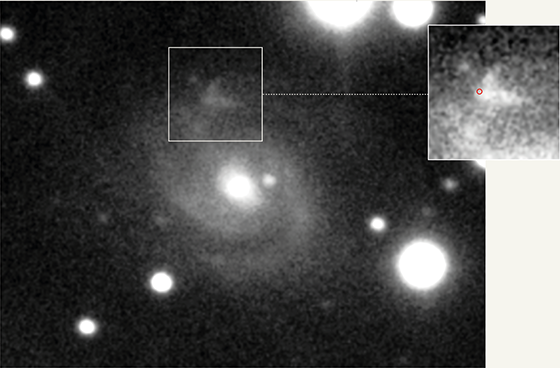
Much has happened in the field of FRBs since then, mainly thanks to data from new facilities such as ASKAP in Australia, CHIME in Canada (pictured above), and FAST in China. A number of new FRBs have been detected including nine more repeaters. Additionally, the new range of facilities has allowed for more detailed location measurements, including some for non-repeating FRBs which are more challenging due to their unpredictable occurrence. Since non-repeating bursts were found to be in more conventional galaxies than that of the repeater, a fully different origin of the two types of FRBs seemed the more likely explanation.
The latest localisation measurement of an FRB, using data from CHIME and subsequent triangulation via eight radio telescopes from the European VLBI network, throws this theory into question. Writing in Nature, the international team found that another repeater was not only the closest FRB found to date (at a distance of 500 million light years), it was found in a star-forming region of a galaxy not that different from the Milky Way and therefore very different from the other localised repeating FRB. This precise localisation measurement, which allowed astronomers to pinpoint the location within an area just seven light years across, indicates that extreme environments are not required for repeater FRBs. Additionally, some of the repeated signals from this source were not strong enough to have come from any of the non-repeating FRBs as these are all at a larger distance. The latter finding casts doubt on the idea of two distinct classes of FRBs as the non-repeaters could just simply be too far away for some of their signal to reach us.
Although these latest findings give new insights in the quickly evolving field of FRBs it is clear that more measurements are required. The new radio facilities will soon make populations studies possible. Such populations studies have previously answered many questions for the fields of gamma-ray burst and quasars which in their early stages showed large similarities with the state in which FRB studies are now. Such studies could show if one of the two vastly differing environments in the two repeaters are found is simply a peculiarity or if FRBs can be produced in a range of different environments. Additionally, studies of the burst intensities and the distances of their origin will be able to prove if repeaters and non-repeaters are only different because of their distance.
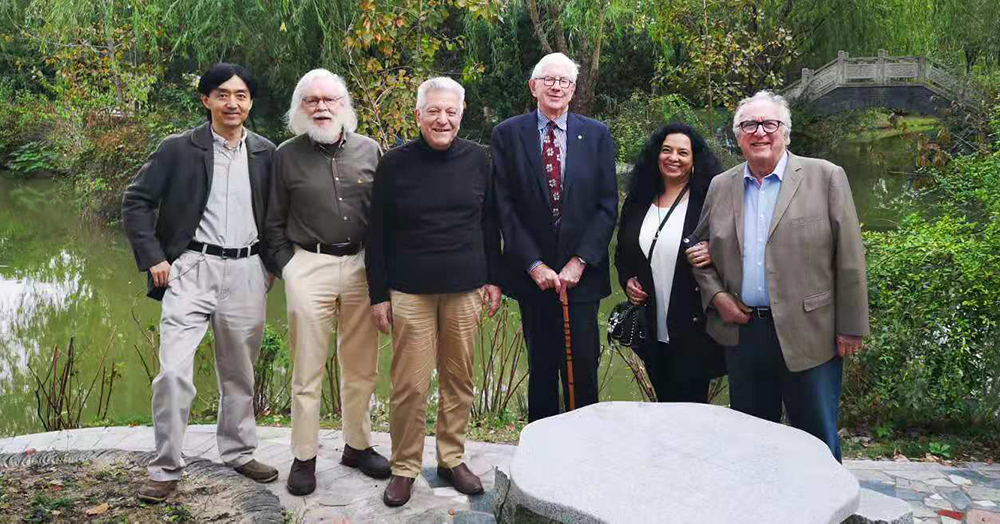
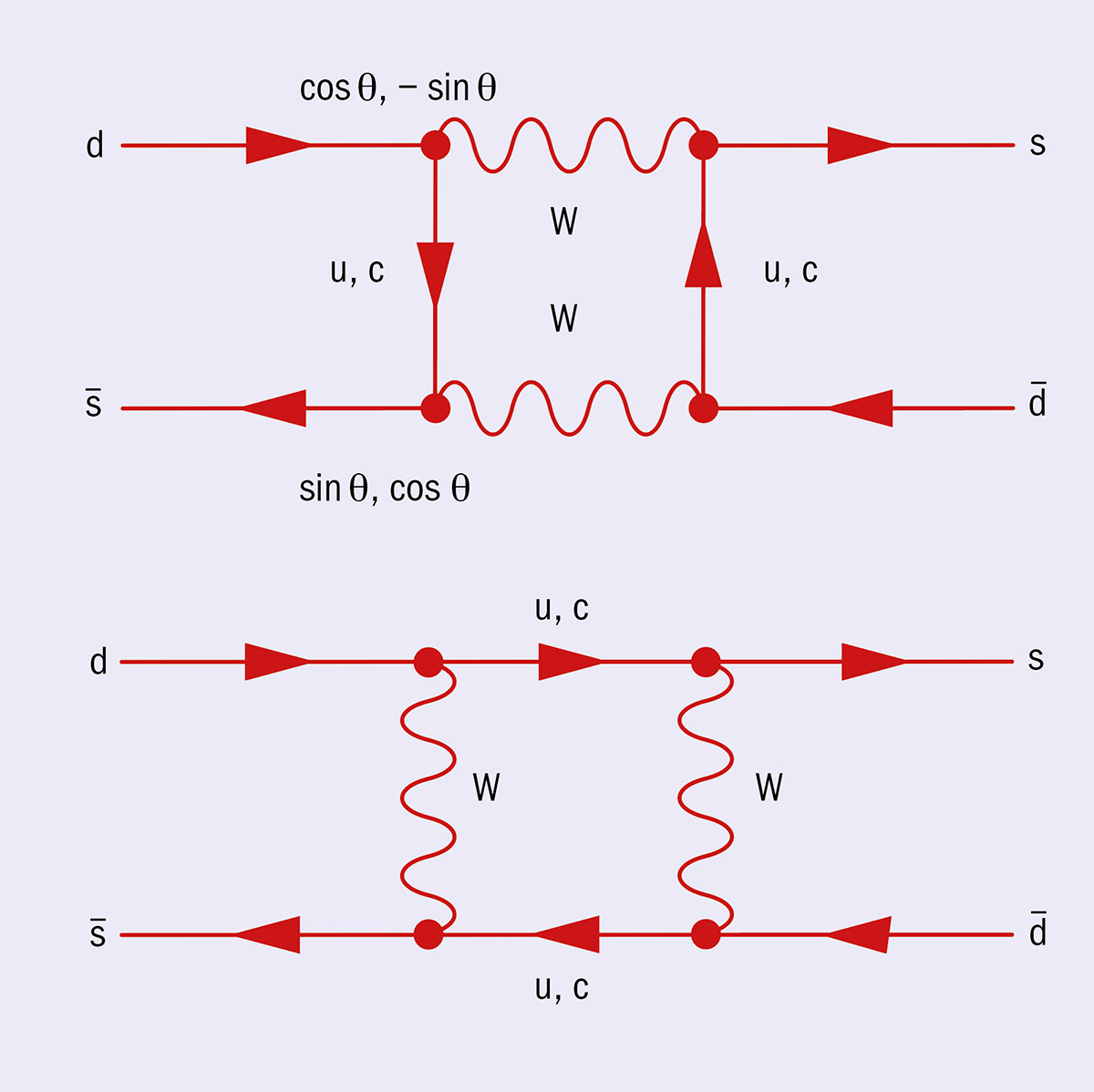
In 1969 many weak amplitudes could be accurately calculated with a model of just three quarks, and Fermi’s constant and the Cabibbo angle to couple them. One exception was the remarkable suppression of strangeness-changing neutral currents. John Iliopoulos, Sheldon Lee Glashow and Luciano Maiani boldly solved the mystery using loop diagrams featuring the recently hypothesised charm quark, making its existence a solid prediction in the process. To celebrate the fiftieth anniversary of their insight, the trio were guests of honour at an international symposium at the T. D. Lee Institute at Shanghai Jiao Tong University on 29 October, 2019.
The UV cutoff needed in the three-quark theory became an estimate of the mass of the fourth quark
The Glashow-Iliopoulos-Maiani (GIM) mechanism was conceived in 1969, submitted to Physical Review D on 5 March 1970, and published on 1 October of that year, after several developments had defined a conceptual framework for electroweak unification. These included Yang-Mills theory, the universal V−A weak interaction, Schwinger’s suggestion of electroweak unification, Glashow’s definition of the electroweak group SU(2)L×U(1)Y, Cabibbo’s theory of semileptonic hadron decays and the formulation of the leptonic electroweak gauge theory by Weinberg and Salam, with spontaneous symmetry breaking induced by the vacuum expectation value of new scalar fields. The GIM mechanism then called for a fourth quark, charm, in addition to the three introduced by Gell-Mann, such that the first two blocks of the electroweak theory are made each by one lepton and one quark doublet, [(νe, e), (u, d)] and [(νµ, µ), (c, s)]. Quarks u and c are coupled by the weak interaction to two superpositions of the quarks d and s: u ↔ dC , with dC the Cabibbo combination dC = cos θC d + sin θC s, and c ↔ sC , with sC the orthogonal combination. In subsequent years, a third generation, [(ντ, τ ), (t, b)] was predicted to describe CP violation. No further generations have been observed yet.
Problem solved
The GIM mechanism was the solution to a problem arising in the simplest weak interaction theory with one charged vector boson coupled to the Cabibbo currents. As pointed out in 1968, strangeness-changing neutral-current processes, such as KL → µ+µ− and K0 – K0 mixing, are generated at one loop with amplitudes of order G sinθC cosθC (GΛ2), where G is the Fermi constant, Λ is an ultraviolet cutoff, and GΛ2 (dimensionless) is the first term in a perturbative expansion which could be continued to take higher order diagrams into account. To comply with the strict limits existing at the time, one had to require a surprisingly small value of the cutoff, Λ, of 2 − 3 GeV, to be compared with the naturally expected value: Λ = G-1/2 ~ 300 GeV. This problem was taken seriously by the GIM authors, who wrote that “it appears necessary to depart from the original phenomenological model of weak interactions”.
To sidestep this problem, Glashow, Iliopoulos and Maiani brought in the fourth “charm” quark, already introduced by Bjorken, Glashow and others, with its typical coupling to the quark combination left alone in the Cabibbo theory: c ↔ sC = − sinθC d + cosθC s. Amplitudes for s → d with u or c on the same fermion line would cancel exactly for mc = mu, suggesting a more natural means to suppress strangeness-changing neutral-current processes to measured levels. For mc >> mu, a residual neutral-current effect would remain, which, by inspection, and for dimensional reasons, is of order G sinθC cos θC (Gmc2). This was a real surprise: the “small” UV cutoff needed in the simple three-quark theory became an estimate of the mass of the fourth quark, which was indeed sufficiently large to have escaped detection in the unsuccessful searches for charmed mesons that had been conducted in 1960s. With the two quark doublets included, a detailed study of strangeness changing neutral current processes gave mc ∼ 1.5 GeV, a value consistent with more recent data on the masses of charmed mesons and baryons. Another aspect of the GIM cancellation is that the weak charged currents make an SU(2) algebra together with a neutral component that has no strangeness changing terms. Thus, there is no difficulty to include the two quark doublets in the unified electroweak group SU(2)L×U(1)Y of Glashow, Weinberg and Salam. The 1970 GIM paper noted that “in contradistinction to the conventional (three-quark) model, the couplings of the neutral intermediary – now hypercharge conserving – cause no embarrassment.”
The GIM mechanism has become a cornerstone of the Standard Model and it gives a precise description of the observed flavour changing neutral current processes for s and b quarks. For this reason, flavour-changing neutral currents are still an important benchmark and give strong constraints on theories that go beyond the Standard Model in the TeV region.
Despite the thick haze of bushfire smoke hanging over the skyline, 200 delegates gathered in Sydney from 2 to 6 December for the 14th edition of the TeV Particle-Astrophysics conference (TeVPA), to discuss the status and future of astroparticle physics.
The week began with a varied series of talks on dark matter. Luca Grandi (Chicago) and Tom Thorpe (LNGS) updated delegates on progress towards the next generation of xenon and argon-based experiments: these massive underground detectors are now approaching total masses in the multiton-scale. Experiments like XENON, LZ and DarkSide are poised to be so sensitive to rare signals that they will even able to detect coherent elastic neutrino-nucleus scattering – the ultimate background to direct dark-matter searches. Meanwhile, Greg Lane (Australian National University) brought us news of exciting developments in Australian dark-matter research. The Stawell Underground Laboratory—the first deep underground site in the southern hemisphere—will host part of the SABRE experiment, which aims to test the annually modulating event rate seen by the DAMA experiment. This highly controversial, dark-matter-like signal has been observed for two decades by DAMA, but remains in irreconcilable tension with null results from many other experiments. Excavation at Stawell is underway as of October last year. The site will form a central component of the Centre of Excellence for Dark Matter Particle Physics, recently awarded by the Australian Research Council.
Galaxies can be used as laboratories for particle physics
Eminent astrophysicist Joe Silk (IAP) reviewed the many ways in which galaxies can be used as laboratories for particle physics. One of the most persistent hints of dark-matter particle interactions in astrophysical data is the notorious excess of GeV gamma rays coming from the galactic centre. Recent analyses of the excess using improved statistical techniques and better models for the Milky Way’s central bulge were detailed by Shunsaku Horiuchi (Virginia Tech). While dark-matter-related explanations remain tempting, there is growing evidence in support of millisecond pulsars being responsible, given the spatial morphology of the excess. Francesca Calore (LAPTh) told us that multi-wavelength probes of the excess will be possible in the near-future, and may finally allow us to conclusively determine the origin of the signal.
Probing the cosmos
Delegates enjoyed a stirring series of talks on the ever-increasing number of probes of cosmology. Following a review of the post-Planck status of cosmology by Jan Hamaan (UNSW), Xuelei Chen (CAS) explained how the unique 21 cm radio line can be used to map neutral hydrogen throughout the universe and across cosmic time. A host of upcoming ground and space-based experiments attempting to observe the sky-averaged 21 cm line will hopefully allow us to peer back to the birth of the first stars at “cosmic dawn”. We also heard from Yvonne Wong (UNSW) about how cosmological data can be used as a test of neutrino physics and how neutrino physics may in turn be a means to alleviate tensions between cosmological datasets. For example, strong self-interactions between neutrinos could bring the two increasingly divergent measurements of the Hubble constant, from the cosmic microwave background and type-1a supernovae respectively, into agreement.
The 21 cm radio line can be used to map neutral hydrogen throughout the universe and across cosmic time
Much of the week’s schedule was devoted to cosmic-ray research, gamma rays and indirect searches for dark matter. The antimatter cosmic-ray detector AMS, mounted on the International Space Station, is making measurements of cosmic-ray spectra to within 1% accuracy. Weiwei Xu (Shandong) summarised an impressive array of physics results made over almost a decade by AMS, including the most recent measurement of the positron flux, which has a clear high-energy component with a well-defined cutoff at 810 GeV – just as expected for galactic dark-matter annihilations. As with the GeV gamma-ray excess, however, pulsars represent a possible natural astrophysical explanation. The mystery could be resolved by the fact that, unlike pulsars, dark-matter annihilations are expected to produce antiprotons. While current antiproton data show a tantalisingly similar trend to the positron spectrum, more data is needed to identify the origin of the high-energy positrons. Many ongoing and upcoming observatories in the fields of cosmic-ray and gamma-ray research were also introduced to us, such as DAMPE (Jingjing Zang, CAS), the Cherenkov Telescope Array (Roberta Zanin, CTAO), the Pierre Auger Observatory (Bruce Dawson, U. Adelaide) and LHAASO (Zhen Cao, CAS). We are entering an exciting time when many of the enticing but ambiguous anomalies in cosmic-ray spectra will be definitively tested, potentially identifying a signal of dark matter in the process.
Gamma ray bursts (GRBs) generated much enthusiasm this year, with Edna Ruiz-Velasco (MPIK) and Elena Moretti (IFAF) talking about brand new observations of GRBs from the H.E.S.S. and MAGIC collaborations, including the first detection of a GRB afterglow at very high energies (>100 GeV), by H.E.S.S. These observations have helped resolve long-standing mysteries surrounding the complex array of processes that are needed to produce the phenomenal energies of GRB emission. An important contribution is now known to be “synchrotron self-Compton” – emission in which a synchrotron photon generated from an electron spiralling around a magnetic field line is Compton up-scattered by the same electron that produced it.
Many well-motivated theories of modified gravity are now finding little room to hide
Finally, the subject of gravitational waves continues to surge in popularity within this community. We were first given a summary by Susan Scott (Australian National University) of over 50 confirmed gravitational-wave discoveries made by Advanced LIGO and Advanced Virgo to date, and from Tara Murphy (Sydney), about the intense work involved in rapidly following-up luminous gravitational-wave events with radio observations. LIGO’s discoveries of neutron-star and black-hole mergers are a window into the one of the strongest regimes of gravity we have ever been able to see. With general relativity still holding up as robustly as ever, many well-motivated theories of modified gravity are now finding little room to hide.
The next TeVPA will take place in late October 2020 in Chengdu, China.
To provide the best experiences, we use technologies like cookies to store and/or access device information. Consenting to these technologies will allow us to process data such as browsing behavior or unique IDs on this site. Not consenting or withdrawing consent, may adversely affect certain features and functions.
Functional
Always active
The technical storage or access is strictly necessary for the legitimate purpose of enabling the use of a specific service explicitly requested by the subscriber or user, or for the sole purpose of carrying out the transmission of a communication over an electronic communications network.
Preferences
The technical storage or access is necessary for the legitimate purpose of storing preferences that are not requested by the subscriber or user.
Statistics
The technical storage or access that is used exclusively for statistical purposes.The technical storage or access that is used exclusively for anonymous statistical purposes. Without a subpoena, voluntary compliance on the part of your Internet Service Provider, or additional records from a third party, information stored or retrieved for this purpose alone cannot usually be used to identify you.
Marketing
The technical storage or access is required to create user profiles to send advertising, or to track the user on a website or across several websites for similar marketing purposes.