This year, SLAC celebrates its remarkable past while continuing its quest for a bright future. This presentation takes a look at how it all started with the lab’s two-mile-long linear accelerator and accompanying groundbreaking discoveries in particle physics; explores how the lab’s scientific mission has evolved over time to include many disciplines ranging from X-ray science to cosmology; and discusses the most exciting perspectives for future research, from developing new quantum technology to pushing the frontiers of our understanding of the universe on its largest scales.
JoAnne Hewett is a world-class theoretical physicist with well over 100 publications in theoretical high-energy physics. Her research probes the fundamental nature of space, matter and energy, where she most enjoys devising experimental tests for preposterous theoretical ideas. She is best known for her work on the possible existence of extra spatial dimensions. She has twice been a member of the HEPAP advisory panel and made major contribution to the recent Particle Physics Project Prioritization Panel (“P5”) plan, which defines US high-energy physics research priorities for the next 10 years.
Since joining the SLAC faculty in 1994, JoAnne has served in key leadership roles here at SLAC, including head of the theoretical physics group, deputy director of the Science Directorate and Director of SLAC’s Elementary Particle Physics (EPP) Division. During her tenure as EPP Division director, JoAnne aligned the program with the highest P5 priorities by establishing a neutrino theory program and extending SLAC’s experimental efforts work in accelerator-based neutrino physics and neutrinoless double-beta decay. She was elected a fellow of the American Physical Society in 2008 and named a fellow of the American Association for the Advancement of Science in 2009, and served as chair of the American Physical Society’s Division of Particles & Fields in 2016.
The worldwide interest in axions and other weakly interacting slim particles (WISPs) as constituents of a dark sector of nature has strongly increased over the last years. A vibrant community is developing, constructing and operating corresponding experiments, so that most promising parameter regions will be probed within the next 15 years.
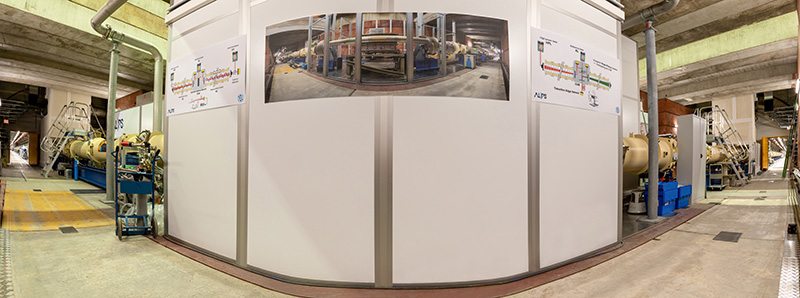
Many of these approaches rely on WISPs converting to photons. At DESY in Hamburg, larger-scale projects are pursued: the “light-shining-through-a-wall” experiment, ALPS II in the HERA tunnel, will start data taking soon. The solar helioscope BabyIAXO is nearly ready to start construction, while the dark matter haloscope MADMAX is in the prototyping phase.
This webinar will introduce the physics cases and focus on the axion search activities ongoing at DESY.
Axel Lindner was working in accelerator-based particle physics, astroparticle physics and management before he engaged in WISP searches in 2007 as the spokesperson of the ALPS I experiment. Since 2018 he has been leading a new experimental group at DESY in Hamburg in charge of realizing non-accelerator-based particle physics experiments on-site. Axel has been a member of the MADMAX and IAXO collaborations and spokesperson of ALPS II since 2012.
The 2022 edition of the yearly workshop “Implications of LHCb measurements and future prospects” from 19 to 21 October at CERN was already the 12th instance in a series of meetings between LHCb and the theory community. The large attendance, with 294 people registered, reflects the excitement of both the experimental and theory community for the physics case of LHCb. In several plenary streams the newest experimental and theoretical developments were presented in mixing and CP violation, flavour changing neutral and charged currents, QCD spectroscopy and exotic hadrons, electroweak physics (now yearly rotating with the stream on fixed target and heavy ion physics) as well as in the newly established stream on model building for flavour physics. The workshop was preceded by “Theory Lectures” about CP violation. This is a new initiative that will henceforth be held yearly in conjunction with the Implications Workshop on various topics of interest.
The conference opened with an overview of the LHCb experiment, where the first milestones of the Upgrade I commissioning were presented. The new fully software trigger scheme of LHCb, with the highest data processing scheme of any LHC experiment, has been successfully implemented for the full LHCb detector.
The hot-off-the-press result on the simultaneous determination of the ratios R(D*)= BR(B→D*τ–ντ)/BR(B→D*μ–νμ) and R(D)= BR(B–→D0τ–ντ)/BR(B–→D0μ–νμ) was shown. This result, which superseded the previous LHCb measurement, is 1.9 σ away from the Standard Model (SM) expectation. Another highlight was the first observation of the decay Λ0b→Λ+cτ–ντ, and its use to test lepton flavour universality using the ratio of the tauonic to muonic decay, R(Λ+c), which is yet in agreement with the SM. The newest precision extractions of the moduli of the Cabibbo-Kobayashi-Maskawa (CKM) matrix elements |Vcb| and |Vub| were discussed, showing that the long-standing puzzle of inclusive versus exclusive measurements keeps being a hot topic with many upcoming developments in the near future.
Within the mixing and CP violation (CPV) stream, a major highlight was the measurement of the time-integrated CP asymmetry in Do→K+K– decays, leading to the first determination of the direct CP asymmetries in both Do→K+K– and Do→π+π– in the latter case constituting the first evidence for CPV in a single charm decay. These results led to exciting discussions about the size of U-spin breaking and possible underlying mechanisms. A new theoretical methodology for the derivation of amplitude U-spin sum rules was presented, making sum rules feasible for any system at any order in the expansion in the symmetry-breaking terms.
Further major results were the determination of the charm mixing parameters
yCP-yKπCP, very large local CP asymmetries seen in B+→h+h’– h’+ (with h,h’=π,K), as well as a new simultaneous determination of the weak phase γ together with charm mixing and decay parameters. On the theory side, it was also presented the completion of the next-to-next-to-leading order (NNLO) QCD calculation of the width difference of Bos mesons, allowing for an improved comparison with the corresponding experimental results.
The versatility of LHCb was showcased by covering rare beauty, kaon and charm decays, along with new tests on lepton-flavor universality violation
The rare decays session again showcased the versatility of LHCb by covering rare beauty, kaon and charm decays, including the most recent results on lepton-flavor universality violation. Recent progress on handling QCD corrections of b→sℓ+ℓ–, which are important for the interpretation of the B anomalies, were presented, and it was shown a new method for the extraction of CKM matrix elements using time-dependent kaon decays. Lots of future opportunities lie in the measurements of rare charmed baryon decays which are very little probed so far.
New exciting results were shown in the spectroscopy stream, where one new pentaquark and three new tetraquark states were presented, showing the leading contribution of LHCb to the discovery of exotics and yet-not-understood states. Progress on QCD predictions along with new data-driven and machine-learning based methods were discussed.
The BSM session gave a great overview of a diverse range of beyond-the-SM models including leptoquarks, Z’ models, axion-like particles (ALPs) as well as models with extra dimensions. Importantly, these models induce correlations between the B anomalies and other anomalies like g-2 or the Cabibbo angle anomaly. Complementary and partially competitive constraints on the viable model space come from direct searches and high-pT observables.
Interesting discussions took place in the electroweak precision-measurements session, where the LHCb W-boson mass measurement was presented, which is in line with the world average and in tension with the recent precise CDF measurement at the 4σ level. This measurement will soon be complemented with the full Run 2 dataset.
The workshop closed with a grand overview given in the keynote talk by Alexander Lenz. The next instance of the Implications Workshop will take place at CERN in October 2023.
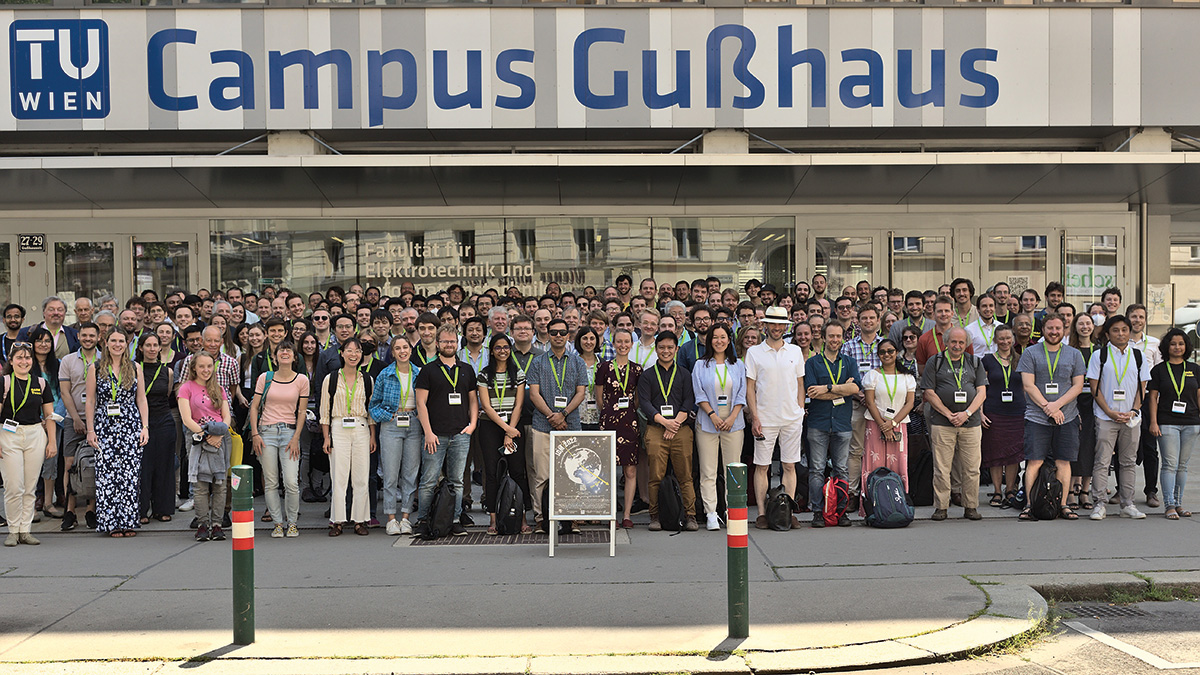
The international conference series on the identification of dark matter (IDM) was brought to life in 1996 with the motto that “it is of critical importance now not just to pursue further evidence for its existence but rather to identify what the dark matter is.” Despite earnest attempts to identify what dark matter comprises, the answer to this question remains elusive. Today, the evidence for dark matter is overwhelming; its amount is known to be around 27% of the universe’s energy-density budget. IDM2022 illuminated the dark-matter mystery from all angles, ranging from cosmological evidence via astrophysics to possible dark-matter particle candidates and their detection via indirect searches, direct searches and colliders.
The 14th edition of IDM took place in Vienna, Austria, from 18 to 22 July, attracting about 250 physicists and more than 200 contributions. The conference was initially scheduled for 2020 but changed to an online format due to the pandemic, while the in-person IDM was delayed until 2022. Many young scientists were able to meet the dark-matter community for the first time “in real life”. The Strings 2022 conference took place in Vienna simultaneously, with complementary presentations.
One focus of IDM2022 was the direct detection of dark matter. Tremendous progress in the sensitivity of direct detection experiments has been achieved in the past few decades over a wide dark-matter particle mass range. All major experiments presented their latest results. While in the past, direct searches focused on the classical WIMP region in a mass between a few GeV and several TeV, the search region is now enlarged towards even lighter dark-matter particles down to the keV region. Different mass regions require different technologies and new ideas were presented to increase the sensitivities towards these unexplored mass regions. For GeV WIMP dark-matter searches, the XENON collaboration displayed the first results from their latest setup, XENONnT, which has a significantly lower background level and recently eliminated a previously seen excess in XENON1T. The XENON, Darwin and LZ collaborations recently formed the XLZD collaboration with the aim of building a next-generation liquid-xenon experiment.
While the XENON1T excess is gone, direct-detection experiments exploring the sub-GeV mass regime still face unknown background contributions, especially in solid-state detectors. This is currently one of the biggest obstacles to increasing the sensitivity to even smaller cross-sections. No complete understanding has been achieved so far, but combining the results, knowledge and expertise of the experiments points to stress relaxations in crystals as one primary underlying source. To tackle this tricky problem, a subset of the IDM2022 participants held a dedicated satellite meeting. This EXCESS workshop was the third event of its kind, and the first to take place in person.
The direct detection experiment DAMA has observed a statistically significant signal of an annual modulated event rate for several years. This observation is consistent with Earth moving through the dark-matter halo, but has not been confirmed by any other experiment. DAMA recently reduced the energy threshold to 0.5 keV electron equivalent by upgrading their readout electronics to further increase sensitivity. Several new dark-matter experiments based on the same target material – NaI – are running or being commissioned to provide more information on the long-standing DAMA observation: ANAIS, COSINE, COSINUS and SABRE. Even lighter forms of dark matter, such as axions and axion-like particles, were discussed, as well as the possibility that dark matter comprises bound states.
Primordial black holes are also attractive potential dark-matter candidates. Astronomical data from, for example,microlensing, structure formation and gravitational waves hint at their existence. However, current data gives no handle on whether primordial black holes could be responsible for all the universe’s dark-matter content, or only correspond to part of the overall dark-matter density. Besides black-hole mergers, gravitational-wave signals can provide additional information to understand the origin of dark matter. In particular, processes in the early universe detected via gravitational waves could provide new insights into the particle nature of dark matter. With the increased sensitivity of operating and future gravitational-wave detectors, new players will provide additional data to unravel the dark-matter problem.
With a plethora of new ideas and experiments presented at this year’s IDM, the path is prepared for the next edition in L’Aquila, Italy, in 2024.
In the dark abysses of the Mediterranean Sea, what promises to be the world’s largest neutrino telescope, KM3NeT, is rapidly taking shape. Using transparent seawater as the detection medium, its large three-dimensional arrays of photosensors will instrument a volume of more than one cubic kilometre and detect the faint Cherenkov light induced by the passage of charged particles produced in nearby neutrino interactions. The main physics goals of KM3NeT are to detect high-energy cosmic neutrinos and identify their astrophysical origins, as well as to study the fundamental properties of the neutrino itself.
KM3NeT (the Cubic Kilometre Neutrino Telescope) is the successor to the ANTARES neutrino telescope, which operated continuously from 2008 and has recently been decommissioned (see “The ANTARES legacy” panel). KM3NeT comprises two detectors: ARCA (Astroparticle Research with Cosmics in the Abyss), located at a depth of 3500 m offshore from Sicily, and ORCA (Oscillation Research with Cosmics in the Abyss), located at a depth of 2450 m offshore from southern France. ARCA is a sparse detector of about 1 km3 that is optimised for the detection of TeV–PeV neutrinos, while ORCA is a 7 Mt-dense detector optimised for sub-TeV neutrinos. The KM3NeT collaboration comprises more than 250 scientists from 16 countries.
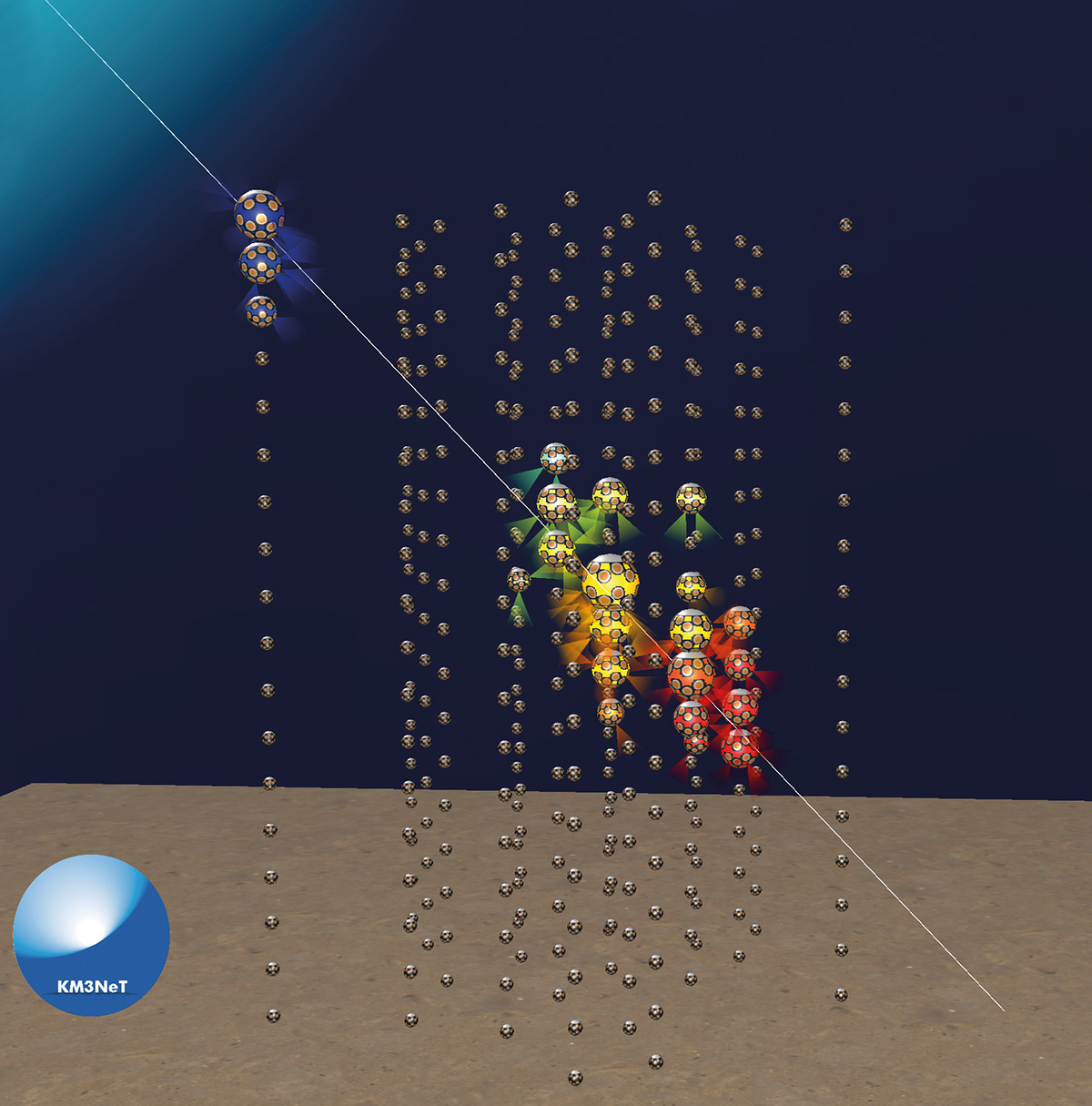
The key technology is the digital optical module (DOM) – a pressure-resistant glass sphere hosting 31 three-inch photomutiplier tubes, various calibration devices and the readout electronics (see “Modular” image). A total of 18 DOMs are hosted on a single detection line, and the lines are anchored to the seafloor and held taut by a submerged buoy. The ORCA detector will comprise around 100 lines and the ARCA detector will have twice as many. The bases of the lines are connected via cables on the seafloor to junction boxes, from which electro-opticalcables many tens of kilometres long bring the data to shore along optical fibres. Information on every single photon is transmitted to the shore stations, where trigger algorithms are applied to select interesting events for offline analysis.
From the light pattern recorded by the DOMs, the energy and the direction of a neutrino can be estimated. Furthermore, the neutrino flavour can also be distinguished; muon neutrino charged–current (CC) interactions produce an extended track-like signature (see “Subsea shower” image) whereas electron– and tau–neutrino CC interactions, as well as neutral-current interactions, produce more compact shower-like events. By selecting up-going neutrinos, i.e. those that have travelled from the other side of Earth, the large background from down-going atmospheric muons can be rejected and a clean sample of neutrinos obtained.
The first KM3NeT detection line was connected in 2016 and currently a total of 32 lines are operating at the two sites. The first science results with these partial detectors have already been obtained.
Fundamental neutrino properties
Sixty-six years after their discovery, neutrinos remain the most mysterious of the fermions. As they whiz through the universe, barely interacting with any other particles, they have the unique ability to oscillate between their three different types or flavours (electron, muon and tau). The observation of neutrino oscillations in the late 1990s implies that neutrinos have a non-zero mass, contrary to the Standard Model expectation. Understanding the origin and order of the neutrino masses could therefore unlock a path to new physics. Numerous neutrino experiments around the world are closing in on the neutrino’s properties, using both artificial (accelerator and reactor) and natural (atmospheric and extraterrestrial) neutrino sources.
The KM3NeT/ORCA array is optimised for the detection of atmospheric neutrinos, produced when cosmic rays strike atomic nuclei at an altitude of around 15 km. Such interactions produce a cascade of particles on Earth’s surface, mostly pions and kaons, which decay to neutrinos capable of traversing the entire planet. About two thirds of these are muon neutrinos and antineutrinos, and the remainder are electron neutrinos and antineutrinos.
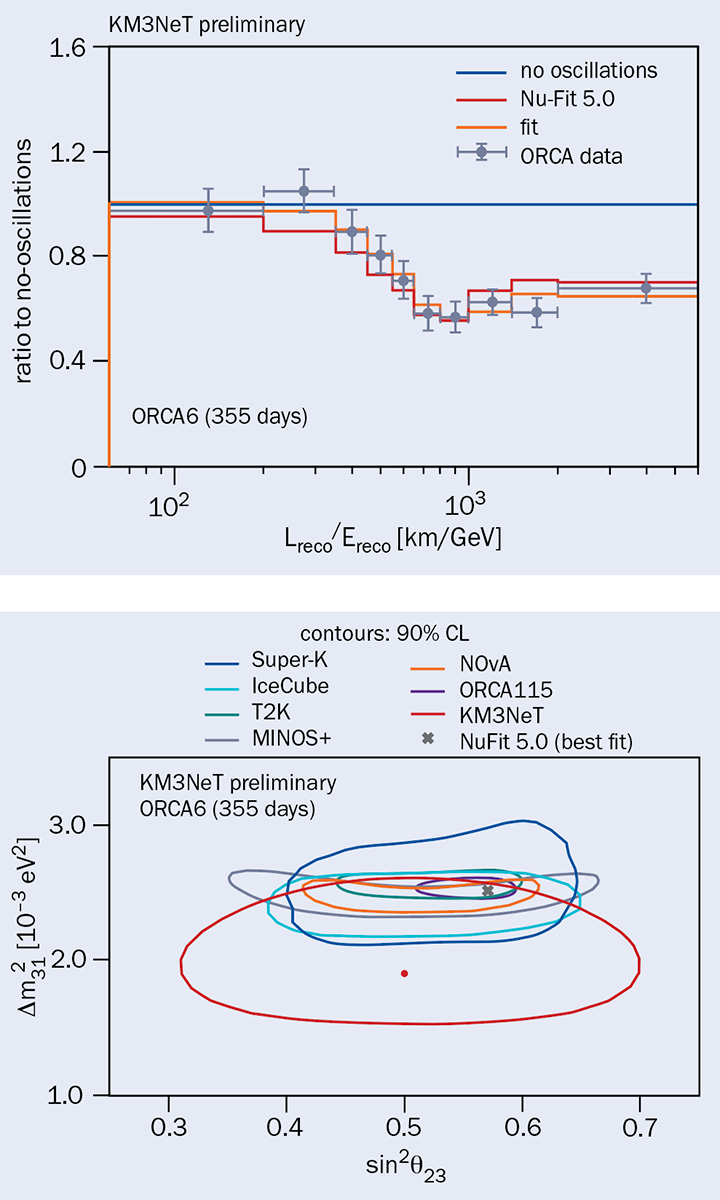
Measuring the directions and energies of the detected atmospheric neutrinos allows the oscillatory behaviour of neutrinos to be studied, and thus elements of the leptonic “PMNS” mixing matrix to be determined. The measured direction is used as a proxy for the distance the atmospheric neutrino has travelled through Earth between its points of production and detection. First preliminary results with six ORCA lines and one year of data clearly show the expected disappearance of muon neutrinos with increasing baseline/energy. The corresponding constraints on θ23 (the mixing angle between the m2 and m3 states) and Δm232 (the mass difference of the squared masses) already start to be competitive with multi-year results from the current long-baseline accelerator experiments (see “Physics debut” figure).
Building a telescope anchored deep at the bottom of the sea requires skill, patience and expertise. KM3NeT would not be on its way without the invaluable experience gained from its older sibling, the ANTARES telescope. ANTARES operated continuously for more than 15 years, and pioneered solutions to construct and operate a neutrino detector in the challenging environment of the deep sea. Despite ANTARES containing only 12 detector lines compared to 86 in IceCube, its superior angular resolution (due to the intrinsic water properties) and its Northern Hemisphere location provided competitive results and valuable insights and constraints in various domains.
Following IceCube’s discovery of a diffuse flux of cosmic neutrinos, the ANTARES all-flavour neutrino data sample revealed a mild (1.8σ) excess of high-energy events consistent with the neutrino signal detected by IceCube. ANTARES also contributed strongly to the multi-messenger endeavour, participating in the search for a neutrino counterpart to major alerts from the LIGO/Virgo gravitational-wave interferometers, IceCube, ground-based imaging air Cherenkov telescopes, as well as X- and gamma-ray satellites. For instance, the TXS0506+056 blazar is the second most significant point source, with a local significance of 2.8σ, strengthening its case as the first high-energy neutrino source. ANTARES also distributed its own neutrino alerts with an unprecedented low latency for a neutrino telescope.
Its energy threshold of a few tens of GeV allowed the study of atmospheric muon neutrino disappearance due to neutrino oscillations and to constrain the “3+1” neutrino model. In this domain, results consistent with world best-fit values were obtained, as well as competitive limits on non-standard interactions. The data were also used to search for dark-matter particles that would have accumulated in astrophysical bodies like the Sun or the galactic centre before annihilating or decaying into neutrinos. Since no excesses were found, competitive limits were set that reduce the parameter space to be explored by direct, indirect (including KM3NeT) and collider dark-matter experiments.
Recently superseded in sensitivity by KM3NeT, ANTARES was finally decommissioned in February 2022.
A longer-term physics goal of KM3NeT is to determine the neutrino mass ordering, i.e. whether the third neutrino mass eigenstate is heavier or lighter than the first two. This is important to help constrain the plethora of theoretical models proposed to explain the neutrino masses. Due to the large distances travelled by atmospheric neutrinos as they pass through Earth’s mantle and core, subtle matter effects come into play and distort the expected oscillation pattern in the zenith angle/energy plane. By comparing the observed distortions to those expected for either “normal” or “inverted” mass ordering, and thanks to the large neutrino sample collected, the neutrino mass ordering can be determined.
A 115-line configuration of ORCA operating for three years is expected to provide a three-sigma sensitivity for most θ23 values. KM3NeT could therefore be the first detector to unambiguously determine the neutrino mass ordering, on a time scale in advance of the planned long-baseline accelerator experiments. New-physics scenarios (for example, non-standard interactions, neutrino decays and sterile neutrinos) that modify the oscillation patterns recorded in both ORCA and ARCA have already been explored. While no significant deviations from the Standard Model have been observed, the enhanced sensitivity as the detectors grow will push the existing limits and probe uncharted territories.
Neutrino astronomy
At the beginning of the 1960s, it was realised that the neutrino could play a special role in the study of the universe at large. Weakly interacting with matter and electrically neutral, it enables exploration at greater distances and higher energies than is possible with conventional electromagnetic probes. In addition, neutrinos are the unambiguous smoking gun of hadronic acceleration processes occurring at their source.
Since the observation of a significant flux of cosmic high-energy neutrinos in the TeV–PeV range by the IceCube Neutrino Observatory at the South Pole in 2013, the focus of neutrino astronomers has been to identify the astrophysical origins of these neutrinos. Amongst the diverse possible sources, a multi-messenger approach has identified the first: the flaring blazar TXS0506+056. While other source candidates have appeared, such as tidal disruption events and radio-bright blazars, the currently identified source population(s) cannot fully explain the detected flux. Having a neutrino telescope with a sensitivity similar to that of IceCube and with a complementary field of view allows the full neutrino sky to be continuously monitored. KM3NeT’s location in the Northern Hemisphere provides an optimal view of the galactic plane and makes it the ideal instrument to detect, characterise and resolve sources that may emit galactic neutrinos.
Soon, KM3NeT will start sending alerts to its multi- messenger partners – including conventional electromagnetic telescopes but also other neutrino telescopes such as IceCube and Baikal/GVD – when a neutrino candidate with a high probability of astrophysical origin is detected. This is right on time for the fourth observing run of the LIGO, Virgo and KAGRA gravitational-wave interferometers. While so far no neutrinos have been observed from binary compact systems detected through gravitational waves, a joint detection would reveal unique information on the high-energy processes in the environment of the mergers. Furthermore, the exceptional pointing resolution of KM3NeT would significantly reduce the region of interest where electromagnetic partners should search for a counterpart. The ARCA detector, for example, will benefit from the low optical scattering of deep seawater to reconstruct the direction of muon-neutrino events to less than 0.1 degrees at 100 TeV and around 1 degree for the electron/tau neutrino flavours.
Last but not least, KM3NeT is already waiting for the next close-by core-collapse supernova. Such astrophysical events are rare: the first and only one ever detected in neutrinos, SN1987a, occurred 35 years ago. The KM3NeT DOMs are continuously monitoring for a short-duration increase in counting rates on many DOMs simultaneously – the signature of a flash of MeV supernova neutrinos passing through the detectors – and the detector is networked with other neutrino telescopes via the SuperNova Early Warning System (SNEWS). If a galactic supernova would happen today, the number of neutrinos detected by SNEWS would be four orders of magnitude more than for SN1987a!
Whether the cosmic-neutrino sources are point-like, extended, transient or variable, the KM3NeT collaboration has developed reconstruction techniques, event selections and statistical frameworks to identify them and determine their characteristics. Disentangling the galactic from the extragalactic components, the steady from the transient and the electromagnetically bright from the obscure are on KM3NeT’s to-do list for the coming decade.
Marine science
KM3NeT is important not only for particle physics, but is also a powerful tool for marine sciences. The acquisition of long-term oceanographic data helps researchers understand and eventually mitigate the harmful effects of global processes, such as climate change and anthropogenic impact, as well as study episodic events such as earthquakes, tsunamis, biodiversity changes and pollution – all of which are difficult to study with short-term conventional marine expeditions. To this end, the seafloor infrastructures of first the ANTARES and now the KM3NeT sites are unique cabled marine observatories. They are open to all scientific communities, and as such are important nodes of the European Multidisciplinary Seafloor and water-column Observatory, EMSO.
Sixty-six years after their discovery, neutrinos remain the most mysterious of the fermions
Furthermore, the KM3NeT optical sensors and the acoustics sensors (used for the positioning of the DOMs) themselves provide unique information on deep-sea bioluminescence and bioacoustics. The ANTARES collaboration has several publications studying deep-sea bioluminescence and acoustic detection of cetaceans, and recently KM3NeT invited citizen scientists to analyse its optical and acoustic data via the Zooniverse platform in the context of the EU project REINFORCE.
The KM3NeT detectors will continue to grow in size and sensitivity as additional new lines are installed over the next five years. With three major neutrino telescope facilities now online – Baikal/GVD, IceCube and KM3NeT – neutrino astronomy is truly entering its golden era.
Studies of rare B-meson decays at the LHC provide a sensitive probe of physics beyond the Standard Model (SM) and allow us to explore energy scales much higher than those directly accessible. A key factor in the success of these studies is the availability of precise theoretical predictions that can be compared with experimentally accessible processes. The dimuon decays B0S→ μ+μ– and B0→ μ+μ– are a case in point. In particular, studies of these decays could help researchers to understand the nature of several anomalies seen in other rare B-meson decays.
The CMS collaboration recently reported a new measurement of the B0S→ μ+μ– branching fraction and effective lifetime, as well as the result of a search for the B0→ μ+μ– decay, using data recorded during LHC Run 2. This new study benefits not only from a large event sample but also from advanced machine-learning algorithms, which are used to uncover the rare signal events out of the overwhelming background. The B0S→ μ+μ– signal is very clearly seen (see figure 1), leading to more precise measurements than previously achieved. The B0S→ μ+μ– branching fraction is measured to be (3.8 ± 0.4) × 10–9, the relative uncertainty of 11% being a remarkable improvement with respect to that of the previous CMS result, 23%.
This measured value is consistent with the SM prediction of (3.7 ± 0.1) × 10–9, and reduces a previous tension between theory and experiment, which was based on the combination of the previous CMS result with the ATLAS and LHCb values. The variation in the central value of the CMS measurements is mostly driven by the use of a larger data sample and by the change of the B-hadron fragmentation fraction ratio (by about 8%). The measured effective lifetime of the B0S→ μ+μ–decay, 1.8 ± 0.2 ps, is also consistent with the SM prediction. The precision of this measurement is approaching the level necessary to probe the CP properties of B0S→ μ+μ–, which could differ from the SM prediction. Finally, the B0→ μ+μ– decay remains unseen.
CMS physicists are looking forward to continuing these rare-decay studies with the large data samples to be collected during LHC Run 3. Besides the improved precision expected for B0S→ μ+μ– measurements, seeing the first evidence of B0→ μ+μ– is high on their wish list.
The LHCb experiment is designed to study heavy-flavour particles containing beauty and charm quarks. Nevertheless, thanks to the large strangeness production cross-sections at the LHC as well as the excellent reconstruction performance of LHCb at low momenta, the experiment is also able to produce precise results in strange decays, complementary to those from dedicated experiments such as NA62 and KOTO. The collaboration has recently released a “trillio-scale” upper limit on the branching fraction of the decay K0S→ μ+μ–μ+μ–, being the first at this scale at the LHC. The same dataset was used to search for K0L→ μ+μ–μ+μ–, yielding the world best upper limit f and the first LHC result on a K0L decay.
According to the Standard Model (SM), K0S (K0L) mesons decay into four muons at a very small rate of a few 10–14 (10–13). The decay rates of these processes are very sensitive to possible contributions from new, yet-to-be discovered particles such as dark photons, which could significantly enhance or suppress the decay rate via quantum interference with the SM amplitude. Despite the unprecedented K0-meson production rate at the LHC, performing this search is challenging due to the low transverse momentum (typically a few hundred MeV) of the muons. LHCb exploits its unique capability to select, in real time, low transverse-momentum muons – a capability that has improved in recent years thanks to the versatility of its online trigger system. The analysis used machine learning to discriminate long-lived particles from combinatorial background, as well as a data-driven and detailed map of the detector material around the interaction point. The invariant mass of the four-muon system is used as a control variable to statistically separate the potential signal from the remaining combinatorial background.
No selected event consistent with the decay of K0S into four muons, which should appear in the region around the K0S mass of 498 MeV, was observed (see figure 1). In the absence of a signal, upper limits on the respective branching fractions are set to 5.1 × 10⁻¹² for the K0S decay mode and 2.3 × 10⁻⁹ for the K0L mode at 90% CL. These results represent the world’s most precise searches for these decays, and the branching fraction for K0S→ μ+μ–μ+μ– is the most stringent upper limit on a K0S decay mode.
The upgraded LHCb detector, which started data-taking this year, offers excellent opportunities to further improve the search precision and eventually find evidence of this decay. In addition to the increased luminosity, the LHCb upgrade has a fully software trigger, which is expected to significantly improve the efficiency for K0 decays into four muons and other decays with very soft final-state particles.
The study of elastic hadron scattering is a cornerstone in understanding the non-perturbative properties of strong interactions. A key role is played by experiments at the LHC, where it is possible to precisely measure proton–proton (pp) interactions at a very high centre-of-mass energy. The goal is to detect the process pp → pp, in which the interacting protons remain intact and are scattered at angles of a few microradians with respect to the beamline. The importance of such measurements follows from their relation to the total hadronic pp cross section via the optical theorem, and to properties of proton interactions at asymptotically high energies via dispersion relations.
In ATLAS, elastic scattering is studied using a dedicated experimental setup – the ALFA detectors, which allow measurements of scattered-proton trajectories inside the beam pipe, just a few millimetres from the LHC beam. They are installed inside so-called Roman pots located at distances of 237 and 245 m on either side of the ATLAS interaction point.
Recently, ATLAS reported a measurement of elastic scattering at a centre-of-mass energy of 13 TeV. The data were collected with a special setting of the LHC magnets characterised by a high β* of 2500 m, which results in a large beam-spot size and a very small beam divergence. The latter allows precise measurements of small scattering angles. With these optics, the ALFA system detected events characterised by very small values of the Mandelstam t variable, which is proportional to the scattering angle squared. Measurements of small |t| values give access to the Coulomb–nuclear interference (CNI) kinematic region, where the contribution from electromagnetic and strong interactions are of similar magnitude.
The ALFA detectors use scintillating- fibre technology to measure the position of the passing proton. The t value for each event is reconstructed from the measured positions using knowledge of the magnetic fields of the LHC magnets between the interaction point and the detectors. The selection of candidate events is based on the strong correlations between the elastically scattered protons, resulting from energy and momentum conservation. The analysis is heavily based on data-driven techniques, which are used for the alignment of the detectors, background estimation, evaluation of reconstruction efficiency and optics tuning.
Figure 1 presents the measured differential elastic cross section as a function of t. The shape of the distribution is sensitive to important physics parameters, such as the total cross section (σtot) and the ρ parameter, defined as the ratio of real to imaginary parts of the forward scattering amplitude. The smallest |t| values, and thus the smallest scattering angles, are dominated by the electromagnetic interaction between the protons. The CNI effects are strongest for |t| around 10–3 GeV2 and provide the sensitivity to the ρ parameter. For larger |t| values, the strong interaction dominates, and the spectrum depends on the value of σtot. The physics parameters are extracted from a fit to the t distribution.
The ρ parameter is related, through dispersion relations, to the energy dependence of σtot, with a certain sensitivity also to energies above those at the LHC. In addition, ρ is sensitive to possible differences between pp and pp scattering amplitudes at asymptotic energies. ATLAS measured ρ = 0.098 ± 0.011, in agreement with a previous TOTEM measurement. The result is in conflict with pre-LHC theoretical expectations (see the COMPETE line in figure 2), which assumed that no pp/pp difference is present asymptotically and that σtot increases proportionally to the squared logarithm of the centre-of-mass energy, similarly to the evolution observed at accessible energies back then. This suggests that one of the above assumptions is incorrect: either the increase of σtot slows down above LHC energies, or protons and antiprotons interact differently at asymptotic energies. The second statement is often associated with the so-called odderon exchange. Both possibilities affect our understanding of the high-energy behaviour of strong interactions.
ATLAS also measured the total pp hadronic cross section σtot = (104.7 ± 1.1) mb. This is the most precise measurement to date at this energy, due to a dedicated luminosity measurement that contributed less than 1 mb to the total systematic uncertainty. However, the long-standing tension between the ATLAS and TOTEM σtot measurements, with the latter being about 5% higher than ATLAS, persists.
ATLAS has collected more elastic scattering data in LHC Run 2, which are currently being analysed. New data taking is planned during Run 3, where a special run is foreseen at a centre-of-mass energy of 13.6 TeV.
At the LHC, light nuclei and antinuclei are produced both in proton–proton and in heavy-ion collisions. Unstable nuclei, called hypernuclei, are also produced. First observed in cosmic rays in 1953, hypernuclei are formed by a mix of protons, neutrons and hyperons containing one or more strange quarks and undergo weak decays. Almost 70 years since their discovery, hypernuclei are still a source of fascination for nuclear physicists since their production is very rare and the measurement of their properties is extremely challenging.
The only hypernucleus observed so far at the LHC is the hypertriton (3ΛH), composed of a Lambda baryon (Λ), a proton and a neutron. While, traditionally, hypernuclei are studied in low-energy nuclear experiments, the hundreds of hypertritons and antihypertritons produced in each lead–lead run at the LHC provide one of the largest data samples for their study. The hypertritons fly for a few centimetres in the experimental apparatus before decaying into a 3He nucleus and a charged pion, which are then identified by the detectors.
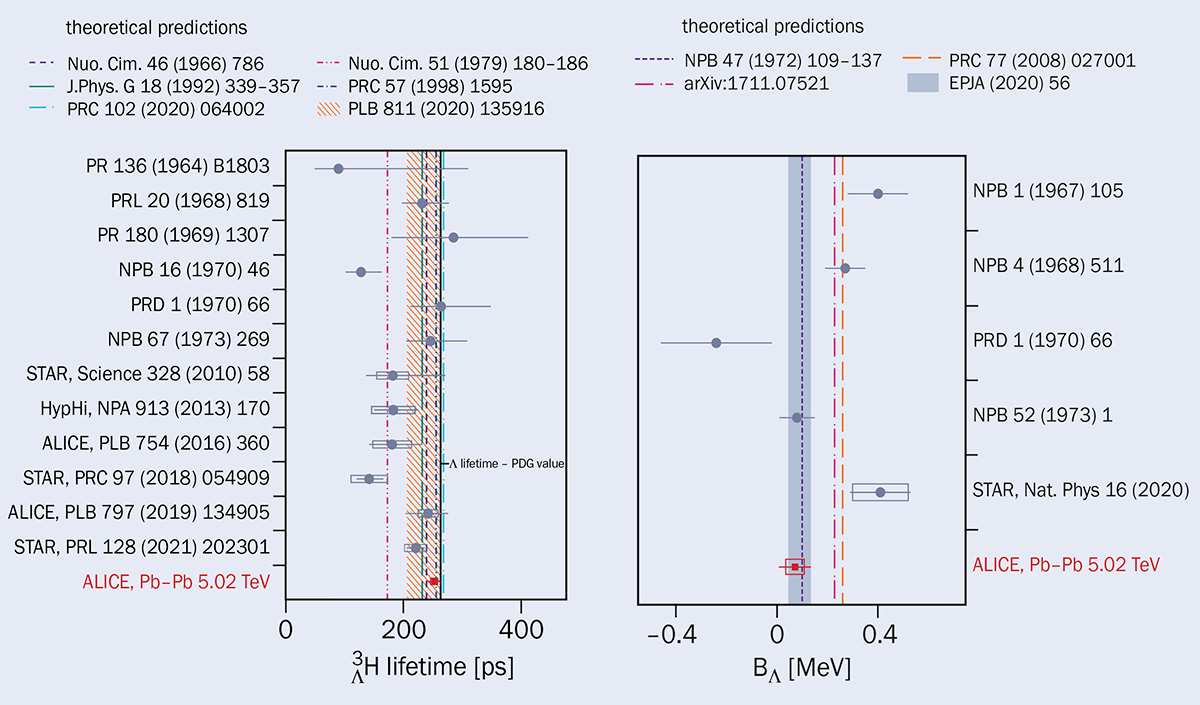
The ALICE collaboration recently completed a new analysis of the largest Run 2 data sample, achieving the most precise measurements to date of the hypertriton lifetime and its Λ-separation energy (the energy required to separate the Λ from the rest of the hypertriton). The lifetime, measured from the distribution of reconstructed two-body decay lengths, was found to be 253 ± 11 (stat.) ± 6 (syst.) ps, while the separation energy, obtained from the hypertriton invariant-mass distribution, was measured to be 72 ± 63 (stat.) ± 36 (syst.) keV.
These two quantities are fundamental to understand the structure of this hypernucleus and therefore the nature of the strong interaction. While the strong force binding neutrons and protons inside atomic nuclei is well understood, the characteristics of the strong force binding nucleons and hyperons are not precisely known.
The study of this interaction is not only interesting per se, but it is also an input for modelling of the dense core of neutron stars. Indeed, the creation of hyperons is energetically favoured compared to ordinary nucleonic matter in the inner core of neutron stars. Therefore, detailed knowledge of the interactions between nucleons and hyperons is required to understand these compact astrophysical objects.
The new ALICE measurements indicate that the interaction between the hyperon inside the hypertriton and the other two nucleons is extremely feeble (see figure 1). This is also confirmed by the lifetime of the hypertriton, which is compatible with the free Λ-baryon lifetime. Finally, since at the LHC matter and antimatter are produced in the same amount, the ALICE collaboration could compare the lifetimes of the antihypertriton and the hypertriton. Within the experimental uncertainty, the lifetimes were found to be compatible, as expected from CPT invariance.
During LHC Run 3, ALICE will extend its studies to heavier hypernuclei, putting tighter constraints on the interaction models among hyperons and nucleons.
Active galactic nuclei (AGN) are one of the most studied astrophysical objects. Known to be the brightest persistent sources of photons in the radio to gamma- ray spectrum, they are also thought to be responsible for high-energy cosmic rays and neutrinos. As such, they play an important role in the universe and its evolution.
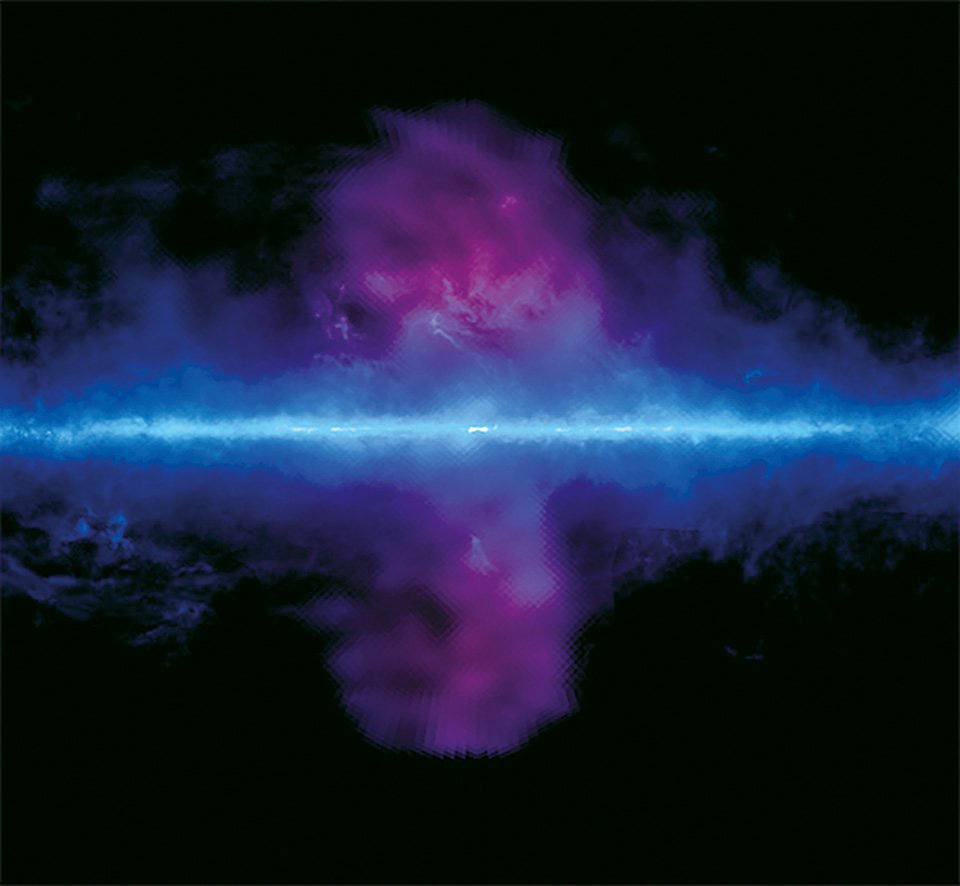
AGNs are galaxies in which the supermassive black hole at their centre is accreting matter, thereby producing violent jets responsible for the observed emissions. While our galaxy has a supermassive black hole at its centre, it is currently not accreting matter and therefore the nucleus of the Milky Way is not active. Strong hints of past activity were, however, discovered using the Fermi–LAT satellite in 2010. In particular, the data showed two giant gamma-ray emitting bubbles – now known as the Fermi bubbles – extending from the galactic centre and covering almost-half of the sky (see image). The exact origin of the giant plasma lobes remains to be understood. However, their position and bipolar nature point towards an origin in the Milky Way’s centre several million years ago, likely during a period of high activity in the galactic nucleus.
A new study led by Trisha Ashley from the Space Telescope Science Institute, Baltimore, brings a fresh perspective on the origin of these structures. Her team focused on the chemical composition of gas clouds inside the bubbles using UV absorption data collected by the Hubble Space Telescope and Green Bank Telescope. Based on their location and movement, these high-velocity clouds had been assumed to originate in the disk of the Milky Way before being swept up as the bubbles were emitted from the galactic centre. However, measurements of the clouds’ elemental makeup cast doubt on this assumption.
UV surprise
Gas clouds from the galactic disk should have a similar chemical composition (referred to as metallicity by astronomers) to those that once collapsed into stars like the Sun. In the galactic disk, the abundance of elements heavier than hydrogen (high metallicity) is expected to be higher thanks to several generations of stars responsible for the production of such elements, whereas in the galactic halo the metallicity is expected to be lower due to a lack of stellar evolution. To measure the chemical composition of the gas clouds, Ashley and her team looked at the UV spectra from sources behind them to see the induced absorption lines. To their surprise, they found not only clouds with high metallicity but also those with a lower metallicity, matching that of galactic halo gas, thereby implying a different origin for these clouds. Suggestions that the second class of clouds is a result of heavy clouds accumulating low-metallicity gases are unlikely to hold, as the time it would take to absorb these gases is significantly longer than the age of the Fermi bubbles. Instead, it appears that while the bubbles did drag along gas clouds from the galactic plane, they also swept up existing halo gas clouds as they expanded outwards.
These results imply that events such as those which produced the Fermi bubbles play an important role in gas accumulation in a galactic plane. They remove gas from the galactic disk, while in parallel, push back gas flowing into the galactic disk from the halo. As less gas reaches the disk, star formation gets suppressed, and as such, these events play an important role in galaxy evolution. Since studying small-scale details such as gas clouds in other galaxies is impossible, these results provide a unique insight into our own galaxy as well as into galaxy evolution in general.
To provide the best experiences, we use technologies like cookies to store and/or access device information. Consenting to these technologies will allow us to process data such as browsing behavior or unique IDs on this site. Not consenting or withdrawing consent, may adversely affect certain features and functions.
Functional
Always active
The technical storage or access is strictly necessary for the legitimate purpose of enabling the use of a specific service explicitly requested by the subscriber or user, or for the sole purpose of carrying out the transmission of a communication over an electronic communications network.
Preferences
The technical storage or access is necessary for the legitimate purpose of storing preferences that are not requested by the subscriber or user.
Statistics
The technical storage or access that is used exclusively for statistical purposes.The technical storage or access that is used exclusively for anonymous statistical purposes. Without a subpoena, voluntary compliance on the part of your Internet Service Provider, or additional records from a third party, information stored or retrieved for this purpose alone cannot usually be used to identify you.
Marketing
The technical storage or access is required to create user profiles to send advertising, or to track the user on a website or across several websites for similar marketing purposes.



 Axel Lindner was working in accelerator-based particle physics, astroparticle physics and management before he engaged in WISP searches in 2007 as the spokesperson of the ALPS I experiment. Since 2018 he has been leading a new experimental group at DESY in Hamburg in charge of realizing non-accelerator-based particle physics experiments on-site. Axel has been a member of the MADMAX and IAXO collaborations and spokesperson of ALPS II since 2012.