


(more information TBA)


(more information TBA)
XQCD is a series of international workshop-style conferences held annually, which aims at covering recent advances in the theory and phenomenology of QCD under extreme conditions of temperature and/or baryon density, together with related topics.
Accompanying the XQCD 2023 will take place 2024 XQCD PhD school between July. 14 and July. 16th.
Further details about the conference will be updated later.
We want to extend to you our cordial invitation to the 42nd International Conference on High Energy Physics to be held 17-24 Jul 2024 in Prague, in the Czech Republic. No one can predict the results that will be shown here. Yet we may expect a rich harvest from the current LHC run as well as from other experiments. We will also like to hear about the European Strategy Update.
ICHEP is a series of international conferences organized by the C11 commission of the International Union of Pure and Applied Physics (IUPAP). It has been held every two years since more than 50 years, and is the reference conference of particle physics where most relevant results are presented.
At ICHEP, physicists from around the world gather to share the latest advancements in particle physics, astrophysics/cosmology, and accelerator science and discuss plans for major future facilities.
The 2024 International Workshop on Future Linear Colliders (LCWS2024) continues the series devoted to the study of the physics, detectors, and accelerator issues relating to high-energy linear electron-positron colliders. A linear collider will initially operate as a Higgs factory, and provides a clear path for upgrades in energy and luminosity.
Since the last workshop (LCWS2023), many significant steps have been made. With a wide program of plenary and parallel sessions, this workshop will provide an opportunity to present ongoing work and to get informed and involved.
The workshop is scheduled from the morning of 8th of July to the late afternoon of 11th of July. We plan to have an evening reception on the 8th, and a conference dinner on the 10th. The workshop will be held at the University of Tokyo (Hongo and/or Yayoi campus), located in the heart of Tokyo.
The goal of this conference is to draw a complete picture of the status of dark matter searches from the theoretical to the experimental point of view.
IDM 2024 is planned as an in-person conference on July 8-12, 2024. It will be held in L’Aquila, the capital city of the Abruzzo region in Italy. After the tragic earthquake of 2009 and the intense large-scale reconstruction of the last 14 years, L’Aquila has a strong commitment to innovation, science and technology.
This 15th IDM edition is jointly organized by the Gran Sasso Science Institute (GSSI), the Department of Physical and Chemical Sciences of the L’Aquila University (UnivAQ) and the National Gran Sasso Laboratory (LNGS). The city of L’Aquila is hungry for scientific and cultural events. Hosting three big scientific institutions, L’Aquila is a crossroads playing a crucial role in modern dark matter searches. LNGS is one of the most advanced underground facilities worldwide, hosting top-class experiments in a variety of particle physics fields. The Lab is an internationally recognized science centre and has an enormous cultural impact on the region. UnivAQ is a well-established reality with 17000 students and 7 departments, including Physics and Chemistry, Engineering, and Humanities. The excellence Ph.D. school GSSI, established in 2013 as part of the cultural renovation of the city, gained in a few years international relevance in its 4 research areas: Physics, Mathematics, Computer Science, and Social Studies.
The workshop will cover a broad range of issues in high-energy theory. Topics closer to gravity and cosmology have now been separated into a new workshop. The talks are expected to be informal and interactive, with a substantial pedagogical component. We strongly encourage blackboard presentations.
The workshop is hosted by the BANGKOK FUNDAMENTAL PHYSICS GROUP.
The workshop will be held at the physics department of Chulalongkorn University (commonly abbreviated as “Chula”, pronounced choo-lah, with a stressed second syllable), Thailand’s leading school in natural science fields centrally located in the modernized Pathumwan district of Bangkok.
The XXXI International Workshop on Deep Inelastic Scattering and Related Subjects (DIS2024) will be organized in Grenoble, France, from April 8 to April 12, 2024.
The conference covers a large spectrum of topics in high energy physics. A significant part of the program is devoted to the most recent theoretical advances and results from large experiments at BNL, CERN, DESY, FNAL, JLab and KEK.
The venue of the workshop is the Maison MINATEC congress center which is part of the scientific area Grenoble Presqu’Île close to the city center.
(more information TBA)
The 21st International Conference on Strangeness in Quark Matter (SQM 2024) will focus on new experimental and theoretical developments on the role of strange and heavy-flavour quarks in high energy heavy-ion collisions and in astrophysical phenomena.
Scientific topics include:
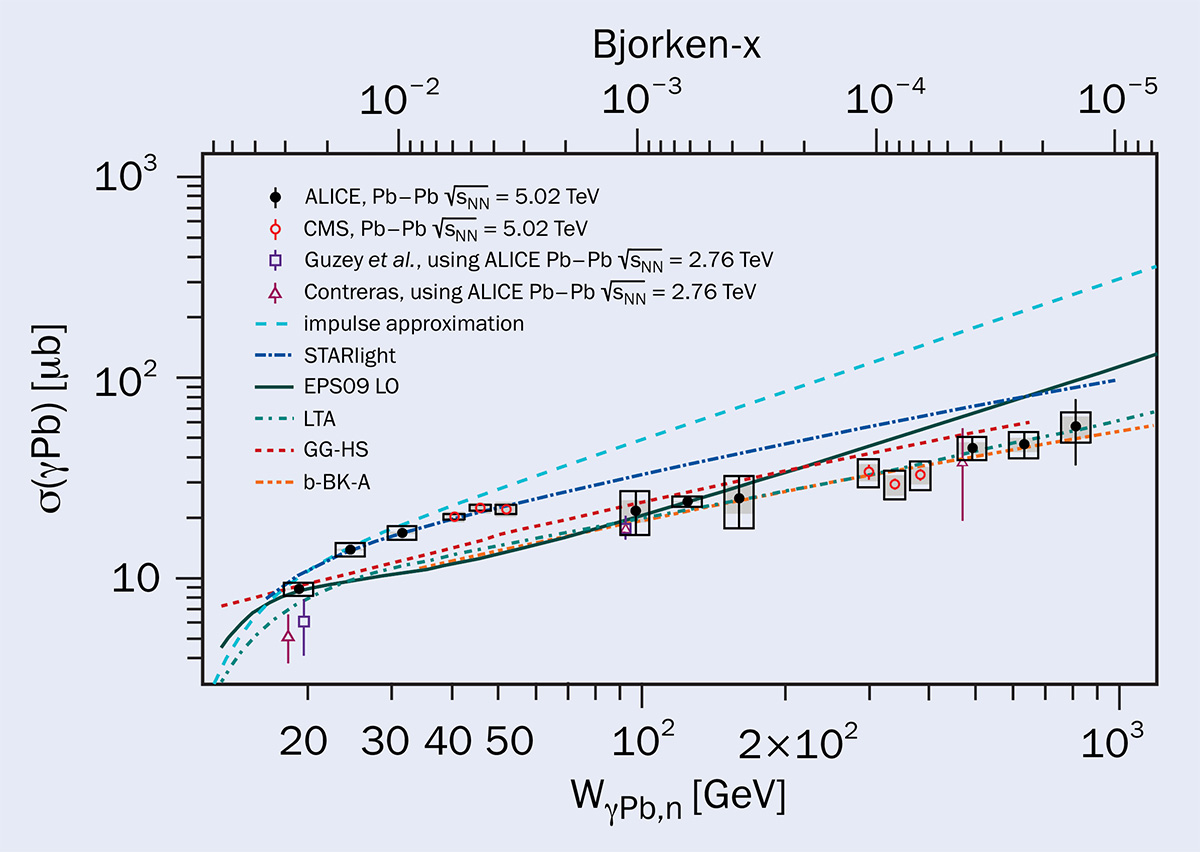
To advance our understanding of gluonic saturated matter at the LHC, the ALICE collaboration has presented a new study using photon-induced interactions in ultra-peripheral collisions (UPCs). In this type of collision, one beam emits a very high energetic photon that strikes the other beam, giving rise to photon–proton, photon–nucleus and even photon–photon collisions.
While we know that the proton – and most of the visible matter of the universe – is made of quarks bound together by gluons, quantum chromodynamics (QCD) has not yet provided a complete understanding of the rich physics phenomena that occur in high-energy interactions involving hadrons. For example, it is not known how the distribution of gluons evolve at low values of Bjorken-x. The rapid increase in gluon density observed with decreasing x cannot continue forever as it would eventually violate unitarity. At some point “gluon saturation” must set in to curb this growth.
So far, it has been challenging to experimentally establish when saturation sets in. One can expect, however, that it should occur at lower energies for heavy nuclei than for protons. Thus, the ALICE Collaboration has studied the energy dependence of UPC processes for both protons and heavy nuclei. At the same time, other physics phenomena, such as gluon shadowing originating from multi-scattering processes, can exist with similar experimental signatures. The interplay between these phenomena is still an open problem in QCD.
ALICE has presented new results on J/ψ meson-production UPC, where the photon probes the whole nucleus. The new ALICE results, analysed using LHC Run 1 and Run 2 data, probe a wide range of photon-nucleus collision energies from around 10 GeV to 1000 GeV. These results confirm previous measurements by ALICE, obtained at lower energies, that indicated a strong nuclear suppression when such photon–nucleus data are compared to expectations from photon–proton interactions. The present analysis employs novel methods for extracting the energy dependence, providing new information to test theoretical models. The present data at high energies can be described by both saturation-based and gluon shadowing models. The coherent J/ψ meson production at low energy, in the anti-shadowing region, is not described by these models, nor can available models fully describe the energy dependence of this process over the explored energy range.
ALICE will continue to investigate these phenomena in LHC Runs 3 and 4, where high-precision measurements with larger data samples and upgraded detectors will provide more powerful tools to better understand gluonic saturated matter.