Welcome to the 8thIUPAP International Conference on Women in Physics (ICWIP2023)
The International Union of Pure and Applied Physics (IUPAP) has recognised a particular need to foster the participation of women in physics. The IUPAP Conferences series on Women in Physics, organised by IUPAP Working Group 5, has a history not only of success and growth but also of making a difference to the physics community. The 8th conference in this series will be held virtually during 10-14 July 2023 with India as the host country and it will be jointly organised by the Gender in Physics Working Group (GIPWG) of Indian Physics Association (IPA) and the Tata Institute of Fundamental Research (TIFR). The conference will be hosted by the Homi Bhabha Centre for Science Education (HBCSE) – a national centre of TIFR, strongly focused on promoting quality and equity in Science & Mathematics education from primary school to introductory college levels.
While the community of women physicists in India has long been vocal in discussing gender issues and promoting equity, recent years have seen these efforts gain a formal shape. The IPA established the GIPWG in 2017, while a Working Group on Gender Equity of the Astronomical Society of India was established in 2015. The national science academies in India have also set up panels on women in science. The Government of India has been strongly supportive of efforts to increase the participation of women in science. This commitment has been signaled by its having set up a Task Force on Women in Science and a Standing Committee on Women in Science. Most recently, it has launched GATI, an accreditation program to promote gender equity.
Organizing ICWIP2023 in India is a unique opportunity to further India’s commitment to the cause of promoting women in physics. In addition, many initiatives in the country to support gender equity in science will serve as illustrative examples for developing countries, dealing with the women under-representation in Physics and other STEM disciplines.
The program will consist of plenary sessions, interactive workshops, poster presentations, and networking sessions. In addition to the country papers depicting the status of women in physics, registered participants can make contributions in physics, physics education and gender issues.
Poster contributions broadly based on the following topics are invited from registered participants.
26 “HIGH-ENERGY PHYSICS INTERNATIONAL CONFERENCE IN QUANTUM CHROMODYNAMICS”
SCIENTIFIC PROGRAM
QCD at Colliders
Hadron dynamics
Quark-Gluon Plasma
Non-perturbative QCD
Weak decays
Higgs and Vector Bosons
Standard Model and Beyond
17TH INTERNATIONAL WORKSHOP ON THE DARK SIDE OF THE UNIVERSE
The DSU events are a series of international workshops in cosmology and astro-particle physics. The workshops bring together a wide range of theorists and experimentalists to discuss current ideas on models of the dark sector of the Universe, and relate them to ongoing and future experiments. Topics covered include: dark matter, dark energy, cosmic rays, neutrino physics, large-scale structure, black holes, gravitational waves, physics beyond the standard model, and more. The 17th event of the series will be hosted by EAIFR on 10-14 July 2023, jointly organized by EAIFR and ICTP.
The 21st International Conference on B-Physics at Frontier Machines, “BEAUTY 2023”, will be held in Clermont-Ferrand, France, from the 3rd to the7th July 2023.
Initiated in Prague – 1993, the BEAUTY conference series is devoted to reviewing the latest theoretical and experimental and theoretical advances in heavy flavour physics.
The scientific programme will cover a wide range of topics, including CP violation, rare decays, spectroscopy, and production of heavy flavoured B and charmed hadrons. Prospects for upcoming B-physics experiments at frontier machines, and at the next generation of high-energy colliders will also be discussed.
During the week, several social activities are scheduled (welcome reception, excursion, conference dinner), as well as an Outreach event (in french). Informal “Pints of Science” gatherings will also be organised.
The conference fee will cover lunches throughout the week, breaks, as well as the conference dinner and social events. Check the “Registration” page for details (registration will open soon).
Participants should book their accommodation at their earliest possible convenience (July 2023 being touristic high season in Clermont-Ferrand).
We are pleased to announce that this year’s HEFT workshop will take place in Manchester in June 2023.
HEFT is an annual workshop focusing on the use of effective field theories to search for physics beyond the Standard Model. A broad range of topics are encouraged, ranging from collider phenomenology and formal aspects to the latest experimental updates on dedicated searches. The meeting aims to foster discussions between theorists and phenomenologists from varied backgrounds as well as with experimental colleagues.
The 2023 edition is organised by the Particle Theory Group of the University of Manchester. The workshop will begin on June 19th morning and in the afternoon on June 21st.
Abstract submission is open. Abstracts are particularly welcome also from junior scientists (PhD students, young postdocs).
For more information and some accommodation suggestions, see also: https://heft2023.com
Please be aware of scam emails offering to organise accommodation for you!
Studies of the Higgs boson by ATLAS and CMS have observed and measured a large spectrum of production and decay mechanisms. Its relatively long lifetime and low expected width (4.1 MeV, compared with the GeV-range decay widths of the W and Z bosons) make the Higgs boson a sensitive probe for small couplings to new states that may measurably distort its branching fractions. The search for invisible or yet undetected decay channels is thus highly relevant.
Dark-matter (DM) particles created in LHC collisions would have no measurable interaction with the ATLAS detector and thus would be “invisible”, but could still be detected via the observation of missing transverse momentum in an event, similarly to neutrinos. The Standard Model (SM) predicts the Higgs boson to decay invisibly via H → ZZ*→ 4ν in only 0.1% of cases. However, this value could be significantly enhanced if the Higgs boson decays into a pair of (light enough) DM particles. Thus, by constraining the branching fraction of Higgs-boson decays to invisible particles it is possible to constrain DM scenarios and probe other physics beyond the SM (BSM).
The ATLAS collaboration has performed comprehensive searches for invisible decays of the Higgs boson considering all its major production modes: vector-boson fusion with and without additional final-state photons, gluon fusion in association with a jet from initial-state radiation, and associated production with a leptonically decaying Z boson or a top quark–antiquark pair. The results of these searches have now been combined, including inputs from Runs 1 and 2 analyses. They yield an upper limit of 10.7% on the branching ratio of the Higgs boson to invisible particles at 95% confidence level, for an unprecedented expected sensitivity of 7.7%. The result is used to extract upper limits on the spin-independent DM-nucleon scattering cross section for DM masses smaller than about 60 GeV in a variety of Higgs-portal models (figure 1). In this range and for the models considered, invisible Higgs-boson decays are more sensitive than the results from DM-nucleon scattering detection experiments.
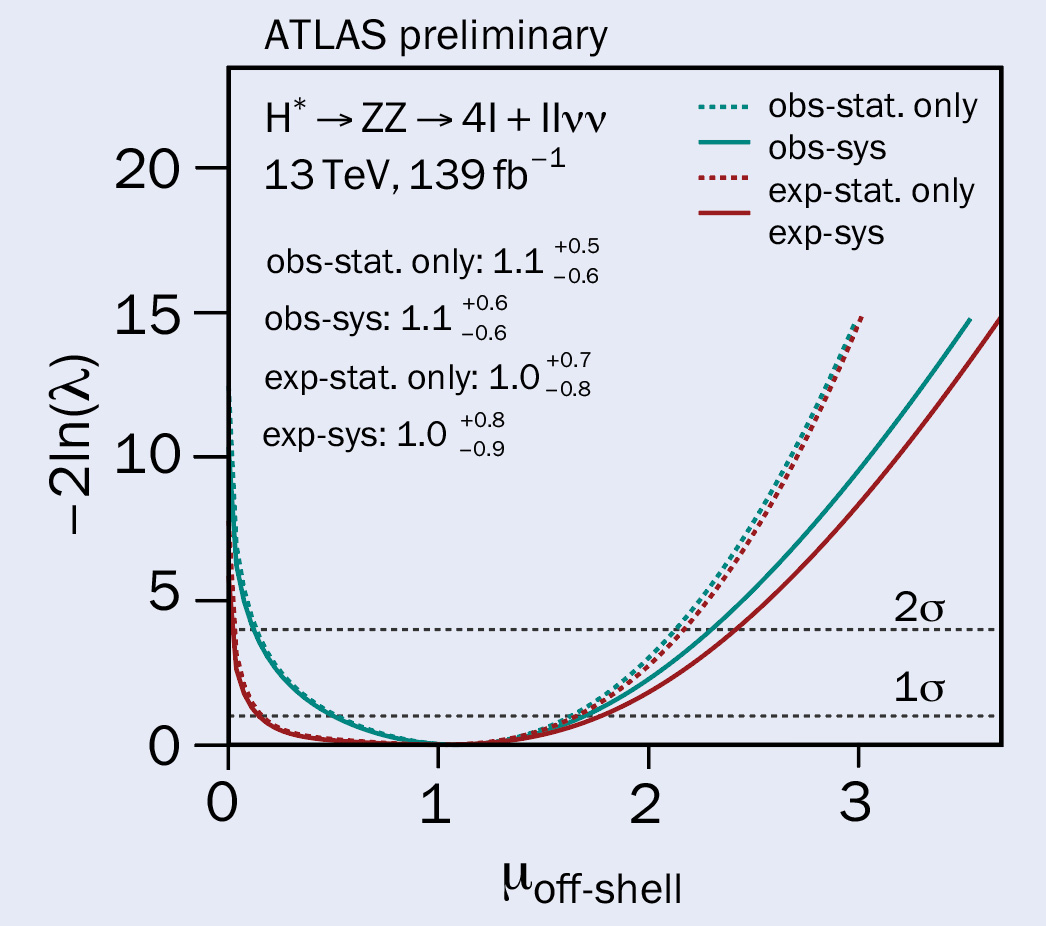
An alternative way to constrain possible undetected decays of the Higgs boson is to measure its total decay width ΓH. Combining the observed value of the width with measurements of the branching fractions to observed decays allows the partial width for decays to new particles to be inferred. Directly measuring ΓH at the LHC is not possible as it is much smaller than the detector resolution. However, ΓH can be constrained by taking advantage of an unusual feature of the H → ZZ(*) decay channel: the rapid increase in available phase space for the H → ZZ(*) decay as mH approaches the 2mZ threshold counteracts the mass dependence of Higgs-boson production. Furthermore, this far “off-shell” production above 2mZ has a negligible ΓH dependence, unlike “on-shell” production near the Higgs-boson mass at 125 GeV. Comparing the Higgs-boson production rates in these two regions therefore allows an indirect measurement of ΓH. Although some assumptions are required (e.g. that the relation between on-shell and off-shell production is not modified by BSM effects), the measurement is sensitive to the value of ΓH expected in the SM. Recently, ATLAS measured the off-shell production cross-section using both the four-charged lepton (4l) and two-charged lepton plus two neutrino (2l2v) final states, finding evidence for off-shell Higgs-boson production with a significance of 3.3 σ (figure 2). By combining both the previously measured on-shell Higgs-boson production-cross section and the of-shell Higgs-boson production-cross section, ΓH was found to be 4.5+3.3–2.5 MeV, which agrees with the SM prediction of 4.1 MeV but leaves plenty of room for possible BSM contributions.
This sensitivity will improve thanks to the new data to be collected in Run 3 of the LHC, which should more than triple the size of the Run 2 dataset.
The 20th International Conference on Hadron Spectroscopy and Structure (HADRON 2023) is to be held in Genova, Italy, from June 5th to 9th 2023.
This series of conferences started in 1985 at Maryland, USA. It brings together experimentalists and theorists every other year to review the status and progress in hadron spectroscopy, structure and related topics and to exchange ideas for future explorations.
Dark Matter 2023: From the Smallest to the Largest Scales is a conference devoted to discussing the latest developments in the field of dark matter, from experiments to theory and phenomenology. DM2023 will be held at Hotel Chiqui, just a few steps from the beautiful Sardinero Beach in the city of Santander, a well known Summer resort on the northern coast of Spain.
The meeting starts on the afternoon of May 29th and will end after the morning session on Jun 2nd.(approx. at 1:30 PM). On Tuesday 30th May, we will enjoy a welcome cocktail reception (included in the conference fee) at the beautiful Palacio de la Magdalena.
The Flavor Physics and CP Violation (FPCP) conferences are intended for the exchange of new ideas, for presentation of the latest experimental and theoretical results in the areas included in the conference title, and for discussions about future projects in the field. The conference is open to all experimental and theoretical physicists interested in the field.
This conference series results from the merging of the Heavy Flavor Physics Conference and the International Conference on B Physics and CP Violation in 2002.
The 25th Planck conference in the series “From the Planck scale to the electroweak scale” will take place in Warsaw, May 22-26, 2023. It will be focused on “Hot topics in particle physics and cosmology: theory facing experimental prospects”. Thus, its mostly theoretical character will be guided and organized according to the following blocks:
To provide the best experiences, we use technologies like cookies to store and/or access device information. Consenting to these technologies will allow us to process data such as browsing behavior or unique IDs on this site. Not consenting or withdrawing consent, may adversely affect certain features and functions.
Functional
Always active
The technical storage or access is strictly necessary for the legitimate purpose of enabling the use of a specific service explicitly requested by the subscriber or user, or for the sole purpose of carrying out the transmission of a communication over an electronic communications network.
Preferences
The technical storage or access is necessary for the legitimate purpose of storing preferences that are not requested by the subscriber or user.
Statistics
The technical storage or access that is used exclusively for statistical purposes.The technical storage or access that is used exclusively for anonymous statistical purposes. Without a subpoena, voluntary compliance on the part of your Internet Service Provider, or additional records from a third party, information stored or retrieved for this purpose alone cannot usually be used to identify you.
Marketing
The technical storage or access is required to create user profiles to send advertising, or to track the user on a website or across several websites for similar marketing purposes.