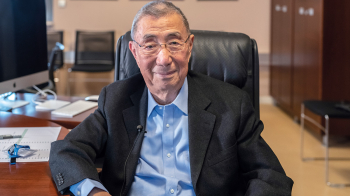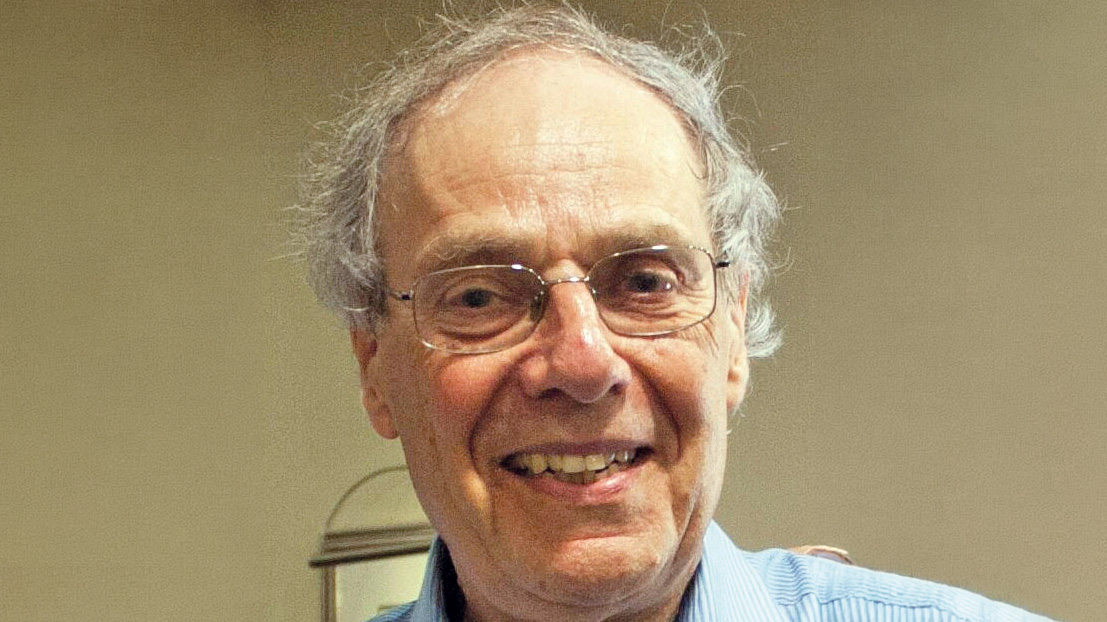
To the shock of family, colleagues and friends, Norman McCubbin died suddenly at his home in Oxford on 22 June. His long and distinguished career included vital roles in UK particle physics and at CERN.
Norman was born in north London on 27 June 1948, the eldest of three sons. His family later left Leicester for Kenya, where Norman attended Kenton College in Nairobi. He then boarded at the prestigious Repton School in Derbyshire, to which he jokingly ascribed his success in winning ballot tickets to England test cricket matches. He attended New College, University of Oxford, achieving a first-class honours degree and a doctorate. His thesis contained an analysis of K–p interactions in the CERN 2 m bubble chamber.
Norman moved to CERN as a Lancaster postdoc, working on the CHLM experiment at the Intersecting Storage Rings. After joining the Rutherford Appleton Laboratory (RAL) as a postdoc in 1976, he moved to the British–French–Scandinavian collaboration on the Wide-Angle Spectrometer and then the Axial Field Spectrometer, where he worked on the world’s first uranium compensating calorimeter. After getting tenure at RAL, Norman joined the HELIOS fixed-target heavy-ion experiment, of which he became spokesperson.
He was involved in the early stages of the ZEUS experiment at DESY, becoming leader of the RAL ZEUS group in 1990, and managed a large group of capable technical staff and research associates who worked on the construction and commissioning of the central tracking detector. Norman also played an important role in developing the experiment’s software and held senior positions, including simulation coordinator. He remained closely involved throughout ZEUS’s running.
As ZEUS matured, he began to work on ATLAS, again leading the development of the software. He was computing coordinator from 1999 to 2003, steering the decision on computing language with typically consummate tact. His advice was greatly valued by successive ATLAS spokespersons, who gave him numerous important responsibilities, including chairing the committee that in 2007 recommended task-sharing algorithms and criteria for ATLAS membership, authorship and financial contributions. He was assiduous in employing his exceptional command of English to correct and polish ATLAS papers, and maintained his keen interest in heavy ions as an expert within ATLAS.
Norman was a leader of UK particle physics, becoming first division leader and, from 2007, director of RAL’s Particle Physics Department, while gaining the admiration and respect of all who worked with him. After officially retiring from RAL in 2012, Norman continued to contribute to ATLAS and taught physics to undergraduates at St Anne’s College, Oxford. He inspired many generations of students and was an extremely popular tutor, relishing the core subjects of thermodynamics, statistical mechanics, relativity and symmetries.
Norman McCubbin was a Renaissance man, learned but never pedantic, broad in interests and expertise. He loved cricket and golf, music and current affairs. He was an exceptional physicist, publishing both cutting-edge particle-physics papers and articles on the history of physics. He will be greatly missed by his family and his many colleagues and friends.
• A fund has been set up in Norman’s memory to endow an annual prize for the best physics student at the college at which he taught, St. Anne’s Oxford.