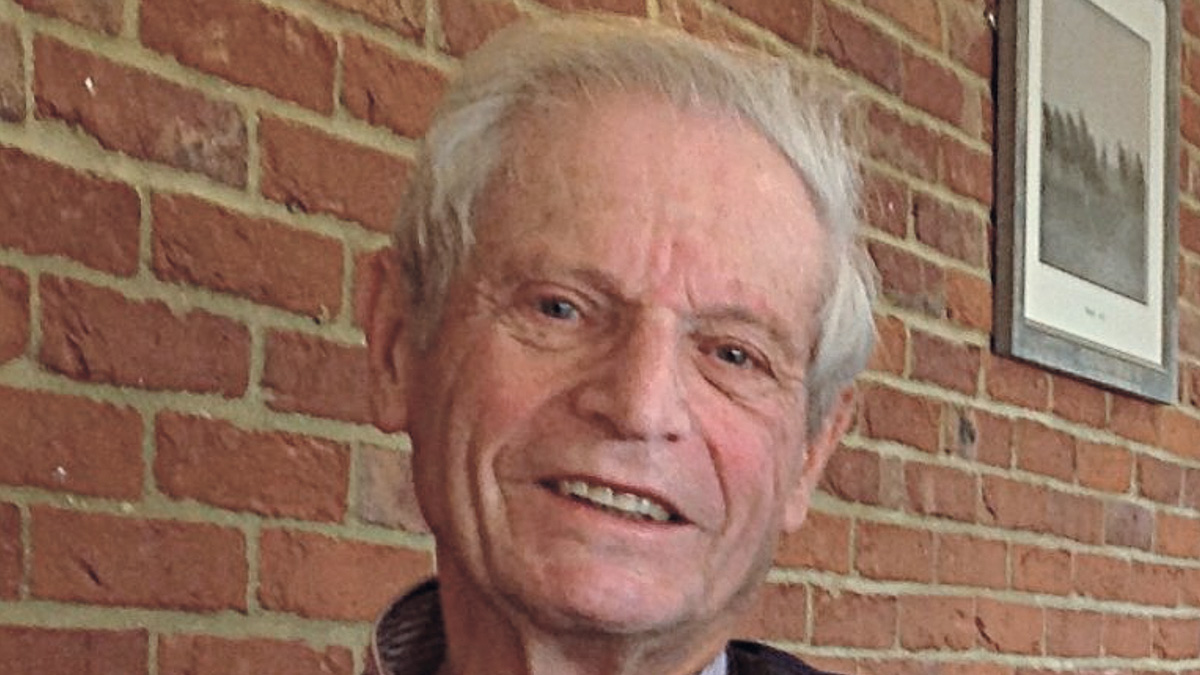
It is with great sadness that we learned George Kalmus passed away on 27 May, at the age of 91. George had a long and distinguished career in particle physics, which took him from the early days of bubble chambers to the LHC and beyond.
Born in Beočin, Yugoslavia, on 21 April 1935, George moved to London with his family in 1939. He obtained his physics degrees at University College London (UCL), gaining his PhD in 1959 with the pioneering study “Physical properties of bubble chambers”. As a research assistant at UCL, he was responsible for the design and specification of the magnet for the British Heavy Liquid Bubble Chamber. He also studied semileptonic decays of Λ hyperons with UCL colleagues and a group at the Lawrence Radiation Laboratory in Berkeley, later the Lawrence Berkeley Laboratory (LBL), using their 30-inch heavy liquid chamber.
From 1962 to 1967, apart from one year back at UCL, he worked at LBL as a research assistant, studying semileptonic Λ decays and all aspects of K+ meson decays, especially the rare semileptonic four-body K+e4 channel. He became a tenured senior physicist at LBL in 1967, switching to the study of hadron resonances using K– and π+ beams.
In 1972, George returned to Europe to lead the bubble-chamber group at the Rutherford Appleton Laboratory (RAL). His large group participated in various collaborations, with George himself proposing and working on K–p and K0Lp experiments in the 2 m hydrogen bubble chamber at CERN.
Following the discovery of open charm in 1976, he proposed and led a major experiment to investigate direct electron production by hadrons using a track-sensitive target in the Big European Bubble Chamber at CERN. He subsequently led a collaboration at the SLAC Hybrid Facility, where he instigated the addition of a high-resolution camera. This was crucial to the successful measurement, in 1982, of the decays of D mesons produced by 20 GeV photons in the 1 m hydrogen bubble chamber. His exploitation of bubble chambers and work on kaon and charm physics contributed to his election as fellow of the Royal Society in 1988.
George went on to establish the UK collaboration working on DELPHI at CERN’s LEP collider, where he applied his formidable expertise to all aspects of the experiment: design, realisation and analysis. He led RAL’s involvement in the construction of the superconducting solenoid – at the time the largest in the world – and pushed for the addition of a silicon microvertex detector, one of the first at LEP. He was elected deputy spokesman for DELPHI and chaired its collaboration board from 1986 to 1993.
George was director of RAL’s Particle Physics Department from 1986 to 1997, with wide-ranging responsibilities for the whole of the UK’s particle-physics programme, latterly including the preparation of the LHC experiments. He was appointed to CERN’s Scientific Policy Committee from 1990 to 1997 – a time that saw the approval of the LHC – and chaired it from 1999 to 2001.
In 1998 George returned to his earlier interest in ultra-rare kaon decays by joining the NA48 experiment at CERN. He retired from RAL in 2000, but not from physics, joining the ZEPLIN-III experiment to search for dark matter in the Boulby Underground Laboratory in Yorkshire, UK.
George had a special combination of scientific ability, integrity and human skills, all greatly appreciated by those who knew and worked with him. He helped many careers and led UK particle physics with a sure hand through sometimes tempestuous waters for more than a decade. We owe him a great deal. He was survived by his brother, Peter, professor at Queen Mary University of London, his three daughters and his grandchildren. Our deepest sympathy goes to the whole family.
• We are very saddened to have learned that Peter Kalmus passed away on 2 August. A full obituary will appear in a later edition of CERN Courier.