Samuel Ting reflects on seven decades in experimental physics, from testing quantum electrodynamics, through the discovery of the J particle, to the magnetic spectrometer he still runs in orbit.
Where did your path to research begin?
I was born in 1936 in Ann Arbor, Michigan, where my parents were graduate students. Soon after, as war was breaking out between China and Japan, they decided to return to save their country. I was only a few months old, so I had nothing to say. I grew up as a refugee, in many cities, one step ahead of the advancing Japanese army. In 1948, I moved to Taiwan, where I realised I was a US citizen by birth. When a delegation from the University of Michigan visited, my mother mentioned I had been born in their hospital, and its president said I could study there without paying. So I left for Michigan in 1956, flying from Taipei through Okinawa, Tokyo, Anchorage and Seattle. It was a long way. I had asked my parents for $100, telling them that American students put themselves through college without taking money from home. “You may need more,” they said. As soon as I landed in Detroit, I bought a hamburger, and it cost $1. I immediately realised the mistake I had made. Fortunately, the dean of engineering, George Granger Brown, knew my parents and took me into his home, where I discovered American football. In six years, from freshman to PhD, I never missed a single game, and I still go back every year.
Physics was not the original plan, though.
My mother was a professor of psychology, and my father of engineering. I went for engineering, too. In my second term, I had extremely good grades in all courses except engineering drawing. I could not get a single straight line. My advisor told me I was no engineer, and that I had to switch to physics and mathematics.
Once inside physics, you first head for theory. What changed your mind?
Like most students with good grades, I wanted to do theoretical physics, and I worked with George Uhlenbeck, who had co-discovered the electron spin. One day, over tea in his office, he suddenly said: “If I were to do my life over again, I would be an experimentalist rather than a theorist.” This was one of the giants of the century, so I asked him why. He said: “Every experimentalist is very useful, because you always measure a number, you contribute knowledge. Every theorist is not. You can count them in the 20th century. There is Einstein, there is Dirac, there is Heisenberg…” I took a walk in the garden, came back and said: “You are right. I am leaving you.” I knew absolutely nothing about experiments. After my PhD, I went to CERN, where Giuseppe Cocconi taught me instrumentation. Understanding your instrument is the single most important thing for an experimentalist. You must know what you can do, what to treat with suspicion and what to check, and recheck, and recheck.
From CERN, you went to Columbia, just as quantum electrodynamics (QED) was running into trouble…
A Harvard group had measured electron–positron pair production and found an electron radius of 10–13 to 10–14 cm, in contrast with QED. The result was soon confirmed independently. No question mattered more, and I decided to do the experiment myself. Colleagues I had met through my work at CERN put me in touch with Willibald Jentschke, the founder of the Deutsches Elektronen-Synchrotron (DESY) in Hamburg, and he invited me.
How did your experiment work?
We repeated the measurement with an independent method. When you send photons onto a target, the rate at which they convert into wide-angle electron–positron pairs tells you whether QED holds at small distances. To deal with the enormous background associated with our 1011 photons on target, we built a pair spectrometer. In it, a magnet bends the pairs away from the photon beam, and the detector sits behind it. Measure once and measure twice, and the magnet sweeps away the background of the first measurement before the second. We showed that QED was correct, presenting the result at a 1966 conference in Berkeley. Feynman, of course, was very happy. The spectrometer then led us to the heavy photons: the vector mesons rho, omega and phi, which share the photon’s quantum numbers, apart from their masses. After years of this work, I asked myself why every vector meson sat near 1 GeV. Rho at 765 MeV, omega at 783, phi at 1020. Could there be something heavier?
What did it take to find out?
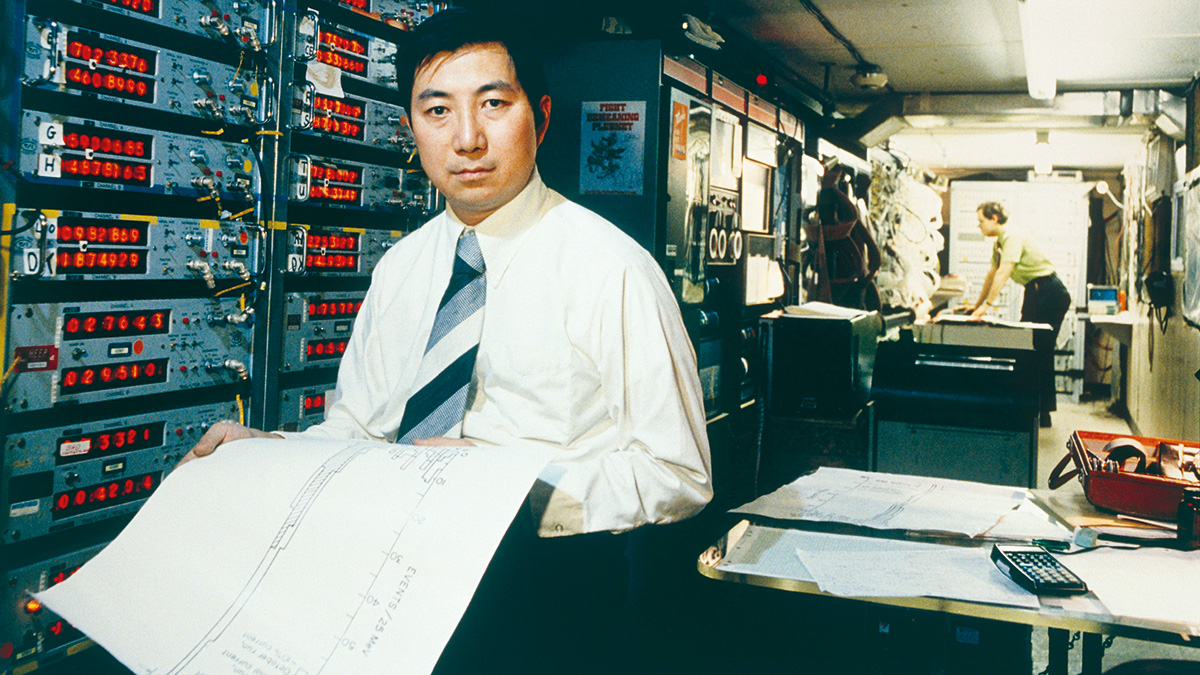
At the time, people were more interested in the strong interaction, so it was hard to get the experiment approved. Fortunately, Brookhaven accepted it, and MIT, where I had just returned, went all the way to support us. The design was the same as at DESY: we sent protons onto a target and measured the mass of the electron–positron pairs coming out, looking for a peak. With some 108 hadrons produced for every electron pair, the detector had to misidentify no more than one hadron in 1010. We were extremely careful with the instrument. In July, I was taking data at higher pair masses, around 4 to 5 GeV, and finding absolutely nothing. So I moved to lower energies, and suddenly all the particles came out, always at a mass of 3.1 GeV (see “The peak” image). No other particle, nothing. To verify it, we lowered the magnetic field by 10%, which moved the particles to a different region of the detector. Had it been background, it would have disappeared.
It did not disappear, of course. What happened next?
On 11 November, I learned that Burton Richter had also seen the same peak at SLAC, and we called Giorgio Bellettini at Frascati, where they reproduced the result within days. The particle, which we called J, lived some 10,000 times longer than comparable hadrons, indicating a new kind of matter: a fourth quark bound to its antiquark. Before, the quark model had been one respected idea among many. Afterwards, it carried a much heavier weight. As it deserved.
The name itself has gathered legends. Can you set the record straight, once and for all?
There are many theories. One says that J resembles my name in Chinese. Another that J is the first letter of Jeanne, my daughter’s name. Neither is true. We had come from the vector mesons, and in the vector-meson dominance model, the electromagnetic current is Jμ. That is where the J came from.
Those were also the years of your return to China, almost 30 years after you had left. How did it happen?
I had left in 1948, on a boat from Shanghai. I was 12 years old, and my mother took me up to the deck to look at China. “You may never see it again,” she said. In 1975, an invitation from the Chinese Academy of Sciences brought me back, and in 1978 came another, to lunch with Deng Xiaoping. He turned out to know his nuclear physics, and his wife and son were physicists. The lunch was excellent, as he had very good taste in food. It was just after the Cultural Revolution, and he asked: “How about we send some physicists to work with you?” That night, I called Herwig Schopper, who led DESY, and Schopper called Bonn. The next day, I could tell Deng that the German government would welcome them. “Good,” he said, “let me send 100 people.” I answered: “There is a difference between training soldiers and physicists. Select of the order of 10, and let me interview them.” I spent hours with each one, asking them to ask me questions, because when I asked, they could not answer. From that year on, they kept coming, and the three most recent director-generals of the Institute of High Energy Physics in Beijing all came from this school.
At PETRA you led the MARK-J experiment, which shared in the discovery of the gluon. Then came L3, at CERN’s Large Electron–Positron collider (LEP)…
MARK-J was built to measure the forward–backward asymmetry of muon pairs, seeking evidence for the existence of the intermediate vector bosons, and could rotate in both θ and φ to reduce the systematic errors. It went on to provide the first experimental evidence for the existence of the Z0. The accidental discovery of gluons at MARK-J was due to the detector’s ability to show that the three-jet distributions and their production rate were both in agreement with QCD. L3 then took 20 years, and 20 countries, East and West Germany, Pakistan and India, China and Taiwan among them. We never found a name for the detector, which remained simply the third letter of intent submitted for LEP. From L3 came 300 PhDs, and results that can be stated simply. Three charged leptons, three neutrinos, six quarks. Everything agreed with the electroweak theory. I knew Steven Weinberg quite well, and he was very happy. I told him, “I would be much happier if I did not agree with you!”
You were also involved in the Superconducting Super Collider (SSC), cancelled in 1993. Where did that leave you?
When Congress closed the SSC, I was almost 60 and had spent my entire career at accelerators. I remember distinctly walking back and forth in my garden and realising that retirement was not an option. I decided to work on something completely different, a problem I knew nothing about. Years earlier, at Brookhaven with Leon Lederman, I had helped find the antideuteron, the first antimatter nucleus, and the question had stayed with me: if antimatter binds into nuclei and exists anywhere in the universe, some of its nuclei would reach us as cosmic rays. Looking for them meant putting a magnet in space, and nobody thought that was possible. A magnet in the Earth’s field is a compass: one end points north, the other south. On a space station, it is unstable. Working out a magnet whose torques would cancel took many years.
… and a rocket to carry it to space. How did you get NASA on board?
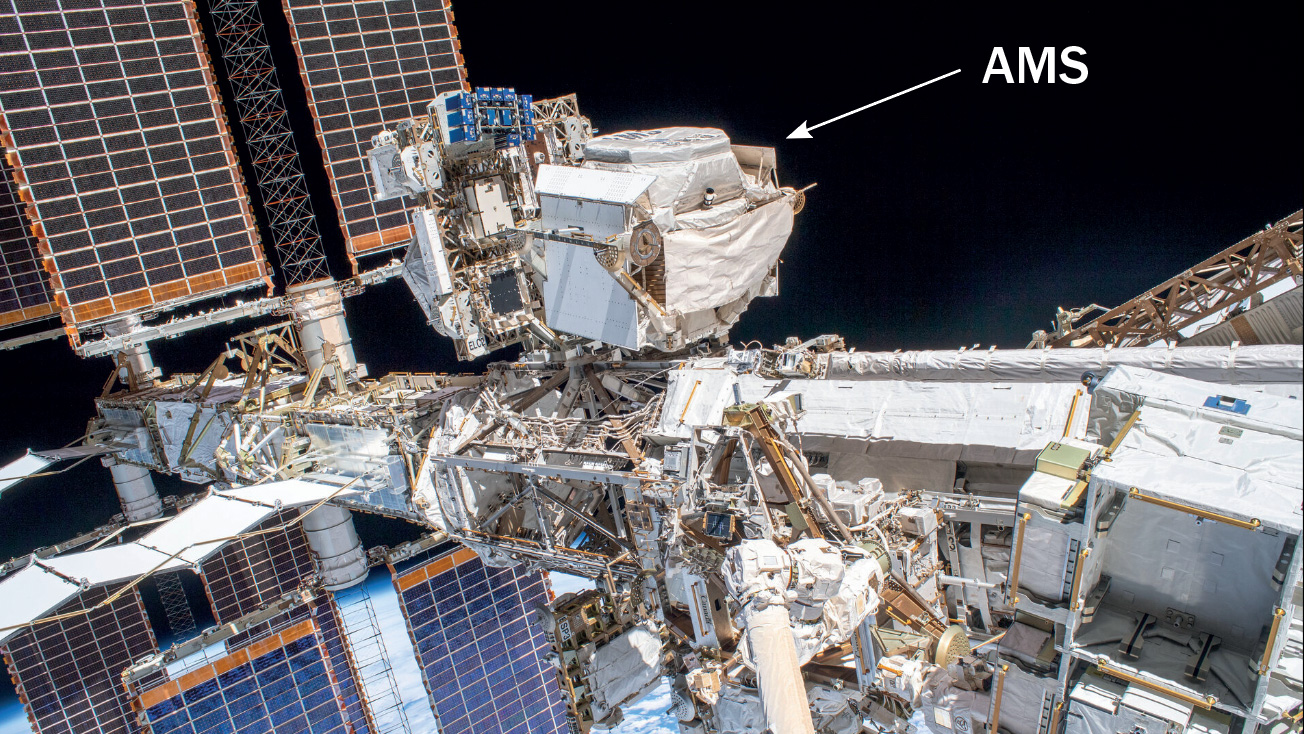
Roald Sagdeev, who ran Russian space research, recommended me to Dan Goldin, the head of NASA. When Goldin asked how heavy my detector was, he caught me off guard. “My last experiment, Mr Goldin, weighed 10,000 tonnes,” I said. His advice was to build a magnet, fly a prototype on the shuttle and, if it worked, go to the International Space Station (ISS). That magnet became the Alpha Magnetic Spectrometer (AMS). The prototype flew in 1998 and went quite well, so for the ISS we built something more ambitious: a superconducting magnet. Then, in April 2010, I discovered the shuttle programme had been cancelled, and without shuttles to refill its superfluid helium, the superconducting magnet could not survive. When you have been totally involved in an experiment for years, you can only go forward. We took AMS apart and rebuilt it around the permanent magnet very quickly. Otherwise, it would not be flying today.
AMS has now spent 15 years on the ISS. What is it like to run such an experiment from Earth?
In space, there is no Christmas, no summer vacation, no weekend. The ISS never stops, so you take data all the time. And space is unforgiving: if something goes wrong and you do not know it, you will make a mistake, so we check the instrument every two minutes. When the cooling system stopped, the only way to replace it was an open-heart surgery, performed by astronauts, where one wrong cut would have ended the experiment. NASA spent three years training them in a swimming pool. I have known many astronauts. They are all very intelligent, but also extremely calm. In space, the distance between life and death is very short. You must discipline yourself.
On to the results, then. AMS has been collecting positrons since day one. What have they shown?
So far we have 4.2 million of them, up to the TeV region, and the spectrum is not a smooth curve. The low-energy part can be explained by ordinary cosmic-ray collisions. But at high energies, there are far more positrons than collisions can produce, and this excess rises and then drops suddenly, around 810 GeV. It must come either from a new source, such as pulsars, or from dark-matter collisions, and we cannot yet tell which. The antiprotons, though, behave in the same way, and antiprotons cannot come from pulsars. If it is dark matter, its mass must be around 1.5 TeV.
And the antimatter?
We have a few antihelium candidates, particles with a charge of minus two and masses up to about 3.8 GeV, but we have announced nothing. The rate is one in 108, and no one knows their instrument to better than 1%. Even 1% is a miracle. Another magnet on top would settle it, but it would weigh 15 tonnes, and nothing can carry 15 tonnes to space. So we wait patiently, either for more candidates or for anti-carbon and anti-oxygen. Fortunately, there is no competition.
AMS also measures matter nuclei in cosmic rays. What have you found there?
In total, we have measured 265 billion cosmic rays. Among them, we can identify 28 elements of the periodic table, from hydrogen up to nickel, and measure them all very precisely. Each element has its own rigidity spectrum, so you would expect them to have different spectral shapes. In the 20 elements we have analysed so far, we see only four, two from the primary cosmic rays and two from secondaries produced by collisions along the way. Every element is a combination of these four, and none is explained by current models. There are hundreds of suggestions as to why. I do not spend time on them, because our first obligation is to ensure the data are correct: over the next 40 or 50 years, no spectrometer will repeat this measurement. The coming upgrade, a new tracker layer on top of the detector, exists just for that.
More broadly, where do you see particle physics going?
I do not know who is qualified to answer this question! Before the discovery of the J particle, nobody would have done physics on it. The future really depends on the next discovery. You have to go forward.