Read article 'Ready for the Bs'
Ready for the Bs
In February, physicists at SLAC, Stanford, successfully finished commissioning the PEP-II B-factory.

 Read article 'Ready for the Bs'
In February, physicists at SLAC, Stanford, successfully finished commissioning the PEP-II B-factory.
 Read article 'CMS experiment crystal clear'
As a result of the technological problems to be solved and the global level of participation in the major experiments at CERN's LHC proton collider, supply and manufacturing has to explore unusual so...
 Read article 'Leader of the PAC'
his years's Particle Accelerator Conference in New York City on 29 March - 2 April included news from several major new machines that are beginning to flex their muscles.
 Read article 'What’s the quark matter?'
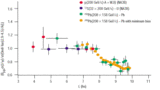
Careful analysis of data collected by the NA50 experiment studying high-energy heavy-ion collisions at CERN shows clear signs of new behaviour, suggesting that under these conditions the colliding nu...
 Read article 'Astrowatch'
Gamma-ray bursts The most powerful objects in the universe are also the most mysterious. Gamma-ray bursts can emit more energy in a few seconds than all of the 1011 stars in our galaxy emit over a few...
Read article 'Michael Witherell to direct Fermilab'
Michael Witherell, from the the University of California, Santa Barbara, will succeed John Peoples as director of Fermilab on 1 July. The search for a new Fermilab director began last year, when John ...
 Read article 'CP violation gets clearer'
New data from the KTeV experiment at Fermilab blow away some of the fog around the mystery of CP violation and underline the effects suggested by earlier results from CERN.
 Read article 'HERA strikes it RICHER'
The article "HERA strikes it RICH" in the November 1998 issue described the first rings seen in the Ring Imaging Cherenkov (RICH) being commissioned for the HERA-B experiment at the HERA electronpro...
Read article 'Another way to get RICH'
A prototype detector for the ALICE experiment at CERN's LHC collider will be installed in the STAR detector at Brookhaven's RHIC heavy ion collider, scheduled to come into action this year.
 Read article 'Historic hardware'
Article reporting the exhibition of hardware used to detect the W and Z particles in the microcosm exhibition.