By Frank Close, Taylor & Francis. Paperback ISBN 9781584887980 £22.99 ($39.95).
Back in 1983, the world of particle physics was very different: LEP was under construction and the LHC was just a dream for a few people; the top quark had not been discovered; the amount of dark matter in the universe was not known; and dark energy was not even imagined. However, high-school physics was much the same as it is now, with most lessons focusing on the basics and rarely touching on “modern” state-of-the-art science. “Popular science” books were not in abundance, so it came as a breath of fresh air when the first edition of The Cosmic Onion was published. According to Close, the original “inspired a generation of students to take up science”. A grand claim indeed, but not without substance – the author of this review is living proof.
Like the original version, the revised one takes the reader through the most important periods in particle physics, from the discoveries of atoms and nuclei to our most up-to-date theories, including the Higgs mechanism, supersymmetry and grand unified theories. Close tackles some difficult topics along the way, such as QCD and the electroweak force, yet manages to convey their intricacies in a clear and concise manner. This is helped by the fact that each chapter contains a number of self-contained boxes that explain the more advanced concepts. The book finishes with a chapter devoted to the relationship between particle physics, cosmology and the Big Bang – a fitting end, or should that be start?
I found the chapter on the LEP era particularly good. Although it is relatively short, it provides a good summary of the most important findings of the previous “big accelerator” at CERN. It includes hints of new physics that should become clearer once the LHC is operating. Much of the book can be seen as explaining why we are building the LHC, and this should appeal to high school students interested in a career in particle physics – some of whom may end up analysing LHC data in years to come.
There are many differences in the content between the original and The New Cosmic Onion, bringing it up to date without changing the overall style. Close also manages to avoid delving into the realms of fiction, sticking with the most likely theories and avoiding the more exotic ones. This does not make the book any less enjoyable – far from it. Even though the world has changed and the number of popular particle-physics books available has grown enormously, The New Cosmic Onion remains distinct and one of the few books that is enjoyable to read, plus it is a useful reference for physics students. Let’s hope it will inspire another generation of particle physicists.
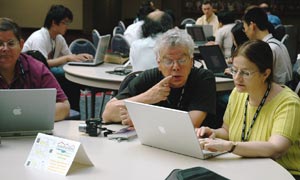
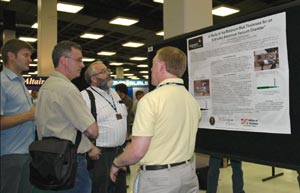
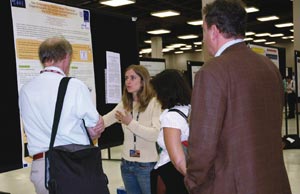
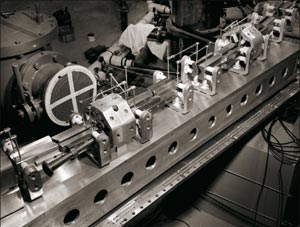
The 22nd Particle Accelerator Conference, PAC ’07, held in Albuquerque on 25–29 June was one of the largest yet. Nearly 1400 participants and 70 vendor companies attended, and more than 1400 papers were published, again demonstrating the important and prolific work that worldwide collaborations are doing in a multidisciplinary field. In all, it was a great success. This article briefly reports the highlights.
The high-energy frontier is still luring particle physicists and challenging accelerator designers and builders, with the next big step being the LHC at CERN. Following the accumulation of several minor delays, CERN dropped the plan for a low-energy run of the new collider later this year. The schedule foresees the commissioning of the machine at full energy starting in spring 2008. At the conference, talks and posters dealt with schemes for optimizing the performance of the LHC, as well as the potential for upgrades.
Meanwhile, US efforts at RHIC at the Brookhaven National Laboratory (BNL) now include luminosity improvements that will require the development of a facility at the cutting edge of beam cooling. Estimates suggest that electron cooling will require electron energies up to 54 MeV at an average current of 50–100 mA, and in a particularly bright electron beam. The aim is to generate this electron beam in a superconducting energy-recovery linac (ERL) using a superconducting RF gun with a laser–photocathode. An intensive R&D programme is currently underway. There are also plans for RHIC to produce 200 GeV polarized protons routinely, once there is a better understanding of the effects of polarization loss owing to intrinsic high-energy spin resonances. The acceleration of electrons at the proposed e-RHIC will allow continuity in the experimental programme, followed earlier at HERA, the electron–proton collider at DESY that shut down in July after 16 successful years of operation.
At Fermilab, the luminosity of the Tevatron proton–antiproton collider continues to improve, setting the record for hadron colliders. Fermilab has achieved the first electron cooling of a relativistic hadron beam (8 GeV antiprotons in the Recycler), contributing heavily to the success of Run II at the Tevatron. Studies of ways to improve further the beam–beam compensation efficiency in the Tevatron are also underway. Tests have already demonstrated compensation using electron lenses, paving the way for beam–beam compensation in RHIC and the LHC.
The conference also heard reports on the commissioning of multibatch slip-stacking in the Fermilab main injector. This technique has allowed doubling of the neutrino intensity for the Neutrino beam for the Main Injector (NUMI) project. Incorporating the Recycler for proton accumulation yields a four-fold increase in the neutrino source and may lead to a project dubbed SuperNUMI, although this could face strong competition from the Japan Proton Accelerator Research Complex (J-PARC) and an upgraded CERN Neutrinos to Gran Sasso (CNGS) project. Further steps will be necessary to ensure a leading position for the US in long-baseline neutrino experiments, such as Fermilab’s proposed Project X.
The high-energy frontier brings challenges that can only be met by strong, successful international collaborations. Barry Barish, director of the Global Design Effort for an International Linear Collider (ILC), reviewed the status, plans and main issues towards an ILC project. The Reference Design Report for the ILC, which will be based on superconducting (SC) RF technology, should be released in the coming months. The current baseline configuration uses the TESLA project’s SC cavity shape for the 500 GeV stage and assumes an accelerating gradient of 31.5 MV/m. The R&D programme includes work on alternative cavity shapes that promise higher gradients, but the designs are not yet mature enough to adopt as the baseline. The ILC will complement the LHC by allowing precision measurements at well-defined energy and angular momentum in the same regime, without the complications of the complex composite structure of the protons.
The push towards even higher energies requires innovative approaches. Visiting researchers from the University of California Los Angeles and the University of Southern California are working with researchers at SLAC to investigate plasma wakefield acceleration and have already demonstrated the energy-doubling of the 42 GeV electrons from the three-kilometre long SLAC linac in a plasma device less than a metre long. The implied acceleration gradient of 50 GeV/m is more than three orders of magnitude greater than in the SLAC linac. The same team had presented at PAC ’05 the results of a first demonstration of an energy gain greater than 1 GeV. It is remarkable that they extended their work in such a short time to test the concept of a plasma afterburner for doubling the energy of a beam from a real collider. This concept is expected soon to become a realistic technology for building future accelerators.
Lower energies, higher powers
At low to medium energies, the emphasis is often on achieving higher powers, either in sources or injectors for higher-energy machines or to deliver final beams at lower energies. The conference heard the latest results from commissioning studies at J-PARC and at the Spallation Neutron Source (SNS) at Oak Ridge. Both facilities are producing exciting results and are on track for ramping up to high beam powers. There were also reports on the successful first-stage commissioning of TRIUMF’s Isotope Separation and Acceleration (ISAC) facility, ISAC-II; the status of the Dual-Axis Radiographic Hydrodynamic Test phase II commissioning at the Los Alamos National Laboratory; and the results from commissioning of the proton linac for the Low Energy Neutron Source at Indiana University. Talks about non-scaling, fixed-field alternating gradient (FFAG) accelerators discussed new developments in this class of machine. There were also reports on the status of the Facility for Antiproton and Ion Research (FAIR) at GSI and on the results of longitudinal profile measurements made in the SNS linac.
Invited speakers on the latest source and injector technology looked at the development of reliable high-current, low-emittance injectors for various applications, particularly high-power spallation sources and heavy-ion fusion. Specific topics included GaAs-based photoguns with a high degree of polarization, and laser-driven sources of heavy ions with an emphasis on direct plasma injection into the subsequent accelerator structure. The general design principles for an electron cyclotron resonance (ECR) source of heavy ions were illustrated with a design for an advanced ECR. The meeting also discussed a multi-beamlet injector for a heavy-ion fusion accelerator, as well as the test and production versions of a high-performance electron-beam ion source for very highly charged heavy ions. In addition, contributed papers presented an optically pumped source of polarized H– ions with a very high degree of polarization; new development approaches with RF-driven H– ion sources; model-based optimization of plasma parameters for ECR ion sources; and a comparison of measured and simulated beam inhomogeneities found with ECR ion sources.
Applied accelerators
Accelerator-based facilities support a rich and diverse set of user programmes in basic and applied science, but at the same time there is an increasing number of varied applications for accelerators. The interest in hadron therapy continues to grow around the world as the number of new facilities in both design and construction stages demonstrates. Although cyclotrons and synchrotrons are the technologies of choice for these facilities, efforts to optimize cost and performance have reinvigorated interest in other technologies, such as FFAGs. New concepts for strengthening US national security involving accelerator technology and the production of particle and photon beams are also emerging, as scanning systems are tailored to address specific concerns. In addition, high-power, energy-recovered free-electron lasers (FELs) are enabling new applications for accelerators in research and industry.
The next generation of advanced light sources will provide many exciting research possibilities. Recent advances, such as ERLs, are making intense, broadly tunable sources of X-ray and XUV radiation feasible. These will allow real-time studies of reaction dynamics in chemical systems on the femtosecond timescale – previously thought impossible. The only short-wavelength FEL currently in operation is the FLASH facility at DESY. Important “pump probe” experiments are already underway there to test the theory. Future facilities may lead to quantum-level chemical control and reaction initiation at room temperatures, and may offer new insights into the dynamic behaviour of matter at the atomic level.
The success and continuing progress of three operating FELs based on ERLs (the Jefferson Lab IR FEL, the Japanese Atomic Energy Authority’s FEL and the high-power THz FEL at the Budker Institute for Nuclear Physics) promise many future applications in ERL technology. Besides high-power FELs and light sources, applications also include electron cooling and high-luminosity electron–ion colliders. The challenge will be in achieving high electron source brightness, maintaining high beam brightness during beam transport and acceleration/deceleration, and controlling high and peak current effects in superconducting RF systems. Some of these challenges are already being addressed within the projects now underway to build X-ray FELs at SLAC, Spring-8 and DESY. All three of these XFELs will rely on the principle of self-amplified spontaneous emission, which does not require mirrors and allows wide wavelength tunability. Talks and posters covered current progress at these facilities as well as new concepts based on computer modelling and theory.
As is now the trend, the largest number of contributions at the conference concerned beam dynamics and the accurate computation of electromagnetic fields. Implementation of 3D electromagnetic simulations for complex geometries and processes continues to advance in direct proportion to advances in computer hardware and storage capabilities. The direct link between these calculations and the ability to optimize the performance and operation of modern accelerators is clear. Scientists are developing sophisticated models to address many of the difficult technical issues facing the next generation of machines, such as beam losses and halo formation in high-intensity hadron beams, space-charge driven resonances, tailoring beam phase-space distributions, and understanding electron cloud effects. Talks and posters at the conference presented a broad range of topics, including collective effects and instabilities, developments in codes and simulations, single- and multi-particle dynamics, and beam optics. In particular, the conference heard of the latest simulation and experimental results of bunch compression in high-intensity electron bunches – important for both current and next-generation FEL projects.
Talks on instabilities and feedback emphasized new results in controlling collective effects through wideband feedback and in impedance or instability computation, benchmarked with instability observations. These included the successful demonstration of wideband feedback against electron–proton instability and for longitudinal stochastic cooling of a high-energy bunched beam. Two studies of the suppression of the electron cloud effect have led to in situ tests of TiN/Al-coated flat and grooved chambers and an idea for a distributed, low-impedance clearing electrode. Other contributors described analytical and/or experimental studies of novel instabilities in cooled antiproton beams, the possible interplay between resistive wall and fast beam-ion instability, and vertical instability in a proton bunch tail; they also discussed cures. Finally, impedance computation remains an important subject, in particular the accurate computation of the transverse impedance of LHC collimators verified with beam tests, reduction of taper impedance through nonlinear tapering, and the use of the impedance database computation method to predict accurately single bunch limits and collective effects.
The integration of sophisticated beam modelling and computer controls continues to advance. The conference heard about recent progress in developing software tools for commissioning the SNS, while posters and talks also discussed modern accelerator control architecture and its use in machine and personnel protection. A concluding overview of modern accelerator control systems emphasized the continuing need for global standardization and collaboration. Although construction of the ILC is not imminent, much thought has already been given to the control and operation of this machine of the future.
The next PAC conference will be in Vancouver in June 2009.
In the spring of 1947, Philip Morse and M Stanley Livingston visited Cornell University, where I was a post-doc working in nuclear physics under Hans Bethe. They talked about the newly established Brookhaven National Laboratory (BNL), where Morse was the director and Livingston was in charge of a project to build a gigantic accelerator that would reach 3 GeV – which was 10 times what anyone had achieved previously. This fascinated me, and I accepted their invitation to join the project for the summer. I worked with Nelson Blachman at BNL on some of the orbit problems of the proposed machine, and discovered that I enjoyed this type of work. I returned to Cornell, and joined the laboratory permanently the following year.
The project to build the Cosmotron (so called because it would almost emulate cosmic rays) proceeded, and by early 1952 success was in sight. French physicist Edouard Regenstreif of the University of Rennes visited us in the spring. He represented a consortium of 12 European countries (Conseil Européen pour la Recherche Nucléaire – the provisional CERN) that aimed to establish a new laboratory featuring an accelerator like the Cosmotron, only bigger. We showed him what we had, and he was duly impressed.
On 20 May 1952, the Cosmotron accelerated a beam of protons to a little more than 1 GeV – by far the highest energy ever attained by artificial acceleration – just 20 years after Livingston and Ernest Lawrence had achieved the first million volts with a cyclotron. The energy soon came close to the design value of 3 GeV and almost immediately we started to ask ourselves how our success could be extended to higher energy. Livingston (who had returned to the Massachusetts Institute of Technology in 1948) came back for the summer to lead a study group.
A delegation from CERN was due to follow up on Regenstreif’s visit to see whether they could pick up some pointers from us. They were planning to build a proton synchrotron similar to the Cosmotron as the centrepiece of their new international laboratory, but with an energy of around 10 GeV. Our study group considered what advice we could give them.
The story of how we came upon the “strong focusing” or “alternating gradient” scheme, which enhances orbit stability, has been told many times. The most important consequence of this enhanced stability is that the magnets for an accelerator may be much smaller, making it feasible to go to higher energy at a reasonable cost. We promptly considered the possibility of building new accelerators in the range of 30–100 GeV.
A week or two later the delegation from CERN arrived, comprising Odd Dahl, who had worked with high-voltage machines in Washington before the war; Frank Goward, one of the first people to make a working synchrotron; and Rolf Wideröe, the Norwegian who had first devised a scheme to use radio frequency repeatedly to produce more energy than the corresponding voltage, and whose 1928 paper led to Lawrence’s invention of the cyclotron. The visitors were impressed, and they returned home recommending the new method to build an accelerator for 30 GeV, rather than the planned 10 GeV.
Shortly afterwards, John and Hildred Blewett and I received an invitation to travel to Europe to discuss the new idea with CERN physicists. We set out in November – in sleeper berths on a Boeing Stratocruiser – on a 12-hour, non-stop flight to Paris. We met a number of interested people in a meeting led by Pierre Auger at UNESCO headquarters. It was there that I met Kjell Johnsen, leading to a friendship lasting until his death this summer. A number of people went to Geneva to look at an empty field as a possible site for the accelerator.
I left Geneva for my native city of Göttingen, to give a talk (the only one I have ever given in German) to Werner Heisenberg and people at the Max Planck Institute. I went on to Copenhagen to see Niels Bohr and his people, some of whom had built a mechanical model illustrating how alternating focusing and defocusing can give stability. The Blewetts went to Bergen for discussions with Dahl and I concluded my European trip with a visit to Harwell in England – which, as far as I can recall, is when I first met John Adams and Mervyn Hine.
Back at BNL, we went to work on exploring the requirements for actually building an accelerator – and of course the CERN people did the same. Both groups decided to aim for an energy of around 30 GeV – and the race was on. However, we collaborated in this race as much as we competed, sharing internal reports and informal communications. The Blewetts took six months’ leave in 1953 to work with Dahl in Bergen. At the time, CERN was scattered over several sites prior to the establishment of the central laboratory in Geneva. At a conference at the University of Geneva in October 1953, participants discussed the theoretical and technical design issues for an alternating gradient synchrotron. I was one of several American participants and Hildred Blewett edited the proceedings – I still have a copy after all these years.
The rivalry and collaboration between the projects at BNL and CERN continued. As a result, the two accelerators are similar in overall design, not only in size but in most of the details. The machine at BNL is called the Alternating Gradient Synchrotron (AGS) and the one at CERN is the Proton Synchrotron (PS); in fact, both names apply to both machines.
There were still some differences. One possible problem was a phenomenon called the “transition energy”, an energy where the mechanism of phase stability demands a sudden change of phase of the accelerating field. All the theory – by Kjell Johnsen at CERN and me at BNL – predicted that this should be easy to deal with. The people at CERN were convinced that this was correct, while some of the powers-that-be at BNL decided that they would feel safer if there was an experimental demonstration of the feasibility of going through this critical energy. As a result, BNL built a small-scale model (the Electron Analog) to verify that calculation, while CERN did not. The Electron Analog worked perfectly, but it cost us some time. Consequently, CERN won the race – they had an accelerated beam in 1959, while ours came in 1960. Each was the world’s highest-energy accelerator when it came on.
There are numerous accelerators and colliders today with energies exceeding the PS and the AGS. These two venerable machines are approaching their 50th anniversaries and are breaking records in longevity rather than energy. They now function as injectors for their successors: the AGS for RHIC at BNL, and the PS for the SPS at CERN – which the LHC will soon succeed. Continued collaboration between BNL and CERN – and other high-energy laboratories around the world – is a matter of course.
Lee Teng: une carrière passionnée dans les accélérateurs
Cette année, la Société américaine de physique a décerné le prix Robert R Wilson de la meilleure réalisation en physique des accélérateurs de particules à Lee Teng, du Laboratoire national d’Argonne. Ce prix marque non seulement l’apogée d’une carrière prestigieuse, mais reflète aussi un parcours de 60 ans, qui a commencé en 1947, lorsque Teng a quitté la Chine pour les États-Unis. Sa carrière, qui a débuté au Synchrocyclotron Fermi, à Chicago, illustre les cinquante dernières années des accélérateurs de particules, car il a déployé sa créativité dans tout le domaine, notamment en inventant l’extraction résonnante et en dirigeant la conception d’une installation de protothérapie.
Each year, the American Physical Society (APS) confers awards to outstanding researchers across the field of physics. This year, those honoured include Lee Teng, senior physicist emeritus at the Advanced Photon Source, Argonne National Laboratory (ANL). Officially, the award is for his inventions, not his passion. Unofficially, everyone who knows Teng knows him for his passion for speed – particle speed, that is – and for his sincere desire to direct his passion for the benefit of the public.
Teng received the 2007 Robert R Wilson Prize for achievement in the physics of particle accelerators during the 22nd Particle Accelerator Conference in Albuquerque (see “Accelerator experts meet in Albuquerque“). The APS honoured him for "the invention of resonant extraction and transition-crossing techniques critical to hadron synchrotrons and storage rings; for early and continued development of linear matrix theory of particle beams; and for leadership in the realization of a facility for radiation therapy with protons." The award not only marks the zenith of a distinguished career, but also a 60-year journey that began in 1947 when Teng arrived in the US from China.
Reviewing Teng’s career is like studying the history of particle accelerators of the past 50 years. "I am very blessed to have been involved with particle accelerators at this time. The field witnessed great advances and I was able to contribute to all phases of the progress," says Teng. "Since the early development of particle accelerators in the 1930s, there have been significant breakthroughs every five years or so, and we have experienced rapid progress with tremendous momentum."
Starting out at the University of Chicago, Teng worked as a graduate assistant on the "Fermi" synchrocyclotron project, which at the time was the most powerful accelerator available. It was there that he made his first major achievement, discovering the method of "regenerative extraction" – now known as "resonant extraction" – to extract the beam after the proton is accelerated. To this day, this is the only beam extraction system for cyclotrons, with an extraction efficiency of nearly 50%.
Teng obtained his PhD from the University of Chicago in 1951 and he soon joined the University of Minnesota, as the university was in the midst of building a linear proton accelerator. To increase beam intensity, Teng designed a quadrupole focusing system for the linac using a matrix formulation derived from his regenerative extraction system – the first application of a matrix formulation to alternating gradient focusing systems.
Teng joined ANL in 1955 after a short period at Wichita State University. He rose to become director of the particle accelerator division in 1961, responsible for constructing and operating the Zero Gradient Synchrotron (ZGS) and the associated beam transport lines and bubble chambers. During his tenure, the division accomplished several important innovations in accelerator design and operation, making the ZGS the highest-energy weak-focusing synchrotron ever built – and possibly the last.
If passion plays a role in Teng’s adventure in exploring the world of particle accelerators, it is his risk-taking, sound judgement, and willingness to step forward that make him stand out from the crowd. He joined Fermilab in 1967 as the head of accelerator theory and remained there for 22 years. During this time, Teng witnessed the changing world of accelerators and anticipated the enhancement of synchrotrons from 70 to 900 GeV, including Fermilab’s launch of the world’s first superconducting accelerator in February 1984. He served briefly as the associated director of the Accelerator Division in the early 1980s, later becoming head of the Advanced Accelerator Project.
Once the commissioning of the Tevatron collider system had passed smoothly, Teng began to look for projects that required shorter construction times and delivered faster pay-offs than high-energy machines. It was then that his life took another turn, parting from the exciting frontier of high-energy physics to choose an avenue that he hoped would "make something that is more immediately useful for human lives".
This change in direction led him to Asia, and he took a two-year partial leave of absence from Fermilab in 1983 to serve as the founding director of what is now the National Synchrotron Radiation Research Centre (NSRRC) in Taiwan. He led the design and construction of the first third-generation synchrotron radiation facility in Asia. The Taiwan Light Source boasted more than 7000 running hours a year after its completion in 1993, and more than 95% reliability. It now has 30 beamlines and nearly 1500 scientists and students use it. In 2004, the NSRRC began the planning of a second facility, a 3-GeV synchrotron radiation source.
Back at Fermilab, in a meeting of the Proton Therapy Coordination Group in 1986, Jim Slater, the head of the radiology department of Loma Linda Hospital in California, proposed that Fermilab should design and build a proton accelerator for cancer therapy. Teng, naturally, took on the project. The accelerator had to provide a rapidly variable energy up to 250 MeV and an extracted beam with a uniform long spill for raster-scan irradiation across tumours. By choosing a weak-focusing synchrotron with slow resonant extraction, Teng’s design fulfilled the criteria. The facility established Loma Linda as the first hospital with a clinical capability for proton therapy. The entire project took nearly two years, and during that time Teng had to learn a great deal about the techniques and standards of radiation oncology.
In 1989, the project for the new 7-GeV Advanced Photon Source started at ANL and the laboratory invited Teng back as head of the project’s accelerator physics contingent. He retired 15 years later (in 2004), but maintains his association with ANL through his honorary appointment as emeritus senior scientist. He also remains a member of the board of trustees of the NSRRC and travels to China at least once a year to serve on review and advisory committees and to give talks at workshops or conferences.
Back in 1947, when Teng arrived in the US, the only tools available to physicists were essentially pencils and calculators. Creativity was clearly the main force driving progress. In turn, passion proved to be the driving force behind Teng’s unique creativity in accelerator physics. He has met the increasingly challenging needs of accelerator technology by collaborating with, among others, Brookhaven National Laboratory, Los Alamos National Laboratory, TRIUMF, KEK, the Budker Institute of Nuclear Physics and CERN. His interest in problem solving has never faded over the years, and this has been a blessing for the design of modern accelerators.
Analysis of six-year old archival data of the Parkes radio telescope in Australia has revealed a giant burst of radio waves. Extremely bright, brief and distant, this unique event seems to come from a completely new type of phenomenon. Its detection could open a new field in astrophysics similar to the discovery of gamma-ray bursts in the 1970s.
Pulsar surveys are best suited to detect short radio bursts and to discriminate them from terrestrial interference. The pulsar survey at the 64 m Parkes antenna in New South Wales led to the discovery of a new population of spinning neutron stars – known as rotating radio transients – which emit repeated bursts of radio waves (CERN Courier April 2006 p10). Now, astronomer Duncan Lorimer of West Virginia University and colleagues have reported a burst that is 10–100 times brighter than these periodic events emitted in the galaxy. In February, David Narkevic, an undergraduate student at West Virginia, discovered this unique event by chance when he re-analysed observations from a Parkes radio survey of the Small Magellanic Cloud (SMC). The flare was recorded on 24 August 2001 and is located near, but clearly outside, this neighbouring dwarf galaxy.
The observed properties of the radio burst provide additional evidence that the event cannot be of terrestrial origin, nor be associated with our galaxy or the SMC, but probably comes from an object at a cosmological distance. Astronomers can use the shift of the burst arrival time as a function of radio-wave frequency to estimate the distance to the source. The frequency-dependent refractive index of ionized gas within our galaxy or in intergalactic space induces this time delay. An accurate measurement of this delay allows the team to estimate the projected density of free electrons along the line of sight – the dispersion measure – and hence the distance to the source. The dispersion measure that Lorimer and colleagues obtain suggests a cosmological distance of more than a thousand million light-years (redshift z ˜ 0.12) when assuming a realistic contribution from ionized gas in our galaxy and in the source’s host galaxy, which is still unidentified.
The observed radio flux of this flare and its derived distance match well that of 3C 273, the brightest quasar in the sky. This makes it an extremely energetic event lasting 5 ms at most, which limits the size of the source to about a tenth of the size of Earth. Although these properties are reminiscent of gamma-ray bursts, there was no such high-energy event detected at the time of the radio burst, and the burst characteristics also differ from expectations for the radio counterpart to gamma-ray bursts.
This exotic event seems to be a new class of phenomenon that could occur several times a day but have so far remained unnoticed. The search for other radio hyperbursts in the complete archive of the Parkes telescope is ongoing. As astronomers detect new events, they will have a better idea of the possible origin. The best candidates to date are merging neutron stars or the last "cry" of a black hole as it evaporates completely through Hawking radiation (CERN Courier November 2004 p27).
On the evening of 4 October, the team in the control room at FLASH, the soft X-ray, free-electron laser facility at DESY, observed lasing at a wavelength of 7 nm for the first time. Just 24 hours later, the team achieved the design value of 6.5 nm. This comes two weeks after the facility had reached the design beam energy of 1 GeV.
In FLASH, superconducting modules accelerate electrons before they pass through an undulator. The aim is for the spontaneous radiation that they emit in the undulator to amplify itself to form free-electron laser radiation pulses. During the latest shutdown, researchers installed the sixth and final accelerator module and replaced another so that the operators could begin to take FLASH to its design energy for the first time.
On 21 September, the DESY team observed a peak around 6 nm in the wavelength spectrum of the spontaneous radiation generated in the undulator. This proved that all six accelerator modules were working as planned and accelerating the electron bunches to an energy of 1 GeV. Then, on 4 October the team observed the first laser pulses at 6.5 nm.
The central tracker detector of the Anti Matter Spectrometer (AMS) arrived at CERN on 25 September ready for assembly with the other components of the experiment. One of the main goals of AMS is to search for antimatter from the early universe. To achieve this, it will fly on board the International Space Station (ISS).
The antiparticles – mainly positrons – that are detected in cosmic rays on Earth or in the atmosphere are almost certainly the by-products of interactions. By going above the atmosphere, AMS should detect any antimatter among the primary cosmic rays. Detection of a significant quantity of antimatter on the ISS would constitute irrefutable proof that there is still an active source of antimatter in the cosmos. AMS will also look for dark matter by trying to detect the annihilation products of the hypothesized supersymmetric particles, and measure more precisely the composition of cosmic rays.
The central tracker was constructed at the University of Geneva and will soon be surrounded by a powerful cryogenic magnet and other high-precision detectors. The assembly and construction of the whole experiment, which will weigh more than 7 tonnes, will be finalized next spring.
AMS must be ready and delivered to the Kennedy Space Centre in Cape Canaveral, Florida, by the end of 2008 at the latest. It will be launched on a space shuttle and will remain on board the ISS for several years.
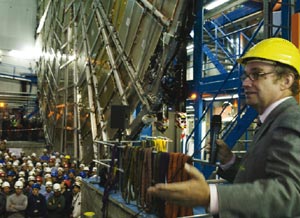
The ATLAS collaboration recently celebrated installing the last of the eight “big wheels” that form part of the endcap muon spectrometer of the detector. The big wheels harbour ATLAS’s middle layer of muon chambers in the forward region and are one of the last large pieces to be installed. Each is 25 m across, weighs between 40 and 50 tonnes and contains around 80 precision tracking chambers or 200 trigger chambers.
Because of their sheer size, each wheel had to be made in 12 pieces for the trigger planes and 16 pieces for the tracking planes. Designing a suitable support structure was a unique challenge, and the result is a uniquely thin and light structure that is precise to less than a millimetre.
Each wheel was assembled at CERN using components from all over the world. The 100-member collaboration from China, Europe, Israel, Japan, Pakistan, Russia and the US began assembly of components in 2005 and installation in 2006. Now, just two smaller-scale wheels and the end-wall chambers remain to be installed. The big wheels have already begun to take part in test runs using cosmic-ray data that ATLAS performs on a six-weekly basis.
DESY is to establish a new research group in which young scientists from DESY and three Russian institutes will work together to resolve current questions in particle physics. DESY’s proposal for “Physics and Calorimetry at the Terascale” is one of eight applications selected from 26 submissions to form a Helmholtz–Russia Joint Research Group. This comes as part of an initiative launched in 2006 by the president of the Helmholtz Association, Jürgen Mlynek, and the chair of the Russian Foundation for Basic Research, Vladislav Khomich. One aim of the new three-year support programme is to promote scientific co-operation between DESY and Russia and to provide attractive research opportunities for young scientists in particle physics. Within the joint research group, DESY will collaborate with three institutes based in Moscow: the Institute for Theoretical and Experimental Physics, Moscow State University and Moscow Engineering Physics Institute. The group will be involved in physics analyses of experiments at HERA and the LHC and for the proposed International Linear Collider (ILC), as well as in detector design and construction for the LHC and ILC.
The approval of this joint research group acknowledges the long and successful collaboration between DESY and its Russian partner institutes. The proposed activities will complement those of the Helmholtz Analysis Centre at DESY and the strategic alliance between DESY and German universities.
Following a summer shutdown, the National Superconducting Cyclotron Laboratory (NSCL) at Michigan State University is looking ahead to new experiments with fast and reaccelerated beams.
The NSCL is a user facility and during the course of several years and hundreds of users, the list of experimenters’ requests became long enough to warrant a significant reconfiguration of the laboratory’s experimental area. The four-month long reconstruction project, which concluded successfully at the end of September, achieved a number of goals set by the users. These include a new capability to detect neutrons at larger angles to the beam axis and enhanced two-neutron detection; improved means for filtering proton-rich rare isotope beams and studying neutron-deficient nuclei; increased agility and flexibility in delivering beam to the experimental vaults; and performing an array of reaction studies, including precise measurement of neutron time-of-flight.
The reconfiguration, which cost $2.7 million, was the largest construction project at NSCL since the completion of the Coupled Cyclotron Facility seven years ago. During the shutdown, more than 600 tonnes of concrete wall blocks were moved, as well as 1350 tonnes of roof beams. To speed up the rebuilding of the experimental vaults and to make it easier to change the layout of the facility in the future, NSCL installed 18 modular 22.5-tonne wall sections.
Following the reconfiguration, NSCL users now have access to a next-generation radio frequency separator, funded by the US National Science Foundation. The separator has performed well in early tests, for example, in selecting proton-rich isotopes near doubly magic 100Sn .
Laboratory upgrades will continue into 2008 and beyond. Current plans call for the implementation of two gas stoppers – a cyclotron gas stopper and a linear gas cell. The relative performance of each will be measured to determine the most efficient way to stop ions produced in flight and the best option for the NSCL reacceleration superconducting linear accelerator. This linac, being designed for use at NSCL and in a next-generation facility, will be able to reaccelerate thermalized beams of rare isotopes to energies of 3.2 MeV/nucleon with the option to upgrade it to 12 MeV/nucleon over the entire mass range.
To provide the best experiences, we use technologies like cookies to store and/or access device information. Consenting to these technologies will allow us to process data such as browsing behavior or unique IDs on this site. Not consenting or withdrawing consent, may adversely affect certain features and functions.
Functional
Always active
The technical storage or access is strictly necessary for the legitimate purpose of enabling the use of a specific service explicitly requested by the subscriber or user, or for the sole purpose of carrying out the transmission of a communication over an electronic communications network.
Preferences
The technical storage or access is necessary for the legitimate purpose of storing preferences that are not requested by the subscriber or user.
Statistics
The technical storage or access that is used exclusively for statistical purposes.The technical storage or access that is used exclusively for anonymous statistical purposes. Without a subpoena, voluntary compliance on the part of your Internet Service Provider, or additional records from a third party, information stored or retrieved for this purpose alone cannot usually be used to identify you.
Marketing
The technical storage or access is required to create user profiles to send advertising, or to track the user on a website or across several websites for similar marketing purposes.