Comsol -leaderboard other pages

Topics

Brookhaven laboratory develops stochastic cooling for RHIC

Accelerator physicists at Brookhaven National Laboratory have developed a way to apply the technique of stochastic cooling to the beams in the Relativistic Heavy Ion Collider (RHIC). This is the first time that the technique for concentrating a particle beam has been used in a machine where the particles are bunched. The results of the tests in 2007, which offer a “fast track” to upgrading the luminosity at RHIC, were presented in February at the Quark Matter 2008 meeting in Jaipur.
CCnew7_03_08

RHIC circulates two beams of heavy ions moving in opposite directions in two separate rings, each beam being in bunches of more than 109 ions per bunch. With the high electrical charges of the heavy ions, the particles spread out (“heat up”) while the beams are stored during colliding-beam operations, and ultimately they become lost. This reduces the collider’s luminosity and, in consequence, the probability for collisions. It also necessitates beam “cleaning” to avoid particles diverging into the superconducting magnets and causing them to quench.

One way to overcome this effect is to direct the particles back on track, which is just what happens with stochastic cooling. Invented by Simon van der Meer at CERN, the technique was applied in the 1980s to accumulate and cool antiprotons prior to injection and acceleration in the SPS. This led to the Nobel Prize for Physics for van der Meer and Carlo Rubbia, when the W and Z particles were discovered in proton–antiproton collisions in the SPS. However, later tests at both the SPS and Fermilab’s Tevatron showed that there are complications when applying stochastic cooling to a machine where the particles are already in a bunched beam.

The technique relies on measuring the random fluctuations in the beam shape and size – hence the name “stochastic”, which is derived from statistics and means random. The measurements are made at one point on the accelerator by devices that generate signals proportional to how far the particles are straying from their ideal positions.

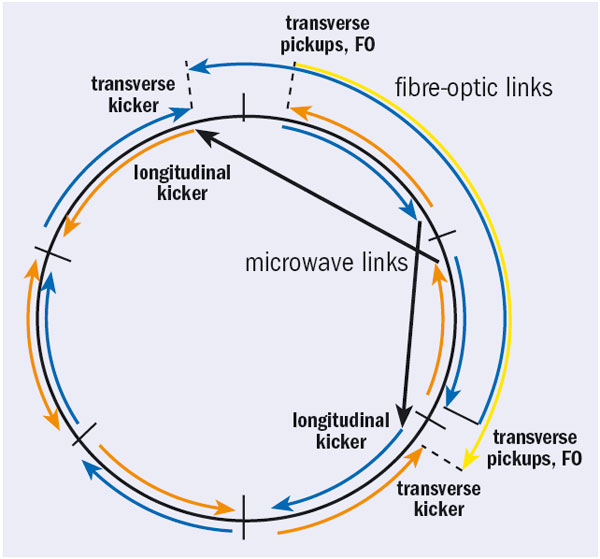
At RHIC these devices send the signals via fibre-optic or microwave links to a position ahead of the speeding beam, where electric fields are generated to kick the charged particles back towards their ideal positions. This results in more tightly squeezed (“cooler”) ion bunches. The signals stay ahead of the beam by taking one of two shortcuts: either travelling from one point to another across the circular accelerator or backtracking along the circle to meet the speeding beam roughly halfway round on its next pass.

So far, the team at RHIC has tested stochastic cooling in the longitudinal direction – along the direction of the beam – in one of RHIC’s two rings. Longitudinal cooling compensates for the ion bunches’ tendency to lengthen as they circulate. This improvement has already increased RHIC’s heavy-ion collision rate by 20%. The team has now installed equipment to implement the longitudinal cooling system in the second of RHIC’s rings.

The aim is also to install a system for transverse cooling in one of the beams before 2009. This would allow tests of significantly increased luminosity in gold–gold collisions in RHIC.

This successful demonstration of stochastic cooling provides an alternative way to increase collision rates that is less costly and quicker than other methods considered for RHIC II, electron cooling in particular, which would cost $95 m. Simulations suggest that stochastic cooling, together with other improvements, could increase the luminosity for gold–gold collisions to some 50 × 1026 cm–2s–1, or about 70% of the design goal for RHIC II. The team should be able to complete the system for stochastic cooling with an extra $7 m. According to Steven Vigdor, Brookhaven Associate Laboratory director for nuclear and particle physics, the laboratory hopes to implement the full stochastic cooling system by 2011.

Relaxation Processes in Micromagnetics

by Harry Suhl, Oxford University Press. Hardback ISBN 9780198528029 £49.95 ($150).

413+b0h8a1L._SX342_SY445_QL70_ML2_

Electrons in solids behave like microscopic bar magnets, and in certain solids these align to produce macroscopic magnetizations. This book deals with the dynamics of this magnetization field, which is intrinsically nonlinear. This is important in applications, particularly magnetic recording, which involves very large motion of the magnetization, well beyond the validity of linearized (small motion) approximations or their limited extensions. The author therefore emphasizes nonlinear solution methods but with only minimal use of numerical simulation. The book should be useful to physicists studying magnetic phenomena.

Mesoscopic Physics of Electrons and Photons

by Eric Akkermans and Gilles Montambaux, Cambridge University Press. Hardback ISBN 9780521855129 £55 ($99).

9780521855129 feature

Quantum mesoscopic physics covers a whole class of interference effects related to the propagation of waves in complex and random media, ranging from the behaviour of electrons in metals and semiconductors to the propagation of electromagnetic waves in suspensions such as colloids, and quantum systems like cold atomic gases. A solid introduction to the field, this book addresses the problem of coherent wave propagation in random media. With more than 200 figures, and exercises throughout, it will be useful for graduate students in physics, applied physics, acoustics and astrophysics.

The Power of α: Electron Elementary Particle Generation with α-Quantized Lifetimes and Masses

by Malcolm H MacGregor, World Scientific. Hardback ISBN 9789812569615 £50 ($93).

41TXVGbus0L

This book focuses on the most pressing unsolved problem in elementary particle physics – the mass generation of particles. It contains physics that is not included in the Standard Model as it is now formulated but at the same time is in conformity with its major results (i.e. isotopic spins and interactions). It differs from the Standard Model in the treatment of masses and pseudoscalar mesons, and in the role assigned to the coupling constant, α. Presented in a careful and phenomenological way, the material can easily be followed by all physicists, both experimental and theoretical, and also by interested workers in other fields.

Laser Control of Atoms and Molecules

by Vladilen S Letokhov, Oxford University Press. Hardback ISBN 9780198528166 £55 ($110).

51I7WctIbCL._SX346_BO1,204,203,200_

The general term “laser control of atoms and molecules” covers a variety of problems, including the laser selection of atomic and molecular velocities for the purpose of Doppler-free spectroscopy; laser trapping and cooling of atoms; and laser control of atomic and molecular processes (ionization, dissociation) with a view to detecting single atoms and molecules and, in particular, separating isotopes and nuclear isomers. During the past decade, the principal problems have been successfully solved, many evolving in subsequent research worldwide. The aim of this book by one of the acknowledged experts in the field is to review these topics from a unified point of view, providing a resource for researchers in the various different fields.

Classical Charged Particles (third edition)

by Fritz Rohrlich, World Scientific. Hardback ISBN 9789812700049 £33 ($58).

51LpaOUbewS._SX328_BO1,204,203,200_

Originally written in 1964, this text is a study of the classical theory of charged particles. Many applications treat electrons as point particles, but there is nevertheless a widespread belief that the theory is beset with various difficulties, such as an infinite electrostatic self-energy and an equation of motion that allows physically meaningless solutions. The classical theory of charged particles has meanwhile been largely ignored and left incomplete. Despite the efforts of great physicists such as Lorentz, Poincaré and Dirac, it is usually regarded as a “lost cause”. Thanks to more recent progress, however, the author has been able to resolve the various problems and to complete this unfinished theory successfully.

Optical Trapping and Manipulation of Neutral Particles Using Lasers: a Reprint Volume with Commentaries

by Arthur Ashkin, World Scientific. Hardback ISBN 9789810240578 £102 ($187). Paperback ISBN 9789810240585 £58 ($106).

9789810240585

This volume by the pioneer of optical trapping and “optical tweezers” contains selected papers and extensive commentaries on laser trapping and the manipulation of neutral particles using radiation pressure forces. These optical methods have had a revolutionary impact on the fields of atomic and molecular physics, biophysics and many aspects of nanotechnology. With his colleagues, Ashkin first demonstrated optical levitation, the trapping of atoms, and “tweezer” trapping and manipulation of living cells and biological particles. This extensive review should be of interest to researchers and students in atomic physics, molecular physics, biophysics and nanotechnology.

Principles of Phase Structures in Particle Physics

by Hilegard Meyer-Ortmanns and Thomas Reisz, World Scientific. Hardback ISBN 9789810234416 £71 ($131).

41pi1dvR6uL._SX330_BO1,204,203,200_

The phase structure of particle physics shows up in matter at extremely high densities and/or temperatures as reached in the early universe or in heavy-ion collisions in modern laboratory experiments. This book cover the various analytical and numerical tools needed to study this phase structure. These include convergent and asymptotic expansions in strong and weak couplings, dimensional reduction, renormalization group studies, gap equations, Monte Carlo simulations with and without fermions, finite-size and finite-mass scaling analyses, and the approach of effective actions as a supplement to first-principle calculations.

New limits constrain the WIMPs

The Chicagoland Observatory for Underground Particle Physics (COUPP) has tightened constraints on the spin-dependent properties of the weakly interacting massive particles (WIMPs) that are candidates for dark matter. At the same time, the Cryogenic Dark Matter Search (CDMS) has announced results that set the world’s best constraints on the spin-independent properties of dark-matter candidates.

CCnew4_03_08

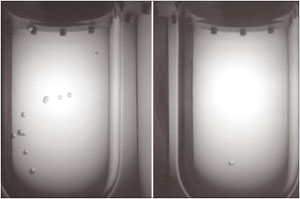
The COUPP experiment is an intriguing new application of the bubble chamber technique, located 100 m underground in the tunnel for the Neutrinos at the Main Injector project at Fermilab. It uses a small quartz vessel at room temperature filled with 1.5 kg of superheated iodotrifluoromethane (CF3I), a refrigerant that is often used in fire extinguishers. Two effects reveal the formation of bubbles in the chamber: the sound and pressure rise caused by their growth, and the changes in their appearance monitored by two CCD cameras. Once they reach a millimetre or so in size, they trigger the system to record photographs of the chamber. The chamber then goes through a cycle of compression and decompression to bring it back to a bubble-free, superheated state.

CCnew5_03_08

The innovative detector offers several advantages in the search for WIMPs, the most important being that the superheated liquid can be tuned to respond only to particles with large stopping power. This means that it can be set up in such a way that muons, gamma-rays, X-rays, and other kinds of common background, deposit too little energy to form bubbles. When the detector is searching for WIMPs, the threshold for bubble nucleation is typically above 50 keV/μm.

CCnew6_03_08

The team operated the chamber continuously from December 2005 to December 2006, with around 100 s between expansions. Although the chamber is only a prototype, the first results from COUPP, combined with the findings of other dark-matter searches, contradict the claims for the observation of WIMPs by the Dark Matter experiment (DAMA) in Italy. Previous experiments had already constrained the possibility that the DAMA observations result from dark-matter, spin-independent interactions and COUPP has now ruled out the last region of parameter space allowed for a spin-dependent explanation (Behnke et al. 2008). If the DAMA result had been due to spin-dependent WIMPs, then COUPP should have found hundreds of examples, but instead it found none above background.

The COUPP team now aims to improve the sensitivity of the experiment by increasing the amount of liquid in the detector from 1 l to 30 l, and it expects to start testing the larger chamber soon. The experiment could move to a deeper tunnel to reduce the background from cosmic radiation even further.

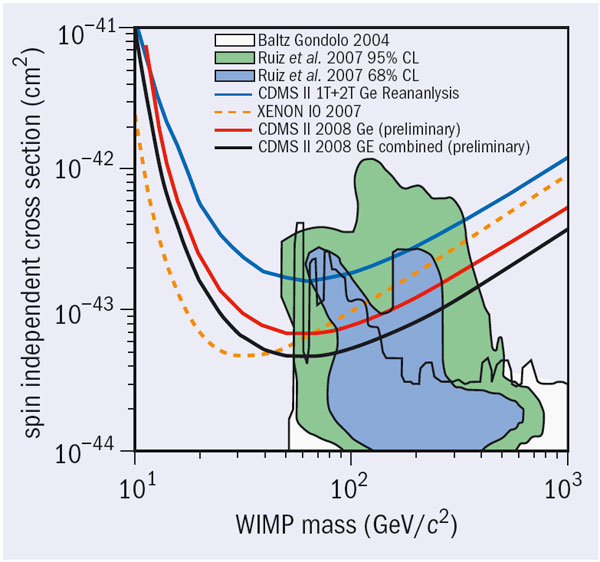
Meanwhile, the CDMS collaboration announced the world’s most stringent limits on how often dark-matter particles interact with ordinary matter and on how heavy they are, in particular in the theoretically favoured mass range of more than 40 times the proton mass. The CDMS experiment, situated in the Soudan Underground Laboratory, Minnesota, is now running with all of its detectors – 19 germanium detectors of 250 g each and 11 silicon detectors of 100 g. The detectors operate at 50 mK and each consists of a disc some 7.5 cm in diameter and 1 cm thick.

The new results, announced at the Dark Matter 2008 conference in Marina del Ray, California, are based on the analysis of data collected from 15 germanium detectors between October 2006 and July 2007 (Ahmed et al. 2008). The analysis resulted in no dark-matter events and excludes the parameter space for WIMPs with masses above 42 GeV/c2.

UA1 magnet sets off for a second new life

A magnet built originally for the UA1 detector at CERN and later used by the NOMAD experiment has set sail for a new life in Japan. Thirty-five containers carrying 150 pieces departed CERN in the last two weeks of January, with the last components – the large aluminium coils – following in March.

CCnew3_03_08

In 2005, at the request of European physicists involved in the international Tokai to Kamioka (T2K) long-baseline neutrino experiment, CERN decided to donate the former UA1 magnet, its coils and other equipment to KEK in Japan. For T2K, which will start in autumn 2009, the Japan Proton Accelerator Research Complex at Tokai will use a 40 GeV proton beam to produce an intense low-energy neutrino beam directed towards the Super-Kamiokande neutrino observatory 300 km away.

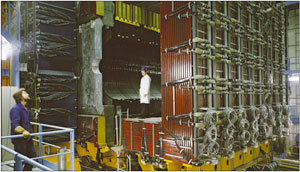
Built in 1979, the UA1 magnet was later given a second lease of life with the NOMAD neutrino-oscillation experiment at CERN. Since NOMAD was dismantled in 2000, the magnet has been stored in the open air, exposed to the elements, at CERN’s Prévessin site. All the parts were cleaned, polished and repainted before shipment to Japan, including a general overhaul in readiness for transport. However, many of the parts could not be transported in one piece, especially by sea, so much of the equipment had to be dismantled before being loaded into containers.

The general overhaul, and other work needed to prepare the parts for shipping, took almost a year. On 14 January, one by one, 35 sea-going containers began their long journey to Tokai, 60 km north of Tokyo. They first travelled by train to Antwerp, from where they were bound for the port of Hitachinaka via Pusan, in South Korea. The final, and largest, component – consisting of the four very fragile coils – was scheduled to leave CERN at the end of March. With a height of 4.75 m, the aluminium coils weigh close to 40 tonnes and have been packaged into two 1.70 m wide consignments for transport as an exceptional lorry load to Basel, then by barge to Rotterdam to set sail for Japan.

bright-rec iop pub iop-science physcis connect