Comsol -leaderboard other pages

Topics

Life in physics and the crucial sense of wonder

As a grad student at Columbia around 1950, I had the rare opportunity of meeting Albert Einstein. We were instructed to sit on a bench that would intersect Einstein’s path to lunch at his Princeton home. A fellow student and I sprang up when Einstein came by, accompanied by his assistant who asked if he would like to meet some students.

“Yah,” the professor said and addressed my colleague, “Vot are you studying?”

“I’m doing a thesis on quantum theory.”

“Ach!” said Einstein, “A vaste of time!” He turned to me: “And vot are you doing?”

I was more confident: “I’m studying experimentally the properties of pions.”

“Pions, pions! Ach, vee don’t understand de electron! Vy bother mit pions? Vell, good luck boys!”

So, in less than 30 seconds, the Great Physicist had demolished two of the brightest – and best-looking – young physics students. But we were on cloud nine. We had met the greatest scientist who ever lived!

Some years before this memorable event, I had recently been discharged from the US army, having been drafted three years earlier to help General Eisenhower with a problem he had in Europe. It was called World War II. Our troop ship docked at the Battery and, having had a successful poker-driven ocean crossing, I taxied to Columbia University and registered as a physics grad student for the fall semester.

I was filled with enthusiasm to resume my study of physics but also exhausted by three years of mostly mindless military service. Things quickly degenerated towards disaster. I had indeed forgotten simple equations, how to study and, most crucially, forgotten the joy that I had found in my college physics classes. Full-time, intense study did not seem to help. I failed the crucial qualifying exam, twice. I was ready to quit.

I had been assigned a lab on the 10th floor of the Pupin Physics Building where I had been given the job of making a cloud chamber work. This was a 12-inch cylinder of glass and plastic filled with N2 alcohol vapour. This device can render the path of a nuclear particle visible since the “wake” of the intruder particle produces a trail of disturbed atoms. This encourages alcohol vapour to coalesce from vapour to drops of liquid. A flash photograph then captures a record of the nuclear particle – much like the vapour trail of a jet airliner. But as much as I tried, my cloud chamber produced no tracks, only a cloud of white smoke. This failure, added to the failed tests and joyless lectures, brought me misery and to the point of quitting. I decided to take the PhD qualifying test once more and took two weeks to study.

After the test (I felt only slightly better), I returned to the lab to find a janitor mopping the wire-strewn floor and singing an Italian operatic tune. As I entered, the guy shouted something in Italian and offered a handshake.

I said, “Okay, but be careful. The wires are carrying a high current and your wet mop may produce a short circuit.” He stared cluelessly and, in total disgust, I walked out in the hall to wait for the guy to leave.

In the hall, there was the department chairman. “We have a new, dumb janitor, huh?” I said.

“New? No, wait! You mean the guy in your lab?”

“Yeah.”

“That’s no janitor, dummy, that’s Professor Gilberto Bernardini, a world-famous Italian cosmic-ray expert whom I invited to spend a year here to help you in your research.”

“Oh, my God!” I gasped and rushed in to repair my damage.

Over time, Bernardini and I learnt how to communicate and I began to watch Gilberto. There was his habit of entering a dark room, pushing the light switch: light. Pushing it again: off. On, off five or six times. Each time there would be a loud “fantastico!” Why? He seemed to have this remarkable sense of wonder about simple things.

Then the cloud chamber.

Gilberto: “Wat’s dat wire in de middle?”

Leon: “That’s carrying the radioactive source.”

Gilberto: “Tayk id oud.”

Leon: “It makes tracks.”

Gilberto: “Tayk id oud.”

After a few minutes, tracks appeared. My source had been far too radioactive for the chamber! Now we had a success.

But this was only the beginning of my learning from Bernardini. Next, we constructed a kind of Geiger counter. We machined, soldered, polished, flushed with clean argon gas and watched the oscilloscope. Soon we had tracks.

Bernardini went nuts. “Izza counting!” he screamed. Half of my height and weight, he lifted me and danced me round the lab to the music of Bernardini’s sense of wonder. He explained: “Dese particles, cosmic ray, come from billions of miles away to say buonjourno to us on de tenth floor of Pupin Physics Building. Izza beautiful! So little particle, so long da trip.”

So, through Bernardini, I began to recover my love of physics, of searching for simplicity and elegance of how the world works. I recovered academically and eventually graduated to a professorship.

Gilberto warned me about what happened next. Some years into my Columbia career, I was on the night shift of an experiment. It was 3 a.m.; I had checked that all the apparatus was working when one computer began to beep out of tune. I tuned it to scan the data and – there it was, the most spectacularly beautiful track I had ever seen. What I was seeing was a muon entering from a thin metal plate and passing through 10 more plates. A muon! The only explanation was that a neutrino had generated this track – a muon neutrino! Its implications dawned on me – two neutrinos – this would change how we taught physics; this would make headlines from Scotland to Argentina… My palms were wet, my breathing became difficult. I tested everything, but only confirmed the discovery. At 4 a.m. I telephoned Gilberto, who was then visiting in Illinois. His wonderful “fantastico!” had been Americanized and when I told him what we had found, out came “Holy shit!”

Gilberto knew everybody. Fermi, Amaldi, Bohr, Schrödinger, … Einstein. At a meeting (after receiving my PhD), we heard Einstein describe relativity: “scarcely anyone who truly understands this theory can escape its magic.”

As Keats said: “Truth is Beauty and Beauty Truth. That is all ye know of Earth.” And Plato: “The soul is awestruck and shudders at the sight of the beautiful.”

Some years later, Gilberto and my wife, Ellen, were in Sweden to help me receive the Nobel prize. Gilberto’s “fantastico!” was ubiquitous. And I said to Ellen, “Did you ever in your wildest dreams imagine that we would be in Sweden dining with the king and queen?” Ellen, as ever sceptical, said, “You were never in my wildest dreams!”

Science has always been and will continue to be a mixture of 96% frustration and (if lucky) 4% elation. But having a Bernardini to restore that crucial sense of wonder sure helps.
the queen of all sciences and Intelligent Design

In the mid-1930s, physics was heavily attacked by the most famous Italian philosopher of the time, who called physicists “vile mechanicians”. It was on this occasion that Enrico Fermi told his young fellows: “Don’t worry. Physics is the queen of all sciences.”

We physicists cannot remain silent and keep ignoring the cultural debate on “Intelligent Design”. Other scientists discuss what their observations allow them to say about Intelligent Design: practically all fields of science are present in the debate. Physics, however, is absent. But it is the only science that studies the fundamental logic of nature. Therefore we are the most involved in the hypothesis of Intelligent Design. The purpose of this note is to review, briefly, the scientific basis for this hypothesis, which I describe more fully elsewhere (Zichichi 2008).

Mankind has always been concerned with this extremely important problem but it is only in the past four centuries that, following Galileo Galilei, an impressive series of experimental discoveries has allowed us to reach the conclusion that a fundamental logic of nature exists. The point I would like to make clear is that all other fields of scientific research are not in a position to study this logic for the very simple reason that, no matter what the field may be, the root of our existence has to be investigated in order to overcome the basic difficulty in dealing with the foundations of this logic.

For example, whether we study the evolution of inert matter or the evolution of matter endowed with the property of life, at the very end we discover that all forms of matter – with or without life – have to obey the same fundamental logic. No matter what form of evolution we attempt to study, the key issue is that if a fundamental logic exists, then nature – including its evolution – has to obey this logic.

For the universe to be as it is now, three basic transitions are needed and each must obey the logic of nature.

The field of research where this logic is studied is physics. For the universe to be as it is now, endowed with the properties of life and reason, three basic transitions are needed and each must obey the logic of nature.

The first of these transitions is the Big Bang, which describes how the universe – consisting of inert matter – came into being from a vacuum and subsequently evolved. I call this Big Bang 1. There are many problems to be studied for Big Bang 1 to be rigorously described on the basis of first-level “Galilean Science”; that is, through experimentally reproducible results that can be described with the rigour of mathematical formalism. Although Big Bang 1 and the subsequent cosmic evolution are a one-off event, every step must obey the fundamental logic discovered with first-level Galilean science; this logic is based on three fundamental forces (electroweak, strong and gravitational) and three families of elementary particles.

The second transition in the universe, Big Bang 2, deals with the problem of how to describe the transition from inert matter to living matter. So far no one has been able to solve this problem but once it is solved, the evolution of all different forms of living matter must be studied and referred to the fundamental logic of nature before the evolution of the living matter can be classified as Galilean science.

Then, Big Bang 3 – the transition from living matter without reason to living matter endowed with reason – must be described. It is thanks to Big Bang 3 that we are able to discuss Big Bang 2 and Big Bang 1. The fact that out of the innumerable number of different forms of living matter, there is only one endowed with the property called reason, needs to be examined in detail.

Once all of these problems have been solved we will be able to say that we have a scientific description of the theory of evolution. The present status of our culture takes for granted that the Darwinistic approach to the theory of evolution is scientifically founded. As I have outlined above, this is not the case.

The basic message coming from science is that a fundamental logic exists that governs all forms of inert and living matter. If a fundamental logic exists then the author of this logic must exist too. The atheistic culture claims that the author is not there, but no one is able to prove, using either theoretical logic (mathematics) or experimental logic (science), that this is the case. Those who claim that this logic does not exist are in conflict with science and its most advanced achievements.

Four centuries ago Galilei discovered why it is not enough to be “smart” in order to understand the logic of nature. He pointed out that experiments need to be implemented if we want to know the correct answers to our questions. To express a question in a rigorous way – as is the case, for example, for a supersymmetric world, using a relativistic quantum string-like theory – is not enough; experimental proof of its existence is needed. The reason is that the fellow who created the world is smarter than all of us, no one excluded.

This is at present all that physics can say on the author of Intelligent Design. The hypothesis of which, to the extent that it is based on the argument that this fundamental logic exists, proposes nothing other than that there is an intelligence that designed such logic. And this is in perfect agreement with the most advanced frontier of our field of activity which was defined by Fermi as “the queen of all sciences”.

• A Zichichi 2008 Rigorous Logic in the Theory of Evolution, presented at the Plenary Session on “Scientific Insights into the Evolution of the Universe and of Life”. Proceedings of the Pontifical Academy of Sciences (Vatican, 31 October – 4 November 2008), pp101-178.

Introduction to Elementary Particle Physics

By Alessandro Bettini, Cambridge University Press. Hardback ISBN 9780521880213, £35 ($70). Also available in e-book format.

CCboo1_04_09

I was a graduate student when the first version of Introduction to High Energy Physics by Donald H Perkins appeared; the slim one with the plain grey cover, written before the discovery of charm. This book was a welcome sight to many of us “youngsters” because it contained a wealth of concentrated information so valuable to the budding experimentalist. The book began with a nice discussion of the passage of radiation through matter in a form that was not as dated or cumbersome as the two must-read classics by Bruno Rossi and Emilio Segrè. It was also sufficiently detailed to call upon as a ready reference for an upcoming oral exam. Since then, perhaps in part because I have lived through all subsequent discoveries in particle physics, I have not been impressed with any of the rather few particle-physics texts that have appeared; not, at least, until the publication of Alessandro Bettini’s Introduction to Elementary Particle Physics. Like Perkins before him, Bettini’s expertise as a careful, methodical and experienced experimentalist shines brightly throughout the text. The reader is never left in any doubt that physics is an experimental science.

The choice of topics and the level of detail are excellent and the explanations are clear. The book is rich in physics content, especially its emphasis of important concepts, including relativistic kinematics, the wave nature of particles and quantization of fields. Some of my favourite examples are determination of the spin and parity of the pion and why this is important, the Lamb shift in quantum electrodynamics and the discussion of αs and the proton mass. The author is an expert in neutrino physics and this comes through in the material clearly. He does a good job of emphasizing the physics at an appropriate level without getting absorbed in the mathematics of Feynman diagrams, which belongs in a course on field theory. The text is sprinkled with a few historic gems, such as the story of Marty Block asking Dick Feynman who asked C-N Yang at the 1956 Rochester conference: “Is it possible to think that parity is not conserved?” The book is extremely well written, topically informative and easy to read – but best of all it is full of physics.

Bettini’s text is suited for a one-semester introductory course in particle physics; the one I have taught at Boston University is attended by a mixture of beginning graduate students and advanced undergraduates. The text (431 pages) is organized into 10 chapters, which can be easily covered in 16 weeks. Each chapter contains a number of accessible and readable references, as well as a generous number of end-of-chapter problems. A complete instructors’ solution manual is also available in electronic form.

After this well deserved praise, do I have any complaints? Sure, but they are relatively minor: the use of dashed lines instead of wavy lines for W and Z propagators; time not going “up” in Feynman diagrams; and &Lamda;QCD written unconventionally as &lamda;QCD. I would personally have introduced several aspects of the weak interaction much earlier, such as parity violation in beta decay, helicity in pion decay, and the discovery of the τ. I would also have covered deep-inelastic scattering before QCD and included more details on hadron jets, but these are largely personal choices. I was somewhat disappointed that a large number of complete solutions to end-of-chapter problems are available in the text, limiting what I could assign from the book as homework. The bottom line, however, is that as a particle physicist I enjoyed Bettini’s book three times – not unlike a fine wine: the first time when admiring its contents; the second when reading it; and a third time when teaching from it. Bravo, Sandro!

Cosmology

By Steven Weinberg, Oxford University Press. Hardback ISBN 9780198526827, £45 ($90).

CCboo2_04_09

Those who think that a book on cosmology and gravitation overlaps with science fiction should probably not even try to flick through the latest treatise by Nobel laureate Steven Weinberg. Conversely, those who believe that gravitation, astrophysics and cosmology could offer fertile playgrounds for the analytical methods of theoretical physics will find in Cosmology a stimulating source of intellectual excitement. Finally, those who think that the physics of the early universe is a mere mathematical game with no observational relevance will also be disappointed, because observations play a central role in the book’s nearly 600 pages.

On the 30th anniversary of the discovery of neutral currents by Gargamelle, a round-table discussion took place in the main auditorium of CERN. Various Nobel laureates, including Weinberg, were present. Some of the questions from the audience addressed the worries of the particle-physics community, always anxious about novelty and excitement; some of Weinberg’s replies in that discussion reverberate in the preface of this book: “Today cosmology offers the excitement that particle physicists had experienced in the 1960s and 1970s”.

The treatise consists of 10 chapters organized around the three observational pillars of the standard cosmological paradigm, i.e. the physics of the cosmic microwave background (CMB), the analysis of supernova light-curves and the observations of large-scale structures. The first four chapters, following a didactical trail, cover the basic aspects of the standard paradigm, often dubbed the &Lamda;CDM scenario, where &Lamda; stands for the dark-energy component and CDM refers to the cold dark-matter component. The remaining six chapters cover, with more theoretical emphasis, the description (chapter 5), the evolution (chapter 6), the effects (chapters 7, 8 and 9) and the normalization (chapter 10) of inhomogeneities in Friedmann–Robertson–Walker universes.

Readers will not find the usual pretty pictures and maps that often decorate cosmology books. Instead the author adapts the style of theoretical particle physics to cosmology and gravitation: solid, analytical calculations and semi-analytical estimates are preferred over fully numerical results. Analytical methods are implicitly viewed as a mandatory step for an effective comprehension of natural phenomena. The latter aspect is evident in the discussion of the anisotropies in the CMB, where the author exploits some of his own results that have appeared over the past five years in Physical Review. The book contains eight assorted appendices, which are useful for both newcomers and experienced readers. The notations used by the author are unusual at times but may quickly become a standard.

While the relevant technical aspects of the presentation can only be fully appreciated after a careful reading, a clear message emerges with vigour after the first reading: atomic physics, nuclear physics, field theory, high-energy physics and general relativity all come together in the description of our universe. In other words, Cosmology provides a vivid example of the basic unity of physics, which is something to bear in mind during the decades to come.

Collisions to start at 3.5 TeV

CCnew1_07_09

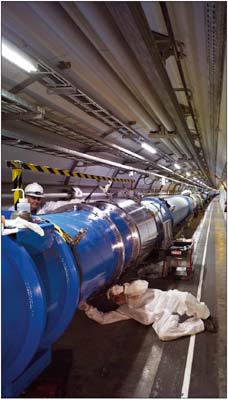
The LHC will initially run at an energy of 3.5 TeV per beam when it starts up in November this year. This decision has comes after all tests on the machine’s high-current electrical connections were completed at the end of July, indicating that no further repairs are necessary for safe running.

“We’ve selected 3.5 TeV to start,” explained CERN’s director-general, Rolf Heuer, “because it allows the LHC operators to gain experience of running the machine safely while opening up a new discovery region for the experiments. The LHC is much better understood than it was a year ago. We can look forward with confidence and excitement to a good run through the winter and into next year.”

Following the incident of 19 September 2008 that brought the LHC to a standstill, testing has focused on the 10,000 high-current superconducting electrical connections of the kind that led to the fault. These consist of two parts: the superconductor itself, and a copper stabilizer that carries the current in case of a quench – when the superconductor warms up and stops superconducting. There is negligible electrical resistance across these connections when they are in their normal superconducting state, but in a small number of cases tests have revealed abnormally high resistances in the superconductor. These have been repaired. However, there remain a number of cases where the resistance in the copper stabilizer connections is higher than it should be for running at full energy.

The latest round of tests has looked at the resistance of the copper stabilizer. As a result, many copper connections showing anomalously high resistance were repaired. The tests on the final two sectors, which concluded at the end of July, revealed no further anomalies. This means that no more repairs are necessary for safe running this year and next.

The procedure for the 2009 start-up will be to inject and capture beams in each direction, take collision data for a few shifts at the injection energy, and then commission the ramp to higher energy. The first high-energy data should be collected a few weeks after the first beam of 2009 is injected. The LHC will run at 3.5 TeV per beam until a significant data sample has been collected and the operations team has gained experience in running the machine. Thereafter, with the benefit of that experience, the energy will be taken towards 5 TeV per beam. At the end of 2010, the LHC will be run with lead ions for the first time. After that, the LHC will shut down and work will begin on moving the machine towards 7 TeV per beam.

Earlier in July leaks of helium into the vacuum insulation were found in Sectors 8-1 and 2-3 while they were being prepared for the electrical tests on the copper stabilizers at around 80 K. In both cases the leak occurred at one end of the sector, where the electrical feedbox, DFBA, joins Q7, the final magnet in the sector. The end vacuum subsectors – a 200 m stretch of the LHC sealed off by vacuum barriers – will be warmed to room temperature in order to locate the leaks and repair them. Suspicion rests in both cases on flexible hose in the liquid-helium transport circuits; two years ago, a similar leak occurred during the first cool-down of Sector 4-5. Unfortunately, the repair necessitates a partial warm-up of both sectors, with a consequent impact on the schedule for the restart. It is now foreseen that the LHC will be closed and ready for beam injection by mid-November.

• CERN is publishing regular updates on the LHC in its internal Bulletin, available at www.cern.ch/bulletin, as well as via Twitter and YouTube at www.twitter.com/cern and www.youtube.com/cern.

PETRA III generates first X-ray beam

CCnew2_07_09

DESY’s new synchrotron radiation source PETRA III generated the first X-ray light for research on the weekend of 18–19 July. The electron storage ring, 2.3 km in circumference, went through a two-year upgrade costing €225 million, which converted into the world’s most brilliant storage ring X-ray source. Following test runs of individual instruments, PETRA III will start regular user operation in 2010.

As the most powerful light source of its kind, PETRA III will offer excellent research possibilities, in particular to researchers who investigate ever smaller samples with ever finer details, or those who require tightly focused and very short-wavelength X-rays for their experiments. PETRA III first stored its first positron beam in April. Following this milestone, the undulators were put in place to force the beam to oscillate and emit the high brilliance synchrotron radiation.

CCnew3_07_09

PETRA was originally built as an electron–positron collider for particle physics and more recently was used as a pre-accelerator for the electron/positron–proton collider, HERA, which closed down in June 2007. In less than two years PETRA has been completely refurbished and modernized, the remodelling funded mainly by the German Federal Ministry of Education and Research, the City of Hamburg and the Helmholtz Association. A 300 m long experimental hall was built over the PETRA storage ring, to house 14 synchrotron beamlines and up to 30 experimental stations. To ensure that the samples under study are not affected by vibrations, the experiments will be installed on the largest monolithic concrete slab in the world.

New neutron-rich nuclei support ‘island of inversion’ theory

Researchers at the National Superconducting Cyclotron Laboratory (NSCL) at Michigan State University have succeeded in making and measuring the production rates of 15 new neutron-rich isotopes. Several of these rare isotopes were produced at significantly higher-than-expected rates. The results suggest the existence of a new “island of inversion” – a region of isotopes with enhanced stability in a sea of mostly fleeting and unstable nuclei at the edge of the nuclear map.

Motivation to explore this region of nuclides was provided in part by an earlier experiment at NSCL that produced and measured the production rates of three new isotopes of magnesium and aluminium. In particular, the aluminium isotope measured (42Al) was beyond the limit of stability predicted by one of the leading theoretical models. It was therefore logical to ask: how well do existing theories describe the behaviour of heavier, neutron-rich nuclei?

Perhaps not so well, according to the results of continued studies at NSCL, which have investigated the nuclei of elements from chlorine to manganese. Most of the nuclei in this region were expected to be characterized by low binding energies, and thus be exceedingly unstable and difficult to produce. However, the experiments revealed unexpectedly higher production rates for several isotopes of potassium, calcium, scandium and titanium (Tarasov et al. 2009).

The results could imply the existence of a new island of inversion for neutron-rich nuclei. The island would be the result of changes in the interaction strength between protons and neutrons, which is already known to depend on the number of protons and neutrons inside the nucleus. Nearest the stable isotopes, the change is often small enough to go unnoticed, but in very neutron-rich nuclei the effects can be amplified in localized areas, leading to small groupings of isotopes with very distinctive properties.

Element 112 is to be given the name ‘copernicium’

CCnew4_07_09

The team that discovered element 112 at GSI Darmstadt has proposed naming it “copernicium”, with the element symbol “Cp”, in honour of the scientist and astronomer Nicolaus Copernicus. The International Union of Pure and Applied Chemistry (IUPAC) should officially endorse the new element’s name in around six months, the period set to allow the scientific community to discuss the proposal.

Copernicus, who lived from 1473 to 1543, paved the way for the modern view of the universe when he firmly planted the Earth in orbit about the Sun in his famous work De revolutionibus orbium coelestium. With its planets revolving around the Sun on different orbits, the solar system became a model for other physical systems, in particular the atom, with electrons in orbit around the nucleus. Although this model of the atom soon became surpassed by quantum mechanics, it still provides a strong visual image. In an atom of the new element, 112 electrons surround the nucleus.

Element 112 was first observed 13 years ago but has only recently received official recognition from IUPAC. It is the heaviest element discovered so far in the periodic table, being 277 times heavier than hydrogen. Produced by nuclear fusion when bombarding zinc ions onto a lead target, the element rapidly decays so its existence can be proved only with the help of extremely fast and sensitive analysis methods. Twenty-one scientists from Germany, Finland, Russia and Slovakia were involved in the experiments at GSI that led to the discovery.

Fermilab’s CDF experiment observes the Ωbbaryon

CCnew5_07_09

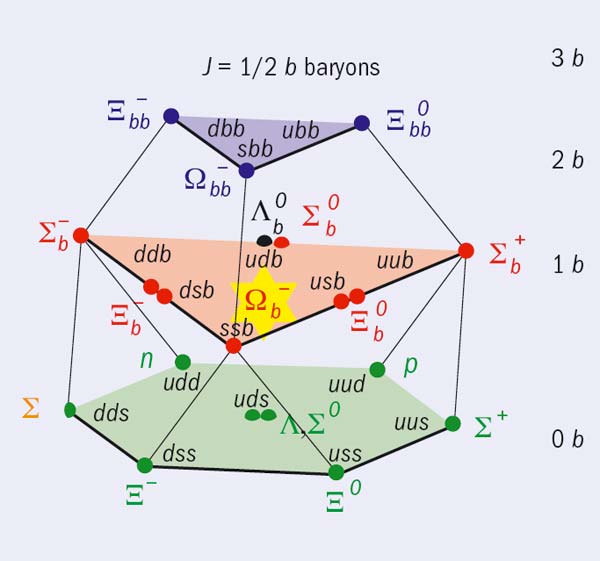
The CDF collaboration has announced the observation of a new particle, the Ωb baryon, containing three quarks: two strange quarks and a bottom quark (ssb). The sighting of this “doubly strange” particle, predicted by the Standard Model, is significant because it strengthens physicists’ confidence in their understanding of how quarks form matter. However, it conflicts with a result announced in 2008 by CDF’s sister experiment, DØ.

The Ωb is the latest entry in the “periodic table of baryons” illustrated in the figure. The Tevatron is unique in its ability to produce baryons containing the b quark, and the large data samples now available after many years of successful running have enabled experimenters to find and study these rare particles. The discovery of the Ωb follows the first observations of two types of Σb baryons at the Tevatron in 2006 and the discovery there of the Ξb baryon in 2007.

Combing through almost 5 × 1011 proton–antiproton collisions produced by the Tevatron, the CDF collaboration isolated 16 examples in which the particles emerging from collisions reveal the distinctive signature of the Ωb, which travels only a fraction of a millimetre before it decays into lighter particles. CDF has performed the first ever measurement of the Ωb‘s lifetime and obtained 1.13 + 0.53 – 0.40(stat.) ± 0.02(syst.) × 10–12 s.

In August 2008, the DØ experiment announced its own observation of the Ωb based on a smaller sample of data from the Tevatron. Interestingly, the new observation from CDF conflicts with this earlier result. The CDF collaboration measures the mass of the Ωb to be 6054.4 ± 6.8(stat.) ± 0.9(syst.) MeV/c2, compared with DØ’s findings of 6165 ± 10(stat.) ± 13(syst.) MeV/c2. These two results are statistically inconsistent, leaving the teams from the two experiments wondering whether they are measuring the same particle. Furthermore, the experiments observed different rates of production for this particle. Perhaps most interesting is that neither experiment sees a hint of evidence for a particle at the mass value measured by the other.

Although the latest result announced by CDF agrees with theoretical expectations for the Ωb, both in the measured production rate and in the mass value, further investigation is needed to solve the puzzle of these conflicting results.

Is quantum theory exact or approximate?

Quantum mechanics has puzzled the scientific community from the beginning. One of the major sources of difficulties comes from the measurement problem: why do measurement processes always have definite outcomes, despite the fact that the Schrödinger equation allows for superpositions of states? And why are such outcomes random (distributed according to the Born rule), while the Schrödinger equation is deterministic? New experiments and observations could help to answer such questions by providing a more precise idea of the possible limits of validity of quantum theory (Adler and Bassi 2009).

Most solutions to the measurement problem look for a reinterpretation of the formalism of quantum mechanics. Models in which the wave function collapses spontaneously, however, follow a different route. They purposely modify the Schrödinger equation by adding new nonlinear and stochastic terms, which break quantum linearity above a scale fixed by new parameters. Physically, the wave function is coupled (nonlinearly) to a white-noise classical scalar field, which is assumed to fill space.

By modifying the Schrödinger equation, collapse models make predictions that differ from those of standard quantum mechanics and that can be, in principle, tested. The scale at which deviations from standard quantum behaviour can be expected gives indications of the sensitivity that experiments should reach if they are to provide meaningful tests of collapse models and quantum mechanics.

There have already been experiments that directly or indirectly test collapse models against quantum mechanics and others are proposed for the future. Probably the best known are the diffraction experiments with macromolecules (C60, C70, C30H12F30N2O4), which set an upper bound 13 decades above the most conservative value of the collapse parameter λ (related to the noise strength) and five decades above the strongest value suggested. Other tests include the decay of supercurrents and proton decay, but the upper bounds are even weaker than in the diffraction experiments. One interesting proposal is an experiment that includes a tiny mirror mounted on a cantilever, within an interferometer: it will set an upper bound of 9 (1) decades on the weakest (strongest) value of λ.

The strongest bound, however, comes from the spontaneous emission of X-rays from germanium-76, as predicted by the continuous spontaneous localization (CSL) model, the most popular collapse model. It sets an upper bound of only six decades on the weakest value of λ. The strongest value is disproved by these data, but the bound is weakened if non-white-noise is considered with a frequency cutoff. The data coming from spontaneous X-ray emission are very raw, and several contributions from known sources (e.g. gamma-ray contamination, double beta-decay) have not been subtracted. A dedicated experiment on spontaneous photon emission could set a much stronger upper bound and would represent the most accurate test of quantum mechanics against the rival theory. Such a project is under discussion between the University of Trieste and the INFN, Laboratori Nazionali di Frascati.

Collapse models also make predictions that have cosmological implications. The apparent violation of energy conservation arising from the interaction with the collapsing noise places important upper bounds. The strongest comes from the intergalactic medium: requiring that the heating produced by the noise remains below experimental bounds places an upper bound of 8 (0) decades on the weakest (strongest) value of λ.

bright-rec iop pub iop-science physcis connect