Comsol -leaderboard other pages

Topics

ATLAS sheds light on new physics

CCnew5_06_11

Photons have an important role at the LHC, not only as tools for testing the Standard Model but also as heralds of new physics. The ATLAS collaboration has recently announced two measurements that in one case make use of photons as probes of QCD and in a second analysis use them to set limits on the production of the Higgs boson.

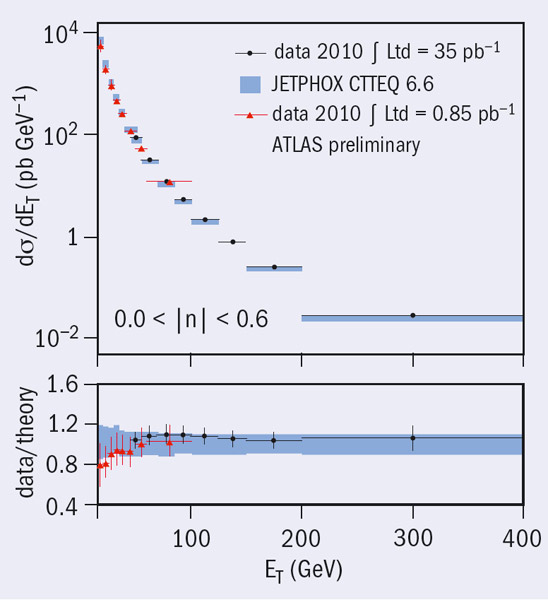
The production mechanism of photons in proton–proton collisions is sensitive to the density of the basic constituents within the colliding particles. This makes the measurement of their properties an excellent way to test the theoretical predictions of perturbative QCD, with a technique that is complementary to studies based on jets. One example is the new measurement made by the ATLAS collaboration of the inclusive production of isolated prompt photons.

The analysis uses the full 2010 data sample collected by ATLAS in LHC proton–proton collisions at 7 TeV, corresponding to an integrated luminosity of 35 pb–1. The result extends the measurement of the cross-section up to a photon transverse momentum of 400 GeV (figure 1), thus covering a kinematic region similar to that achieved at Femilab’s Tevatron and by the CMS collaboration at the LHC. QCD calculations performed at next-to-leading order (NLO) predict cross-sections that are in good agreement with the measured data across five orders of magnitude. Below 25 GeV, where the NLO predictions are less accurate, the predicted cross-section is larger than that measured in the data.

Photons are also important signatures of new physics, a familiar example being the production of a Standard Model Higgs boson decaying into a photon pair. If nature has chosen the Standard Model Higgs as the mechanism for electroweak-symmetry breaking, then about 10,000 Higgs bosons should already have been produced in ATLAS, assuming a light mass for the Higgs of about 120 GeV/c2. In this mass region, the decay into two photons remains the most promising channel for discovery, despite the small branching ratio of about 0.2%.

CCnew6_06_11

Using an integrated luminosity of 209 pb–1 from the full 2010 data sample, and the first part of the data collected in 2011, the ATLAS collaboration has studied the di-photon invariant mass spectrum in the mass range 100–150 GeV/c2 and looked for a possible excess of events that could be attributed to the decay of a new neutral particle. In this analysis, the different components associated to known processes were separated using the same data-driven technique as was used to measure the inclusive photon production cross-sections. The fluctuations observed in the di-photon invariant mass spectrum are compatible with the expected statistical fluctuations of the background. This translates into limits on the production cross-section of a Standard Model-like Higgs boson decaying into a pair of photons that range between 4 and 16 times the cross-section expected.

With the LHC delivering increasing amounts of data, both measurements are already set to improve.
ALICE and the charm of heavy-ion collisions

CCnew7_06_11

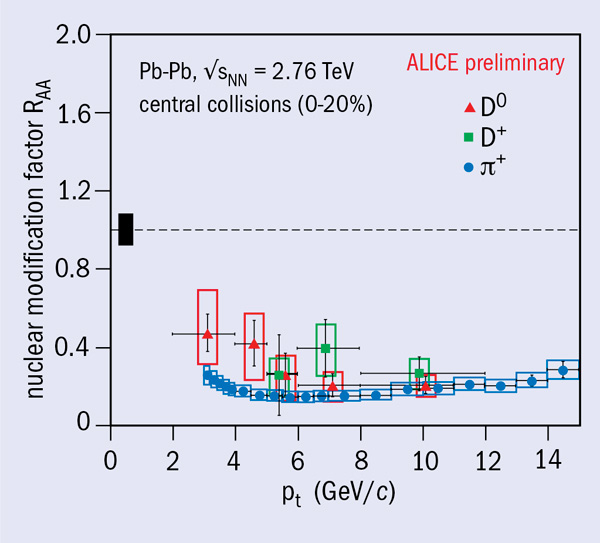
The ALICE collaboration has measured the production of the charmed mesons D0 and D+ in lead–lead collisions at the LHC. In central (head-on) collisions they find a large suppression with respect to expectations at large transverse momentum, pt, indicating that charm quarks undergo a strong energy loss in the hot and dense state of QCD matter formed at the LHC. This is the first time that D meson suppression has been measured directly in central nucleus–nucleus collisions.

Heavy-flavour particles are recognized as effective probes of the highly excited system (medium) formed in nucleus–nucleus collisions; they are expected to be sensitive to its energy density, through the mechanism of in-medium energy loss. The nuclear modification factor RAA – the ratio of the yield measured in nucleus–nucleus collisions to that expected from proton–proton collisions – is well established as a sensitive observable for the study of the interaction of hard partons with the medium. Because of the QCD nature of parton energy-loss, quarks are predicted to lose less energy than gluons (which have a higher colour charge); in addition, the so-called “dead-cone” effect and other mechanisms are expected to reduce the energy loss of heavy partons with respect to light ones. Therefore, there a pattern of gradually decreasing RAA suppression should emerge when going from the mostly gluon-originated light-flavour hadrons (e.g. pions) to the heavier D and B mesons: RAA(π) < RAA(D) < RAA(B). The measurement and comparison of these different probes provides, therefore, a unique test of the colour-charge and mass dependence of parton energy-loss.

Experiments at the Relativistic Heavy Ion Collider at Brookhaven measured the suppression of heavy flavour hadrons indirectly in gold–gold collisions at 200 GeV through the RAA of the inclusive decay electrons. Using data from the first lead–lead run at the LHC (√sNN = 2.76 TeV), the ALICE collaboration has measured the production of prompt D mesons via the reconstruction of the decay vertex in the channels D0→Kp+ and D+→Kp+p+. The results show a suppression of a factor 4–5, as large as for charged pions, above 5 GeV/c (see figure). At lower momenta, there is an indication of smaller suppression for D than for π mesons. Data with higher statistics, expected from the 2011 lead–lead run, will allow the collaboration to study this region with more precision and address this intriguing mass-dependence in QCD energy-loss.

The result implies a strong in-medium energy loss for heavy quarks, as also suggested by the suppression measured by the ALICE collaboration for electrons and muons from heavy flavour decays, and by the CMS collaboration for J/Ψ particles from B meson decays.

CMS observes Y suppression in lead–lead collisions

CCnew8_06_11

The heavy-ion collision data collected in November 2010 at the LHC continue to provide exciting new physics results. Recently, at the time of the Quark Matter 2011 conference, the CMS collaboration released the first results on the observation of a suppression of the excited Υ resonances in the lead–lead collisions at 2.76 TeV per nucleon pair. The suppression of heavy quarkonia is considered to be one of the “candle” signatures for the possible formation of a quark gluon plasma (QGP).

The Υ, a quarkonium system consisting of a bottom and an antibottom quark, exists in three states known as 1S, 2S and 3S, in decreasing order of how tightly the quarks are bound. The 1S is the ground state of the Υ, while the others are excited states. Because they are more loosely bound, the 2S and 3S states are less likely to survive in QGP matter. This means that the number of Υ(2S) and Υ(3S) particles observed relative to Υ(1S) in heavy-ion collisions is expected to be less than the corresponding numbers from proton collisions.

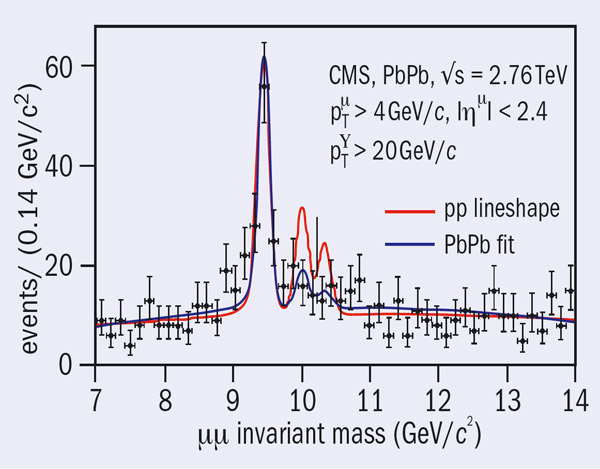
CMS studied pairs of muons that are part of the post-collision debris in the detector, in which pairs of muons produced from the decays of particles such as the Υ will outnumber the pairs that are created by random processes. Thanks to the excellent momentum resolution of the CMS detector, a spectrum can be produced from the masses of each pair, with clear peaks corresponding to the masses of the particles from which they decayed.

The results show a dramatic difference in the number of Υ(2S) and Υ(3S) produced in the heavy-ion and proton–proton collisions. From the data collected from both runs at 2.76 TeV, CMS has observed that the relative production of the excited states of the Υ particle in heavy-ion collisions is only about 30% that of the comparable rates from proton collisions, with an uncertainty of about 20% (see figure). The probability of obtaining the measured value, or a lower one, if the true double ratio of the heavy ion and proton results is unity, has been calculated to be less than 1%.

The CMS collaboration is looking forward to the next lead–lead run later this year when more data will allow study of the suppression of the excited Υ states with even higher statistics.

LHCb closes in on Bs oscillations

CCnew9_06_11

In analysing data from the 2010 running of the LHC, the LHCb collaboration has made some important measurements of the oscillation properties of Bs mesons.

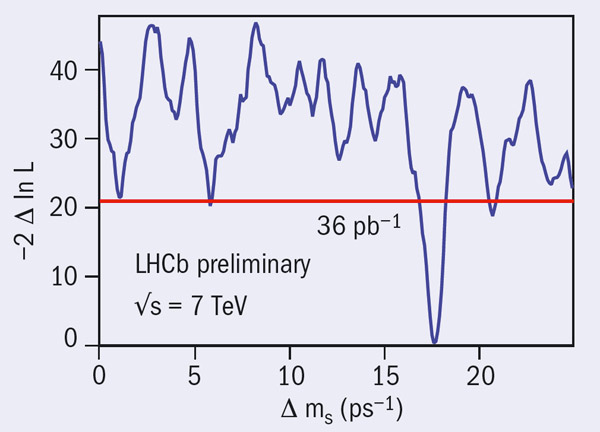
In the Bs system, the Bs and the Bs are mixtures of mass eigenstates that differ in mass by Δms and it this difference that determines the frequency of the oscillations between the Bs and BBs states. It also modifies the probability distribution for the proper time for B0s decays. To measure Δms, the collaboration analysed some 1350 candidates for four decays of the kind B0s → Dsπ and B0s → Ds3π, which were selected from 36 pb–1 of data collected in 2010 at 7 TeV in the centre-of-mass. The team measured the proper decay times for these events, tagging them according to whether they corresponded to un-mixed or mixed decay, i.e. whether the production and decay flavour are the same or opposite, respectively. The preliminary result yields a result of Δms = 17.63 ± 0.11 (stat.) ± 0.04 (syst.) ps–1 (LHCb collaboration 2011a). This is to be compared with the previous best measurement in the world, from the CDF experiment at the Tevatron, of 17.77 ± 0.10 (stat.) ± 0.07 (syst.) ps–1 (CDF collaboration 2006).

The Bs can also decay to J/Ψφ, either by BsBs oscillation or directly, and the interference between these two decay modes gives rise to the CP-violating phase φs. The LHCb collaboration has made its first measurement of this phase using 836 Bs → J/Ψφ signal candidates from the same 2010 data sample used to determine Δms. In the Standard Model, φs is approximately equal to the angle –2βs from a unitarity triangle of the Cabibbo-Kobayashi-Maskawa matrix, and global fits to data give –2βs = (0.0363 ± 0.0017) rad. The Tevatron experiments – CDF and DØ – have reported values for φs that are somewhat inconsistent with the Standard Model expectation, so this is a crucial measurement for LHCb. The first result from last year’s data is consistent with the Tevatron results, but not yet as precise (LHCb collaboration 2011b). However, the LHCb experiment has already taken enough data this year to make a much more precise measurement, and will be able to clarify whether there is any sign of new physics in this decay.

SuperB Factory set to be built at the University of Rome ‘Tor Vergata’

Plans for SuperB

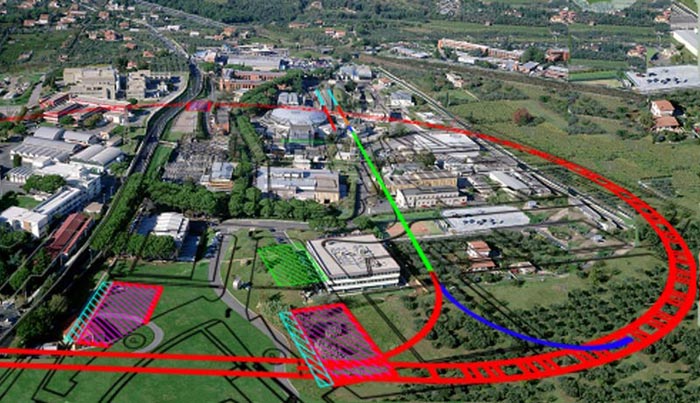
Roberto Petronzio, president of INFN has announced that the SuperB Factory, will be built at the University of Rome ‘Tor Vergata’. The facility tops the list of 14 flagship projects of the National Research Plan of the Italian Ministry for Education, Universities and Research.

The SuperB project involves the construction underground of a new asymmetric high-luminosity electron–positron collider. It will occupy approximately 30 hectares on the campus of the University of Rome ‘Tor Vergata’ and be closely linked to the INFN Frascati National Laboratories, located nearby. The project, which will ultimately cost a few hundred-million euros, obtained funding approval for €250 million in the Italian government’s CIPE Economic Planning Document. It has also attracted interest from physicists in many other countries. At the end of May, some 300 physicists from all over the world gathered on the island of Elba for a meeting that started the formal formation of the SuperB collaboration, a crucial milestone on the road towards realization of the accelerator.

SuperB will be a major international research centre for fundamental and applied physics. The high a design luminosity of 1036 cm–2 s–1 will allow the indirect exploration of new effects in the physics of heavy quarks and flavours through the studies of large samples of B, D and τ decays. The same infrastructure will also provide new technologies and advanced experimental instruments for research in solid-state physics, biology, nanotechnologies and biomedicine.

SACLA laser sets new record

RIKEN and the Japan Synchrotron Radiation Research Institute (JASRI) have successfully produced a beam of X-ray laser light with a wavelength of 0.12 nm. This was created using the SPring-8 Angstrom Compact free electron LAser (SACLA), a cutting-edge X-ray free-electron laser (XFEL) facility unveiled by RIKEN in February 2011 in Harima. It opens a window into the structure of atoms and molecules at a level of detail never seen before.

One of only two facilities in the world to offer this novel light source, SACLA has the capacity to deliver radiation one billion times brighter and with pulses one thousand times shorter than other existing X-ray sources. In late March, the facility marked its first milestone, accelerating beam to 8 GeV and spontaneous X-rays produced at 0.08 nm.

Only three months later, SACLA has marked a second milestone. On 7 June, operators successfully increased the density of the electron beam by several hundred times and guided it with a precision of several micrometres to produce a bright X-ray laser with a wavelength of only 0.12 nm (a photon energy of 10 keV). This matches the record of 0.12 nm set at the only other operational XFEL facility in the world, the Linac Coherent Light Source at SLAC.

With experiments soon to commence and user operations at the facility to begin by the end of fiscal year 2011, this new record offers a taste of things to come with SACLA’s powerful beam.

EuCARD reviews progress at annual meeting

The second annual meeting of the European Co-ordination for Accelerator Research and Development (EuCARD) project took place on 11–13 May at the headquarters of the Centre National de Recherche Scientifique in Paris, attended by more than 120 participants. EuCARD is a four-year project co-funded by the European Union’s Framework Programme 7 and involves 37 European partners.

Among the many results and issues discussed was the progress of the engineering design for a 13 T niobium-tin (Nb3Sn) dipole. The first results on its high-temperature superconductor coil insert showed the need for a second iteration; the Nb3Sn undulator also requires optimization with respect to instabilities. New materials have been identified for more robust collimators; intelligent collimators for the LHC and cold collimators for the Facility for Antiproton and Ion Research are undergoing beam tests.

Linear collider technologies are on the move as well and new findings were reported on the origin of breakdowns in cavities. Stabilization to below 0.5 nm at 1 Hz has been demonstrated and there have been advances in instrumentation and femtosecond synchronization. Several superconducting bulk or coated cavities are in either final design, construction or test stages. These include crab cavities for both the LHC and the Compact Linear Collider study. Finally, novel concepts are progressing, including the new crab-waist crossing being tested at DAFNE, the commissioning of EMMA (the fixed-field alternating gradient machine at Daresbury) and the emittance measurement of tiny laser-driven, plasma-accelerated beams.

The networking activities in neutrino facilities, accelerator performance and RF technologies have confirmed their efficiency as exchange platforms. They have made the case for their expansion in the EuCARD2 proposal, which is under preparation and will be submitted by November 2011. Transnational access to the UK Science and Technology Facilities Council’s MICE facility (precision beams and muon-ionization cooling equipment) is continuing. HiRadMat at CERN, which offers pulsed irradiation, will open this autumn. Potential external users can benefit from financial support from the European Commission.

This year, the meeting dedicated one day to accelerator research and development in France, as well as to topics outside the scope of EuCARD, including the SuperB project (SuperB Factory set to be built at the University of Rome ‘Tor Vergata’), neutrino facilities and Siemens medical accelerators. There was also a visit to the large accelerator platforms at the Institut de Physique Nucléaire d’Orsay and CEA-Saclay.

New European novel accelerator network formed

The European Network for Novel Accelerators (EuroNNAc) was formally launched at a workshop held at CERN on 3–6 May as part of the EuCARD project. The aim was to form the network and define the work towards a significant Framework Programme 8 proposal for novel accelerator facilities in Europe.

The workshop was widely supported, with 90 participants from 51 different institutes, including 10 from outside Europe, and had high-level CERN support, with talks by Rolf Heuer, Steve Myers and Sergio Bertolucci. There were also contributions from leading experts in the field such as Gerard Mourou of the Institute Lumiere Extreme and Toshi Tajima of Ludwig Maximilians Universität, two senior pioneers in this field.

The field of plasma wakefield acceleration, which the new network plans to develop, is changing fast. Interesting beams of 0.3–1 GeV, with 1.5–2.5% energy spread, have now been produced in several places including France, Germany, the UK and the US, with promising reproducibility. Conventional accelerator laboratories are now interested to see if an operational accelerator can be built with these parameters. To avoid replication of work, a distributed test facility spread across many labs is envisaged for creating such a new device.

If a compact, 1 GeV test accelerator were pioneered, it could be copied for use around the world. Possible applications include tests in photon science or as a test beam for particle detectors. This could ease the present restrictions on beam time experienced by many researchers. These developments are currently being restricted to electron accelerators because they can be useful even when not fully reliable. Proton machines for medical purposes would, however, need to be more reliable.

In addition to the R&D aspects, the network discussed plans to create a school on Conventional to Advanced Accelerators – possibly linked to the CERN Accelerator School – and to establish a European Advanced Accelerator Conference.

The network activities will be closely co-ordinated with the TIARA and ELI projects. There is currently high funding support for laser science in Europe – about €4 billion in the next decade. EuroNNAc will help in defining the optimal way towards a compact, ultra-high-gradient linac. CERN will co-ordinate this work with help from the École Polytechnique and the University of Hamburg/DESY.

NSRRC commissions linac system for new photon source

CCnew10_06_11

Only four months after the crates containing parts of the new electron linac system touched ground at the test site, the National Synchrotron Radiation Research Center (NSRRC) completed the commissioning of the linac system for its second synchrotron light source facility, the Taiwan Photon Source (TPS), on 6 May.

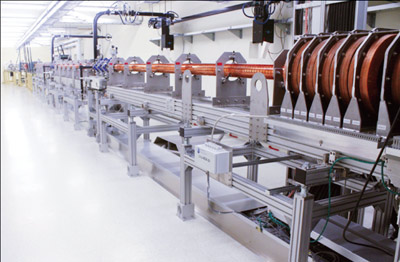
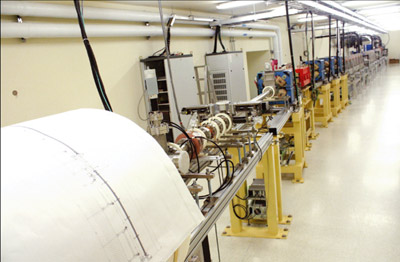
This is a major milestone in a challenging project that has had to contend with waves of worldwide recession, turbulent inflation, price fluctuations for raw materials, and unforeseen obstacles in civil construction. The contract to design and manufacture the single turn-key system, with a minimum output energy of 150 MeV, was awarded to RI Research Instruments GmbH, Germany, in November 2008. The basic design parameters stipulated 2997.924 MHz (S band) radio frequency, pulse duration of 1 ns and 200–1000 ns for short and long pulses respectively, and a maximum repetition rate of 5 Hz. The linac consists of an electron gun, a focusing and bunching section, and an accelerating section. The electron gun is capable of providing pulsed nanosecond electrons with an energy of 90 keV. Once produced, the electrons are further focused, longitudinally bunched and transferred to the 20-m long-accelerating section. This has three acceleration structures equipped with three high-power microwave amplifiers, in which the electrons are accelerated to 150 MeV.

CCnew11_06_11

The linac is the first TPS subsystem to require many supporting subsystems in order to proceed in its testing. During the development, various unexpected situations were encountered and steps were taken to deal with them; these included the availability of the test site ahead of the completion of the building for the TPS storage ring. The establishment of a full-scale linac test site placed an additional workload on the TPS construction teams.

The construction of the linac test site and the process to obtain operating permission from the Atomic Energy Committee occupied the last four months of 2010. In January 2011, the TPS subsystem teams moved in and began working around the clock to set up the facility. Later they joined forces with the engineering teams from RI Research Instruments GmbH to install and test the linac. The effective collaboration between the different teams was a key factor in the smooth and successful commissioning of the linac. Having the TPS linac system up and running opens a number of channels for engineers to test their systems, especially those developed in house by the NSRRC staff including the control and instrumentation group.

The TPS will be equipped with a 3 GeV electron accelerator

The design of the linac system by the four-member linac team began in the spring of 2006 and by June 2008 it was made available for an open bid to vendors worldwide. In November 2008, the project was awarded to ACCEL Instruments GmbH (acquired by Bruker Energy & Supercon Technologies Inc in 2009). This gave RI Research Instruments GmbH, a spin-off division from ACCEL, 27 months to prepare the complete system for commissioning with beam. After the first parts arrived at the linac test site in January 2011, the TPS linac team geared up to prepare for the acceptance test. The intense schedule put linac staff on a 24-hour shift to work on the project, in particular on the high-power RF conditioning of the accelerating structures. This effort reached a conclusion on 5 May, with an output energy greater than 150 MeV and measurement of the major beam parameters.

CCnew12_06_11

The TPS will be equipped with a 3 GeV electron accelerator, 518.4 m in circumference, and a low-emittance synchrotron storage ring. As part of the major advanced scientific research projects under the National Science Council, the TPS is being built next to the NSRRC’s first light source, Taiwan Light Source (CERN Courier June 2010 p16). The first official proposal of the TPS was submitted to governmental authorities in 2006 and the official ground breaking of TPS civil construction began on 7 February 2010.

Swift witnesses a black hole devouring a star

Follow-up observations of an apparently normal gamma-ray burst (GRB) detected by NASA’s Swift satellite have identified the event as a star being ripped apart by a massive black hole in a distant galaxy. Two articles in Science report on the observational investigations and the physical interpretation of this rare sight.

On 28 March 2011 at 12.57 UT, an outburst of gamma rays was detected by the Burst Alert Telescope (BAT) on the Swift satellite. Called GRB 110328A, the GRB looked like one of the hundreds that Swift has already detected since its launch in November 2004 (CERN Courier December 2005 p20). As always, the satellite pointed its narrow-field optical and X-ray telescopes towards the transient source to observe the decline of the GRB afterglow within minutes to hours (CERN Courier October 2005 p11, CERN Courier May 2007 p11). This time, however, the source remained bright and highly variable, with repeated outbursts triggering the BAT three more times in 48 hours. As the days passed with no major decline in X-rays, it became obvious that this source was not a usual GRB and it was thus dubbed Sw 1644+57.

Astronomers had begun ground-based follow-up observations soon after the burst. In one of the reports in Science, Andrew Levan of the University of Warwick and collaborators tell the detective story involved in the identification of the event. While the Gemini-North Telescope in Hawaii had poor weather conditions two hours after the burst, 11 hours later the Nordic Optical Telescope on La Palma in the Canary Islands detected a faint galaxy at the position of the burst. Subsequent spectroscopic observations determined a redshift of 0.35, indicating that the source is nearly four thousand million light-years away. The unusual characteristics of the event awoke the curiosity of the Hubble Space Telescope, which was able to pinpoint it to the very centre of the remote galaxy – a finding confirmed in radio observations by the Very Large Baseline Array.

Could the object be a quasar? Archival data show no sign of nuclear activity in this relatively small galaxy and, furthermore, the luminosity released by the event exceeds by a factor of 100 the flares from the most powerful active galactic nuclei. So what else can release the energy equivalent to 10% of the rest mass of the entire Sun in less than two weeks? A possibility is the disruption and swallowing of a star venturing too close to the event horizon of a black hole. At least this is the conclusion reached by Joshua Bloom of the University of California, Berkeley, and colleagues, although they admit that Sw 1644+57 initially displayed none of the theoretically anticipated– nor observed – characteristics of such an event.

The poor observational and theoretical knowledge of tidal-disruption flares is a consequence of their rarity: they should occur only about 1 to 10 times every 100,000 years in a given galaxy (CERN Courier April 2004 p12). Because such an event would be so unlikely, theorists did not consider that a putative jet emitted from the black hole devouring a star would point right towards Earth. As unlikely as it seems, J Bloom and collaborators found strong evidence that this had to be the case for Sw 1644+57 because the observed luminosity would be too high for the inferred mass of the black hole – below 10 million solar masses – if it were not enhanced by relativistic beaming in a jet aligned with the line-of-sight. So everything points to the disruption of a star that has swiftly turned a dormant black hole into a luminous blazar (see, for example, CERN Courier June 2006 p14). The source was restless for the three following weeks, and so were the scientists who eagerly had to write the two papers and submit them jointly to Science on 18 April 2011!

bright-rec iop pub iop-science physcis connect