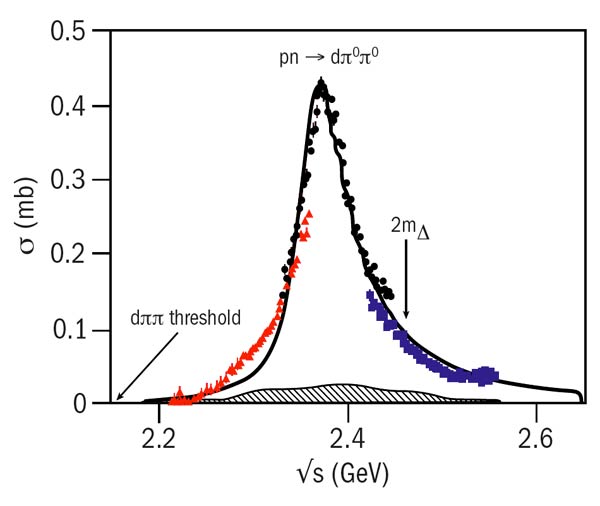
Experiments at the Jülich Cooler Synchrotron, COSY, have found evidence for a new complex state in the two-baryon system, with mass 2.37 GeV and width 70 MeV. The structure, containing six valence quarks, could constitute either an exotic compact particle or a hadronic molecule. The result could cast light on the long-standing question of whether there are eigenstates in the two-baryon system other than the deuteron ground-state. This has awaited an answer since Robert Jaffe first envisaged the possible existence of non-trivial six-quark configurations in QCD in 1977.
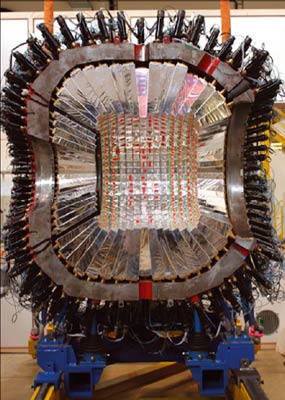
The new structure has been observed in high-precision measurements carried out by the WASA-at-COSY collaboration, using the Wide-Angle Shower Apparatus (WASA). The data exhibit a narrow isoscalar resonance-like structure in neutron–proton collisions for events where a deuteron is produced together with a pair of neutral pions. From the differential distributions, the spin-parity of the new system is deduced to be JP = 3+ and its main decay mode is via formation of a ΔΔ system below the nominal threshold of 2mΔ. The collaboration will further test the resonance hypothesis in elastic proton–neutron collisions with a polarized beam; the JP = 3+ partial waves should be dominated by the new structure, while its contribution to the elastic cross-section should be small.
The resonance structure also turns out to be intimately connected to the so-called ABC effect, in which the two pions produced in a nuclear fusion process are emitted preferentially in parallel. This 50-year-old puzzle, which is named after the initial letters of the surnames of its first observers A Abashian, N E Booth and K M Crowe, could now find its explanation in the way that such a resonance decays.
The CDF collaboration at Fermilab has announced the observation of the Ξ0b, the latest entry in the periodic table of baryons. Although Fermilab’s Tevatron is not a dedicated bottom-quark factory, the sophisticated particle detectors employed there and large integrated luminosity of proton–antiproton collisions delivered to the experiments have made it a haven for discovering and studying almost all of the known bottom baryons. Experiments there discovered the Σb baryons in 2006, observed the Ξ–b baryon in 2007 and found the Ωb in 2009. The lightest bottom baryon, the Λb, was discovered at CERN.
The complex decay pattern of the neutral Ξ0b has made the observation of this particle significantly more challenging than that of its charged sibling. Combing through an integrated luminosity of 4.2 fb–1 of proton–antiproton collisions produced at a centre-of-mass energy of 1.96 TeV, the CDF collaboration isolated 25 examples in which the particles emerging from a collision revealed the distinctive signature of the Ξ0b, through its decay to Ξ+cπ– and the subsequent decay chain. The analysis established the discovery at a level of 6.8 σ and measured the mass of the Ξ0b as 5787.8 ± 5.0(stat) ± 1.3(syst) MeV/c2.
CDF also observed a similar number of events for the charged Ξb, in the decay Ξ–b → Ξ0cπ–, never previously observed; this served as an independent cross-check of the analysis.
At its recent session in June, the CERN Council approved the construction of the Extra Low ENergy Antiproton ring (ELENA) – an upgrade of the existing Antiproton Decelerator (AD). ELENA will allow the further deceleration of antiprotons, resulting in an increased number of particles trapped downstream in the experiments. This will give an important boost to antimatter research in the years to come.
The recent successes of the AD experiments are just the latest in a long list of important scientific results with low-energy antiprotons at CERN that started in the 1990s with the Low Energy Antiproton Ring. Over the years, the scientific demand for antiprotons at the AD has continued to grow. There are now four experiments running there (ATRAP, ALPHA, ASACUSA and ACE). A fifth, AEGIS, has been approved and will take beam for the first time at the end of the year; further proposals are also under consideration. The AD is approaching the stage where it can no longer provide the number of antiprotons needed. As antihydrogen studies evolve into antihydrogen spectroscopy and gravitational measurements, the shortage will become even more acute.
The solution is a small ring of magnets that will fit inside the current AD hall – in other words, ELENA, the recently approved upgrade. ELENA will be a 30 m-circumference decelerator that will slow down the 5.3 MeV antiprotons from the AD to an energy of only 100 keV. Receiving slower antiprotons will help the experiments to improve their efficiency in creating antimatter atoms.
Currently, around 99.9% of the antiprotons produced by the AD are lost because of the experiments’ use of degrader foils, which are needed to decelerate the particles from the AD ejection energy down to around 5 keV – the energy needed for trapping. ELENA will increase the experiments’ efficiency by a factor of 10–100 as well as offer the possibility to accommodate an extra experimental area.
The new ring will be located such that its assembly and commissioning will have a minimal impact on operation of the AD. Indeed, the commissioning of the ELENA ring will take place in parallel with the current research programme, with short periods dedicated to commissioning during the physics run. The layout of the experimental area at the AD will not be significantly modified, but the much lower beam energies involved require the design and construction of completely new electrostatic transfer lines.
The construction of ELENA should begin in 2013 and the first physics injection should follow about three years later. The initial phase of the work will include the installation and commissioning of the ELENA ring while using the existing AD beam lines. The old ejection lines in all of the experimental areas will then be replaced with new electrostatic beam lines that will deliver antiprotons at the design energy of 100 keV. In its final configuration, ELENA will be able to deliver beams almost simultaneously to four experiments, resulting in a vital gain in total beam time.
The International Linear Collider (ILC) Global Design Effort (GDE) has released a major milestone report, The International Linear Collider: A Technical Progress Report. As its title suggests, the 162-page report represents the current status of the global R&D that is currently co-ordinated by the GDE. Coming roughly half way through the ILC Technical Design Phase, it documents the considerable progress that has been made worldwide towards a robust and technically mature design of a 500–1000 GeV electron–positron linear collider. With a stated five-year programme for the technical design phase, the GDE felt it necessary to have a significant mid-term publication milestone that would bridge the gap between the publication of the Reference Design Report (RDR) in 2007 and that of the foreseen Technical Design Report (TDR) in 2012. Because much of the R&D referred to in the report is still ongoing, it necessarily represents a snapshot of the current situation.
The focus of the progress report is on the co-ordinated worldwide “risk-mitigating” R&D that was originally identified at the time of the RDR publication. Although the report is comprehensive in covering nearly all areas of R&D, it has a strong focus on the development of the 1.3 GHz superconducting RF accelerating technology – the heart of the linear collider design. A large fraction of the total resource available has been used to develop the necessary worldwide infrastructure and expert-base in this technology, which includes research into high-gradient superconducting cavities as well as a focus on industrialization and mass-production models for this state-of-the-art technology. A further focus is on the three beam-test facilities: TTF/FLASH at DESY Hamburg, for the superconducting RF linac; the CesrTA facility at Cornell, for damping-ring electron cloud R&D; and ATF/ATF2 at KEK, for final focus optics, instrumentation and beam stabilization. Finally, the report also indicates work towards the ILC TDR baseline design and, in particular, the conventional facilities and siting activities.
The technical progress report will serve as a solid base for the production of the final report on the technical design phase R&D, which will be part of the TDR. Some 350 authors from more than 40 institutes around the globe have contributed to its successful publication. Now attention is already turning to producing the TDR – work that will formally start at the joint ILC-CLIC workshop being held in Granada in September.
• The report, which is available online at www.linearcollider.org/interim-report, is the first of two volumes; a second volume, to be released soon by the ILC Research Directorate, will focus on the ILC scientific case and on the design of the detectors associated with the collider.
In this issue, news from the LHC experiments focuses on a few highlights at the first big summer conference.
The outstanding performance of the LHC enabled the ATLAS and CMS collaborations to report remarkable progress in the hunt for the Higgs boson at EPS-HEP 2011. With an integrated luminosity of more than 1 fb–1 each – the original luminosity goal for all of 2011 – the experiments have been able to extend significantly the exclusion region for the Standard Model Higgs boson and to achieve impressive advances in extending sensitivity in other mass ranges.
In the Standard Model, the Higgs boson endows other particles and itself with mass. At the same time, the dominant decay mode of the Higgs depends on the value of its mass. Consequently, a comprehensive search for the Higgs must look in numerous decay modes.
At the conference, each collaboration reported results on several possible Higgs decay modes. These results were based on the full sample of data recorded by the end of June; the ability to search for so many decay modes so promptly reflected the efficiency of the experiments and the dedication of the collaborations. The most generally promising decay modes, such as H→γγ, H→W+W–, and H→Z0Z0, were well covered by both experiments, while early results on H→τ+τ– from CMS and on H→bb from ATLAS were also produced. In each experiment the results of these searches can be combined to optimize sensitivity across the range of possible Higgs boson masses.
The CMS and ATLAS Higgs limits presented at the conference are summarized by the solid curves in the two figures. These plots show the result of combining the limits from all of the analysed decay modes in each experiment in terms of the range of possible Standard Model Higgs mass that can be excluded with 95% confidence.
The two experiments presented similar exclusion ranges. They have now excluded mass ranges for the Higgs boson from 150 to 200 GeV and 300 to 450 GeV; they have also established expected limits within 50% of the Standard Model prediction for the region in between. Moreover, they are homing in on both the low mass region (around 115–150 GeV), which is preferred by electroweak measurements, and the high mass region above about 450 GeV. Throughout these regions, the experiments have already achieved sensitivities, reflected by the dashed curves, within a factor of 2–3 of the Standard Model cross-section.
While it is still early in the hunt for the Higgs, the ATLAS and CMS data also show some excesses that participants at the conference found tantalizing. For instance, both experiments currently see a small excess of candidate events at a mass of roughly 140 GeV. However, given the large range of masses and modes investigated by the two experiments and the as yet limited statistics, the limits observed do sometimes fluctuate from the limits that are expected. In addition, although the two detectors are independent, the results can be somewhat correlated because their background estimates make use of the same theoretical predictions.
Even as the LHC provides the experiments with more data, the painstaking process of combining the limits of the two experiments is currently underway. A combination with the experiments at Fermilab’s Tevatron, whose searches are particularly complementary in the low mass region, will also eventually be done.
Will the Higgs boson be discovered soon, or will the Standard Model Higgs boson be excluded as more data are accumulated? The answer at present is “watch this space”.
In this issue, news from the LHC experiments focuses on a few highlights at the first big summer conference.
The first major conference since the LHC started to deliver significant luminosities provided the opportunity for the experiments to begin to work together on certain results. CMS and LHCb joined forces in just this way in their search for the decay Bs→μ+μ–. This rare decay mode is suppressed in the Standard Model, which predicts a branching ratio of (3.2 ± 0.2) × 10–9. It has recently gained much attention, with a preliminary measurement from the CDF experiment at Fermilab indicating a possible excess of events over the Standard Model expectation.
Now LHCb and CMS have combined their results based on 0.34 fb–1 and 1.14 fb–1 of proton–proton collisions, respectively, at a centre-of-mass energy of 7 TeV. The observed candidates in both experiments are consistent with the expectation from the sum of backgrounds and Standard Model signal. The combination results in an upper limit on the branching ratio for Bs→μ+μ– of less than 1.1 × 10⁻⁸ at 95% confidence level (CL), which improves on the limits obtained by the separate experiments and represents the best existing limit on this decay. Enhancement of the branching ratio by more than 3.4 times the Standard Model prediction is excluded at 95% CL. However, there remains room for a contribution from new physics, so the experiments will press ahead with this search, as the data flood in from the LHC.
In this issue, news from the LHC experiments focuses on a few highlights at the first big summer conference.
A wealth of physics results from ATLAS emerged at EPS-HEP 2011, ranging from detailed measurements of strong and electroweak processes to a spectrum of searches for new physical processes using the full 2011 dataset collected up until the end of June, and comprising up to 1.2 fb–1 of analysed data. As with the Higgs searches, constraints on other new processes now probe mass ranges that have substantially increased with respect to 2010 data alone, but no evidence has yet appeared for physics beyond the Standard Model. Several measurements also benefited by including the 2011 data, such as measurements of the cross-section for the production of pairs of top quarks with a precision of 8%, and a more than 7σ observation of electroweak production of single top quarks.
The collected integrated luminosity has now brought processes involving the dibosons WW, WZ and ZZ under the microscope at ATLAS. Diboson production at the LHC is of great interest because it tests the fundamental gauge structure of the Standard Model. The production of the pairs involves boson self-couplings that are precisely predicted by the Standard Model, so any deviation from the expected values would be an indication of new physics.
Of the three dibosons, the production of ZZ pairs is particularly rare. The Z bosons were observed in ATLAS via their decays to electrons or muons, giving a very clean signature of four isolated leptons with high transverse momentum. Electrons were identified from a cluster in the fine-granularity ATLAS electromagnetic calorimeter, muons from a track in the muon spectrometer, in each case matched to a track measured in the high-precision inner detector. In events with four leptons, pairs of oppositely charged electrons or muons were combined to form Z candidates.
The figure shows a plot of the mass of one electron or muon pair against the mass of the second pair. The ZZ signal is clearly seen as a cluster of events around the Z boson mass, 91 GeV, for both pairs. ATLAS thus sees 12 events that are consistent with ZZ production, with an expected background of 0.3 events, and measures a cross-section of 8.4+2.7–2.4 pb compared with the Standard Model prediction of 6.5 pb.
ATLAS has also measured cross-sections for WW and WZ production, again using leptonic final states. All values are in agreement with Standard Model expectations, and the WZ and ZZ measurements have been used to constrain gauge boson self-couplings. These constraints are comparable with, and in some cases tighter than, those from measurements at the Large Electron–Positron collider at CERN and at Fermilab’s Tevatron.
The CMS collaboration contributed more than 30 new or updated physics analyses at EPS-HEP 2011. The most eagerly awaited results probably concerned searches for the Higgs boson as well as for new physics beyond the Standard Model. A highly anticipated search is the one for supersymmetry (SUSY), and the corresponding search for the production of new heavy supersymmetry particles. If SUSY exists in nature at the tera-electron-volt scale, it could solve many of the outstanding issues in particle physics, such as the gauge hierarchy problem. It could also deliver a natural candidate particle to explain the high density of dark matter in the universe.
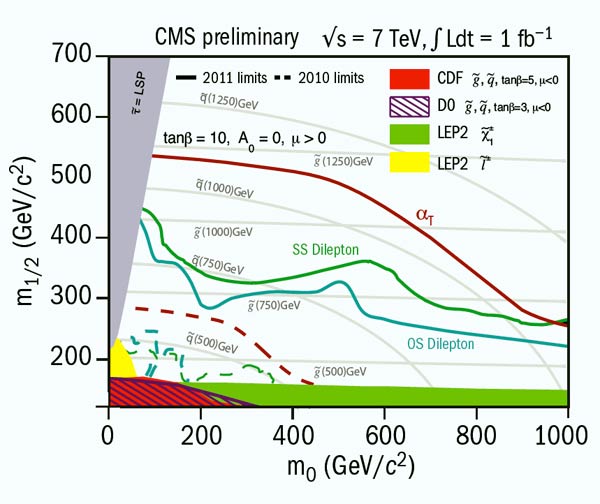
The CMS collaboration released several new analyses at EPS-HEP 2011 on the search for SUSY, based on the full data sample of about 1 fb–1 at 7 TeV in the centre-of-mass, collected by the end of June 2011 and analysed in time for the conference. These analyses search for a variety of characteristic event final-state topologies: e.g. events with a large missing transverse momentum plus either only jets, or leptons and jets. Techniques already used to analyse the 2010 data sample, based on 30 times less data, were further refined and used with the 2011 data.
The results are remarkable, testing regions in the parameter space of SUSY theory where the squarks and gluinos (the supersymmetric partners of quarks and gluons) can be as heavy as 1 TeV. Unfortunately there is no sign so far of the production of SUSY particles. With these latest results, CMS has substantially reduced the phase space where SUSY can hide, particularly in the so-called constrained models such as the Constrained Minimal Supersymmetric extension of the Standard Model (CMSSM). Figure 1 illustrates the impressive reach of the CMS analyses with respect to other experiments in the plane of the universal scalar and gaugino masses at the GUT scale (m0 and m1/2, respectively) of the CMSSM.
The collaboration has also released its first paper based on the 2011 dataset of 1 fb–1, namely on the search for very high mass resonances in events that have at least two jets with a large transverse momentum in the final state. Jets are observed in the detectors as sprays of particles ejected from the interaction point in a given direction – that is, the direction of the original parton produced in the hard scattering of the collision, or in the decay of a heavy new particle. Examples of possible heavy new particles that can be studied in such di-jet invariant mass analyses are new gauge bosons, graviton resonances, string resonances, and more exotic objects that couple via the strong force, such as axigluons or colour octet states. Each one of these particles is predicted in one or more models for new physics beyond the Standard Model.
CMS has now examined the di-jet mass for mass values up to 4 TeV. No significant sign of di-jet resonances has been found and, as figure 2 shows, various other new particles have now been excluded in the range of 1–4 TeV, depending on the model and particle species.
The search for SUSY and other new physics signatures at the LHC is in a very early stage – an important increase in luminosity is expected before the end of 2012. These first data are beginning to disfavour the simplest and more constrained models, but the range of possibilities that need to be explored further is vast. As David Gross said in the concluding remarks at the conference: “Nobody promised it would be easy.”
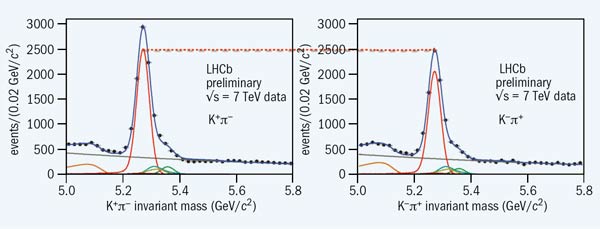
The LHCb experiment has been designed to focus on B physics, which offers a rich hunting ground for new physics as the large numbers of B hadrons produced at the LHC allow the detailed study of rare processes. Two results presented at EPS-HEP 2011 show how quickly the experiment has been able to access this kind of physics. In one case, LHCb has made the first 5σ observation of a CP asymmetry at the LHC, in the mode B0→Kπ; in the other, the collaboration has made the most precise measurement to date of the forward-backward asymmetry of the rare decay B0→K*0μ+μ–, which is very sensitive to new physics.
The CP asymmetry for the B0→Kπ decay is defined as ACP(B0→Kπ) = [Γ(B0→K–π+) – Γ(B0→K+π–)] / [Γ(B0→K–π+) + Γ(B0→K+π–)]. As figure 1 shows, the asymmetry is clearly visible in the raw invariant mass distribution measured by LHCb for a data sample corresponding to 320 pb–1 of integrated luminosity – i.e. most of the data taken up to the LHC’s technical stop in June, just a month prior to the conference. However, to correct for any asymmetry in the production of the B0 and B0 and in the detection of the different final states, the collaboration uses control channels, such as B0→J/Ψ K*0 and D*+→D0π+; they also compare results taken with opposite polarities of the detector’s magnetic field. The corrections are typically at the percent level and yield a corrected asymmetry of ACP = –0.088 ± 0.011 ± 0.008.
This result is a world best, with a significance of more than 5σ, and is in good agreement with the existing world average of ACP(B0→Kπ) = –0.098 +0.012–0.011. It is an important landmark for LHCb. The many CP asymmetries in B decays can be sensitive to physics beyond the Standard Model and form an important part of the physics programme for the experiment.
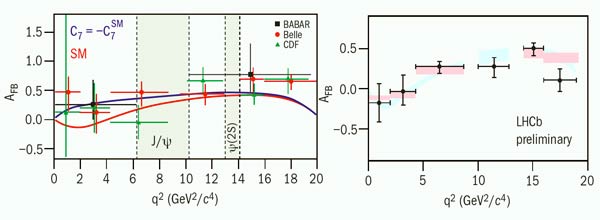
In a second study, LHCb has observed the decay B0→K*0μ+μ–. This is a rare mode involving a flavour-changing neutral current; it proceeds via a b→s transition through a loop diagram, with a branching ratio of order 10–6. New physics processes can therefore enter at the same level as the Standard Model processes, making the decay a sensitive probe of contributions from new physics. The partial rate as a function of the di-muon invariant mass squared (q2) and the di-muon forward-backward asymmetry (AFB) can both be affected in many new physics scenarios. Existing measurements of AFB vs q2, which are shown on the left side of figure 2, have all tended to be rather higher than the expectation from the Standard Model, hinting at possible new physics, although the individual statistical significance is small.
LHCb has already collected over 300 events for B0→K*0μ+μ–, with a signal-to-background ratio above three. This is the largest sample of such decays in the world, and is even cleaner than the samples used by the B factories. The right side of figure 2 shows the distribution of AFB vs q2 for these events, which is in good agreement with the Standard Model expectation (shown by the shaded bands). The collaboration plans to continue to study this channel in finer detail, with measurements that include more angular variables, and expects to achieve high sensitivity to any small deviation from the Standard Model.
While astrophysical jets are often powered by black holes, high-speed plasma flows are also ejected by solar flares and can even arise in the Earth’s magnetosphere. The four Cluster spacecraft have been lucky to observe one of the latter events from inside the plasma flow and witness jet-braking and plasma-heating processes.
The story of the Cluster mission to study the Earth’s magnetosphere and its environment in three dimensions is long and tumultuous. First proposed to the European Space Agency (ESA) in November 1982, the four identical satellites, to be flown in a tetrahedral configuration, should have benefited from a “free” launch on the first test flight of the Ariane-5 rocket. Unfortunately, this flight lasted just 37 s and ended abruptly by breaking up during launch on 4 June 1996. To recover at least part of the 10-year development effort, ESA decided to build one additional Cluster satellite named Phoenix, named after the mythical bird reborn out of its ashes. It soon became apparent that the scientific objectives would not be met by Phoenix alone and that a second Ariane-5 launch would be too expensive. Eventually, in the summer of 2000, all of the obstacles had been overcome and four new Cluster satellites were successfully carried into space, two at a time by Russian Soyuz rockets.
Eleven years after the launch, the Cluster mission is still operating, providing insights into the physical processes involved in the interaction between the solar wind and the magnetosphere of the Earth. These interactions often send electrons and ions to the Earth’s magnetic poles, where they hit neutral gas in the atmosphere and produce aurorae. This occurs either by direct entry of solar-wind particles through the polar cusps or by plasma acceleration in the magnetotail during substorms. The magnetotail is located on the night side of the Earth, where the planet’s magnetic field is drawn out into a long tail by the solar wind. It hosts in its centre the plasma sheet, a large reservoir of particles with ion temperatures of about 50 million degrees. When magnetic reconnection occurs in the magnetotail, the plasma sheet is energized and jets are created.
On 3 September 2006, the four Cluster satellites happened to fly through the magnetotail at an altitude of roughly a quarter of the Earth–Moon distance, just in time to witness the sudden rearrangement of the magnetic field leading to the explosive release into the plasma of much of the stored magnetic energy. The instruments aboard the four Cluster satellites monitored the flux of energetic particles focused along the magnetic field lines into a jet pointing towards the Earth. These observations and their implications are now published in Physical Review Letters by a team from the Swedish Institute of Space Physics, Uppsala, and the Mullard Space Science Laboratory, University College London.
The data indicate that the original, fairly “cold” jet was subsequently heated by a separate mechanism similar to friction. At first, the flow’s interaction with other particles and the enhanced magnetic field closer to Earth caused the front of the jet to slow down. This led to a pile up of the magnetic field in the plasma and to further heating and acceleration of the electrons. The process is called betatron acceleration in reference to the particle accelerators developed in the early 1940s, which used a variable electromagnetic field to accelerate electrons circling in a toroidal vacuum chamber. As Yuri Khotyaintsev, the lead author of the study, points out, this process is likely to occur in other types of astrophysical jets whenever they are interacting with the local environment and braking. So, not only shocks but also the pile-up of the magnetic field at the jet front can result in particle acceleration and heating.
To provide the best experiences, we use technologies like cookies to store and/or access device information. Consenting to these technologies will allow us to process data such as browsing behavior or unique IDs on this site. Not consenting or withdrawing consent, may adversely affect certain features and functions.
Functional
Always active
The technical storage or access is strictly necessary for the legitimate purpose of enabling the use of a specific service explicitly requested by the subscriber or user, or for the sole purpose of carrying out the transmission of a communication over an electronic communications network.
Preferences
The technical storage or access is necessary for the legitimate purpose of storing preferences that are not requested by the subscriber or user.
Statistics
The technical storage or access that is used exclusively for statistical purposes.The technical storage or access that is used exclusively for anonymous statistical purposes. Without a subpoena, voluntary compliance on the part of your Internet Service Provider, or additional records from a third party, information stored or retrieved for this purpose alone cannot usually be used to identify you.
Marketing
The technical storage or access is required to create user profiles to send advertising, or to track the user on a website or across several websites for similar marketing purposes.