On 13 February, US President Barack Obama unveiled his administration’s budget request for fiscal year 2013, which begins on 1 October 2012. The budget for the Department of Energy’s Office of Science would increase by 2.4 per cent to $4.992 billion, but high-energy physics would be reduced by 1.8 per cent to $777 million. In the next step, the two chambers of the US Congress will take up the negotiations to arrive at a final budget.
The proposed cuts in high-energy physics would hit two long-term programmes the hardest: the Long-Baseline Neutrino Experiment (LBNE) and the US R&D programme for the International Linear Collider (ILC). The budget for LBNE would drop to $10 million from $21 million in the current year. The collaboration had requested an increase to advance its plans to search for CP-violation in neutrino interactions by sending neutrinos from Fermilab to a detector in South Dakota (Steps forward for new long-baseline experiment).
Funding for the US ILC R&D programme is eliminated in the request, a cut of $20 million. While the current ILC R&D phase will end this year, the next phase would have helped to advance accelerator technologies that would benefit projects such as Fermilab’s Project X proton accelerator and Berkeley’s Next-Generation Light Source.
Some programmes would fare much better. Funding for non-accelerator physics programmes would increase by $13 million to ramp-up engineering and design efforts for the Large Synoptic Survey Telescope camera project and R&D funding for next-generation dark-matter experiments. The US contribution to the upgrades of the Belle-II detector at KEK in Japan would remain on track, along with near-term neutrino and muon research programmes at Fermilab.
The Daya Bay Reactor Neutrino Experiment, a multinational collaboration operating in the south of China, has reported its first results. The team has analysed tens of thousands of interactions of electron-antineutrinos caught by six massive detectors buried in the mountains adjacent to the powerful nuclear reactors of the China Guangdong Nuclear Power Group.
The copious data revealed for the first time a strong signal of the mixing angle θ13, related to the type of neutrino oscillation in which electron-neutrinos morph into the other two flavours. This is the last mixing angle to be measured precisely and could reveal clues leading to an understanding of why matter predominates over antimatter in the universe. Once thought to be near zero, the first results indicate that sin22θ13 is equal to 0.092 ± 0.017.
The Daya Bay experiment counts the number of electron-antineutrinos detected in the halls nearest the Daya Bay and Ling Ao reactors and calculates how many would reach the detectors in the Far Hall if there were no oscillation. The number that apparently vanish on the way (by oscillating into other flavours) gives the value of θ13. Because of the near-hall/far-hall arrangement, it is unnecessary to have a precise estimate of the antineutrino flux from the reactors.
The initial results will in the coming months and years be honed by collecting more data and reducing statistical and systematic errors. Refined results will open the door to further investigations and influence the design of future neutrino experiments, including how to determine which neutrino flavours are the most massive and whether there is a difference between neutrino and antineutrino oscillations.
The search for the neutrinoless double-beta decay (ββ0ν decay) aims to solve a long-standing question concerning the nature of neutrinos. The decay, in which a nucleus decays by emitting two electrons but no neutrinos, can occur only if the neutrino is its own antiparticle, i.e. a Majorana particle. If it occurs, it must be extremely rare, with a half-life greater than 1024 years. This poses an enormous experimental challenge regarding its unambiguous detection, with just a few nuclear isotopes offering a useful hunting ground. Now an experiment at the ISOLDE facility at CERN has identified a new potential candidate, the palladium isotope 110Pd.
The signature for ββ0ν decay appears in the sum of the energies of the two emitted electrons, which should have a single peak at the Q value for the decay, i.e. at the energy corresponding to the mass difference between the initial and final nuclide. (In double-beta decay with neutrinos (ββ2ν), the emitted electrons have a broad energy spectrum.) Calorimetric experiments searching for ββ0ν require detectors fabricated from sufficient quantities of the transmuting material to allow the detection of a decay within a reasonable amount of time. In addition, the energy of the decay peak must be known precisely if the detector is to have a high resolution at the correct energy.
With its high natural abundance, 110Pd offers a promising alternative for double-beta decay searches, now that its Q value has been measured directly with unprecedented accuracy. An experiment using the Penning-trap mass spectrometer ISOLTRAP at ISOLDE has determined the Q value from the cyclotron frequency ratio of 110Pd and its decay-product 110Cd by manipulating a few, singly charged ions in an isolated environment (Fink et al. 2012).
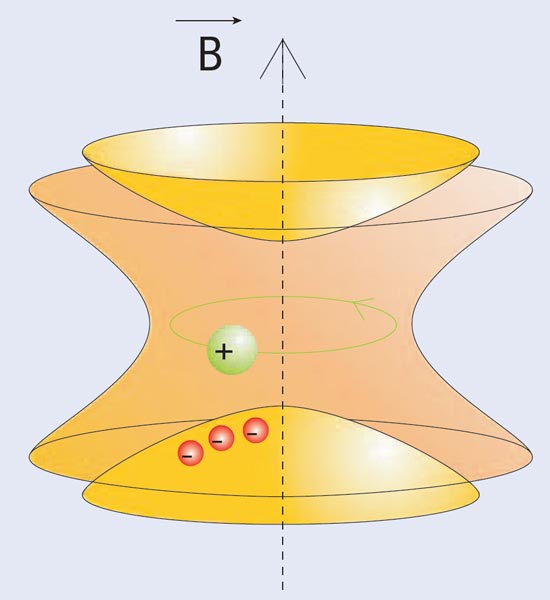
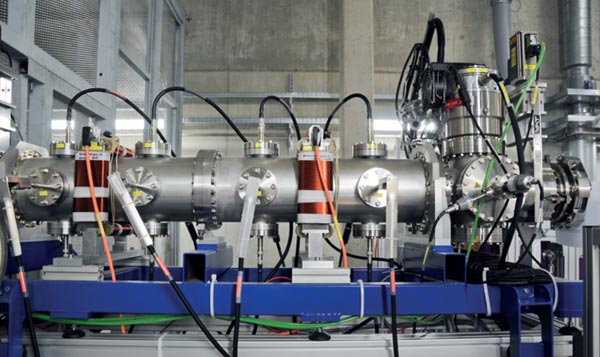
In a Penning trap, a charged particle is bound radially on the cyclotron orbit by a homogeneous magnetic field, while an electrostatic potential between the hyperbola-shaped electrodes provides axial confinement (see figure). Since the ions are trapped in three dimensions, they exhibit three eigenmotions (only one of which is shown in the figure for simplicity). An applied radio-frequency field can modify the energy stored in the eigenmotions, resonantly enhancing the energy transfer when it reaches the exact eigenfrequency. This can be measured using a technique known as time-of-flight ion-cyclotron-resonance. Usually, fewer than 10 ions of one species are excited in the trap and the cyclotron frequency is determined. The other species is then loaded into the trap and excited. This measurement cycle is repeated many times in order to collect statistics and minimize systematic effects.
In this experiment, the Q value was determined after roughly two days of measurement to be Q = 2017.85(64) keV. This value is shifted by 14 keV compared with previous results and is 17 times more precise. While the shift leads to a new value for the 110Pd half life, the lower uncertainty should enable future experiments on ββ0ν decay to have higher resolution.
The LHCb collaboration has determined the sign of the width difference in the Bs system, ΔΓs, through the influence of quantum-mechanical interference. This shows for the first time that the heavier of the two Bs meson states has the longer lifetime, a result that is in agreement with the Standard Model expectation and similar to the situation in the kaon system.
The Bs meson, made up of a b quark and s antiquark, has some fascinating properties. Because it is neutral, it can mix with its antiparticle (which has a b antiquark and s quark), and this quantum-mechanical effect leads to the Bs system having two states with well defined mass, mH and mL (for “heavy” and “light” respectively). The Bs oscillates from its particle to antiparticle state, with a frequency that is proportional to the difference in those masses, Δms = mH – mL, a frequency that is now well measured. However, the two states are also expected to have different lifetimes, so that their widths (defined as the inverse of their lifetimes) should differ by ΔΓs ≡ ΓL – ΓH. Until now, the sign of ΔΓs was not known.
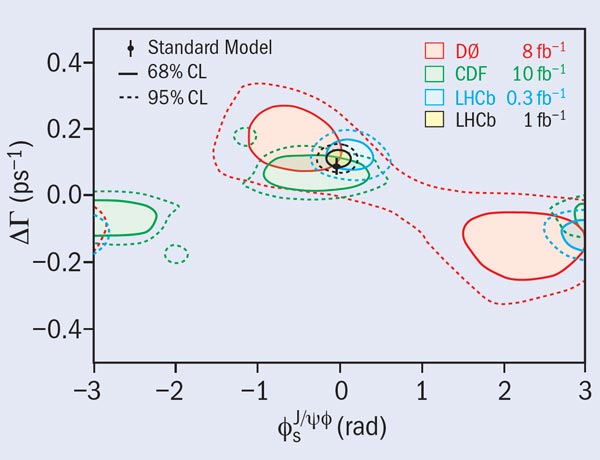
This parameter is intimately involved in the study of CP-violation in Bs mixing, where the phase of the Bs oscillations, φs, is measured. In the Standard Model, the phase is expected to be small but accurately predicted, φs = –0.036 ± 0.002 rad. It has been studied using the decays of the Bs to two lighter mesons, Bs → J/ψ φ. Because of correlations between ΔΓs and φs, the experimental searches have been presented until now as contours in the ΔΓs vs φs plane, as shown in the figure, which is an update of a previous measurement. However, because the sign of ΔΓs was unknown, there was an ambiguity in the solution, seen as two selected regions in the ΔΓs vs φs plane.
The new analysis from LHCb uses the fact that, when the spin-1 φ meson is reconstructed in its decay to K+K– , a small admixture of spin-0 kaon pairs is also included in the selected events, because – at any given K+K– mass value – the two possible spin states are quantum-mechanically indistinguishable, interference effects can be observed in the data. The relative phase of these two components varies as a function of the reconstructed mass and the trend of that variation is to increase or decrease depending on the sign of ΔΓs. The experimental data show clearly a decreasing trend, with 4.7 σ significance, demonstrating that ΔΓs is positive (LHCb 2012a). As a consequence, in the latest update of the CP-violation study there is only a single solution in the plane.
This new result was presented at the Moriond conference (Much food for thought at Moriond) and uses the full data set collected by LHCb so far (LHCb 2012b). When combined with another channel (J/ψ f0), the result is φs = –0.002 ± 0.083 (stat.) ± 0.027 (syst.) rad. While this is consistent with the Standard Model prediction, there is still room for contributions from new physics to this phase. Another exciting step forward is expected with the further doubling of the LHCb data set, expected this year.
Despite the current absence of direct experimental evidence, supersymmetry (SUSY) at the weak scale remains among the most motivated and studied extensions of the Standard Model.
A common feature of many models is that third-generation SUSY particles – the stop (t~), sbottom (b~) and stau (τ~), which are the partners of the third-generation quarks and of the τ lepton – are lighter than the partners of the first two generations. Hence, they can be produced at large rates via pair production or in the decay of gluinos, the scalar partners of gluons. Furthermore, they should decay to heavy quarks (t, b) or τ leptons, providing characteristic and striking experimental signatures. The ATLAS collaboration recently presented the results from several searches for third-generation SUSY particles based on 2 fb–1 of data (ATLAS 2012). Different strategies are used in each of these analyses, which rely on signatures with one or two hadronic taus in τ~ searches, b-jets with a lepton veto in b~ searches and two same-sign leptons or b-jets with a lepton in t~ searches. In the models considered, each SUSY decay-chain ends with the production of a stable, lightest supersymmetric particle (LSP), which is only weakly interacting and escapes detection. Therefore, high missing transverse-momentum is also required in all of these analyses.
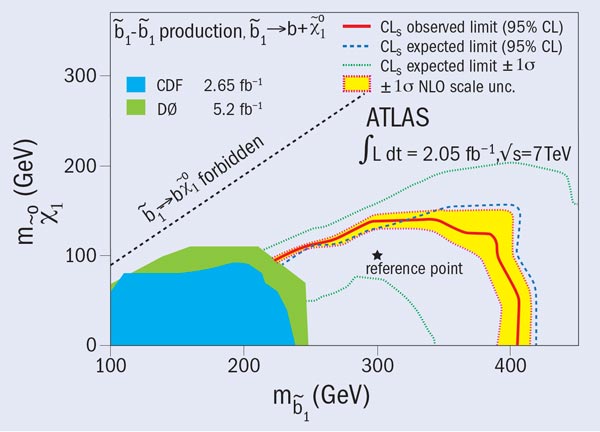
The searches found no significant excess over the Standard Model background and provide the most stringent limits to date on models that are characterized by the decay of third-generation SUSY particles. The figure shows, as an example, that the exclusion limits obtained in the search for scalar bottom pair-production – using events with exactly two b-jets – extend the existing limits on the b~ mass by about 150 GeV.
In the coming months and with increasing amounts of data, these analyses will probe unexplored regions, corresponding for example to high-LSP or gluino masses, and so may shed light on the existence of third-generation SUSY particles.
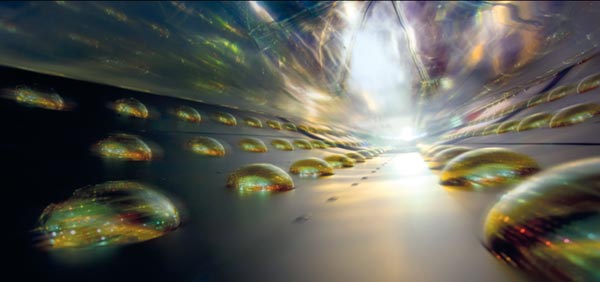
Dark matter may constitute 83% of the particles in the universe, but so far there has been no direct observation of its presence in experiments. With its high-energy collisions, the LHC is a promising hunting ground for this elusive form of “matter”, either by producing dark-matter particles directly or new particles that decay into dark matter. Recently, the CMS collaboration completed a search for dark matter, sifting through the full 2011 data set of proton collisions at a centre-of-mass energy of 7 TeV.
Dark-matter particles produced at the LHC would presumably escape undetected, yielding “missing momentum” in the event. However, they could be accompanied by a jet or a photon, or some other particle. CMS has looked for evidence of these visible companions by studying “monojet” and “monophoton” data. Within the framework of a simple model for the production of dark matter, the CMS analysis significantly extends the sensitivity of direct searches, which look for tiny interactions of dark-matter particles in very sensitive detectors.
The way that the dark-matter particles (χ) are produced and interact depends on their spin. With respect to direct searches, CMS is sensitive in the low-mass region below 3.5 GeV if the spin of the produced particles is ignored, and it can set the world’s best limits at all masses in the spin-dependent case.
The monophoton search looks for single, isolated photons (γ) with transverse energy greater than 145 GeV and more than 130 GeV of missing transverse energy. Events with excessive hadronic activity (jets) are vetoed. After the application of selection criteria, 73 events remain, where 71.9 ± 9.1 would be expected in the absence of dark-matter particles. Standard Model background-events are expected mainly from pp → Zγ – where the Z decays to two neutrinos – and from events with misidentified jets or electrons, or from instrumental sources.
The monojet search requires at least one jet with transverse momentum greater than 110 GeV and more than 350 GeV of missing transverse momentum. Events with isolated leptons or more than two jets are vetoed. After event selection, 1142 events are found in data with an expectation from Standard Model processes of 1224 ± 101 events. Again, a contribution from “invisible” decays to neutrinos dominate this expectation, either from pp → Z+jets with the Z decaying to two neutrinos, or from pp → W+jets where the W escapes detection. There seem to be no signs of a new production mechanism for the two “mono-object” signatures analysed, so CMS can use the null results to place limits on the cross-section for dark matter. The limits depend on the presumed mass of the dark-matter particles and are presented as regions in the plane of cross section vs mass in the figures.
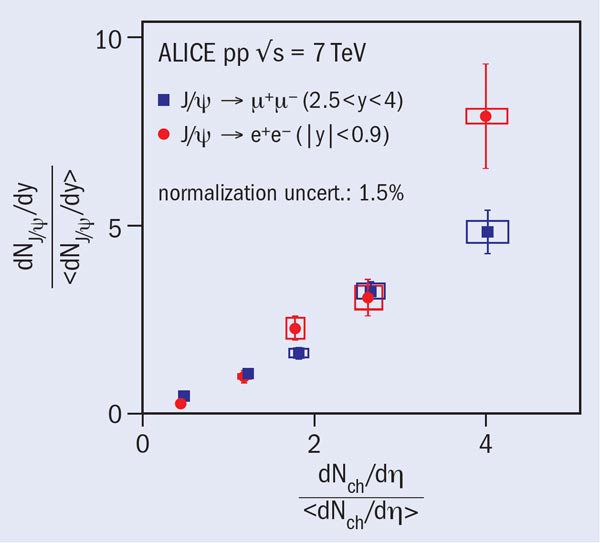
The J/Ψ meson, a bound state of a charm and an anticharm quark, has always been an important testing ground for quantum chromodynamics (QCD). However, understanding J/Ψ production in proton–proton (pp) collisions remains a challenge. While the production of unbound c–c pairs via partonic (quark and gluon) hard-scattering processes can be described within perturbative QCD, the subsequent formation of a colourless bound state, such as the J/Ψ, leaves much room for theoretical modelling. Recently, a new measurement by the ALICE collaboration at the LHC adds yet another challenge for theoretical models.
ALICE, which among the LHC experiments has the unique capability to identify J/Ψ at low transverse momenta, measured J/Ψ production in pp collisions at √s = 7 TeV as a function of the charged-particle multiplicity (dNch/dη) of the underlying event. As the figure shows, this study revealed a remarkably linear increase of the J/Ψ yield with dNch/dη (Abelev et al. 2012). Even though the charged-particle multiplicity is measured only at central rapidity, this increase is seen in not only this region but also at forward rapidities.
The charged-particle multiplicity is mostly the result of processes happening with a small momentum transfer, i.e. so-called soft processes. J/Ψ mesons, on the other hand, are expected to be produced in hard processes, as described above. The assumption has been that the two are not necessarily correlated. However, the measurement by ALICE shows that the yields of the heavy J/Ψ scale just like those of any other light hadron. Regardless of its high rest mass (3.097 GeV/c2) the J/Ψ behaves just like a “light” particle.
The event multiplicity dNch/dη could be directly related to the impact parameter of a given pp collision. This would be analogous to heavy-ion physics where, depending on the centrality of the reaction, different numbers of binary collisions occur between the nucleons. A similar situation could arise in pp collisions at LHC energies because the probability is high that many collisions take place between the quarks and gluons inside the protons. Most of these multiparton interactions are usually assumed to have a relatively low momentum-transfer and therefore to affect mainly soft-particle production. That J/Ψ production behaves similarly to the production of other charged particles might indicate that harder processes are also affected by multiparton interactions.
This measurement is an example of the new experimental opportunities that the LHC has opened up, allowing the correlation of observables on soft and hard scales. Further studies on the charged-particle multiplicity dependence of other hard processes, such as the production of Υ, open charm and beauty, should shed more light on the nature of this effect.
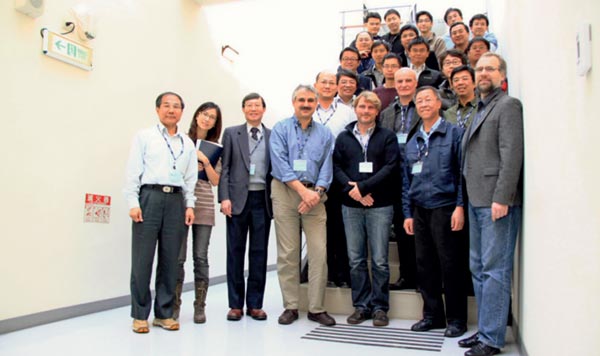
With a view to sustaining a large-scale facility at a time of worldwide economic crisis and soaring energy costs and to provide efficient use of beam time, the National Synchrotron Radiation Research Center (NSRRC) in Hsinchu has been exploring ways to make the most of its facilities. One possibility is an ultrafast X-ray source. This is being considered through a feasibility study and technological investigation aimed at gaining additional leverage for NSRRC’s second accelerator, the Taiwan Photon Source (TPS), which is currently under construction. To this end, NSRRC held a mini-workshop on “Storage-ring ultrafast X-ray sources and their applications” on 16–17 January. Nearly 40 participants attended, including speakers invited to join discussions with NSRRC staff and the ultrafast-science research groups from neighbouring universities, including National Tsing Hua University and National Chiao Tung University.
On the first day, Shaukat Khan of the Technical University, Dortmund, offered a comprehensive overview of ring-based, ultrafast and coherent light-sources, including topics such as laser slicing, low-alpha lattice, coherent harmonic generation and echo-enabled harmonic generation. Gerhard Ingold of PSI introduced several topics: the operational performance of the FEMTO source at the Swiss Light Source at PSI; the proposed upgrade of beamline optics and the laser repetition rate from 2 kHz to 10 kHz (or even 20 kHz); and the study of the ultrafast structural dynamics in condensed matter. Karsten Holldack of the Helmholtz-Zentrum Berlin described the laser system of the femtoslicing facility at the BESSY II synchrotron, known as FEMTOSPEX, which was upgraded to a 6 kHz repetition rate in 2010. It has been over-booked by a factor of three, indicating the growing demand in this domain. At Brookhaven’s National Synchrotron Light Source (NSLS) a feasibility study has been carried out on the NSLS II laser-slicing source with a 4.8 m modulator wiggler in response to users’ requests, as Li Hua Yu of Brookhaven explained.
On the second day, Andreas Streun of PSI discussed in-depth the beam-dynamics issues involved in a high-repetition-rate laser-slicing source, saying that noise caused by beam halo is a critical issue. In general, the side effects of laser slicing on storage-ring performance are mainly contributed by the modulator wiggler and chicane. In addition, a series of presentations by NSRRC team members covered the design requirements and considerations of a proposed beamline for the NSRRC TPS laser-slicing source and its potential applications. Yu also chaired a discussion about how to improve the performance of laser-slicing sources. Methods such as maximizing radiator length, reducing the loss of photon flux in the photon-beamline design, multiple slicing, increasing laser repetition rate and single-bunch current are considered essential for a state-of-the-art laser-slicing source.
Based on input generated at the mini-workshop, the preliminary design of the TPS laser-slicing source with a modulator wiggler, one hard-X-ray radiator and one soft-X-ray radiator in three separate, 7-m straight sections, appears to be a feasible scheme and will provide 10 times more flux than the SLS FEMTO source. However, Ingold suggested a different scenario that requires only two straight sections, with a modulator wiggler and a hard-X-ray radiator in one 12-m-long straight section plus a soft-X-ray radiator in one 7-m-long straight section – and this is regarded as an attractive alternative.
A particle accelerator has been successfully coupled to a nuclear reactor for the first time at the Belgian Nuclear Research Centre (SCK•CEN). The demonstration model GUINEVERE is now in operation, showing the feasibility of an accelerator-driven system (ADS) for nuclear energy. By using an ADS, the accelerator can be turned off to stop the reactor immediately. This system, known as subcritical, is safer than standard nuclear reactors.
GUINEVERE is a test installation of limited power to fine-tune the operation and control of future subcritical reactors. Unlike conventional reactor systems, it produces fast neutrons that can be used for the transmutation of high-level radioactive waste into less-toxic products with shorter life spans, helping to improve their geological disposal.
The GUINEVERE project involves a dozen European laboratories and the European Commission. The accelerator was built by the Centre National de la Recherche Scientifique in France. The French Commissariat à l’Energie Atomique et aux Energies Alternatives helped develop the concept and provided the reactor fuel. Following the inauguration of GUINEVERE in March 2010, the accelerator, as well as the ventilation and monitoring of the installation, were tested exhaustively. In February 2011 the reactor was started in critical mode and was subjected to a long series of tests. The accelerator and reactor have now been connected successfully, making the system subcritical.
The successful launch of GUINEVERE is an important step towards MYRRHA, SCK•CEN’s multipurpose research facility, which will become operational in 2023.
The collaboration working to design the Long-Baseline Neutrino Experiment (LBNE) in the US has recently made major decisions about the experimental configuration, while the collaboration itself continues to grow. More than 600 researchers have now signed on to an experimental programme that will reach unprecedented sensitivity and precision for addressing the neutrino-mass hierarchy, CP-violation in neutrino mixing and the mixing angle θ13 – recently measured for the first time by the Daya Bay experiment (Daya Bay experiment measures θ13).
The first in the series of decisions involved the configuration of the neutrino beamline. The accelerator complex at Fermilab would be used to generate neutrinos for LBNE. The chosen configuration would send the beam up a small hill before it heads underground towards the LBNE far detector at the Homestake Mine in South Dakota. This configuration would make construction easier and more cost-effective, as well as protect the aquifer at Fermilab.
The collaboration then reached consensus on the depth of the facilities at the site of the far detector, choosing a depth of 4850 ft (1470 m). This is optimal for not only the LBNE scientific programme but for other experiments such as direct dark-matter and neutrinoless double-beta-decay searches.
The last crucial decision was the selection of the technology for LBNE’s far detector. Liquid-argon and water-Cherenkov technologies had both been studied and were considered viable options, but either choice would require a significant scaling-up of existing technology to meet the needs of LBNE. While its scaling-up challenge is greater, liquid-argon has more potential because of the detailed information provided on each neutrino event. After an extensive process that involved physics studies and analysis of the technical feasibility of various configurations – as well as external reviews organized by the collaboration – the project manager made the final recommendation to base the far detector on liquid-argon.
Many steps remain before LBNE becomes reality, notably a decision by the US Department of Energy to proceed with detailed design and eventual construction of the project.
To provide the best experiences, we use technologies like cookies to store and/or access device information. Consenting to these technologies will allow us to process data such as browsing behavior or unique IDs on this site. Not consenting or withdrawing consent, may adversely affect certain features and functions.
Functional
Always active
The technical storage or access is strictly necessary for the legitimate purpose of enabling the use of a specific service explicitly requested by the subscriber or user, or for the sole purpose of carrying out the transmission of a communication over an electronic communications network.
Preferences
The technical storage or access is necessary for the legitimate purpose of storing preferences that are not requested by the subscriber or user.
Statistics
The technical storage or access that is used exclusively for statistical purposes.The technical storage or access that is used exclusively for anonymous statistical purposes. Without a subpoena, voluntary compliance on the part of your Internet Service Provider, or additional records from a third party, information stored or retrieved for this purpose alone cannot usually be used to identify you.
Marketing
The technical storage or access is required to create user profiles to send advertising, or to track the user on a website or across several websites for similar marketing purposes.