Comsol -leaderboard other pages

Topics

Maintaining an ideal

August 1959 saw the first issue of CERN Courier – “the long-expected internal bulletin” and idea of Cornelis Bakker, who was then CERN’s Director-General. The goals stated on the first page included the aim to “maintain the ideal of European co-operation and the team spirit which are essential to the achievement of our final aim: scientific research on an international scale” (CERN Courier July/August 2009 p30).

From that very first issue, the Courier contained news about other labs – “Other people’s atoms” – and the cover soon dropped the tag line “Published monthly for CERN staff members” as outside interest grew rapidly. Following a readership survey that showed a thirst for “more news from other laboratories”, the magazine’s 10th anniversary year saw the introduction of the laboratory correspondents – a concept that was formalised further in 1975, after a meeting on “Perspectives in High Energy Physics” in New Orleans, attended by lab directors and senior scientists from Europe, Japan, the US and the USSR.

One topic at the meeting concerned international communication in high-energy physics, and here CERN proposed that the Courier could do more, with the help of more active participation from the other labs plus local distribution in several countries. The issue for January 1976 saw the subtitle “Journal of High-Energy Physics” discreetly positioned inside the front cover above the list of distribution centres and lab correspondents. Five years later, an editorial advisory panel was named for the first time, and the subtitle extended to “International Journal of the High-Energy Physics Community”.

Changing times

That was 35 years ago, and since then CERN Courier has developed through mainly incremental changes to its content. Book reviews, opinion pieces (“Viewpoint”), “Astrowatch”, “Sciencewatch” and an archive page have become regular items, and feature articles, in particular, are signed by the authors. The “look and feel” of the magazine has also changed, from being predominantly black and white to being full colour since IOP Publishing took charge of production. But the basic aim has remained the same, as the Courier has continued to serve an international high-energy readership, with the help of enthusiastic support from the worldwide community.

Over the same period of time, high-energy physics has seen many remarkable developments. The discoveries of the gluon at DESY, of the W and Z bosons at CERN, and of the top quark at Fermilab provided essential pieces of the Standard Model, with the new boson observed at the LHC in 2012 revealing the final keystone associated with the Brout–Englert–Higgs mechanism for giving mass to elementary particles. Meanwhile, the centre-of-gravity of the field has moved slowly but surely from the US to Europe and CERN, with the LHC currently exploring and extending the high-energy frontier.

In addition, the way that scientists communicate has changed dramatically, largely as a result of the internet, the World Wide Web instigated at CERN by Tim Berners-Lee, and arXiv – the electronic preprint repository created by Paul Ginsparg, which became accessible through the web in 1993. Of course, this has been only part of a communication revolution in which information – and, indeed, mis-information – is today transmitted almost immediately, in formats varying from official press releases to informal blogs and tweets.

A new world

These developments have also transformed the way that new results are communicated. Even results in a journal with strict embargoes, such as Nature, are flashed around the world the instant the embargo lifts, quickly propagating through science news channels and social media. Against this background, news in CERN Courier – and, as is increasingly the case, results presented at conferences – can be “old hat”. So where does that leave this magazine?

When I started as editor in 2003, I had a dream to be able to say “you read it first in CERN Courier” – an idea that was really already dead. Today, a more realistic goal would be to say “for the story behind the headlines, read CERN Courier“. ArXiv and open-access publishing make preprints and papers readily accessible to anyone who savours the details of a specific piece of research; nevertheless, there will always be other people who would like a simpler but authoritative summary.

In Physics in the 20th Century, CERN’s former Director-General Victor Weisskopf wrote “…it is beneficial to the scientist to attempt seriously to explain scientific work to a layman or even to a scientist in another field. Usually, if one can not explain one’s work to an outsider, one has not really understood it.” This is, in my opinion, just as true for specialities within a field such as high-energy physics, so it seems to me that CERN Courier should long continue, and so “maintain the ideal of European co-operation and…achievement of our final aim: scientific research on an international scale”.

Beyond the Standard Model of Elementary Particle Physics

By Yorikiyo Nagashima
Wiley
Hardback: £105 €131.30
E-book: £94.99 €118.80
Also available at the CERN bookshop

41HoJe7-IeL._SX328_BO1,204,203,200_

This comprehensive presentation of modern particle physics provides a store of background knowledge of the big open questions that go beyond the Standard Model, concerning, for example, the existence of the Higgs boson or the nature of dark matter and dark energy. For each topic, the author introduces key ideas and derives basic formulas needed to understand the phenomenological outcomes. Experimental techniques used in detection are also explained. Finally, the most recent data and future prospects are reviewed. The book can be used to provide a quick look at specialized topics, both to high-energy and theoretical physicists and to astronomers and graduate students.

Lie Groups and Lie Algebras for Physicists

By Ashok Das and Susumo Okubo
World Scientific
Hardback: £63
E-book: £24

showCoverImage

Ashok Das and Susumo Okubo, colleagues at the University of Rochester, are theoretical high-energy particle physicists from different generations. Okubo’s name is probably best known for the mass formula for mesons and baryons that he and Murray Gell-Mann derived independently through the application of the SU(3) Lie group in the quark model, while Das works on questions related to symmetry. Their book is intended for graduate students of theoretical physics (with a background in quantum mechanics) as well as researchers interested in applications of Lie group theory and Lie algebras in physics. The emphasis is on the inter-relations of representation theories of Lie groups and the corresponding Lie algebras.

Ken Wilson Memorial Volume: Renormalization, Lattice Gauge Theory, the Operator Product Expansion and Quantum Fields

By Belal E Baaquie et al. (eds)
World Scientific
Hardback: £57
Paperback: £29

CCboo1_08_15

As the title of this collection of essays on the work of Kenneth Wilson (1936–2013) indicates, his impact on physics was enormous, transforming both high-energy and condensed-matter physics. He also foresaw much of the modern impact of computers and networking, and I can feel that influence even as I type this review.

This is a long book, comprising 385 pages with 21 essays by many of today’s most influential physicists. It should be made clear that while it includes plenty of biographical material, this is, for the most part, a combination of personal reminiscences and highly technical articles. A non-physicist, or even a physicist without a fairly deep understanding of modern quantum field theory, would probably find much of it almost completely impenetrable, with equations and figures that are really only accessible to the cognoscenti.

That said, a reading of selected parts sheds interesting light on a variety of complex topics in ways that are perhaps not so easily found in modern textbooks. I would not hesitate to suggest such a strategy to a philosopher or historian of science, or an undergraduate or graduate student in physics. The chapters are all well written, and whatever fraction is understood will prove valuable.

Some of the most interesting parts are quotations from Wilson himself. A particularly striking example is from Paul Ginsparg’s essay: “I go to graduate school in physics, and I take the first course in quantum field theory, and I’m totally disgusted with the way it’s related. They’re discussing something called renormalization group, and it’s a set of recipes, and I’m supposed to accept that these recipes work – no way. I made a resolution, I would learn to do the problems that they assigned, I would learn how to turn in answers that they would expect, holding my nose all the time, and some day I was going to understand what was really going on.”

He did, and now thanks to him, we do too. This represents just a fraction of the impact that Wilson has had on our field. The book is long, and not an easy read, but well worth the effort and I highly recommend it.

Quantum Statistical Mechanics: Selected Works of N N Bogolubov

By N N Bogolubov, Jr (ed.)
World Scientific
Hardback: £57
E-book: £43

41vWQaV5dHL._SX328_BO1,204,203,200_

Nicolai Bogolubov (1909–1992) was well known in the world of high-energy physics as one of the founders of JINR, Dubna, and the first director of the Laboratory Theoretical Physics, now named after him. He was also well known in the wider community for his many contributions to quantum field theory and to statistical mechanics. Part I of this book, which is edited by his son, contains some of the elder Bogolubov’s papers on quantum statistical mechanics, a field in which he obtained a number of fundamental results, in particular in relation to superfluidity and superconductivity. Superfluidity was discovered in Russia in 1938 by Kapitza, and in 1947 Bogolubov published his theory of the phenomenon based on the correlated interaction of pairs of particles. This later led him to a microscopic theory for superconductivity, which helped to set the Bardeen–Cooper–Schrieffer theory on firm ground. Part II is devoted to methods for studying model Hamiltonians for problems in quantum statistical mechanics, and is based on seminars and lectures that Bogolubov gave at Moscow State University.

Zeroing in on Higgs boson properties

As Run 2 at the LHC gains momentum, a combined analysis of data sets from Run 1 by the ATLAS and CMS collaborations has provided the sharpest picture yet on the Higgs boson properties (ATLAS 2015, CMS 2015).Three years after the announcement in July 2012 of the discovery of a new boson, the two collaborations are closing the books on measurements of Higgs properties by performing a combined Run 1 analysis, which includes data collected in 2011 and 2012 at centre-of-mass energies of 7 and 8 TeV, respectively. This analysis follows hot on the heels of the combined measurement of the Higgs boson mass, mH = 125.09±0.24 GeV, published in May by ATLAS and CMS (ATLAS and CMS 2015).

The new results are the culmination of one and a half years of joint work by the ATLAS and CMS collaborators involved in the activities of the LHC Higgs Combination Group. For this combined analysis, some of the original measurements dating back to 2013 were updated to account for the latest predictions from the Standard Model. A comprehensive review of all of the experimental systematic and theoretical uncertainties was also conducted to account properly for correlations. The analysis presented technical challenges, because the fits involve more than 4200 parameters that represent systematic uncertainties. The improvements that were made to overcome these challenges will now make their way into data-analysis tools, such as ROOT, that are widely used by the high-energy particle-physics community.

CCnew3_08_15

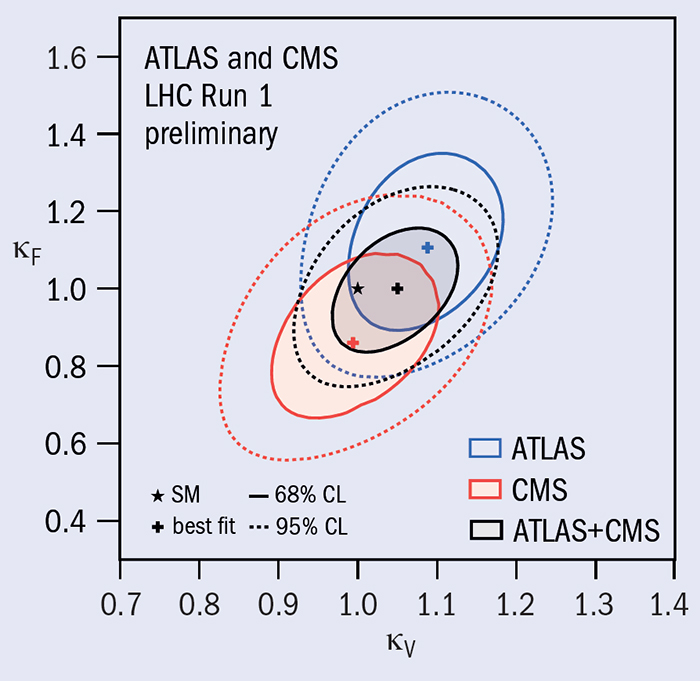
The results of the combination present a picture that is consistent with the individual results. The combined signal yield relative to the Standard Model expectation is measured to be 1.09±0.11, and the combination of the two experiments leads to an observation of the H → τ+τ decay at the level of about 5.5σ – the first observation of the direct decay of the Higgs boson to fermions. Thanks to the combined power of the data sets from ATLAS and CMS, the analysis yields unprecedented measurements of the properties of the Higgs boson, with a precision that enables the search for physics beyond the Standard Model in possible deviations of the measurements from the model’s predictions. The figure shows clearly the increased precision obtained when combining the ATLAS and CMS analyses.

The combined analysis is performed for many benchmark models that the LHC Higgs Cross-Section Working Group proposed, so as to be able to explore the various different effects of physics models that go beyond the Standard Model. As Run 2 gains momentum, the two collaborations are looking forward to reaping the benefits of the increase in centre-of-mass energy to 13 TeV, which will make some of the most interesting processes, such as the production of Higgs bosons in association with top quarks, more accessible than ever. However, even with the first results from Run 2, this set of combined results from 7 and 8 TeV collisions in Run 1 will continue to provide the sharpest picture of the Higgs boson’s properties for some time to come.

So, farewell then…

After nearly 13 years as editor of CERN Courier, I am stepping down as I head off into retirement. I would like to thank the many contributors and also the team at IOP Publishing who bring such a professional standard to the magazine. Most importantly, I must thank the enthusiastic readers for their continued support, and ask everyone to join me in welcoming the new editor, Antonella Del Rosso. Christine Sutton, CERN.

STAR tracker snares heavy flavours

Heavy quarks are important probes of the quark–gluon plasma that is produced when relativistic heavy ions collide. Because of a mass effect, it has been argued that heavy quarks lose less energy through gluon radiation than light quarks as they traverse the medium. However, studying heavy quarks in a particle-dense environment is challenging. Moreover, the physics interest is in bulk behaviour of charm quarks, so it is important to study charmed hadron production over the full range of momentum. At low momenta, multiple scattering is very important, and this places strict constraints on the amount of material in the detector.

The STAR Heavy Flavour Tracker (HFT) was built to meet these challenges. Installed in the STAR detector at the Relativistic Heavy Ion Collider (RHIC) at Brookhaven National Laboratory early last year, it took data during the 2014 and 2015 running periods. It was specifically designed and constructed to allow for the direct topological reconstruction of heavy-flavour decay vertices such as the D0 (decay distance cτ around 120 μm), by tracking the decay particles through four layers of silicon detectors to extend the STAR physics programme to include fully reconstructed charmed hadrons.

To do this, the tracker incorporated a number of novel features. First, in addition to the two outermost layers of standard-technology silicon strips and pad sensors, the innermost two layers of the HFT – the pixel (PXL) detector (figure 1) – are constructed using monolithic active-pixel sensors (MAPS). This is the first large-scale use at a collider experiment of MAPS technology, which integrates the silicon of the detector and the signal processing on a single silicon die. Second, its novel design, with a low-mass carbon-fibre support structure, aluminum conductor read-out cables (instead of copper) and air cooling (instead of water) gives the PXL a sleek footprint with a very low radiation length – 0.4% per layer – to minimize multiple Coulomb scattering. These features give the detector, which was conceived and built by the Relativistic Nuclear Collisions group at the Lawrence Berkeley National Laboratory (LBNL), excellent pointing capabilities, with a resolution for its distance of closest approach of only 40 μm for 750 MeV/c kaons.

In addition, the detector-support mechanics are designed to allow for very fast insertion and detector replacement. The PXL detector can be inserted, cabled and working in 12 hours. This allows for quick changes if the detector suffers radiation damage.

The MAPS chips were developed by the microelectronics group at the Institut Pluridisciplinaire Hubert Curien in Strasbourg, in collaboration with LBNL, and are the result of a 10 year development process. The sensor design is highly optimized for the RHIC environment. A single sensor features 890,000 pixels, each measuring 20.7 μm × 20.7 μm. The detector integration time is 186 μs, allowing the detector to function at RHIC with a very low occupancy. The fast read-out is achieved with binary output using column-level discriminators and on-chip zero-suppression/data-compression circuitry. The detector’s initial performance is in line with expectations: figure 2 shows an invariant D0 → Kπ+ (and conjugate) mass peak, shown at the recent Quark Matter 2015 conference.

Positrons catch a wave at SLAC

In a study reported in Nature, a team working at the Facility for Advanced Accelerator Experimental Tests (FACET) at SLAC has shown that the high electric-field gradients possible in plasma can be harnessed to accelerate positrons, just as well as they can for electrons.

In 2014, an experiment at FACET, which uses the first 2 km of the famous SLAC linac, was able to demonstrate plasma-wakefield acceleration of electrons, with both a high gradient and a high energy-transfer efficiency – a crucial combination that had not previously been achieved (CERN Courier January/February 2015 p9). However, for positrons, plasma-wakefield acceleration is much more challenging, and it was thought that no matter where a trailing positron bunch was placed in a wake, it would lose its compact, focused shape or even slow down.

In the new study, the team demonstrated a new regime for plasma-wakefield acceleration where particles in the front of a single positron bunch transfer their energy to a substantial number of those in the rear of the same bunch by exciting a wakefield in the plasma. In the process, the accelerating field is altered –”self-loaded” – so that in the tests about a billion positrons gained 5 GeV in energy with a narrow energy spread over a distance of just 1.3 m. Moreover, the positrons extract about 30 per cent of the wake’s energy and form a spectrally distinct bunch with a root-mean-square energy spread as low as 1.8%.

This ability to transfer energy efficiently from the front to the rear within a single positron bunch makes the scheme highly attractive as an energy booster for a future electron–positron collider.

ALICE in Vienna: from antinuclei to quark–gluon plasma

The 2015 edition of the European Physical Society Conference on High Energy Physics (EPS-HEP 2015), which took place in Vienna in July (“Vienna hosts a high-energy particle waltz”), provided an opportunity for the ALICE collaboration to present the latest results from analysis of data from Run 1 of the LHC. While many of the presentations centred on the properties of the quark–gluon plasma (QGP) as produced in the collisions of heavy ions, there was also an interesting glimpse of other kinds of physics that ALICE can investigate.

ALICE

Once in a while in the heavy-ion collisions, a few protons and neutrons are created close enough in phase space such that they coalesce into a nucleus. The heavier the nucleus (the larger the number of nucleons), the lower the probability that it is created, but about once in 10 thousand events, for example, a 3He nucleus can be created and detected within ALICE’s tracking and particle-identification set-up. Moreover, the lead–ion collisions at the LHC also provide a copious source of antiparticles, such that nuclei and the corresponding antinuclei are produced at nearly equal rates.

This allows ALICE to make a detailed comparison of the properties of the nuclei and antinuclei that are most abundantly produced. At EPS-HEP 2015, the collaboration presented a new limit on the conservation in nucleon–nucleon interactions of CPT symmetry – the fundamental symmetry that implies that all of the laws of physics are the same under the simultaneous reversal of charges (charge conjugation, C), reflection of spatial co-ordinates (parity transformation, P) and time inversion (T). The new test of CPT invariance was extracted from measurements of the mass-to-electric-charge ratios of the deuteron/antideuteron and the 3He/3He nuclei. The combined results of the difference of the mass-over-charge ratio for each pair of the nucleus/antinucleus species allowed the extraction of differences in their relative binding energies. The measurements, published in Nature Physics, confirm CPT invariance to an unprecedented precision in the sector of light nuclei (ALICE Collaboration 2015).

The strongly interacting hot and dense matter, the QGP, produced in heavy-ion collisions is characterized by the smallest ratio of sheer viscosity to entropy density of all known materials – a substance that flows almost as a perfect liquid. This QGP is a system of quarks and gluons where the mean free path is very short – a so-called strongly coupled system. A parton traversing such a medium, even a highly energetic one, is exposed to the medium and loses part of its energy. The new measurements by ALICE presented at EPS-HEP 2015 indicate that the heavier charm and beauty quarks also lose a significant part of their energy in the dense QGP. For relatively low quark momenta, the interaction with the bulk of the partons in the medium may follow exclusively through elastic scatterings. For high-energy quarks, a number of soft gluons can be radiated, carrying a fraction of quark energy into the medium. These processes are a QCD analogue of phenomena known from QED: the physics of a parton traversing a droplet of QGP resembles the scenario of an electrically charged particle traversing ordinary matter.

In other measurements, the ALICE collaboration has compared data on the production of D mesons (containing a charm quark) with data from CMS on non-prompt J/ψ mesons (the decay products of heavier mesons containing a beauty quark). The comparison shows that the heavier the quark, the less energy it loses inside the medium. Indeed, this was one of the most striking predictions of theoretical models describing strongly coupled QCD matter – the plasma is less opaque to heavy quarks as compared to light quarks and gluons. So, these new measurements at last provide the first confirmation of these predictions.

The nature of the interactions between the heavy quarks and the medium can also be deduced from the azimuthal asymmetry of the production of heavy-flavour hadrons: the magnitude of the asymmetry is proportional to the collective flow of the medium. Measurements of the asymmetry presented by ALICE confirm that the heavy quarks participate in the collective flow of QGP. These results are critical to establishing the focus of future theoretical work on the transport properties of the plasma, while from the experimental point of view, the ALICE collaboration is looking forward to the improved precision from the measurements in LHC Run 2.

The droplet of QGP produced in heavy-ion collisions constantly expands, and lasts at most about 10 fm/c (30 × 10−24 s). After that time, the temperature drops below the critical temperature (about 155 MeV) and the energy density falls below a critical density of about 0.5 GeV/fm3. At that point, the distances between the quarks become large and, owing to the nature of the strong force, the partons are re-confined/combined into colour-neutral hadrons. Following this hadronization process, the system becomes a gas of hadrons and, while the gas is still hot, the hadrons may still interact. The most useful messengers from this phase of the collision are the short-lived hadronic resonances. At the conference, ALICE presented extensive studies of the short-lived mesons and baryons. Their production rates provide sensitive information on the strength of the hadron–hadron interactions, and thus are a vital source for understanding the properties of the hadron gas. Knowing the equation-of-state of the hadron gas allows the genuine QGP signals to be unravelled in greater detail.

Finally, ALICE presented signatures of collective particle production in an extended pseudorapidity range in proton–lead collisions (“ALICE goes forward with the ridge in pPb collisions”). Such collective behaviour, known from heavy-ion collisions, was not initially expected for the smaller proton–lead system. The new measurement provides qualitatively new constraints to theoretical models attempting to explain the novel phenomena.

bright-rec iop pub iop-science physcis connect