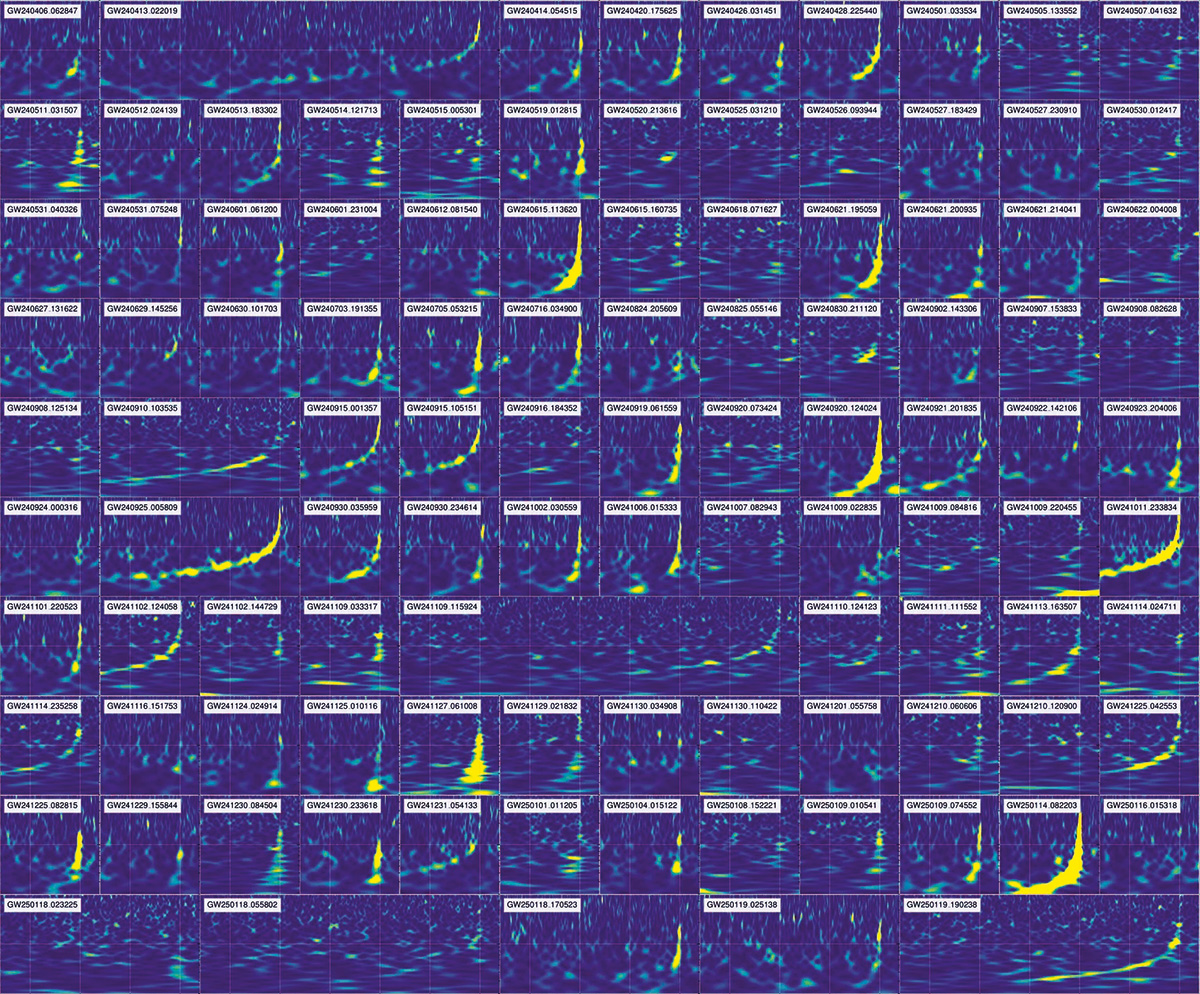
On 14 September 2015, the gravitational waves emitted by a black-hole merger more than a billion light-years away were observed on Earth for the first time (CERN Courier April 2016 p19). The challenge had long seemed daring – if not impossible. A decade on, precision gravitational-wave astronomy has become an established observational discipline. This maturity is most evident in the new Gravitational-Wave Transient Catalog (GWTC-5.0), released in May by the international LIGO–Virgo–KAGRA (LVK) Collaboration, which adds 161 events recorded between 10 April 2024 and 28 January 2025, and brings the number of gravitational-wave signals observed to date to an astounding 390.
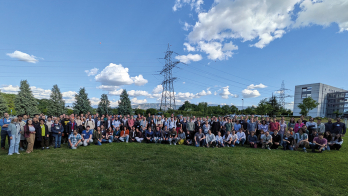
The LVK Collaboration brings together several thousand scientists working with the two Laser Interferometer Gravitational-Wave Observatory (LIGO) detectors in the United States, Virgo in Italy and KAGRA in Japan. Thanks to their steadily improving sensitivity, these interferometers detected three to four gravitational-wave signals every week during the most recent observing run. This growing collection of data is transforming our understanding of black-hole populations, providing clues about how black holes form, evolve and merge.
One of the most striking findings is that some of the black holes taking part in the observed mergers appear to be second-generation objects, the products of earlier mergers rather than of stellar collapse. The case rests largely on the GW241011 and GW241110 signals, generated by events at about 700 million and 2.4 billion light-years from Earth and detected in October and November 2024, respectively. Several of their measured properties, above all the spin of each pair’s heavier black hole, are best explained if these objects are themselves merger remnants. Astronomers have long suggested that in dense environments, such as stellar clusters, black holes may be more likely to collide and merge repeatedly, and gravitational waves provide insights into these extreme astrophysical environments that are difficult to obtain by other means.
The new catalogue also offers a wide variety of increasingly precise tests of general relativity, enabling us to study how gravity and spacetime behave in the immediate vicinity of a black hole, where Einstein’s theory might intersect with quantum mechanics. GW250114, a particularly clear signal that reached Earth on 14 January 2025, enabled the first detection of two dominant vibrational tones from a black hole, along with hints of a third. As the merged remnant settled, it rang like a struck bell, each tone characterised by an oscillation frequency and a damping time. Measuring the dominant tone and its first overtone made this the most accurate such test so far, and the data agreed with the theory’s predictions. By comparing the inferred areas of the two initial black holes with that of the remnant, LVK researchers also found the result consistent with the increase predicted by Stephen Hawking’s area theorem, which states that the total black-hole horizon area cannot decrease.
Another signal in the catalogue, GW240615, detected on 15 June 2024 by LIGO and Virgo, is the most precisely localised gravitational-wave source yet, pinpointed to an area of only six square degrees. Accurate localisation is of tremendous importance to the broader astronomical community, as it enables the search for electromagnetic counterparts to the observed events, in particular for mergers involving neutron stars. GW240615 originated more than 3 billion light-years from Earth and was produced by the merger of two black holes with masses of approximately 26 and 30 times that of the Sun. As expected for a binary black-hole merger, no electromagnetic counterpart was identified.
The expanding universe
Gravitational waves can also be used to measure the expansion of the universe. Improvements in the localisation capabilities of the detector network and the larger GWTC-5.0 dataset have yielded a new independent measurement of the Hubble constant, H0 = 71.7 +9.4 −7.5 km s–1 Mpc–1, 22% more precise than the previous gravitational-wave estimate. The result bears on one of modern cosmology’s unsolved puzzles, the Hubble tension. Its uncertainties are still broad enough to be consistent with determinations from both the nearby and the early universe, which disagree with each other, but gravitational-wave observations add an independent perspective to the debate and may ultimately help to resolve it.
Taken together, these findings show how, in the years to come, gravitational waves will help explore unresolved questions in fundamental physics and in the origin and evolution of the universe. As the census of cosmic mergers grows, they will continue to reveal phenomena that are difficult or impossible to study through electromagnetic observations alone.
Further reading
LIGO–Virgo–KAGRA Collab. 2026 arXiv:2605.27225.
LIGO–Virgo–KAGRA Collab. 2026 arXiv:2605.27227.
LIGO–Virgo–KAGRA Collab. 2025 Phys. Rev. Lett. 135 111403.