 Read article 'Isospin symmetry broken more than expected'
Isospin symmetry broken more than expected
The NA61/SHINE collaboration have observed a strikingly large imbalance between charged and neutral kaons in argon–scandium collisions.

 Read article 'Isospin symmetry broken more than expected'
The NA61/SHINE collaboration have observed a strikingly large imbalance between charged and neutral kaons in argon–scandium collisions.
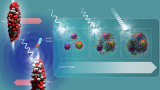 Read article 'The other 99%'
Daniel Tapia Takaki describes how ultraperipheral collisions mediated by high-energy photons are shedding light on gluon saturation, gluonic hotspots and nuclear shadowing.
 Read article 'Isolating photons at low Bjorken x'
A new measurement by ALICE will help to constrain the gluon PDF.
 Read article 'First signs of antihyperhelium-4'
Hypernuclei remain a source of fascination due to their rarity in nature and the challenge of creating and studying them in the lab.
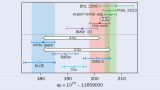 Read article 'Shifting sands for muon g–2'
Two recent results may ease the tension between theory and experiment.
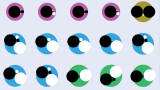 Read article 'A bestiary of exotic hadrons'
Patrick Koppenburg and Marco Pappagallo survey the 23 exotic hadrons discovered at the LHC so far.
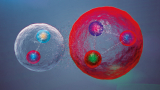 Read article 'Inside pentaquarks and tetraquarks'
Marek Karliner and Jonathan Rosner ask what makes tetraquarks and pentaquarks tick, revealing them to be at times exotic compact states, at times hadronic molecules and at times both – with much sti...
 Read article 'Hypertriton and ‘little bang’ nucleosynthesis'
The ALICE collaboration investigated the nucleosynthesis mechanism by measuring hypertriton production in heavy-ion collisions.
 Read article 'Lattice calculations start to clarify muon g-2'
The 41st symposium, Lattice 2024, welcomed 500 participants to the University of Liverpool from 28 July to 3 August.
 Read article 'ALICE does the double slit'
The ALICE collaboration has measured an interference pattern at the femtometre scale using ultra-peripheral collisions between lead nuclei at the LHC.