 Read article 'New limits on a composite Higgs'
New limits on a composite Higgs
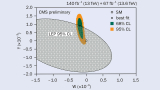
CMS has set new limits on a composite Higgs from high-mass dilepton production.

 Read article 'New limits on a composite Higgs'
CMS has set new limits on a composite Higgs from high-mass dilepton production.
 Read article 'Patience pays at the lifetime frontier'
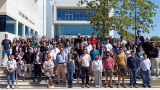
The 16th workshop of the Long-Lived Particle Community gathered more than 70 theorists, phenomenologists and experimentalists.
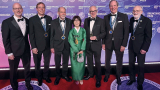 Read article 'Breakthrough honours g–2'
The 2026 Breakthrough Prize in Fundamental Physics recognised the multi-decade programme to measure, with ever-increasing precision, the muon’s anomalous magnetic moment.
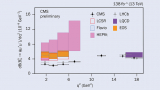 Read article 'A sharper probe of a rare Bs decay'
The CMS collaboration has measured the branching fraction of a rare Bs decay as a function of the dimuon invariant mass squared.
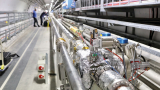 Read article 'New directions for bent crystals'
Long-established in accelerator physics, bent crystals are now being explored as tools to measure the fundamental properties of short-lived charm baryons.
 Read article 'The revolution ahead'
Michael S Turner argues that the next breakthrough in particle physics and cosmology may be just around the corner.
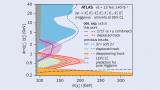 Read article 'The most elusive higgsinos'
Supersymmetry has so far eluded discovery at the LHC, yet it retains strong theoretical appeal as an extension of the Standard Model, and potential hiding places remain.
 Read article 'What can you do with 380 million Higgs bosons?'
Valentina Cairo and Steven Lowette explore the physics reach of the High-Luminosity LHC.
 Read article 'Two strikes for the light sterile neutrino'
Results from KATRIN and MicroBooNE strongly disfavour a light sterile-neutrino explanation of longstanding anomalies.
 Read article 'From theories to signals'
The latest edition of the SEARCH conference took place at CERN from 20 to 24 October 2025.