Read article 'ATLAS homes in on Higgs-quark couplings'
ATLAS homes in on Higgs-quark couplings
The two heaviest quarks, the bottom and top, are particularly interesting because they have the largest couplings to the Higgs boson.

 Read article 'ATLAS homes in on Higgs-quark couplings'
The two heaviest quarks, the bottom and top, are particularly interesting because they have the largest couplings to the Higgs boson.
 Read article 'CMS investigates the width of the top quark'
Twenty years after its discovery at the Tevatron collider at Fermilab, interest in studying the top quark at the LHC is higher than ever.
 Read article 'ATLAS observes single top-quarks at 13 TeV'
ATLAS has recently measured the total cross-sections of single top-quark and top-antiquark production via the t-channel exchange of virtual W bosons.
 Read article 'Probing the electroweak sector with ATLAS'
Precise measurements of final states containing multiple electroweak bosons (W, Z or γ) offer a powerful probe of the gauge structure of the Standard Model.
 Read article 'CMS highlights from the fourth LHCP conference'
The search for new physics in 13 TeV proton collisions continues in earnest, with six new results presented at LHCP.
 Read article 'The Composite Nambu–Goldstone Higgs'
This book provides a description of a composite Higgs scenario as possible extension of the Standard Model (SM).
 Read article 'At the heart of every LHC collision'
Understanding production cross-sections and their evolution as a function of √s are important components to understanding the measurements performed by ATLAS.
 Read article 'CMS updates its search for diphoton resonances'
The energies of particles can be measured with the CMS electromagnetic and hadronic calorimeters without a magnet.
 Read article 'Qu’est-ce que le boson de Higgs mange en hiver et autres détails essentiels'
Philippe Bloch reviews in 2015 (in French) Qu’est-ce que le boson de Higgs mange en hiver et autres détails essentiels.
 Read article 'LHCb determines the electroweak mixing angle'
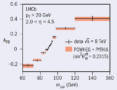
The two most accurate determinations of the angle, carried out at LEP and SLD, are some three standard deviations different.