 Read article '3D cooling for uranium collisions at RHIC'
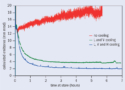
3D cooling for uranium collisions at RHIC
Techniques to shrink the beams of the heaviest ions ever used in a collider.

 Read article '3D cooling for uranium collisions at RHIC'
Techniques to shrink the beams of the heaviest ions ever used in a collider.
 Read article 'Proton run for 2012 extended by seven weeks'
An important piece of news that was almost lost in the excitement of the Higgs update seminar on 4 July is that the LHC proton run for 2012 is to be extended.
 Read article 'The PS Booster hits 40'
The evolution of a key machine at CERN.
 Read article 'ECLOUD12 sheds light on electron clouds'
Workshop brings the experts together.
 Read article 'LHC delivers for the summer conferences'
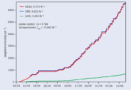
With more luminosity delivered by the LHC between April and June 2012 than in the whole of 2011, the experiments had just what the collaborations wanted: as much data as possible before the summer con...
 Read article 'One billion J/ψ events in Beijing'
In a 40-day run ending on 22 May, the Institute of High-Energy Physics in China accumulated a total of 1.3 billion J/ψ events at the upgraded Beijing Electron Positron Collider (BEPCII) and Beijing ...
 Read article 'LHCf: bringing cosmic collisions down to Earth'
Data from the LHC are providing input for models used to measure the highest-energy cosmic rays.
 Read article 'CERN’s accelerators, experiments and international integration 1959–2009. The European Physical Journal H 36 (4).'
Christine Sutton reviews in 2012 CERN’s accelerators, experiments and international integration 1959–2009. The European Physical Journal H 36 (4).
Read article 'Ramping up to higher luminosity'
After a flying start, with the first stable beams at the new energy of 4 TeV on 5 April, the LHC successfully operated with 1380 bunches per beam – the maximum planned for 2012 – on 18 April.
 Read article 'LHC yields data rapidly at new collision energy of 8 TeV'
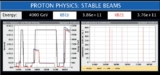
At 12.38 a.m. on 5 April, the LHC shift crew declared "stable beams" as two 4 TeV proton beams were brought into collision at the LHC’s four interaction points.