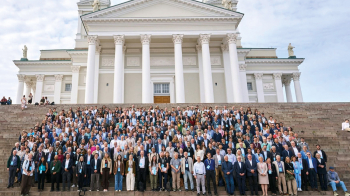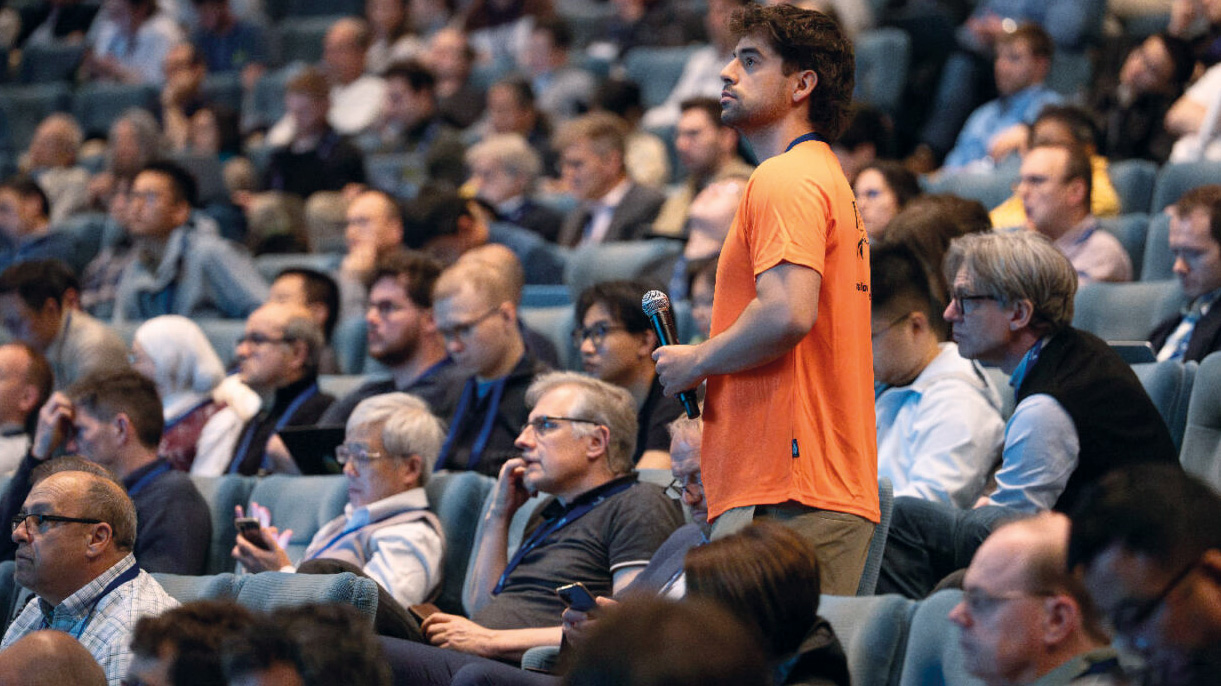
The 17th International Particle Accelerator Conference (IPAC’26) took place from 17 to 22 May 2026 in Deauville, a charming small town in Normandy, France. The event drew 1520 registered participants, including 264 students, from more than 40 countries. The programme ranged across flagship high-energy accelerator projects, synchrotron light sources, novel acceleration techniques, and the underlying technologies and beam dynamics.
Present facilities and beyond
In his opening talk, Robin Ferdinand (GANIL) reviewed the installations, activities and plans at the host institute GANIL, which provides a large variety of ion beams. Next, CERN Director-General Mark Thomson outlined CERN’s priorities and future vision, from the implementation and exploitation of the HL-LHC to the FCC-ee, the proposed next high-energy physics flagship project (see CERN Council updates the European Strategy). He set out the aim of bringing FCC-ee to a state where it can be proposed for approval in 2028.
With facilities transitioning from third- to fourth-generation, synchrotron light sources stood out as a particularly active field – as reflected in a plenary talk by Laurent Chapon (Argonne National Laboratory), director of the Advanced Photon Source. Later contributions returned to topics such as the preparation for the fourth-generation SOLEIL II, the rapid and successful commissioning and first operation of SLS 2.0 at PSI, and the plans for MAX 4U, an upgrade even beyond the fourth generation.
The opening plenary sessions also included a talk by Masashi Otani (KEK) on a proof-of-principle demonstration of a method to produce and accelerate low-emittance positive muon beams (see CERN Courier July/August 2018 p8). A status report by Natalia Milas (ESS) on the commissioning of the ESS highlighted key milestones and steady progress towards first beam on target in 2027.
Presentations on proposed and operational high-energy flagship facilities included a review of linear colliders by Steinar Stapnes (University of Oslo), a report by Jörg Wenninger (CERN) on the luminosity records achieved by the LHC, a progress report by Paul Jurj (Imperial College London) on ongoing muon collider studies and a final review by Michiko Minty (BNL) on a quarter of a century of RHIC (see CERN Courier May/June 2026 p10), whose infrastructure will be largely reused for the Electron–Ion Collider.
Robert Apsimon’s (Lancaster University) presentation on the innovative “ghost collider” drew wide interest among participants. By superimposing electron and positron bunches, it mitigates the strong non-linear forces of conventional collisions at the interaction point (IP) and suppresses beam loading along the energy-recovery linacs. A second feature is the energy transfer between the electron and positron bunches, so that their energy in the return arcs is slightly more than half that at the IP, strongly reducing synchrotron radiation losses.
This edition also saw a significant increase in contributions on machine learning and artificial intelligence (AI), indicating a shift in the development of next-generation accelerators. Several presentations reported substantial progress, particularly through the use of simulated datasets, and potential improvements in commissioning workflows and strategies, as demonstrated at the HIAF complex in China. Thorsten Hellert (LBNL) discussed the growing role of generative AI in accelerator operations, showcasing agentic frameworks enabling natural-language interaction with machines. In the closing plenary, a broader perspective further emphasised that machine learning is increasingly being integrated into accelerator design, optimisation and control, moving toward more autonomous, data-driven facilities.
Advanced acceleration techniques were widely covered, with multiple sessions dedicated to plasma-based acceleration. Medical applications were also discussed, including tests with a mixed helium-carbon beam at MedAustron to develop monitoring techniques in hadron therapy (see The Swiss Army knife of beam simulation), presented by Elisabeth Renner (TU Wien). Also featured were noteworthy contributions on nonlinear beam dynamics, ranging from higher-dimensional resonances and phase-space topology to novel methods for analysing complex beam motion in modern accelerators.
Science and society
The theme of sustainability, as a societal and political necessity to be taken into account when designing future projects, ran through the programme, including the “engagement with industry” session. It also motivated the presentation by Igor Syratchev (CERN) on the development of the TRISTRON, an RF source proposed to increase efficiency.
The conference reached a record 35% of female speakers, and a well-attended equal-opportunities session drew about 380 participants to discuss the main factors limiting gender parity in accelerator science and beyond. In addition to multiple plenary and parallel sessions, scientific results were presented in more than 1500 posters throughout the conference, encouraging in-depth one-to-one discussions. The event also featured a large industrial exhibition, with 113 exhibitors, two media partners and six institutional exhibitors.
The discussions, new collaborations and inspiring contributions shared at IPAC’26 demonstrate the continued strong interest in the particle accelerator field and provide solid foundations for future advances in accelerator science and its applications. The next three IPACs will be held in May 2027 in Detroit, June 2028 in Tokyo and May 2029 in Liverpool.