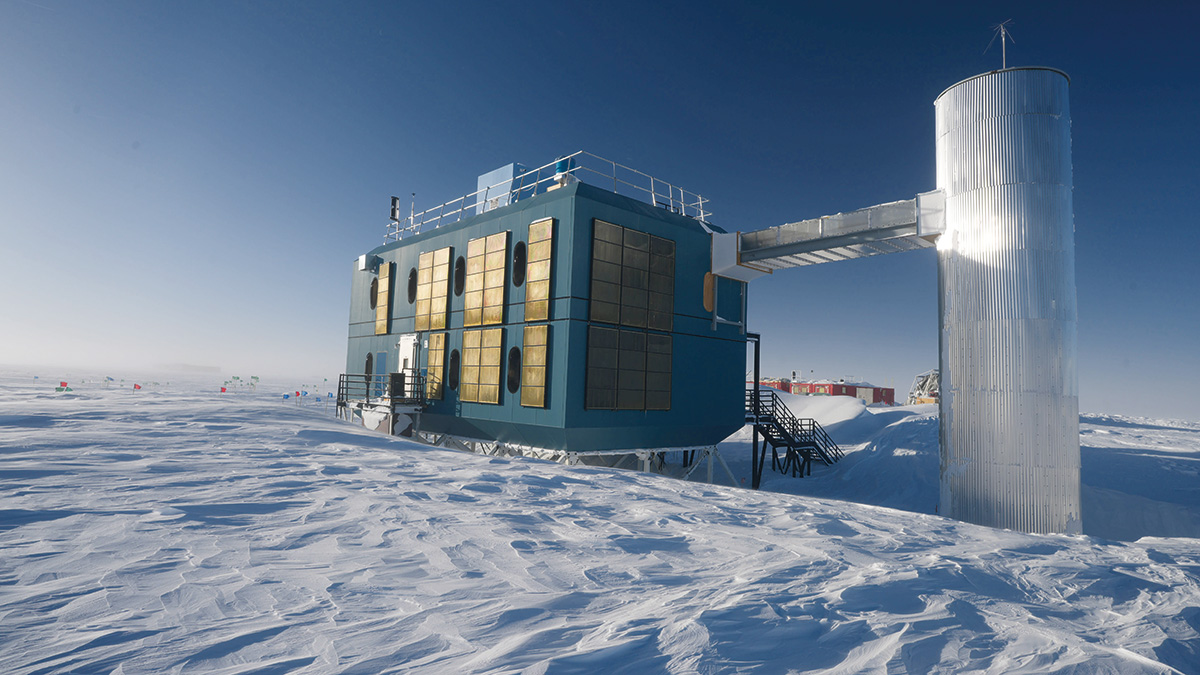
On 6 October, Francis Halzen of the University of Wisconsin–Madison was awarded the 2026 Nobel Prize in Physics “for decisive contributions to the IceCube Neutrino Observatory and the discovery of high-energy neutrinos of astrophysical origin”. The observatory, a cubic kilometre of instrumented ice beneath the South Pole, reported the first evidence for high-energy astrophysical neutrinos in 2013. It has since traced them to a flaring blazar, to the active galaxy NGC 1068 and to the plane of the Milky Way.
“The prize was a fantastic opportunity to advertise that this was a large project, and that it only happened because all the milestones we had to reach were overcome by some brilliant people who solved problems along the way,” says Halzen. He and colleagues at Madison – later joined by physicists at Berkeley – had proposed, around 1990, to freeze photomultipliers into the Antarctic ice sheet to catch the Cherenkov light from neutrino interactions. At the time, whether the ice was clear enough for this to work was unknown. “The real miracle, which nobody anticipated, was an absorption length of 100 metres and more for Cherenkov light. That’s why we are sitting here.”
The first South Pole array, the Antarctic Muon And Neutrino Detector Array (AMANDA), was deployed in the 1993–1994 Antarctic summer at depths between 800 and 1000 m, where air bubbles scattered the light too strongly for tracks to be reconstructed. The answer was to go deeper, betting that the bubbles would give way to clear ice, and AMANDA’s later strings hung mostly between 1500 and 2000 m. Between 2005 and 2010, a hot-water drill melted 86 holes into the ice, and a string of 60 optical modules was lowered into each, to hang between 1450 and 2450 m. There, IceCube records about 275 neutrinos a day from the Earth’s atmosphere. Two events of about 1 PeV, reported in 2013, stood out from that background and gave the first indication of an astrophysical flux. Nicknamed Bert and Ernie, they were joined by 26 more in the data from 2010 to 2012, and the sample ruled out a purely atmospheric origin at 4σ. A third year of data raised the significance to 5.7σ in 2014.
Work on the calibration of the ice and on the reconstruction software then helped to bring sources into view. One of them, the active galaxy NGC 1068, first emerged in 2020 and reached 4.2σ in 2022, with far fewer TeV gamma rays than neutrinos (CERN Courier January/February 2023 p10). The deficit points to the absorption of gamma rays in the dense region at the core of the galaxy. “The most exciting future lies in the synergy between observatories and multi-messenger astrophysics,” says Teresa Montaruli of the University of Geneva, member of the IceCube collaboration, “combining electromagnetic radiation, neutrinos and gravitational waves to explore the most extreme phenomena in the universe.” Beyond astronomy, atmospheric neutrinos lend themselves to other precision studies. “IceCube has measured neutrino cross sections through their absorption in the Earth, complementing measurements by experiments such as FASER,” says Montaruli.
The collaboration completed an upgrade of the detector in the 2025–2026 Antarctic summer. Six new strings, more densely instrumented than the original ones, went into its centre to calibrate the ice and to test the optical modules designed for a proposed extension, IceCube-Gen2. The project would take the observatory to about eight times its instrumented volume and add a radio array for the highest energies.
“This Nobel Prize recognises Francis Halzen’s decades of vision and persistence in making high-energy neutrino astronomy a reality,” says Erin O’Sullivan of Uppsala University, spokesperson of the IceCube collaboration. “We are proud to share this moment with Francis, and excited about what lies ahead for neutrino astronomy, particularly with IceCube-Gen2.”