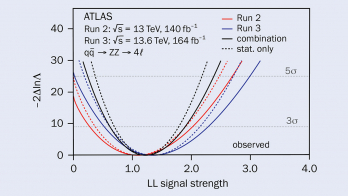
The ATLAS and CMS collaborations have found evidence that the two Z bosons from a Higgs-boson decay are entangled. Using data from the second and third runs of the LHC, ATLAS rejects the hypothesis of a non-entangled pair at 4.7σ, and CMS excludes the only configuration in which the pair would not be entangled at more than 6σ. Both results rest on assumptions about the CP properties of the Higgs boson, in line with what the two collaborations have measured since its discovery.
The experiments had already observed quantum entanglement between top quarks and antiquarks produced in pairs. Since the top quark has spin ½, a measurement of its spin projection along any given direction has only two possible outcomes, +½ or –½. The Z boson, by contrast, is a massive particle with spin 1, so the corresponding measurement can give +1, 0 or –1. When a Higgs boson, which has spin zero, decays into two Z bosons – one of them off shell – their spin projections along the decay axis must cancel out, and remain correlated whichever common direction they are measured along.
Quantum tomography
Neither spin projection can be measured directly. Z bosons decay almost immediately, occasionally into pairs of electrons or muons that can reach the ATLAS and CMS detectors. Owing to the chirality of the weak interaction, which couples the Z boson differently to left-handed and right-handed particles, information on their spin passes to the leptons, and the directions of the four of them carry the spin state of the pair. Over many decays, their angular distributions allow the spin-density matrix of the two Z bosons to be reconstructed – a procedure known as quantum tomography.
CMS measured the matrix in 138 fb–1 of data at 13 TeV and 62 fb–1 at 13.6 TeV, including the degree of longitudinal polarisation of the two Z bosons. With a significance above 6σ, the data rule out purely longitudinal or purely transverse Z-boson configurations. “Assuming CP symmetry holds, that means the Z-boson pair is entangled. We also tested for CP violation in the decay and found the results to be consistent with CP conservation, justifying our assumption,” says Zhiyuan Huang of Johns Hopkins University. The main challenge, she explains, “was to extract the quantum information from the decay without letting it be distorted by potential differences in the Z-boson masses or by detector effects.” The same polarisation analysis can be applied to Z-boson pairs from other processes. “This study establishes a systematic framework for investigating spin correlations and quantum entanglement through polarisation measurements and moment methods,” says Leyun Gao of Peking University. “For example, future studies could investigate quantum entanglement in Standard Model (SM) ZZ production and vector-boson scattering (VBS) processes involving two Z bosons.”
Curiosity and collaboration
ATLAS combined its full Run 2 data set with 164 fb–1 of Run 3 data at 13.6 TeV. “There were only a couple of thousand events of this type produced at ATLAS during Run 2 and Run 3, and those are reduced further by acceptance and efficiency selections, leaving fewer than 500 Higgs-signal events for the ATLAS analysis,” says Alan Barr of the University of Oxford. Too few, that is, to determine all 80 parameters of the spin-density matrix. Assuming the Higgs boson to be a CP-even scalar, however, leaves the pair only one non-entangled state, and ATLAS tested the full four-lepton angular distribution against it and against the SM prediction. “The data were found to be consistent with the entangled hypothesis, the one predicted in the SM, but inconsistent, at the 4.7σ level, with the only non-entangled state,” says Barr. “In early 2023, we began exploring this idea within the ATLAS Higgs physics group, bringing together a small team of experimentalists and theorists,” remarks Theodota Lagouri of Yale University. “It is truly rewarding to see how our initial scientific curiosity, combined with the enthusiasm, close collaboration and dedication of young researchers, evolved into an exciting measurement of quantum entanglement in Higgs-boson decays.”
A question of qutrits
Both analyses describe the decay at tree level, with the two Z bosons as a pair of three-state quantum systems, or qutrits. Since the Higgs boson is lighter than two Z bosons combined, however, at least one of the pair is off shell. “Once we go beyond the tree-level description of the process, complications arise that can make both the interpretation in terms of two qutrits and the tomography more subtle,” says Fabio Maltoni of the University of Bologna and UCLouvain. In a paper posted in September, he and his colleagues trace the difficulty to the interference of photon- and Z-mediated contributions in the off-shell lepton pair, and show that a lower bound on the entanglement survives beyond leading order. “We argue that we reached an understanding of why these problems arise and provided a safe and robust definition of entanglement which, for practical purposes, is very close to what has been used by CMS and ATLAS,” he says.
The measurement is but one instance of a wider programme
For Maltoni, the measurement is but one instance of a wider programme. “In theories beyond the SM, these quantum properties can be modified,” he says. “Quantum observables may therefore provide additional sensitive tests for new physics by probing aspects of the dynamics that are complementary to more traditional observables. One example that is now being investigated is decoherence: the loss or degradation of quantum coherence and entanglement through interactions with additional degrees of freedom or with an effective environment.”
Further reading
ATLAS Collab. 2026 Phys. Rev. Lett. 137 111804.
CMS Collab. 2025 CMS-PAS-HIG-25-011.
J A Aguilar-Saavedra et al. 2023 Phys. Rev. D 107 016012.
M Del Gratta et al. 2026 arXiv:2609.25217.