On 16 June 2023, the LUX–ZEPLIN (LZ) experiment, 1.5 km underground at the Sanford Underground Research Facility (SURF) in South Dakota, recorded an event consistent with a nuclear recoil of about 250 keV, in a region of its data where known backgrounds predict almost none. The observation, reported on 1 September, emerged from 220 live days of data examined up to energies above those targeted by conventional searches, with a global significance against the background-only hypothesis of 2.6σ.
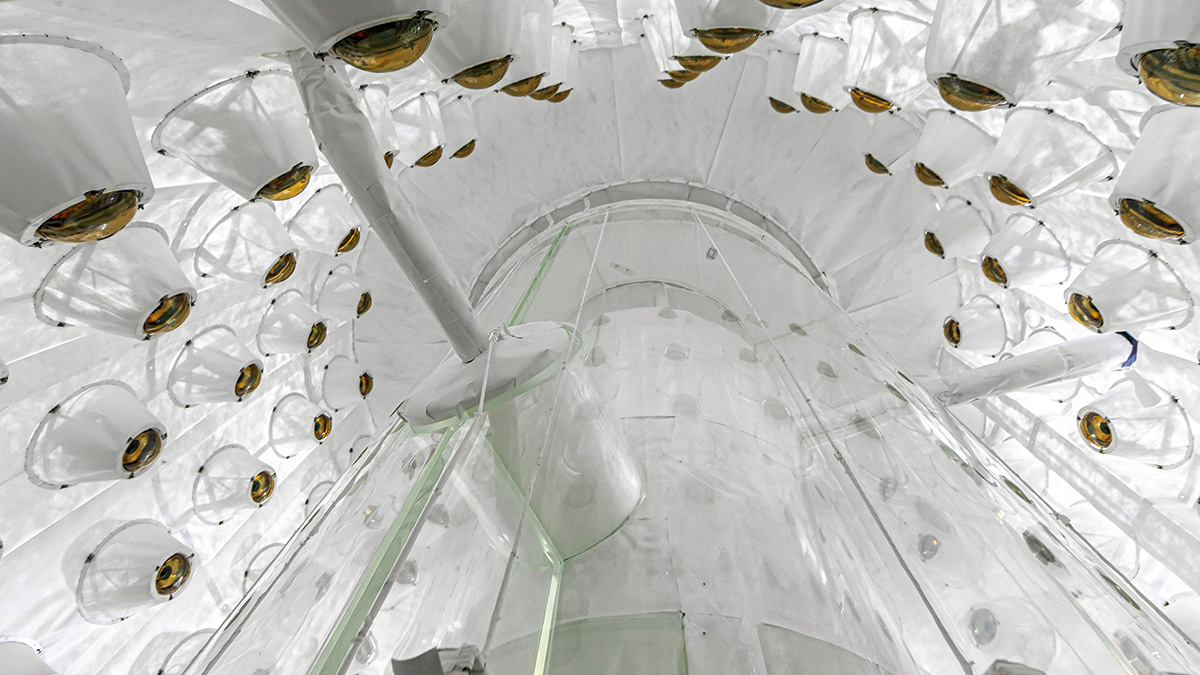
LZ uses seven tonnes of ultrapure liquid xenon to look for dark matter in the form of weakly interacting massive particles (WIMPs) from the galactic halo. When a particle scatters off a xenon nucleus, the recoil produces scintillation light and ionisation electrons. An electric field then drifts the electrons into the gas above the liquid, where they generate a second light signal through electroluminescence. The ratio of the two signals distinguishes a genuine recoil off a nucleus from a scatter off an atomic electron, which is what most backgrounds produce.
Conventional searches concentrate on recoils below about 100 keV, where a WIMP would scatter coherently off the nucleus as a whole. LZ’s large target mass allows it to investigate a broader range of possible interactions, including weaker couplings that would grow with the momentum transfer and so become more prominent at higher recoil energies. The recent study explored energies up to 270 keV.
“We found a single event remaining in the analysis, at around 250 keV,” says Richard Gaitskell, a physicist at Brown University and spokesperson for the LZ collaboration. “It would be consistent with dark matter interacting through a slightly more complicated coupling than usual, one that favours large momentum transfers. I should add that with a single event, a dark-matter interpretation is only one possibility.”
The collaboration considered numerous potential sources of background, including accidental coincidences between scintillation light and single ionisation signals, coherent scattering of atmospheric neutrinos, multiple scattering within the detector and high-energy neutrons. “The one that we found most likely, although rare, is multiple scattering,” says Gaitskell. “What we are concerned about is if one of the scattering vertices happened in a region of the xenon where no charge is collected.” In that case, the event would lose part of its ionisation signal and look more like a nuclear recoil. The experiment’s underground location and shielding, with the detector inside 229 tonnes of water and an active liquid-scintillator detector around the xenon, help suppress unwanted signals.
“We are at the level where the probability that the event is background leakage is expected to be about 1 in 200,” says Gaitskell, who – nonetheless – does not exclude a background of a kind not yet identified. “With one event, you have to hold all those possibilities in mind.”
Several theoretical interpretations have been proposed for the LZ event, including the higgsino, a candidate motivated by supersymmetric extensions of the Standard Model. To scatter off a nucleus at the rate needed to produce the LZ event, the higgsino would have to turn from its stable state into a second one, a few hundred keV heavier. Since only the fastest particles in the halo carry the energy to do so, most would never scatter, and the few that did would leave high-energy recoils.
“The higgsino model has really only one free parameter, the energy/mass splitting between the two neutral states, and once that is fixed, it fits the data fairly well,” says Tracy Slatyer, theoretical physicist at the Massachusetts Institute of Technology. “However, for a higgsino you would expect to see more events at higher energy in LZ. The details depend on the velocity distribution of dark matter, which is uncertain, but there is some tension there. Perhaps more importantly, as Maxim Pospelov and Harikrishnan Ramani pointed out, the dark matter in the higgsino model can also annihilate, so for the parameter choices that fit the LZ event you would expect a flux of high-energy neutrinos from the Sun, which has not been observed.” Variations of the model can evade these bounds. “Perhaps the simplest is just increasing its mass, although this makes it a bit more complicated to generate the correct dark-matter abundance,” says Slatyer.
“We now have more than three times as much data available,” says Gaitskell. “We can use that larger exposure to analyse in more detail whether additional events are occurring and whether their signature is consistent with dark matter.” Complementary searches may also be possible with other liquid-xenon experiments, including XENONnT at Gran Sasso, PandaX-4T and its 20-tonne successor at Jinping in China. Meanwhile, design studies are being carried out for a detector of 60 to 80 tonnes of xenon, referred to as XLZD.
Further reading
LZ Collab. 2026 arXiv:2609.02823.
K Freese and D P Theodosopoulos 2026 arXiv:2609.01583.
N L Rodd et al. 2026 arXiv:2609.04175.
M Pospelov and H Ramani 2026 arXiv:2609.02775.