The ΛCDM model describes a universe dominated by cold dark matter and dark energy, represented by the cosmological constant Λ. From a small set of parameters, constrained by observations of the cosmic microwave background (CMB), it predicts how the nearly uniform early universe developed into the galaxies, clusters and filaments seen today.
Despite the model’s remarkable agreement with a wide range of observations, small cracks have begun to emerge. Alongside the well-known Hubble tension, now exceeding five standard deviations (CERN Courier March/April 2025 p28), CMB observations interpreted within ΛCDM generally predict a universe in which matter is slightly more strongly clustered than indicated by weak gravitational-lensing surveys. The difference, commonly expressed through a parameter known as S8, is modest, typically at the level of two to three standard deviations, but its persistence across multiple datasets has prompted an important question: could the growth of cosmic structure reveal physics beyond ΛCDM?
The model, for instance, takes dark matter and neutrinos to interact only through gravity, an assumption experiments have yet to test. Dark matter accounts for approximately 85% of the matter in the universe, but its microscopic identity remains unknown. Neutrinos, by contrast, are known particles, but several of their properties are only partially understood. Neutrinos were produced in enormous numbers in the early universe, and this relic population should still fill the cosmos today, outnumbering baryons by roughly a billion to one.
Dark acoustics
Extensions of the Standard Model can introduce new mediator particles that couple dark matter to neutrinos, allowing them to scatter elastically. The process would have mattered most in the early universe, when neutrinos – still relativistic – formed a rapidly moving background through which cold dark matter attempted to collect in gravitational potential wells. Scattering with this background would act as a drag, slowing the growth of dark-matter-density perturbations. On sufficiently small scales, the pressure of the relativistic component in the coupled dark matter–neutrino fluid could cause perturbations to undergo dark acoustic oscillations rather than grow freely under gravity, in analogy with the acoustic oscillations imprinted on the CMB. Diffusion damping would further suppress fluctuations on the smallest scales.
As the universe expanded and its density decreased, the interaction would eventually become inefficient. Dark matter would then behave like an ordinary collisionless component, recovering the conventional picture. The early coupling would nevertheless leave a scale-dependent suppression of the matter distribution and, consequently, a reduced abundance of structure at late times. This is the type of effect that could lower the value of S8 inferred from the early universe and bring it closer to late-time weak-lensing measurements.
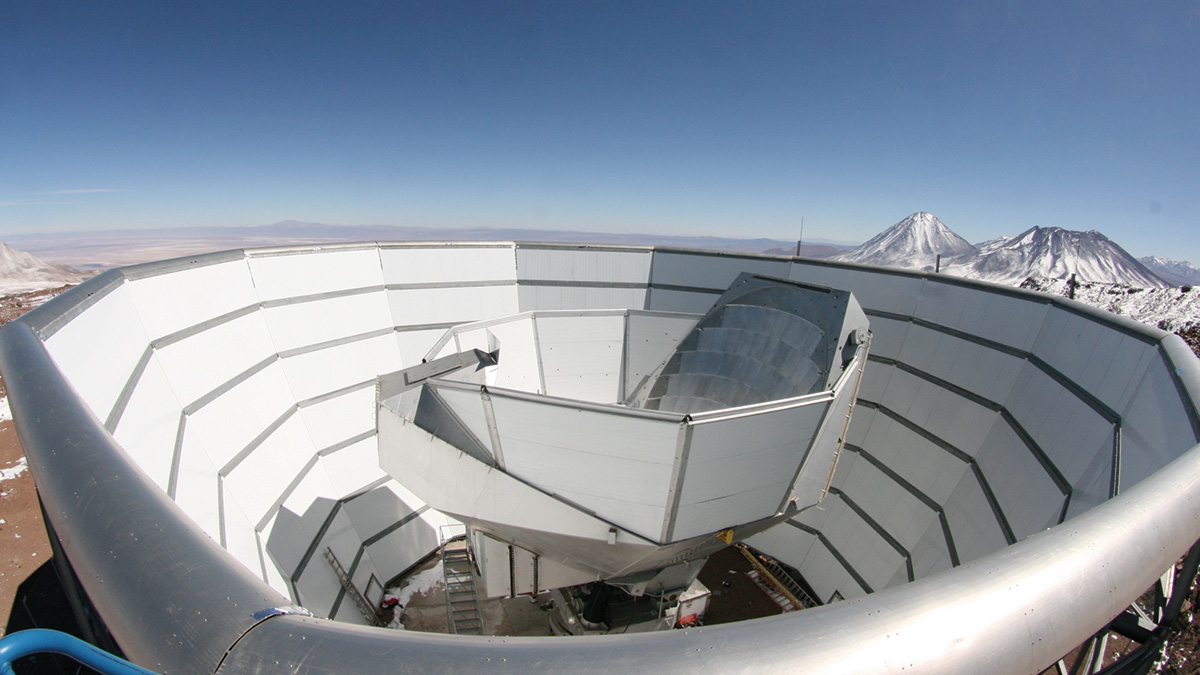
Previous analyses of high-resolution CMB measurements from the Atacama Cosmology Telescope (ACT) had already identified a mild preference for non-zero scattering between dark matter and neutrinos. The effect was driven mainly by the small angular scales, or high multipoles, measured by ACT, which are particularly sensitive to changes in the evolution of primordial perturbations.
In a study published earlier this year, we investigated whether the same interaction could also account for measurements of matter clustering in the late universe. To do so, we combined large-scale CMB information from Planck with smaller-scale data from ACT, baryon acoustic oscillation distance measurements, and cosmic-shear data from the first three years of the Dark Energy Survey (DES Y3).
Cosmological surveys are beginning to test how dark matter behaves and what it interacts with
Cosmic shear is the coherent distortion of the apparent shapes of distant galaxies caused by the intervening matter. Unlike galaxy clustering, it does not rely on galaxies as faithful tracers of the underlying matter density. It therefore provides a comparatively direct view of how matter, dark and luminous, is distributed across the universe. The DES Y3 data mildly favour interaction strengths that overlap with the range independently preferred by the CMB. The two probes measure different physical quantities at very different epochs, but point towards a similar suppression of structure.
The full combination favours non-zero scattering between dark matter and neutrinos at close to the three-standard-deviation level. The preferred interaction is small, but strong enough to leave signatures in both the high-resolution CMB spectra and the late-time clustering. It is also sufficient to reconcile the CMB and weak-lensing constraints on S8.
The implications would extend well beyond cosmology. Many particle-physics models allow dark matter and neutrinos to communicate through new mediator particles or a hidden sector, including scenarios with sterile neutrinos. Cosmological observations are sensitive to such couplings because they probe the cumulative evolution of the universe over billions of years, and they can often test interaction strengths inaccessible to laboratory experiments.
At the same time, caution is warranted. The current preference remains below the threshold required to claim a discovery of new physics, and alternative explanations, including unknown observational systematics or different extensions of the standard cosmological model, cannot yet be ruled out. Further observations will therefore be crucial to determine whether the preference persists.
Galactic mapping
New weak-lensing surveys from the Vera C. Rubin Observatory, Euclid and Xuntian – the Chinese Space Station Telescope (CSST), which will co-orbit with the Tiangong space station – will map billions of galaxies, while next-generation CMB experiments will sharpen our view of the early universe. Our forecasts indicate that Rubin and CSST should either confirm the preferred interaction region or impose stringent limits on the best-motivated possible connection between known particles and dark matter. Either outcome would be valuable.
More broadly, cosmological surveys, once limited to weighing the universe’s components, are beginning to test how dark matter behaves and what it interacts with. Whether forces that have so far escaped laboratory detection connect the visible and invisible sectors of the cosmos is now an observational question.
Further reading
L Zu et al. 2026 Nature Astron. doi:10.1038/s41550-025-02733-1.
W Giarè et al. 2024 Phys. Rev. D 109 063516.
P Brax et al. 2023 Phys. Dark Univ. 42 101321.
P Brax et al. 2023 Mon. Not. R. Astron. Soc. 527 L122.