In July, an experiment at the Paul Scherrer Institute (PSI) in Switzerland produced, captured and transported positrons using a system developed for CERN’s proposed Future Circular Collider (FCC). The results from the PSI Positron Production (P3) experiment at SwissFEL, the laboratory’s X-ray free-electron laser user facility, show that the key elements of the FCC positron-source concept can operate together.
“These are the first positrons for the FCC project, so it’s an important milestone,” says Paolo Craievich from the PSI Center for Accelerator Science and Engineering, who is co-leader of the P3 project.
The electron–positron FCC (FCC-ee), recommended by the CERN Council as the preferred option for CERN’s next flagship project (CERN Courier July/August 2026 p7), would collide electrons and positrons in a 90.7 km ring at the Z pole, the WW threshold, the ZH production peak and the top-quark pair threshold. One of the major technical challenges for the FCC is its positron source. While positrons can be produced easily by firing electrons into a dense target, capturing them in large numbers and efficiently channelling them into a tight beam is much more difficult. “The positrons fly out at large angles, and typically many are lost,” says Craievich. “With our new technology, we should be able to significantly increase the positron yield.”
Capture magnets
At the Z pole, each of the two collider rings would hold 11,200 bunches, kept full by continuous top-up injection from a booster in the tunnel. The injector would supply the booster with pulses of four bunches at 100 Hz, with up to 5 nC per bunch, through a damping ring that reduces the transverse emittance of the positron beam by four orders of magnitude and a high-energy linac that takes it to 20 GeV. The yield of the positron source, the number of positrons captured for each electron sent to the target, sets the charge and power of the drive beam and the heat load on the target. The capture magnets of existing sources are pulsed normal-conducting magnets known as flux concentrators.
Each piece of technology is state of the art
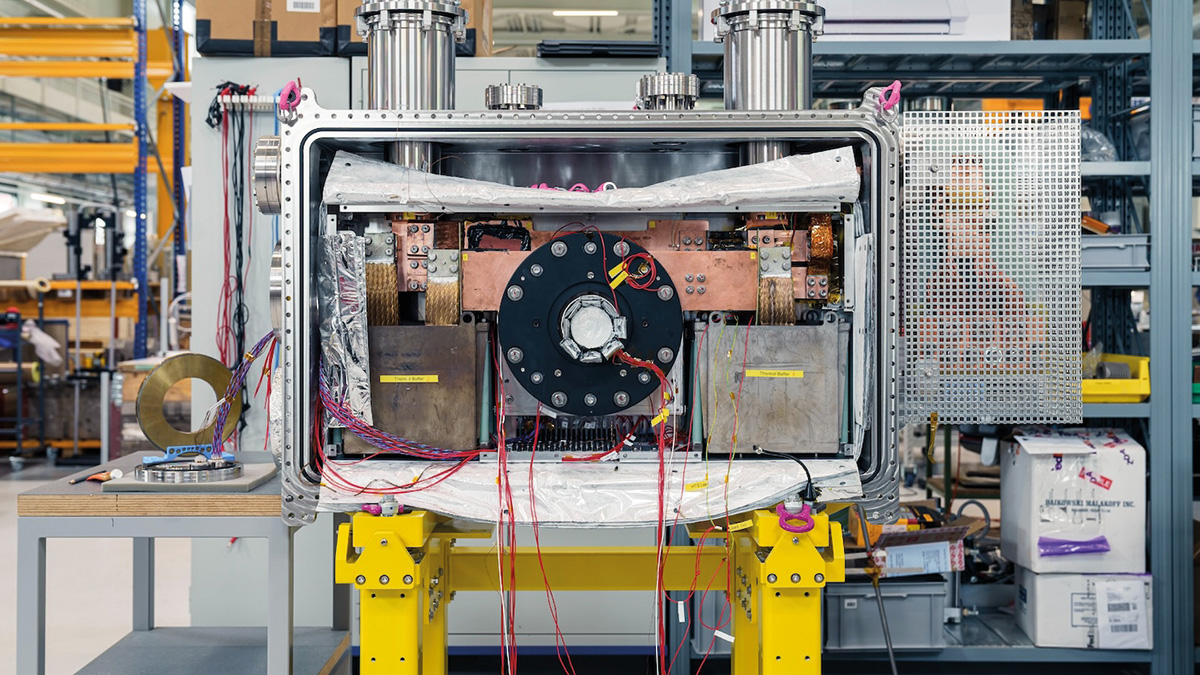
In the P3 setup, electrons from the SwissFEL linac strike a tungsten-target system designed, produced and assembled by CERN, generating a shower of positrons travelling in many different directions. A superconducting magnet surrounding the target then captures as many of them as possible. To meet the stringent technical requirements of the FCC positron source, PSI researchers developed a compact solenoid made of high-temperature superconductors, which reaches a field up to 15 T.
The magnet’s five coils are wound from rare-earth barium copper oxide (REBCO) tape. The turns are not insulated from each other, so that if a spot in the tape loses its superconductivity, the current can cross to the neighbouring turn and flow around it, instead of heating the spot further and quenching the coil. The system is cooled to 15 K by two cryocoolers and has a warm bore 72 mm wide, in which the target sits 3 cm downstream of the centre, at 12.7 T. From there, the field decreases along the beam direction, converting the large angles of the positrons into a larger beam size that fits the aperture of the accelerating structures. Additional components guide, separate and measure the positrons. Radiofrequency cavities accelerate and bunch them so that they can be transported and, eventually, injected into a collider. The two cavities are S-band standing-wave structures with 40 mm irises, inside normal-conducting solenoids of 0.45 T. Simulations give a yield of about four positrons per electron, and up to seven with superconducting solenoids of 1.5 T in their place.
State of the art
The drive beam of 200 pC bunches at 6 GeV reached a screen in front of the target on 13 May. The solenoid was switched on at the end of June, the cavities were conditioned, and the first positrons were recorded in July on the broadband pickups, scintillating screens and Faraday cups along the line. “Each piece of technology is state of the art,” says Craievich. “For example, it would never have been possible in the past to reach such a high magnetic field without the new high-temperature superconducting solenoids.”
In the beam
Between May and August this year, proponents of the IDEA (Innovative Detector for e+e– Accelerator) detector concept for the FCC tested several prototypes of detector components using secondary beams from the Super Proton Synchrotron and the Proton Synchrotron.
Tracking the position of muons in the outermost layers of the FCC-ee detectors is essential, and one beam test explored a prototype based on micro-resistive WELL (micro-RWELL) technology, which offers a spatial resolution as fine as 50 μm. In parallel, a team working on the IDEA drift chamber, which would track and identify particles in the central part of the detector, analysed the performance of a technique called cluster counting that counts the primary ionisation clusters along a track in a helium-based gas mixture to separate particle species.
The FCC-ee physics programme also requires the energy of particle jets to be determined with a precision beyond that of conventional hadron calorimeters. This is driving the development of dual-readout calorimeters, which read out scintillation and Cherenkov light separately to measure the electromagnetic fraction of each hadronic shower. The beam tests at CERN offered the first opportunity to evaluate the full calorimeter concept under study for IDEA, a fibre prototype with about 10,000 silicon photomultipliers and a crystal electromagnetic section, both of which showed promise for future large-scale developments.
“My congratulations go to the P3 team and the many colleagues across PSI who made this achievement possible, together with their collaborators from CERN, IJCLab–Université Paris–Saclay and KEK,” says Michael Benedikt, FCC project leader at CERN. “This work also reflects the vital support of the Swiss CHART programme in helping to build the expertise and advanced technologies needed to turn the FCC vision into a technically credible project.”
The next step for the P3 team is to increase the beam intensity and optimise the system, with the aim of scaling up positron production to the levels required for the FCC. P3 runs with 200 pC bunches at 1 Hz, while the FCC-ee injector would send bunches of up to 5 nC to its target, four per pulse at 100 Hz. Validation of the positron-source yield is one of the deliverables of the FCC’s reference design phase, during which many other parts of the collider and its experiments are being developed. Six concepts for the FCC-ee detectors are being studied at institutes across the world, and this year prototypes for one of them were tested with beam at CERN (see “In the beam” panel). Beyond the FCC, the high-temperature superconducting magnet technology developed for P3 is also being investigated for applications in proton therapy and fusion research.
Further reading
N Vallis et al. 2024 Phys. Rev. Accel. Beams 27 013401.
J Kosse et al. 2025 Supercond. Sci. Technol. 38 035008.
FCC Collab. 2025 arXiv:2505.00274.
IDEA Study Group 2025 arXiv:2502.21223.