The LHC will see no beam until 2030, yet its tunnel has not been this busy since the machine was installed in the 2000s. Jean-Philippe Tock, who leads the coordination of CERN’s third long shutdown, explains how four years of interventions on the LHC were fitted into a schedule with no margin to spare, alongside an intense programme of work across the rest of the accelerator complex.
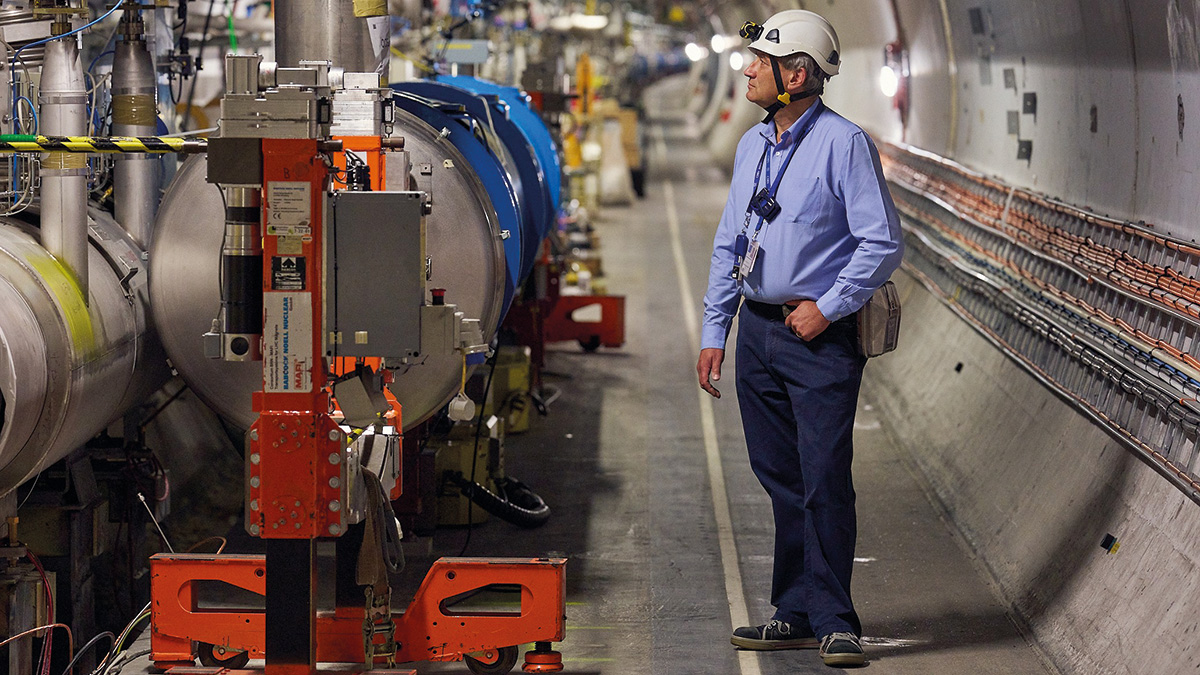
The LHC completed its third run at the end of June. Is that when Long Shutdown 3 (LS3) began?
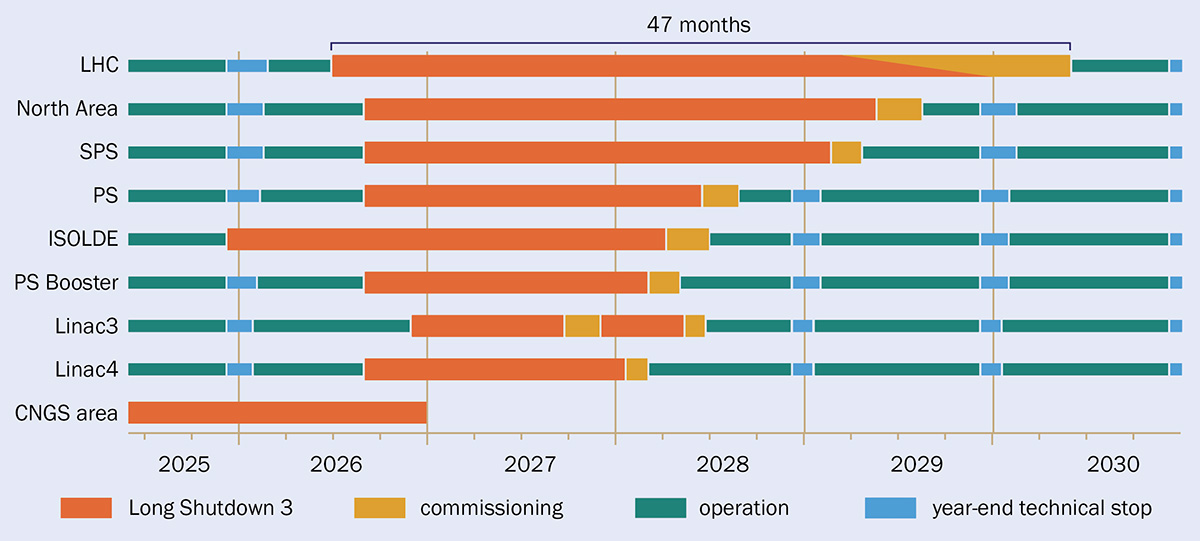
For the LHC, it was. It entered LS3 on 29 June, at exactly 6 a.m. But for some parts of the CERN complex, LS3 had started a year earlier. The first large activity, the removal of the target area of the former CERN Neutrinos to Gran Sasso (CNGS) beam facility, began in June 2025. ISOLDE then stopped in December 2025 for a complete renewal and upgrade of equipment several decades old and will take beam again in 2028. Starting early makes it possible to use the beam as soon as it returns, spreads the load on our resources and gives teams time to ramp up and train.
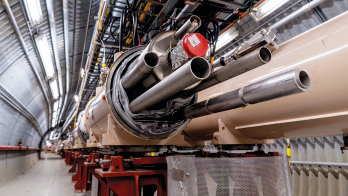
As with the other facilities, the LHC electrical circuits were locked out, so that people could access the equipment safely. Then its superconducting magnets, which operate at 2 K, had to be warmed up before the interventions could start. Bringing some 36,000 tonnes of metal to room temperature, one sector after another, took two and a half months. In parallel, we tested the machine’s mechanical and electrical integrity, looking for any non-conformity to fix for reliable operation in Run 4. Once the warm-up was complete, in September, the intensive removal of components began, to make room for the High-Luminosity LHC (HL-LHC).
What exactly is being removed, and what will replace it?
About 1.2 km of the LHC will be renewed, 300 m on each side of ATLAS and CMS. Along that stretch, the focusing magnets close to the experiments, which make the size of the beams as small as possible at the collision point to maximise the luminosity, will be removed together with other beamline equipment, such as collimators, valves and other magnets. The removal of the cables, cable trays and piping will follow, so that at some point this section of the tunnel will be completely empty. The magnets will then be replaced by new, higher-performing ones, or upgraded and put back in place in the last phase of LS3. The cryogenic line feeding them will also give way to one dedicated to the HL-LHC equipment, providing more cooling power.
That is a massive technical challenge. What about the people involved?
This huge effort covers the LHC and its experiments, the injector complex and its experimental areas, and a large part of the technical infrastructure, so literally every CERN site is touched. It involves CERN staff, collaborators and contractors, with more than a thousand extra people coming just for LS3. Those who operated the accelerators are now carrying out interventions or already preparing for the restart. And since the work will last years, with many people joining as students, graduates or new staff, we must also guarantee the continuity of expertise.
How does LS3 compare in scale with the two previous long shutdowns?
The first, in 2013 and 2014, was triggered by the need to consolidate the electrical splices, the connections between the LHC’s superconducting magnets. The second was mainly dedicated to upgrading the injectors’ chain, to prepare the beams needed for high-luminosity operation of the LHC, but it also covered the upgrades of ALICE and LHCb, the consolidation of the insulation of the diodes that protect the LHC dipoles and much of the underground civil engineering for the HL-LHC, which could not be done during LHC operation because of the vibrations. It started at the end of 2018 and was supposed to end in 2020, but it lasted longer than expected because of the COVID-19 pandemic. LS3 is larger than either, in volume and in extent, both in time and geographically. How much larger depends on the group, but for some the work is two or three times greater.
When did the planning start, and what did it involve?
The trigger for this third multi-year shutdown was the HL-LHC, with the upgrade of the LHC and of its detectors, mainly ATLAS and CMS, so that they can digest the increased luminosity. The installation has been under study for more than 15 years. Since the machines would stop anyway, it was the opportunity for other upgrades, like the complete renovation of the North Area, where some equipment is as much as 40 years old. Drawing on the first two long shutdowns, a coordination team was set up in 2021. It now has about 15 people, experts in planning, logistics and safety – which is our first priority – and representatives of the HL-LHC. We checked that every planned intervention was ready and that all were compatible, first for safety, minimising co-activity between teams working in the same place, and then for resources, which are limited.
Let’s talk about the schedule. The first estimate for the work in the LHC came to a little over 51 months, and it was brought down to 47. How did you manage that?
It came from the LS3 Readiness Review in 2024, where a bottom-up evaluation of all the activities in the LHC exceeded the allocated time. And that figure was already optimised. A reasonable target of 47 months was then set, and we switched to a top-down approach, with the hard objective of fitting into that window.
To achieve that, we reviewed in detail every single activity on the critical path, the sequence of tasks where any delay pushes back the end of the shutdown, and on the near-critical paths. We went to a very fine granularity, both geographically and in time, to maximise parallelism, which was one of the keys to gaining time. Another knob was double-shift work, used at an unprecedented level for key activities on the critical path, such as cabling and de-cabling. We will even use the night shift for transport, which restricts access, and for inspections such as radiography. Shift work, parallelism and the removal of any margin mean that the schedule is highly optimised. The adverse effect is that we have less flexibility to face unexpected events.
How fine did that granularity get? Can you give us an example?
I will give two. One important activity is drilling 28 vertical cores, 1 m wide and 8 m high, to connect the LHC tunnel with the new underground galleries built for the HL-LHC. The galleries were excavated during the second long shutdown, but the final connection has to be drilled during LS3. In the original schedule, drilling was supposed to be the only activity in that part of the tunnel. We divided the 250 m of tunnel into several smaller portions of a few tens of metres, to allow other civil-engineering or infrastructure work in parallel with the drilling.
The other example is in time. The critical path passes through Point 1 and Point 5, where ATLAS and CMS sit and where most of the HL-LHC work takes place. For some activities there, like the electrical lock-out at the start of LS3, we planned down to the day, or even the half-day. We did not do that for all activities, but that was the level of detail. Altogether, with the flexibility, commitment and experience of all the teams involved, and the support of CERN’s management, we just managed to fit into these 47 months.
Forty-seven months is still a long stretch…
It will be a marathon for the team [chuckles], that’s for sure, and far from plain sailing, hopefully with not too many hurdles. But it breaks down into phases common to most facilities. The first is testing, to identify any non-conformity or weakness that we must fix, followed by removal campaigns, to clear space for the improved or new equipment. For the LHC specifically, the drilling of the vertical cores connecting the LHC and HL-LHC worlds will be a key phase. After that, the new technical infrastructure will be installed, then the accelerator or experimental equipment, and finally all the superconducting systems will be cooled down. The last phase before operation is the hardware and beam (re)commissioning (see “Out of phase” figure).
You mentioned that ISOLDE will take beam again in 2028, and some of the people now working on LS3 will be back operating accelerators. How will that work?
It will be a real challenge for managing resources, because the same groups will be supporting operation and carrying out LS3 interventions. The accelerators always restart in order, from the source to the LHC, but after a winter break that takes a few weeks. This time the restart will span two years, from mid-2028 to 2030, which will be a first at CERN on such a scale. So there will be priorities to define, and arbitration. The HL-LHC comes first. It’s a must. By that I mean the project itself, the upgrade of the experiments and all the other projects needed for the LHC to enter the high-luminosity era efficiently and safely.
One of them is the access and alarm system, which dates from the LHC’s installation. The new one has to be ready by the end of 2028, because in the first part of 2029 we will start cooling down some LHC sectors to commission all the new equipment, and for that we will need a safe access system.
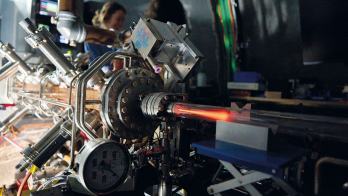
Another is the beam-screen treatment, which will deposit a thin layer of amorphous carbon on 12 km of beam screens, to keep the heat load from the beams within what the cryogenic system can handle.
Is it your team that sets those priorities?
We aim to optimise the schedule for efficient resource allocation, aligned with CERN’s priorities as defined by top management. In addition, I see our role as one of support and service for the groups and projects. They manage their resources and set their objectives, and we are there to give them the best conditions to reach those objectives safely. We also help with logistics, managing more than 40,000 square metres of requests for storage and site compounds – including underground, where space is scarcest. And we foster discussion between the people working on site, because teamwork, flexibility and understanding each other’s constraints are key to solving the everyday issues we encounter.
What is your typical day, if there is one?
That’s an interesting question. The great thing about this work is that it’s not routine, and we face very different issues. Sometimes we have to adapt and reshuffle work because we have discovered a non-conformity that needs fixing. Sometimes unexpected interventions have to be studied and integrated into the already heavy schedule, because we judge them important for the machines’ long-term robustness. If there is a fil rouge, it is the many meetings, presentations and exchanges with all the stakeholders, to understand their needs, their constraints and where there is room for flexibility. People at CERN are committed to their own work, but they also understand the global picture and the interest of the Organization.
How is the mood among the teams, now that the work has started?
For every machine, when operation stops, it is the end of an adventure for the physicists gathering data, and it can be a bit sad. But it is for the best, since it will bring improved machines. On our side, the team has prepared LS3 for years. In this first phase the feeling is that people are eager to start the actual interventions in the field. Seeing this become concrete makes for a nice atmosphere on – and under – the ground. Of course, there will be difficulties to overcome, but I am confident in the team spirit and the commitment of everyone, at all levels. LS3 has to be a success, to boost performance, improve reliability and broaden the physics programme. Everyone contributing to it is paving the way for the discoveries of the decades to come.