Ukraine became an Associate Member State of CERN 10 years ago. Its physicists, Tetiana Hryn’ova argues, have been contributing to the field for far longer.
In 1877, Ivan Pulyui published “About a radiometer or a light mill” in the Lviv journal Pravda – the earliest known physics article in Ukrainian. Nearly 150 years later, the 10th anniversary of Ukraine’s associate membership of CERN coincides with the 35th of its declaration of independence. These milestones – overshadowed by daily Russian attacks, among them one on the National Academy of Sciences of Ukraine on 28 September – provide an occasion to reflect on the contributions of scientists born in Ukraine to the field of particle physics.
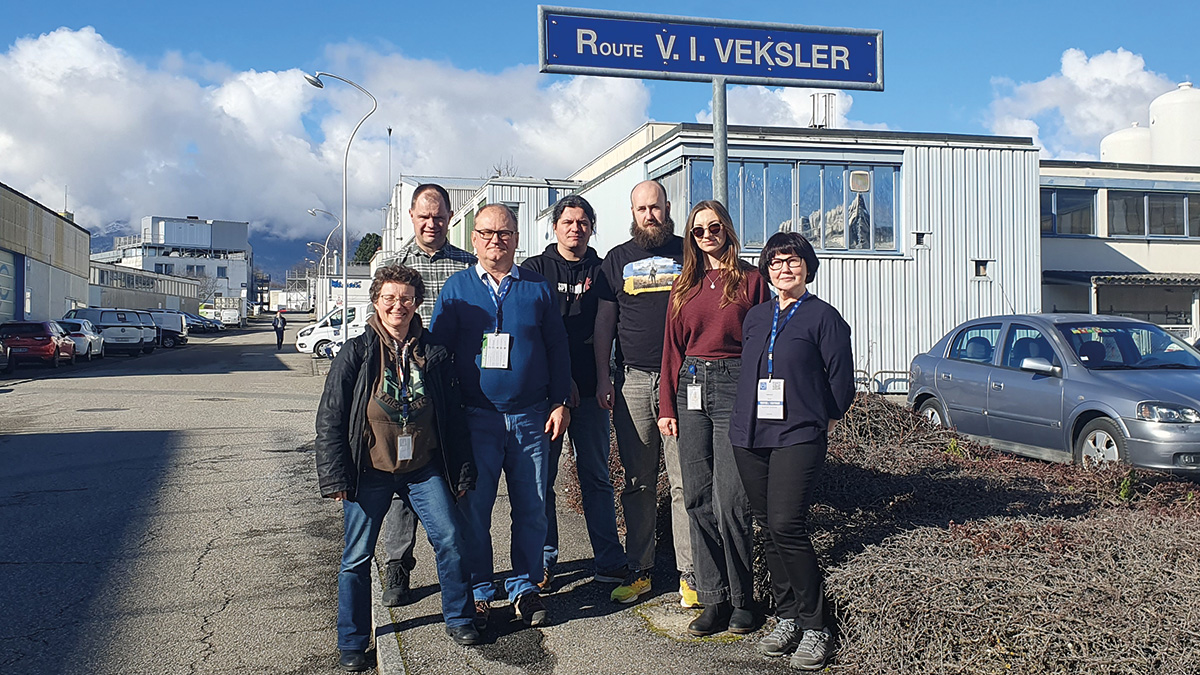
The opening sentence of Georges Charpak’s autobiography is “Born in 1924, in a small town on the Ukrainian plain I was deeply marked by wanderings imposed upon me by geographical, political and cultural events.” These words also apply to many Ukrainians who became scientists despite wars, the Holodomor, the Holocaust, repeated purges of Ukrainian elites and at least six mass emigration waves – the most recent of which is still ongoing. At the same time, scientists from Ukraine helped to establish or led major particle-physics laboratories, with Edward Ginzton at SLAC, Maurice Goldhaber at BNL, Gersh Budker at the Institute of Nuclear Physics in Novosibirsk, Volodymyr Veksler at JINR, and Abram Joffe at the institutes of physics and technology in Kharkiv, Dnipropetrovsk and Leningrad. Through Gleb Wataghin and Marcos Moshinsky, they also played an instrumental role in the development of particle-physics communities in Brazil and Mexico, while Gregory Breit and George Kistiakowsky contributed to the Manhattan Project. George Gamow, who explained alpha decay as quantum tunnelling and laid the foundations of the hot Big Bang model, brought science to the wider public through his popular books. Matvei Bronstein, Moïse Haïssinsky and Stephen Timoshenko were pioneers of quantum gravity, modern radiation chemistry and engineering mechanics, respectively.

A major milestone for particle physics in Ukraine was the establishment of the Ukrainian Institute of Physics and Technology in Kharkiv (UIPT, now KIPT) in 1928. It was there that Dmytro Ivanenko and Lev Landau – and later their students Oleksandr Akhiezer, Isaak Pomeranchuk, and Evgeniy and Ilya Lifshitz – laid the foundation of their schools of theoretical physics. Victor Weisskopf worked in Kharkiv, while Niels Bohr, Robert Van de Graaff and Paul Dirac came for visits. Type II superconductors were discovered in 1935 at UIPT’s cryogenic laboratory by Lev Shubnikov with colleagues Volodymyr Khotkevych, Georgy Shepelev and Yuri Rjabinin (CERN Courier November 2011 p17). Their success, however, led to a downfall. In the second half of the 1930s, at UIPT alone, 16 members of personnel were arrested for espionage, sabotage and “Ukrainian bourgeois nationalism”; seven were executed and one died in prison. Although Kharkiv was home to a 2 GeV electron accelerator between 1965 and 1990, a CERN delegation visiting in 1992 noted that “Few people we have met had had the opportunity to go abroad and our visit was for many the first direct contact with CERN.” For those who did make it to CERN, the experience was life-changing. Among them was Dmitry Volkov, who played a crucial role in the development of supersymmetry and supergravity with his KIPT colleagues Volodymyr Akulov and Vyacheslav Soroka.
Although Kyiv hosted the International Conference on High Energy Physics (ICHEP) in both 1959 and 1970, research carried out by Ukrainian scientists and institutions was rarely recognised internationally as such. Ukrainian-language scientific journals were closed, scientific institutions were systematically Russified, and many of their graduates were prevented from remaining in Ukraine to pursue their careers. Only a few scientists, most notably Mykola Bogolyubov, dared publish their research in Ukrainian. It is therefore hardly surprising that, writing in 1972, Weisskopf described Kharkiv, where he worked in 1933 and which was then the capital of Soviet Ukraine, as being in Russia. More troubling, in my opinion, is that, as recently as 2025, at the 4th International Symposium on the History of Particle Physics at CERN, research from scientific institutions in Kharkiv and Kyiv was presented under the title “Post-1980s Diaspora of Russian Particle Physicists”.
Strong foundations
Following the disintegration of the Soviet Union, one of the priorities of the government of independent Ukraine was to join CERN. This effort was driven by Ukrainian scientists and research institutes, whose achievements provided a strong foundation for the collaboration. Ludmyla Nagorna, from the Institute for Single Crystals in Kharkiv, introduced new techniques for growing large PbWO4 crystals, which are now used in the CMS and ALICE calorimeters. The advanced ultralight interconnection technologies, championed by Gennady Zinovjev from the Bogolyubov Institute for Theoretical Physics in Kyiv, found applications in the tracker of the ALICE experiment. Since the 1990s, Ukrainian scientists have contributed to a wide range of particle-physics experiments, in particular at B-factories, Fermilab, DESY and CERN.
As discussed extensively at the “Ukrainian contributions to particle physics: history and prospects” workshop held at CERN and in Kharkiv in January 2026, Ukraine’s associate membership of CERN marked not a beginning, but a continuation of a century-and-a-half-long scientific journey, reaffirming the role of its researchers in shaping the future of particle physics.