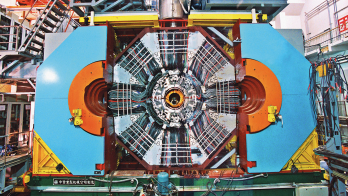
Studies of high-energy collisions of gold ions by the STAR collaboration at the Relativistic Heavy Ion Collider (RHIC), Brookhaven, have revealed evidence of the most massive antinucleus to date. The new antinucleus is an antihypertriton – a negatively charged state containing an antiproton, an antineutron and a Λ. It is also the first antinucleus containing a strange antiquark.
The new state is related to antihelium-3, with the Λ replacing one of the neutrons. The STAR team identified it via its decay into antihelium-3 and a positive pion. Altogether, in an analysis of hundred million collisions, they found 70 ± 17 antihypertritons and 157 ± 30 hypertritons (consisting of pnΛ).
In heavy-ion collisions only a tiny fraction of the emitted fragments are light nuclei, but these states are of fundamental interest. The STAR team finds that the measured yields of hypertritons (antihypertritons) and helium-3 (antihelium-3) are similar. This suggests an equilibrium in the populations of up, down, and strange quarks and antiquarks, contrary to what is observed at lower collision energies.
Further reading
B I Abelev et al. (STAR Collaboration) Science. DOI: 10.1126/science.1183980.