A report from the ALICE experiment.
The ALICE collaboration has measured the dynamics of three unbound protons at femtometre-scale distances, where the strong interaction is at play. Until now, three-nucleon interactions have been studied mainly in bound nuclear systems and through nucleon–deuteron scattering. However, bound states provide information only at specific energies and quantum numbers. Nucleon–deuteron scattering probes a wider kinematic range, but the deuteron has isospin 0, restricting measurements to total isospin 1/2. The isospin-3/2 channel has therefore remained directly unexplored, as it requires three unbound protons or neutrons.
ALICE has overcome this limitation using femtoscopy. In high-energy proton–proton collisions at the LHC, hadrons are produced at mutual separations of only a few femtometres. After production, their mutual interactions modify their momenta, leaving measurable correlations that reveal the forces acting between them. Extending femtoscopy to three particles is challenging because interactions primarily affect the kinematic region where their relative momenta, quantified by the hypermomentum Q3, must be low. Such triplets are rare. In proton–proton collisions at 13.6 TeV, only about one event in 30,000 contains three protons with Q3 < 1.4 GeV. During Run 3, dedicated software triggers therefore recorded all such events over the full integrated luminosity. Using these data, ALICE measured the p–p–p correlation function and isolated the genuine three-proton signal by subtracting background contributions estimated from the data.
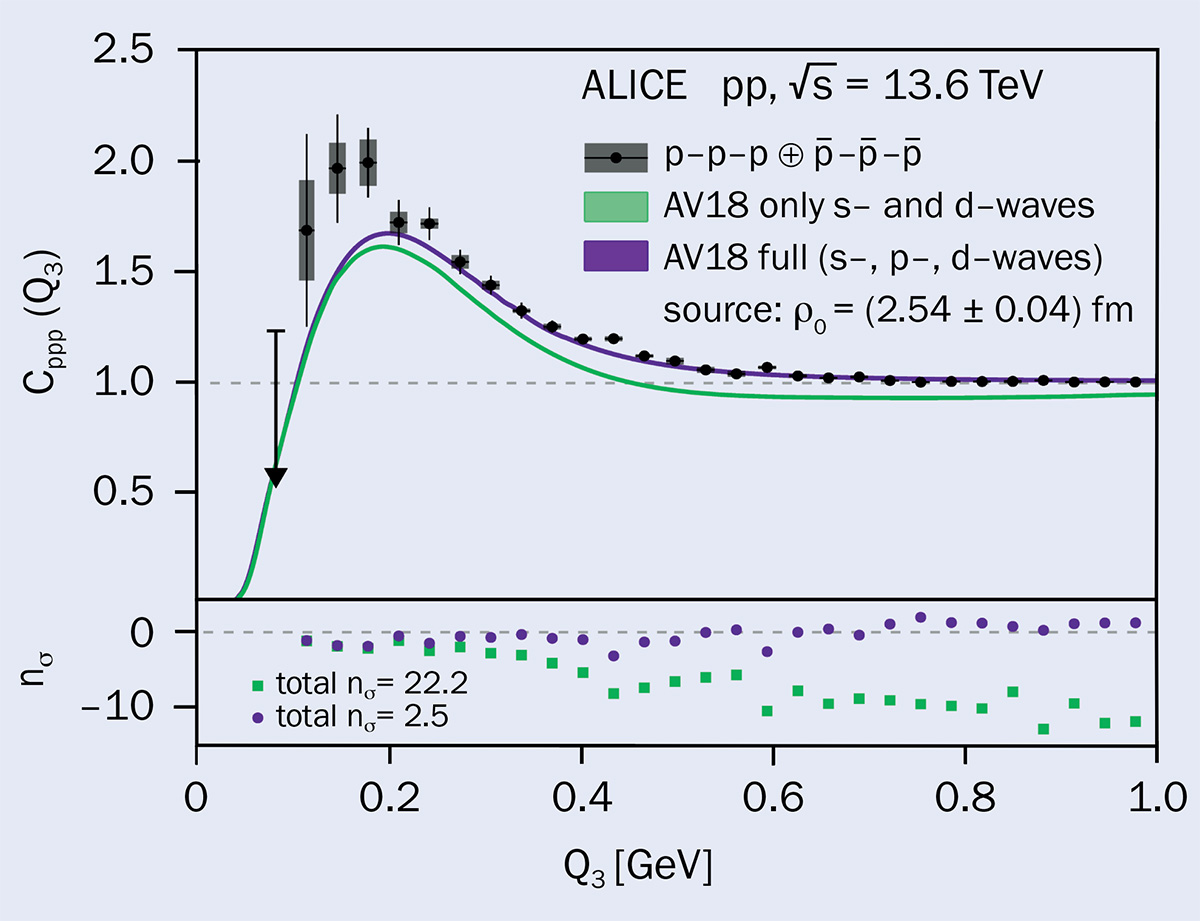
The resulting correlation function behaves as expected for an effective three-to-three scattering process (see figure 1). The data are compared with three-body calculations including quantum statistics, Coulomb repulsion and the proton–proton interaction described by the Argonne v18 potential (AV18), a model of the nuclear force fitted to nucleon–nucleon scattering data. Three-body forces, which account for about 10% of the binding energy of light nuclei, are negligible here, because the Pauli exclusion principle keeps the three identical protons from all coming too close together. The two-body interaction depends on the relative orbital angular momentum l of the pair, and its contributions are classified as s-wave (l = 0), p-wave (l = 1) and higher partial-wave interactions. Calculations without the p-wave contribution fail to describe the data, whereas those with the full interaction agree well, showing that the measurement is sensitive to these partial waves. This is the first direct test of the nuclear interaction in the isospin-3/2 three-nucleon system.
The data also reveal an unexpected feature. At large Q3, only the long-range Coulomb repulsion should act among the three protons, so the correlation function should approach unity from below. Instead, the data show an attraction due to the short-range nuclear force, as if it had acquired an effective long-range component. The explanation is geometric. Even when the three-body system is spatially extended, two of them can remain close enough to interact. This is the first experimental signature of such an effect in a system of three unbound protons.
The method can now be extended to strange three-baryon systems such as p–p–Λ and p–p–Ξ, whose interactions remain poorly constrained. Such systems matter for neutron stars, whose dense cores may contain hyperons. Their appearance would lower the predicted maximum mass of these stars below the values established by astronomical observations, but repulsive hyperonic three-body forces could counteract this effect. With the much larger Run 3 data sample, three-baryon femtoscopy can now constrain such forces directly.
Further reading
ALICE Collab. 2026 arXiv:2608.05708.