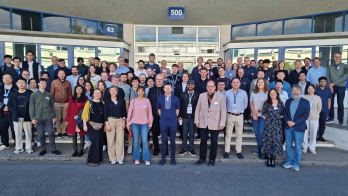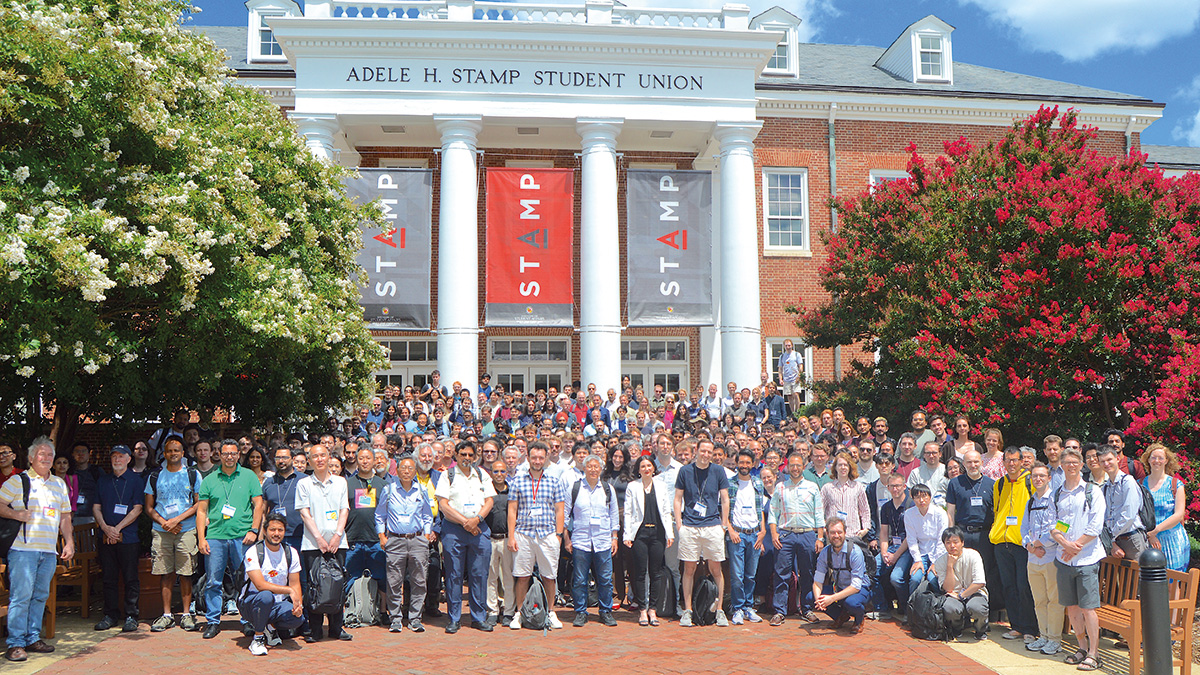
From 26 July to 1 August, the 43rd International Symposium on Lattice Field Theory (Lattice 2026) drew researchers from across the world to the University of Maryland, College Park, to present and discuss the latest advances in lattice quantum chromodynamics (QCD). Launched with a small workshop at CERN in 1982, the series has since grown far beyond its original scope, to span hadron spectroscopy and structure, QCD thermodynamics, physics beyond the Standard Model (SM), algorithms, computer architectures and machine-learning techniques and, increasingly, quantum computing and tensor networks.
This year’s edition, hosted for the first time at the University of Maryland, offered a moment to recall that history. Steven Gottlieb (Indiana University) honoured the legacy of Robert L Sugar, who was central to the formation of USQCD – the US lattice–QCD collaboration – and to the development of the Φ-algorithm at the core of modern simulations of fermions on the lattice.
The programme reflected the breadth of the field, with sessions ranging from muon g–2 hadronic contributions to neural networks and quantum computing.
Plenary talks by Alaina Green (University of Maryland) and Christian Bauer (Lawrence Berkeley National Laboratory) highlighted progress in quantum computing. Green argued that the question is no longer whether quantum computers can be applied to lattice field theory, but how to co-design lattice formulations, algorithms and hardware together so that quantum computing becomes useful. One new direction is the possibility of using qudits, quantum units with more than two levels, where current hardware already reaches more than 10 levels in ions and in superconducting systems.
Game changer
Spectral-density reconstruction was a main highlight of the conference. As Andreas Jüttner (CERN) put it, “spectral-reconstruction methods are a game changer – but loads of development is still required”. The challenge is that spectral densities, which describe how the states of a system are distributed in energy, cannot be calculated directly on the lattice. Instead, they have to be reconstructed from correlation functions, a notoriously difficult inverse problem. Shoji Hashimoto (KEK) explored the challenges and the rapid progress being made, from new mathematical ideas to improved numerical methods and their first phenomenological applications. The potential payoff is considerable, as these methods would make it possible to compute quantities long thought to be beyond reach, such as inclusive decay rates, hadronic amplitudes and energy-smeared versions of the R-ratio, the ratio of the cross-sections for electron–positron annihilation into hadrons and muons. Such quantities are central to precision tests of the SM, offering new ways to determine quark-mixing matrix elements and to study the hadronic vacuum polarisation that enters the muon g–2.
Additional highlights were the lattice–QCD determination of |Vcb| from inclusive Bs semileptonic decays, reported by Alessandro De Santis (Helmholtz Institute Mainz), and new results on the smeared R-ratio from Francesca Margari (University of Rome Tor Vergata). Experiments disagree on the cross-section for electron–positron annihilation into two pions, which dominates the R-ratio at low energies, and preliminary lattice results agree better with experiment when the KLOE and BaBar data are replaced by those of CMD-3.
The breadth of the field was reflected, from muon g–2 hadronic contributions to neural networks and quantum computing
Xin-Yu Tuo (Brookhaven National Laboratory) reported progress in lattice calculations of radiative corrections to weak decays. A puzzle in the radiative decay of a pion or a kaon into an electron and a neutrino was resolved through the inclusion of collinear photons, emitted almost parallel to the electron, showing that radiative corrections must account for experimental details. Another topic, addressed by Andrea Shindler (RWTH Aachen University) and in several parallel talks, was the gradient flow, which has evolved from a technical smoothing procedure into a general QCD framework. Flow time restores rotational symmetry, with the benefit that continuum symmetries are easier to preserve. Avoiding mixing with lower-dimensional operators has made computations of higher Mellin moments for the pion and nucleon possible. Other applications of flow time range from quark masses and B-meson mixing to operators related to electric dipole moments. Shindler also raised the possibility of using the flow time as a genuine factorisation scale, rather than as an auxiliary parameter to be taken to zero.
Robert Perry (MIT), William Detmold (MIT) and Michael Wagman (Fermilab) addressed the problem of spectral incompleteness. The central realisation is that a statistically precise determination of an energy level is not necessarily reliable if the operators used in the calculation miss some of the states contributing to the correlation function. Spectral bounds can separate what the lattice data establish from what depends on assumptions about the spectrum. The controversy over whether two-nucleon systems are bound at the heavy pion masses used in some simulations served as a motivation.
In his talk on physics beyond the SM, Simon Catterall (Syracuse University) discussed how lattice theories can faithfully encode subtle anomaly structures, and how these anomalies may determine when fermions can acquire mass without breaking any symmetry. This opens a potentially new route to nonperturbative formulations of chiral gauge theories, in which left- and right-handed fermions interact differently, as in the SM, and to new-physics model building.
Accelerated solutions
Machine learning, reviewed by Daniel Hackett (Fermilab), was another recurring theme – although in a rather different guise than the current excitement surrounding generative AI. Rather than replacing established numerical methods, machine learning is becoming an additional tool that accelerates first-principles calculations, speeding up the solution of the Dirac equation by learning the setup of multigrid solvers, inverting the Laplace transform that relates correlation functions to spectral densities or, most ambitiously, generating entire gauge configurations with normalising flows, a goal not yet reached for realistic QCD simulations.
The next symposium will be held in Nicosia, Cyprus, from 20 to 26 June 2027.