


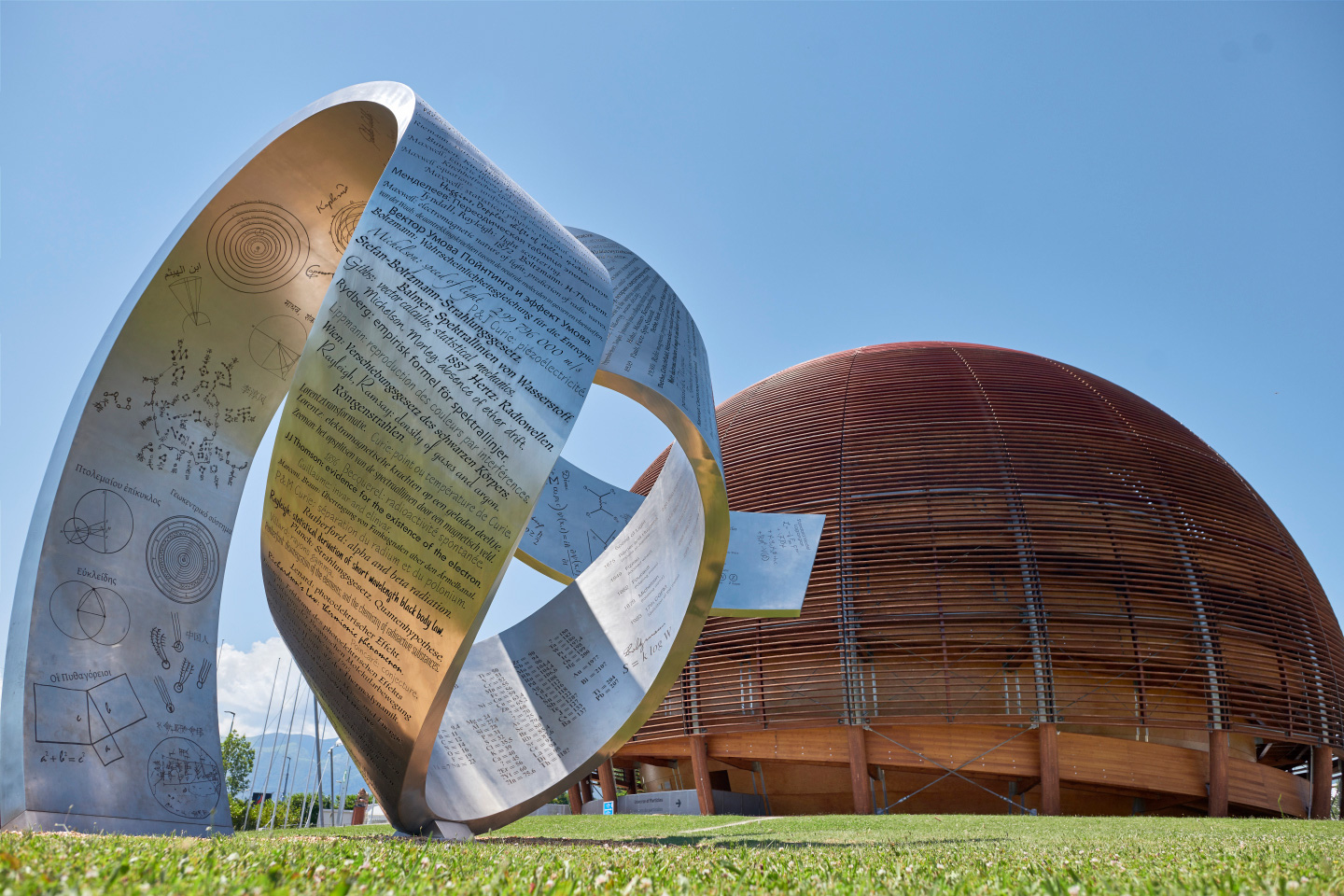


Europe’s foremost particle-physics laboratory, CERN was established near Geneva in 1954 to stop the brain drain to the US that had begun during the Second World War, and to provide a force for unity in post-war Europe. Alongside technological innovations such as the World Wide Web, its contributions to fundamental science include the discovery of the W and Z bosons, the determination of the number of light neutrino families and the discovery of direct CP violation. CERN’s Large Hadron Collider – the highest energy machine in the world – is in the middle of a programme of exploration that has already yielded the discovery of the Higgs boson.
Contact: cern.courier@cern.ch
 Read article 'Welcome to the Science Gateway'
On 8 April, CERN unveiled plans for a major new facility for scientific education and outreach.
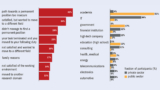 Read article 'Assessing CERN’s impact on careers'
Results from a new survey show the impact of working at CERN on an individual’s career.
 Read article 'Fixed target, striking physics'
A strong tradition of innovation and ingenuity shows that, for CERN’s North Area, life really does begin at 40.
 Read article 'CERN’s ultimate act of openness'
The seed that led CERN to relinquish ownership of the web in 1993 was planted when the Organization formally came into being.
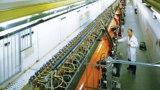 Read article 'The tale of a billion-trillion protons'
Linac2, the machine that feeds CERN’s accelerator complex with protons, has entered a well-deserved retirement after 40 years of service.
 Read article 'CERN thinks bigger'
The Future Circular Collider study would see a 100 km-circumference tunnel built at CERN to host post-LHC colliders.
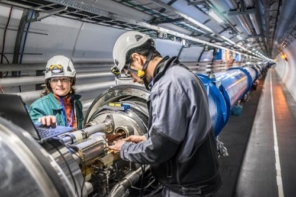 Read about 'Find out more about jobs at CERN'
Explore CERN’s employer profile and see the latest vacancies
 Read article 'When particles went global'
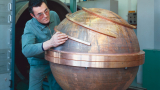
Eliezer Rabinovici reflects on the 4th International Symposium on the History of Particle Physics, and on the two decades during which the field grew to a planetary scale.
 Read article 'Ten years at the missing-energy frontier'
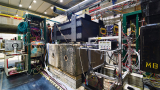
If dark matter couples feebly enough to evade direct detection, it may still betray itself by stealing energy from a beam. NA64 has put this principle to work for 10 years.
 Read article 'Plotting the discovery of Higgs pairs on Elba'
150 physicists convened on Elba from 11 to 17 May for the Higgs Pairs 2025 workshop.
 Read article 'Slovenia, Ireland and Chile tighten ties with CERN'
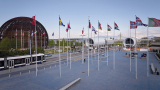
Slovenia becomes CERN’s 25th Member State, and Ireland and Chile have signed agreements to become Associate Member States.
 Read article 'Fritz Caspers 1950–2025'
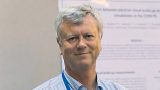
Friedhelm “Fritz” Caspers, a master of beam cooling, passed away on 12 March 2025.
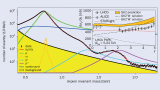 Read article 'Clean di-pions reveal vector mesons'
LHCb has isolated a precisely measured, high-statistics sample of di-pions.
 Read article 'FCC feasibility study complete'
The final report of a study investigating the technical and financial feasibility of a Future Circular Collider at CERN was released on 31 March.
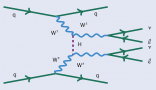 Read article 'Pinpointing polarisation in vector-boson scattering'
Interactions involving longitudinally polarised W and Z bosons provide a stringent test of the SM.
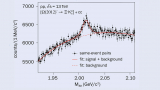 Read article 'ALICE measures a rare Ω baryon'
These results will improve the theoretical description of excited baryons.
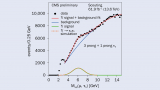 Read article 'Tau leptons from light resonances'
Among the fundamental particles, tau leptons occupy a curious spot.
 Read article 'CMS observes top–antitop excess'
The signal could be caused by a quasi-bound top–antitop meson commonly called "toponium".
 Read article 'Educational accelerator open to the public'
What better way to communicate accelerator physics to the public than using a functioning particle accelerator?