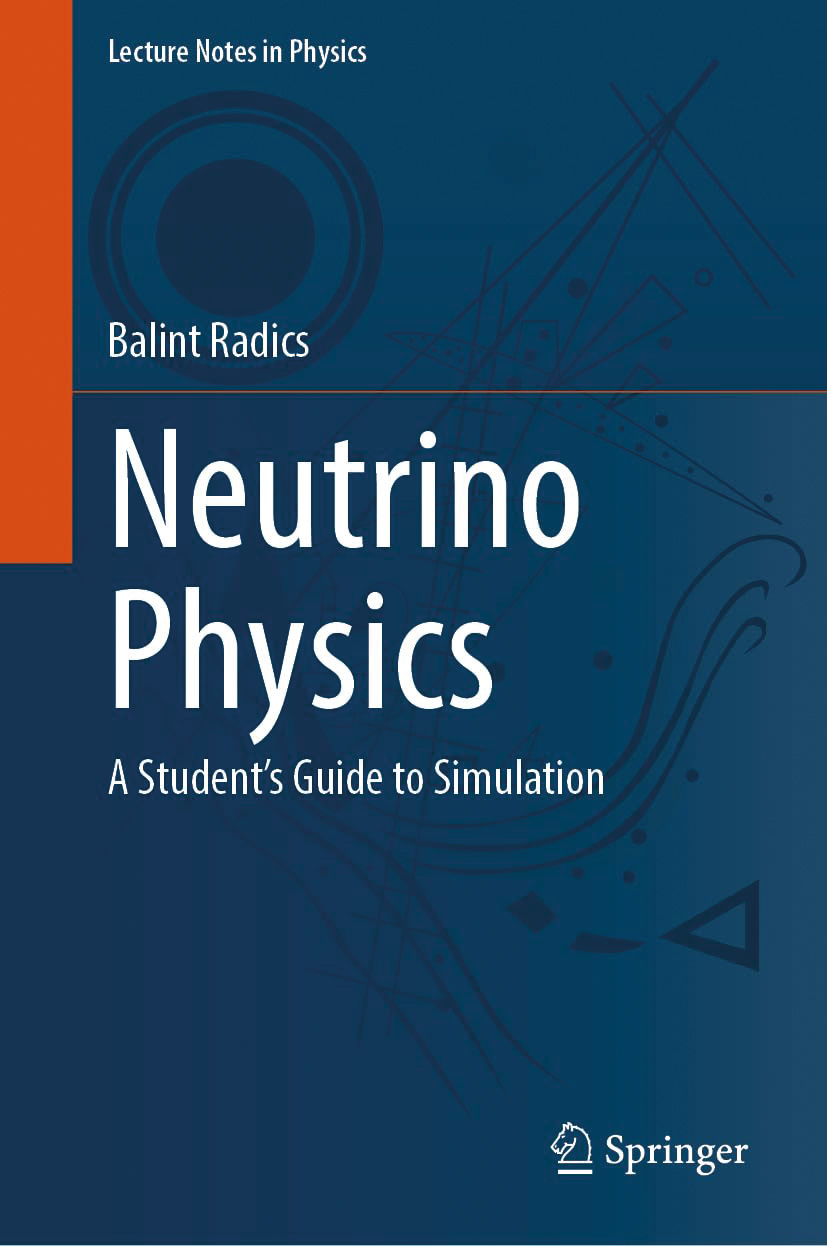
Neutrino Physics: A Student’s Guide to Simulation, by Balint Radics, Springer
Established around the turn of the century, neutrino-flavour oscillation is among the clearest signs of physics beyond the Standard Model (BSM), as it requires neutrinos to be massive. Over the past decades, neutrino-oscillation experiments have grown in physical size, collaborative scale and scientific success.
The missing solar neutrinos identified by the Davis chlorine experiment in the 1960s brought the first hints of oscillation, while atmospheric-neutrino oscillation was established by the Super-Kamiokande experiment in 1998. This was followed by the Sudbury Neutrino Observatory’s confirmation that solar neutrinos do indeed change flavour. Since then, measurements of neutrinos from long-baseline beams and nuclear reactors have confirmed the oscillations seen in natural sources and refined the parameters of the three-flavour neutrino picture.
The current-generation long-baseline experiments are now approaching the limits of their reach, and the community are awaiting results from the next-generation large-scale experiments – the Jiangmen Underground Neutrino Observatory in China, Hyper-Kamiokande in Japan and the Deep Underground Neutrino Experiment in the US. These, along with many smaller neutrino experiments employing various technologies, are chasing down the remaining known parameters of the three-flavour paradigm, testing with precision measurements and pursuing broad searches for BSM physics.
While the primary title of this book, Neutrino Physics, suggests a broad subject matter, the subtitle A Student’s Guide to Simulation immediately indicates the much more constrained scope. The material presented strongly emphasises simulation techniques of interest for neutrino-oscillation data analysis, and is of most direct relevance to long-baseline-beam oscillation experiments. Furthermore, the treatment is confined to simulating the production, oscillation and interaction of neutrinos. It stops before addressing the simulation of neutrino interactions’ final-state products in detectors. While typical expertise sought by students in the field includes detector simulation, event reconstruction from low-level data and parameter inference, these topics are mostly absent, as are many non-oscillation-related neutrino topics. Nevertheless, the topics covered are essential for any student of neutrino physics, and the material provides a clear, concise, step-by-step tutorial that develops both physical insight and practical skills. A student working through this book will gain a substantial understanding of the concepts behind neutrino-event generation and the computation of flavour-transformation effects.
An effective manual to simulate the lives of neutrinos from their birth until they touch a detector
The book is aimed at graduate students who already possess some knowledge of particle physics and basic familiarity with special relativity. For this audience, the level is exactly right. The reader is gently introduced to standard terminology as well as common tools and computational techniques. A review of relativistic kinematics follows, and then a deeper dive into applications to the specific cases most likely to arise in experimental neutrino-oscillation physics. Weak decays and neutrino scattering in the GeV regime are also covered in some detail. The text concludes with a discussion of the computation of flavour transformation in vacuum and matter.
The numerous and well-chosen code examples are a strength of this book. Some might complain that the provided examples make exclusive use of the ROOT software framework. While ROOT remains widely used in high-energy physics and is available in Python via PyROOT, many students now prefer more modern, Python-native tools. Also missing is a discussion of modern AI tools, which have by now become integrated into many code-development workflows.
Nevertheless, the core content of the examples can be easily converted to any software environment. Although it delivers a rather narrower scope than suggested by its primary title, this book is an effective manual for anyone who wishes to simulate the lives of neutrinos from their birth until they touch a detector. It will be of value to all students embarking on research in neutrino-oscillation experiments, and it contains clear pedagogical examples that are likely to be of use to others as well. I will recommend this book to my students and keep a copy on my own virtual shelf.