For 60 years, Rencontres de Moriond has brought theorists and experimentalists in high-energy physics into close, sustained contact. The 2026 Electroweak session, held in the Alpine town of La Thuile, Italy, from 15 to 22 March, gathered around 140 participants for a week covering flavour, neutrinos, dark matter, Higgs and beyond-the-Standard Model physics.
Several updates came from the flavour sector. The LHCb collaboration presented the first measurement of the CP-violating angle γ using a small fraction of the Run 3 dataset (see “An upgraded take on CP violation“). This result, compatible with previous determinations, demonstrated the improved sensitivity of the upgraded trigger. LHCb also reported the observation of a new doubly charmed hadron, the Ξ+cc. The BES III collaboration showed many new measurements in charm and tau physics, while Belle II presented an updated measurement of R(D*) – a test of lepton-flavour universality comparing τ leptons with electrons and muons in the B → D*ℓν decay. This new result, with its improved precision, is consistent with both the Standard Model (SM) at 1.5σ and the world average at 1.3σ. The growing LHCb Run 3 dataset and the record peak luminosity reached by SuperKEKB will enable several interesting results in B-physics.
Branching out
NA62 presented a new result based on 2023–2024 data for the very rare decay K+ → π+νν (see “The kaon stays on script“), whose SM branching ratio of order 10–10 makes it highly sensitive to new physics. Combined with previous NA62 data, the new result determines the branching ratio with a precision of about 20%, in agreement with the SM prediction.
In neutrino physics, new results addressed the sterile neutrino anomalies (Δm2 ~1 eV2). The MicroBooNE experiment, using a combination of data from the Booster Neutrino Beam and the NuMI beam at Fermilab, excluded essentially all the parameter space favoured by the MiniBooNE and LSND anomalies at 95% confidence level. Similarly, the KATRIN experiment showed new results excluding almost all the parameter space favoured by the Gallium anomaly. The 3 + 1 sterile-neutrino explanation of the anomalies now seems to be excluded (see CERN Courier January/February 2026 p8), although new-physics alternatives are still under scrutiny. The JUNO experiment, which measures antineutrinos from nuclear reactors, released its first results based on 59 days of data-taking. With this small fraction of the target exposure, it has already achieved world-leading accuracy on the θ12 and Δm221 mixing parameters. The main goal of JUNO is to establish the ordering of the three neutrino masses, and it should achieve 3–4σ significance in about six to seven years of data-taking, with detector performance already close to the design.
The limits from the LHC experiments provide strong guidance for theorists when building new models
New results from direct searches for dark matter in the 1 GeV–10 TeV range were presented by the LUX-ZEPLIN, XENONnT and DarkSide-50 experiments. The exclusion limits for the WIMP spin-independent cross-section are now approaching 10–48 cm2 for masses in the ~30–70 GeV region. In addition to the “standard” analyses, optimised for WIMPs above 10 GeV, dedicated techniques have been developed to cover the lower WIMP mass region (1–10 GeV). XENONnT and LUX-ZEPLIN are now entering the “neutrino fog”, an irreducible background from coherent elastic neutrino–nucleus scattering, and both report first signals from 8B solar neutrinos.
Many searches for phenomena beyond the SM at the LHC were presented by the ATLAS and CMS collaborations. In addition to the “classical” high-energy signatures, the experiments are now investing large resources to investigate the more challenging phase-space regions characteristic of models with feebly interacting particles and compressed-SUSY scenarios. New trigger strategies, such as scouting and trigger-level analyses, parked data and delayed streams, and end-of-fill triggers, have been developed to address these complicated topologies, while dedicated reconstruction, calibration and machine-learning techniques help identify non-conventional signatures. Despite great efforts, no significant signals have been found – but the limits from the LHC experiments provide strong guidance for theorists when building new models.
Golden era
The ATLAS and CMS collaborations presented several new results on Higgs-boson physics. New total and differential cross-section measurements in the “golden” H → ZZ* → 4ℓ channel were shown, using about half of the LHC Run 3 data set (2022–2024). With this subset of the total collected data, the two experiments have already reached a precision on the total cross-section of less than 10%.
A new ATLAS measurement reached, for the first time, 3σ evidence for the inclusive H → bb production with transverse momentum above 450 GeV. When the detectors were designed, this process was considered unobservable due to the large QCD dijet background. The achievement comes from developing and calibrating in situ a new algorithm based on graph neural networks, optimised to identify boosted objects decaying into heavy-flavour jets.
The research programmes at existing and planned facilities point to strong progress in the coming years
Concerning di-Higgs (HH) production, which provides critical information about the Higgs boson self-couplings and constraints on its potential, ATLAS and CMS presented their legacy Run 2 combination. The measured signal strength is σ/σSM = 0.8+0.9–0.7, showing sensitivity to the SM signal at better than 1σ. The performance gains already seen with Run 3 data point to possible evidence for the process by combining the two experiments’ Run 2 and Run 3 datasets, assuming the SM production rate.
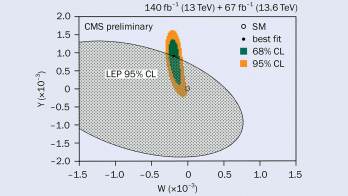
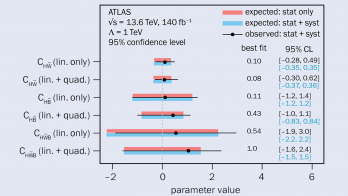
Thanks to the large collected datasets, ATLAS and CMS are now able to explore very rare processes in top-quark and multi-boson production. The latter are very powerful at constraining new-physics interactions in the framework of effective field theory, and several new results were presented, including top + boson, top + diboson and three-top production. It is also worth highlighting the first measurement of the |Vcb| CKM element using on-shell W bosons from top-quark decays presented by ATLAS.
In summary, Moriond Electroweak 2026 demonstrated steady experimental improvements in addressing the fundamental open questions in particle physics. Although the experimental challenges are arduous, the research programmes at existing and planned facilities point to strong progress in the coming years.