A report from the ATLAS experiment.
Supersymmetry has so far eluded discovery at the LHC, yet it retains strong theoretical appeal as an extension of the Standard Model (SM), and potential hiding places remain. In two recent analyses, the ATLAS collaboration sets new bounds on compressed higgsino models, where the proposed particles lie very close in mass. The collaboration used machine-learning techniques to target some of the most elusive signatures at the LHC: low-momentum decay products.
Without extreme fine tuning, quantum corrections would drive the Higgs-boson mass far above the electroweak scale. Supersymmetry prevents this by introducing fermion partners for the SM bosons (and vice versa) so that their quantum contributions naturally cancel. The result is a partner for every SM particle – including higgsinos, the fermionic counterparts of the Higgs field. Higgsinos mix with the partners of the electroweak gauge bosons to form electrically neutral and charged states known as neutralinos (χ̃0) and charginos (χ̃±). The lightest neutralino (χ̃01) is stable in a wide class of models and may naturally account for the observed dark-matter abundance.
In compressed scenarios, the tiny mass-splitting between these new particles poses a distinct experimental challenge. When a heavier state decays to χ̃01, the small mass difference leaves little energy for the accompanying SM particles. The visible decay products therefore carry very low momentum and may fall below reconstruction and identification thresholds. The new analyses focus precisely on this regime using the full Run 2 dataset collected at √s = 13 TeV, with two complementary strategies optimised for different values of the mass splitting.
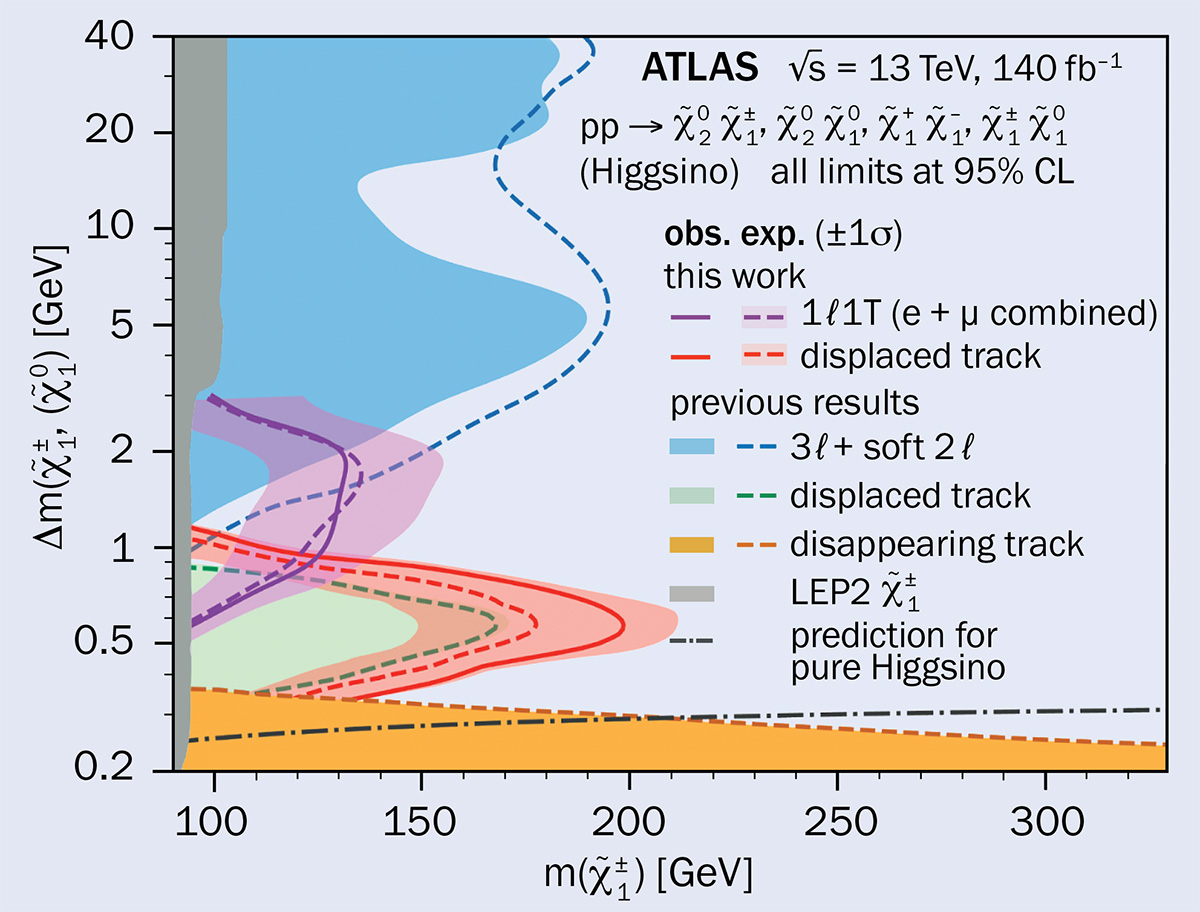
Firstly, a “displaced track” search targets scenarios with a mass difference between the lightest chargino χ̃±1 and χ̃01 of 0.3 to 1 GeV, in which the χ̃±1 has a non-negligible lifetime and can travel a few millimetres before decaying into an invisible χ̃01 and a low-momentum charged pion. The resulting event signature is a pion track with a large transverse impact parameter and high missing transverse momentum from the neutralinos. Significant improvement in signal sensitivity is achieved by the use of two dedicated neural networks (NNs), where one exploits the global event kinematics and the other focuses on the displaced track characteristics.
A “one-lepton-one-track (1ℓ1T)” search instead targets scenarios with a larger mass splitting of 1 to 3 GeV, in which the heavier neutralino χ̃02 promptly decays into the χ̃01 and two low-momentum leptons. Since these could elude the existing ATLAS identification techniques, dedicated low-momentum electron and muon identification algorithms have been developed using NNs that exploit track and calorimeter information. The new algorithms are applied to leptons with momentum as low as 0.5 GeV for electrons and 1 GeV for muons, below the standard reconstruction thresholds, resulting in a signature consisting of one lepton and one lepton-like track. An additional NN enhances sensitivity for event classification, exploiting kinematic features that depend strongly on the mass splitting.
The observed data are consistent with the SM predictions, with no signs of new physics emerging in the targeted phase-space. Based on this result, lower limits on the higgsino masses are set at 95% confidence level (CL) (see figure 1). The 1ℓ1T search excludes a mass-splitting region between 0.8 and 2.0 GeV, extending previous limits from the LEP experiments up to a maximum χ̃±1 mass of 132 GeV for a 1.8 GeV mass splitting. The displaced track search extends the exclusion limits previously set by the ATLAS experiment by about 30 GeV, reaching a χ̃±1 mass of 199 GeV for a 0.6 GeV mass splitting. Together, the two searches exclude χ̃±1 masses below 126 GeV at 95% CL over the targeted mass splitting range. Limits set by the ATLAS collaboration now supersede those from the LEP experiments in all mass-splitting ranges.
With this result, ATLAS is now able to set limits over the full range of higgsino mass splittings that are interesting for naturalness, marking a significant milestone in the search for supersymmetry. The new Run 3 dataset, along with advanced analysis techniques, will push these searches even further – perhaps towards the discovery of physics beyond the SM.
Further reading
ATLAS Collab. 2025 arXiv:2511.20042.