Released in March 2022 on Disney+, Parallels merges two of the most popular concepts in science fiction: time travel and the multiverse. The series, in French, created by Quoc Dan Trang and directed by Benjamin Rocher and Jean-Baptiste Saurel, is set in a village in the mountains of the French–Swiss border where a particle-physics laboratory called “ERN” and a collider strongly resembling the LHC have a major role.
The story begins with a group of four friends who recently graduated from middle school celebrating one of their birthdays near an area where, 10 years earlier, a kid called Hugo disappeared. At the same time, ERN is performing an experiment with its particle accelerator. However, something goes wrong. The lights go out in the village, while a strange space–time phenomenon unfolds, transporting the teenagers to different timelines once the lights are restored. Does this have anything to do with the particle accelerator? Where, or rather “when” are they? Each of the teenagers tries to unravel their temporal confusion in an attempt to return to their original timeline.
Parallels offers a chance to go beyond fiction and explore the often even more incredible ideas explored for real in particle physics
Although the age of the main characters targets younger audiences, Parallels addresses topics such as depression, regret and family issues, which, combined with some humour, make it relevant to other age groups. The visual effects and music create a suspenseful atmosphere and the compact nature of the series (six episodes of around 35 minutes each) draws the viewer into watching it in a single session.
CERN’s experiments and locations are referenced several times throughout, ranging from visual details in the ERN buildings to mentions of ATLAS, CMS and the Antiproton Decelerator – going so far as to reference an “FCC scheduled for operations in October 2025”. The Globe of Science and Innovation and the CMS silicon tracker are also represented.
Many of the concepts introduced, especially those related to the LHC experiments, are not scientifically accurate. The clear depiction of CERN in all but name may also make some physicists feel uncomfortable, given that the plot plays on YouTube-based conspiracy theories about what CERN’s experiments are capable of. For young science-fiction lovers, however, and especially for those who love to unravel temporal paradoxes, as in the popular Netflix series Stranger Things, Parallels is worth a look. For the more inquisitive and open-minded viewer, it also offers a chance to go beyond fiction and explore the often even more incredible ideas explored for real in particle physics.
Ben R Mottelson passed away on 13 May aged 95. He will be remembered as an outstanding physicist who played a decisive role in the understanding of atomic nuclei and as an inspiring and warm human being with an engaging and outgoing personality.
Ben Mottelson was born in Chicago in 1926 into a family where his father held a university engineering degree. He finished high school in 1944 and was drafted into the navy, which rapidly recognised the young man’s potential and sent him to Purdue University to train as a naval officer. He completed his bachelor degree there in 1947 and subsequently obtained his PhD from Harvard University in 1950 with Julian Schwinger as his supervisor. He won a Sheldon travel fellowship and chose in 1950 to go to the Niels Bohr Institute in Copenhagen, where he was to remain the rest of his life, becoming a Danish citizen in 1971.
After a number of temporary positions, Ben became a permanent member of CERN’s theoretical study group, which was temporarily established in Copenhagen in 1953–1957 while the Geneva site was being completed. He became a tenured professor at Nordita, then the Nordic Institute for Theoretical (Atomic) Physics, at the Niels Bohr Institute in 1957 and headed Nordita from 1981 to 1983.
In Copenhagen, he established a close scientific collaboration and friendship with Aage Bohr (1922–2009), the son of Niels Bohr. The pair worked on understanding the structure of atomic nuclei based on an inter-play between collective and single-particle degrees of freedom which, as first pointed out by James Rainwater, might not all be spherical. A consequence of deformation would be the existence of rotational bands, as for molecules, which were discovered experimentally early in the 1950s using Coulomb excitation with the cyclotron at the Niels Bohr Institute. A central question was why the effective moment of inertia of a deformed atomic nucleus is smaller than for a rigid rotor. This was understood by Aage, Ben and David Pines in 1958 as a consequence of the pairing of nucleons leading to an energy gap, in analogy with the pair correlations between electrons in a superconductor.
In subsequent decades Aage and Ben refined the theoretical description of nuclei with a unified nuclear model that accounted for the variety of nuclear excitations in a coherent fashion, establishing a lively collaboration with experimentalists from all over the world. In 1975 Aage, Ben and James Rainwater were awarded the Nobel Prize in Physics for their work. Ben also received the Atoms for Peace award in 1969.
Ben had a close scientific collaboration and friendship with Aage Bohr, the son of Niels Bohr
The partnership between Aage and Ben was fruitful in spite of their different personalities, Aage being the more reserved and Ben the more outgoing personality. The author of this obituary fondly remembers the pair attending the weekly experimental group meetings and attentively questioning all the speakers, sharing insights and always providing kind inspiration to both young and old. Later, Ben turned his attention to other manifestations of shell structure in mesoscopic systems of atomic clusters and to the properties of cold atomic Bose–Einstein gases. From 1993–1997 he was director of the ECT* theory centre, which he helped establish in Trento, Italy.
Ben Mottelson was an unpretentious, open and engaging family man. Until close to the end he continued to come regularly to the Niels Bohr Institute, attending seminars and scientific events, often to be seen on his bicycle. He will be sorely missed.
Director-general of the ITER Organization, Bernard Bigot, passed away on 14 May, aged 72. An inspirational leader for more than four decades across multiple fields of science and energy, his personal dedication and commitment to ITER over the past seven years shaped every aspect of the project. While his untimely passing will be felt as a tragic blow to the global fusion community, Bigot’s careful design and preparation of the ITER senior management team in recent years gives reassurance for the project’s continued success.
Bigot took the helm at ITER in March 2015 at a critical point in the project’s history, when it was experiencing significant difficulties reflecting the managerial challenges inherent in both its complex engineering and its multinational approach to design, manufacturing and construction. He accepted these challenges with humility and unwavering resolve, proposing a multifaceted plan that transformed the project’s culture. Today, ITER is more than 75% complete and stands as a monumental example of scientific and engineering prowess, and a testimony to the merits of international collaboration.
Trained as a physical chemist at the École normale supérieure, with a PhD in chemistry, Bigot had a deep understanding of the challenges that went with mastering hydrogen fusion. He was a high-ranking university professor at the École normale supérieure de Lyon, which he helped to establish and then directed for several years. The author of more than 70 publications in theoretical chemistry, Bigot was also in charge of research at the École normale supérieure, director of the Institut de recherche sur la catalyse (a CNRS laboratory specialising in catalysis research) and president of the Maison de la Chimie foundation.
The experience he acquired at the highest levels of the scientific and research establishment – as private secretary to ministers, high commissioner for atomic energy, chairman and CEO of the CEA, and as such the principal interface between France and ITER between 2008 and 2015 – had prepared him for the daunting task of leading a 35-nation, long-term endeavour, as unique in its goals as it is in its organisation and governance. However, the uniqueness of ITER required more than experience in science, the management of large institutions and the oversight of complex construction projects. ITER – particularly at the time Bigot took over – also demanded political finesse and diplomatic subtlety, qualities that he had in abundance. Always ready to exchange with media representatives, politicians, economists, VIPs or general visitors, he knew how to make complex subjects understandable and meaningful.
He received numerous awards, including his status as a Commander in the French Order of the Legion of Honour, a Commander in the Royal Swedish Order of the Polar Star, an Officer of the French Order of the National Merit, the holder of the Gold and Silver Star in the Japanese Order of the Rising Sun, and the recipient of the China Friendship Award. Beyond these achievements and accolades, he will be remembered as a visionary leader, intensely focused on the enhancement of global society and the desire to leave the world a better place. The greatest honour we can pay is to continue delivering the ITER project with the same unwavering commitment and dedication that he demonstrated to all of us.
Bernard Bigot was a man of duty and service, who placed loyalty above all virtues, a deeply human leader, as demanding of others as he was of himself. He will be deeply missed.
Leading Soviet particle physicist Boris Ioffe passed away in Moscow on 18 July at the age of 96.
Boris Ioffe was born in Moscow in 1926 into a Jewish family. In the late 1940s he passed Landau’s famous “theoretical minimum” entry exam and in 1949 he graduated frоm Moscow State University with a diploma in theoretical physics. He started his research work under the supervision of Isaak Pomeranchuk. Between 1950 and 1955 Ioffe participated in the original Soviet nuclear-bomb project, at its later stage devoted to the hydrogen bomb. Until 18 July he was the only participant of this project still alive.
In 1960–1980 Ioffe was one of the leading Soviet particle physicists. He was a pioneer of parity (non-)conservation (with Okun and Rudik, 1957). His work with E Shabalin (1967) provided an impetus for the creation of the Glashow–Iliopoulos–Maiani mechanism. Ioffe’s work on deep inelastic scattering (1969) helped establish the Bjorken scaling and the parton model of Feynman–Bjorken.
During the later stages of his career, Ioffe focused on quantum chromodynamics and its consequences for the theory of hadrons. His contributions to the theory of baryons are well-known and appreciated worldwide.
Ioffe never abandoned his early research in nuclear physics. In fact, he was an expert nuclear physicist and in the early 1970s was in charge of the physics design of the first commercial nuclear power plant in former Czechoslovakia. Since 1977 he was the head of the ITEP Laboratory for Theoretical physics, where he had a number of PhD students.
All his life Ioffe was a devoted mountaineer. It is hard to name a mountain peak that he had not conquered. His life journey was long, adventurous and misadventurous simultaneously. Ioffe’s memoirs are available both in Russian and English.
Involving around 1500 participants, 17 parallel sessions, 900 talks and 250 posters, ICHEP2022 (which took place in Bologna from 6 to 13 July) was a remarkable week of physics, technology and praxis. The energy and enthusiasm among the more than 1200 delegates who were able to attend in person was palpable. As the largest gathering of the community since the beginning of the pandemic – buoyed by the start of LHC Run 3 and the 10th anniversary of the Higgs-boson discovery – ICHEP2022 served as a powerful reminder of the importance of non-digital interactions.
Roberto Tenchini’s (INFN Pisa) heroic conference summary began with a reminder: it is 10 years since ICHEP included a session titled “Standard Model”, the theory being so successful that it now permeates most sessions. As an example, he highlighted cross-section predictions tested over 14 orders of magnitude at the LHC. Building on the Higgs@10 symposium at CERN on 4 July, the immense progress in understanding the properties and interactions of the Higgs boson (including legacy results with full Run 2 statistics in two papers by ATLAS and CMS published in Nature on 4 July) was centre stage. CERN Director-General Fabiola Gianotti gave a sweeping tour of the path to discovery and emphasised the connections between the Higgs boson and profound structural problems in the SM. Many speakers highlighted the concomitant role of the Higgs boson in exploring new physics, dashing notions that future precision measurements are “business as usual”. Chiara Mariotti (INFN Torino) pointed out that only 3% of the total Higgs data expected at the LHC has been analysed so far.
Hot topics
Another hot electroweak topic was CDF’s recent measurement of the mass of the W boson, as physicists try to understand what could cause it to lie so far from its prediction and from previous measurements. Andrea Rizzi (Pisa) confirmed that CMS is working hard on a W-mass analysis that will bring crucial information, on a time-scale to be decided. Patience is king with such a complex analysis, he said: “we are really trying to do the measurement the way we want to do it.”
CMS presented a total of 85 parallel talks and 28 posters, including new searches related to b-anomalies with taus, and the most precise measurement of Bs→ μ+μ–. Among new results presented by ATLAS in 71 parallel talks and 59 posters were the observation of a four charm–quark state consistent with one seen by LHCb, joint-polarisation measurements of the W and Z bosons, and measurements of the total proton–proton cross section and the ratio of the real vs imaginary parts of the elastic-scattering amplitude. ATLAS and CMS also updated participants on many searches for new particles, in particular leptoquarks. Among highlights were searches by ATLAS for events with displaced vertices, which could be caused by long-lived particles, and by CMS for resonances decaying to Higgs bosons and pairs of either photons or b quarks, which show interesting excesses. “Se son rose fioriranno!” said Tenchini.
The sigmas are rather higher for exotic hadrons. LHCb presented the discovery of a new strange pentaquark (with a minimum quark content ccuds) and two tetraquarks (one corresponding to the first doubly charged open-charm tetraquark with csud), taking the number of hadrons discovered at the LHC so far to well over 60, and introducing a new exotic-hadron naming scheme for “particle zoo 2.0” (Exotic hadrons brought into order by LHCb). LHCb also reported the first evidence for direct CP violation in the charm system (LHCb digs deeper in CP-violating charm decays) and a new precise measurement of the CKM angle γ. Vladimir Gligorov (LPNHE) described how, in addition to the flavour factories LHCb and Belle II, experiments including ATLAS, CMS, BESIII, NA62 and KOTO will be crucial to enable the next level of understanding in quark mixing. Despite no significant new results having been presented, the status of tests of lepton flavour universality (LFU) in B decays by LHCb generated lively discussions, while Toshinori Mori (Tokyo) described exciting prospects for LFU tests in charged-lepton flavour experiments, in particular MEG-II, which has just started operations at PSI, and the upcoming Mu2e and MUonE experiments.
ICHEP2022 served as a powerful reminder of the importance of non-digital interactions
Moving to leptons that are known to mix, neutrinos continue to play very important roles in understanding the smallest and largest scales, said Takaaki Kajita (Tokyo) via a link from the IUPAP Centennial Symposium taking place in parallel at ICTP Trieste. Status reports on DUNE, Hyper-K, JUNO, KM3NeT and SNB showed how these detectors will help constrain the still poorly-known PNMS matrix that describes leptonic mixing, while new results from NOvA and STEREO further reveal anomalous behaviour. Among the major open questions in neutrino physics summed-up by theorist Joachim Kopp (Mainz and CERN) were: how do neutrinos interact? What explains the oscillation anomalies? And how do supernova neutrinos oscillate?
Several plenary presentations showcased the increasing complementarity with astroparticle physics and cosmology, with the release of the first-science images from the James Webb Space Telescope on 12 July adding spice (Webb opens new era in observational astrophysics). Multiband gravitational-wave astronomy across 12 or more orders of magnitude in frequency will bloom in the next decade, predicted Giovanni Andrea Prodi (Trento), while larger datasets and synchronisation of experiments offer a bright future in all messengers, said Gwenhael De Wasseige (Louvain): “We are just at the beginning of the story.” The first results from the Lux–Zeplin experiment were presented, setting the tightest limits on spin-independent WIMP–nucleon cross-sections for WIMP masses above 9 GeV (CERN Courier September/October 2022 p13), while the increasingly crowded plot showing limits from direct searches for axions illustrate the vibrancy and shifting focus of dark-matter research. Indeed, among several sessions devoted to the exploration of high-energy QCD in heavy-ion, proton–lead and proton–proton collisions, Andrea Dainese (INFN Padova) described how the LHC is not only a collider of nuclei but an (anti-)nuclei factory relevant for dark-matter searches.
The unique ability of theorists to put numerous results and experiments in perspective was on full display. We should all renew the enthusiasm that built the LHC, and be a lot more outspoken about the profound ideas we explore, urged Veronica Sanz (Sussex); after all, she said, “we are searching for something that we know should be somewhere.” A timely talk by Gavin Salam (Oxford) summarised the latest understanding of QCD effects relevant to the muon g-2 and W-mass anomalies and also to future Higgs-boson measurements, concluding that, as we approach high precision, we should expect to be confronted by conceptual problems that we could, so far, ignore.
The unique ability of theorists to put numerous results and experiments in perspective was on full display
Accelerators (including a fast-paced summary of the HL-LHC niobium-tin magnet programme from Lucio Rossi), detectors (68 talks and posters revealing an increasingly holistic approach to detector design), computing (highlighting a period of rapid evolution thanks to optimisation, modernisation, machine-learning algorithms and increasing hardware diversity), industry, diversity and outreach were addressed in detail. A highly acclaimed outreach event in Bologna’s Piazza Maggiore on the evening of 12 July saw thousands of people listen to Fabiola Gianotti, Guido Tonelli, Gian Giudice and Antonio Zoccoli discuss the implications of the Higgs-boson discovery.
Only the narrowest snapshot of proceedings is possible in such a short report. What was abundantly clear from ICHEP2022 is that, following the discovery of the Higgs boson and as-yet no new particles beyond the SM, the field is in a fascinating and challenging period where confusion is more than matched by confidence that new physics must exist. The strategic direction of the field was addressed in two wide-ranging round-table discussions where laboratory directors and senior physicists answered questions submitted by participants. Much discussion concerned future colliders, and addressed a perceived worry in some quarters that the field is entering a period of decline. For anyone following the presentations at ICHEP2022, nothing could be further from the truth.
Do you remember the first time you heard about CERN? The first time someone told you about that magical place where bright minds from all over the world work together towards a common goal? Perhaps you saw a picture in a book, or had the chance to visit in person as a student? It is experiences like these that motivate many people to pursue a career in science, whether in particle physics or beyond.
In 2016 I had the pleasure of visiting CERN on a school trip. We toured the Synchrocyclotron and the SM18 magnet test facility. I was hooked. The tour guides talked with passion about the laboratory, the film presenting CERN’s first particle accelerator and the laboratory’s mission, and all those big magnets being tested in SM18. It was this experience that motivated me to study physics at university and to try to come back as soon as I could.
Accreditation
That chance arrived in September 2021 when I started a one-year technical studentship as editorial assistant on the Courier. From the first day I was eager to see as much as I could. During the final months of Long Shutdown 2, my supervisor and I visited the ATLAS cavern. The experience motivated me to ask one of my newly made friends, also a technical student who had recently become a tour guide, how to apply. The process was positive and efficient. After completing all the required courses from the learning hub and shadowing experienced guides, I became a certified ATLAS underground guide in November 2021 and gave my first tour soon after. I was nervous and struggled with the iris scanner when accessing the cavern, but all ended well, and further tours were scheduled. Then, in mid-December, all in-person tours were cancelled due to COVID-19 restrictions. I needn’t have worried, as CERN was fully geared up to provide virtual visits. Among my first virtual audience members were students from the high school that brought me to CERN five years earlier and from my university, Nottingham Trent in the UK.
The most satisfying thing is people’s enthusiasm and their desire to learn more about CERN and its mission
The virtual visits were quite challenging at first. It was harder to connect with the audience than during an in-person visit. But managing these difficulties helped me to improve my communication skills and to develop self-confidence. During this period, I conducted more than 10 virtual visits for different institutes, universities, family and friends, in both English and Spanish.
At the beginning of March 2022, CERN moved into “level yellow” and in-person visits were resumed. Although only possible for a short period, I had the chance to guide visitors underground and had the honour of guiding the last in-person visit into the ATLAS cavern on 23 March before preparations for LHC Run 3 got under way. With the ATLAS cavern then off-limits, I signed up to present at as many CERN visit points as possible. At the time of writing, I am a guide for the Synchrocyclotron, the ATLAS Visitor Centre, Antimatter Factory, Data Centre, Low Energy Ion Ring and CERN Control Centre.
Get involved
The CERN visits service always welcomes new guides and is working towards opening new visit points. Anyone working at CERN or registered as a user can take part by signing up for visit-point training on the tour-guide website: guides.web.cern.ch. General training for new guides is also available. All you need to show CERN to the public is passion and enthusiasm, and you can sign up for as many or as few as your day job allows. Diversity is encouraged and those who are multilingual are also highly valued.
Today, visits are handled by a dedicated section in the Education, Communications and Outreach group. The number of visitors has gradually increased over recent years, with 152,000 annual visitors before the pandemic started, excluding special events such as the CERN Open Days. The profile of visitors ranges from school pupils and university students to common-interest groups such as engineers and scientists, politicians and VIPs, and people with a wide range of interests and educational levels.
The benefits of becoming a CERN guide are immense. It gives you access to areas that would otherwise not be possible, the chance to experience important events in-person and to see your work at CERN, whatever it involves, from a fresh perspective. My personal highlight was watching test collisions at 13.6 TeV before the official start of Run 3 while showing Portuguese high-school students the ATLAS control room. The most satisfying thing is people’s enthusiasm and their desire to learn more about CERN and its mission. I particularly remember how a small child asked me a question about the matter–antimatter asymmetry of the universe, and how another young visitor ran from Entrance B at the end of a tour just to tell me how much she loved the visit.
The visits service makes it as easy as possible to get involved, and exciting times for guides lie ahead with the opening of the CERN Science Gateway next year, which will enable CERN to welcome even more visitors. If a technical student based at CERN for just one year can get involved, so can you!
Understanding hadronic final states is key to a successful physics programme at the LHC. The quarks and gluons flying out from proton–proton collisions instantly hadronise into sprays of particles called jets. Each jet has a unique composition that makes their flavour identification and energy calibration challenging. While the performance of jet-classification schemes has been increased by the fast-paced evolution of machine-learning algorithms, another, more subtle, revolution is ongoing in terms of precision jet-energy corrections.
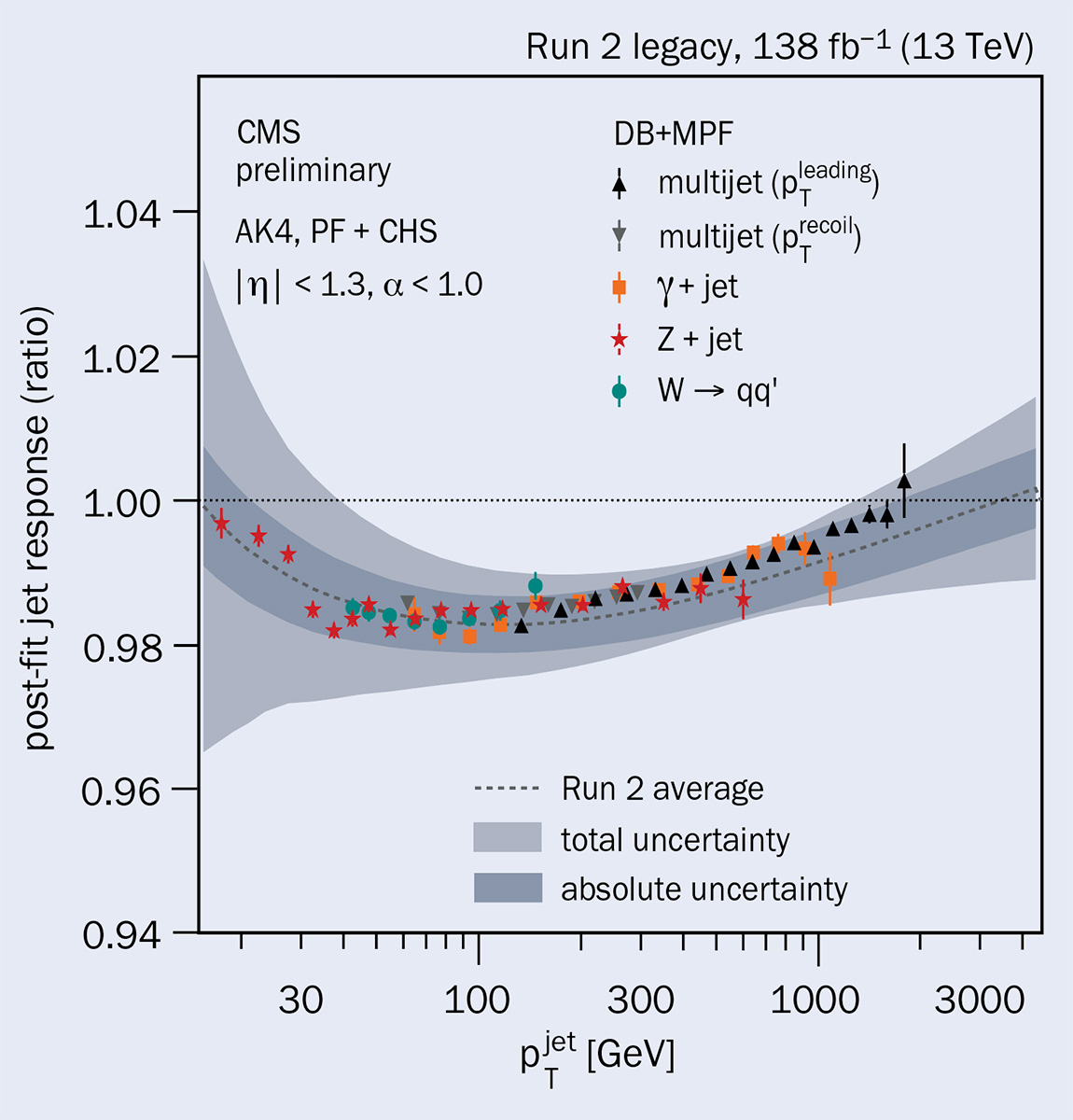
CMS physicists have taken advantage of the data collected during LHC Run 2 to observe jets in many different final states and systematically understand their differences in detail. The main differences originate from the varying fractions of gluons making up the jets and the different amounts of final-state radiation (FSR) in the events, causing an imbalance between the leading jet and its companions. The gluon uncertainty was constrained by splitting the Z+jet sample by flavour, using a combination of quark–gluon likelihood and b/c-quark tagging, while FSR was constrained by combining the missing-ET projection fraction (MPF) and direct balance (DB) methods. The MPF and DB methods have been well established at the LHC since Run 1: while in the DB method the jet response is evaluated by comparing the reconstructed jet momentum directly to the momentum of the reference object, the MPF method considers the response of the whole hadronic activity in the event, recoiling versus the reference object. Figure 1 shows the agreement achieved with the Run 2 data after carefully accounting for these biases for samples with different jet-flavour compositions.
Precise jet-energy corrections are critical for some of the recent high-profile measurements by CMS, such as an intriguing double dijet excess at high mass, a recent exceptionally accurate top-quark mass measurement, and the most precise extraction of the strong coupling constant at hadron colliders using inclusive jets.
The expected increase of pileup in Run 3 and at the High-Luminosity LHC will pose additional challenges in the derivation of precise jet-energy corrections, but CMS physicists are well prepared: CMS will adopt the next-generation particle-flow algorithm (PUPPI, for PileUp Per Particle Id) as the default reconstruction algorithm to tackle pileup effects within jets at the single-particle level.
Jets can be used to address some of the most intriguing puzzles of the Standard Model (SM), in particular: is the SM vacuum metastable, or do some new particles and fields stabilise it? The top-quark mass and strong-coupling-constant measurements address the former question via their interplay with the Higgs-boson mass, while dijet-resonance searches tackle the latter.
Underlying these studies are the jet-energy corrections and the awareness that each jet flavour is unique.
Photon-induced reactions are regularly studied in ultra-peripheral nucleus–nucleus collisions (UPCs) at the LHC. In these collisions, the accelerated ions, which carry a strong electromagnetic field, pass by each other with an impact parameter (the distance between their centres) larger than the sum of their nuclear radii. Hadronic interactions between nuclei are therefore strongly suppressed. At LHC energies, the photoproduction of charmonium (a bound state of charm and anti-charm quarks) in UPCs is sensitive to the gluon distributions in nuclei over a wide low Bjorken-x range. In particular, in coherent interactions, the photon emitted by one of the nuclei couples to the other nucleus as a whole, leaving it intact, while a J/ψ meson is emitted with a characteristic low transverse momentum (pT) of about 60 MeV, which is roughly of the order of the inverse of the nuclear radius.
Surprisingly, in 2016 ALICE measured an unexpectedly large yield of J/ψ mesons at very low pT in peripheral, not ultra-peripheral, PbPb collisions at a centre-of-mass energy of 2.76 TeV. The excess with respect to expectations from hadronic J/ψ-meson production was interpreted as the first indication of coherent photoproduction of J/ψ mesons in PbPb collisions with nuclear overlap. This effect comes with many theoretical challenges. For instance, how can the coherence condition survive in the photon–nucleus interaction if the latter is broken up during the hadronic collision? Do only the non-interacting spectator nucleons participate in the coherent process? Can the photoproduced J/ψ meson be affected by interactions with the formed and fast-expanding quark–gluon plasma (QGP) created in nucleus–nucleus collisions? Recent theoretical developments on the subject are based on calculations for UPCs in which the J/ψ meson photoproduction-cross section is computed as the product of an effective photon flux and an effective photonuclear cross section for the process γPb → J/ψPb, with both terms usually modified to account for the nuclear overlap.
The ALICE experiment has recently measured the coherently photoproduced J/ψ mesons in PbPb collisions at a centre-of-mass energy of 5.02 TeV, using the full Run 2 data sample. The measurement is performed at forward rapidity (2.5 < y < 4) in the dimuon decay channel. For the first time, a significant (> 5σ) coherently photoproduced J/ψ-meson signal is observed even in semi-central PbPb collisions. In figure 1, the coherently photoproduced J/ψ cross section is shown as a function of the mean number of nucleons participating in the hadronic interaction (<Npart>). In this representation, the most central head-on PbPb collisions correspond to large <Npart> values close to 400. The photoproduced J/ψ cross section does not exhibit a strong dependence on collision centrality (i.e. on the amount of nuclear overlap) within the current experimental precision. A UPC-like model (the red line in figure 1) reproduces the semi-central to central PbPb data if a modified photon flux and photonuclear cross section to account for the nuclear overlap are included.
To clarify the theory behind this experimental observation of coherent J/ψ photoproduction, the upcoming Run 3 data will be crucial in several aspects. ALICE expects to collect a much larger data sample, thereby measuring a statistically significant signal in most central collisions. At midrapidity, the larger data sample and the excellent momentum resolution of the detector will allow for pT-differential cross-section measurements, which will shed light on the role of spectator nucleons for the coherence condition. By extending the coherently photo-produced J/ψ cross-section measurement towards most central PbPb collisions, ALICE will study the possible interaction of these charmonia with the QGP. Photoproduced J/ψ mesons could therefore turn out to be a completely new probe of the charmonium dissociation in the QGP.
The top quark – the heaviest known elementary particle – differs from the other quarks by its much larger mass and a lifetime that is shorter than the time needed to form hadronic bound states. Within the Standard Model (SM), the top quark decays almost exclusively into a W boson and a b quark, and the dominant production mechanism in proton–proton (pp) collisions is top-quark pair (tt) production.
Measurements of tt production at various pp centre-of-mass energies at the LHC probe different values of Bjorken-x, the fraction of the proton’s longitudinal momentum carried by the parton participating in the initial interaction. In particular, the fraction of tt events produced through quark–antiquark annihilation increases from 11% at 13 TeV to 25% at 5.02 TeV. A measurement of the tt production cross-section thus places additional constraints on the proton’s parton distribution functions (PDFs), which describe the probabilities of finding quarks and gluons at particular x values.
In November 2017, the ATLAS experiment recorded a week of pp-collision data at a centre-of-mass energy of 5.02 TeV. Although the main motivation of this 5.02 TeV dataset is to provide a proton reference sample for the ATLAS heavy-ion physics programme, it also provides a unique opportunity to study top-quark production at a previously unexplored energy in ATLAS. The majority of the data was recorded with a mean number of two inelastic pp collisions per bunch crossing compared to roughly 35 collisions during the 13 TeV runs. Due to much lower pileup conditions, the ATLAS calorimeter cluster noise thresholds were adjusted accordingly, and a dedicated jet-energy scale calibration was performed.
Now, the ATLAS collaboration has released its measurement of the tt production cross-section at 5.02 TeV in two final states. Events in the dilepton channel were selected by requiring opposite-charge pairs of leptons, resulting in a small, high-purity sample. Events in the single-lepton final states were separated into subsamples with different signal-to-background ratios, and a multivariate technique was used to further separate signal from background events. The two measurements were combined, taking the correlated systematic uncertainties into account.
The measured cross section in the dilepton channel (65.7 ± 4.9 pb) corresponds to a relative uncertainty of 7.5%, of which 6.8% is statistical. The single-lepton measurement (68.2 ± 3.1 pb), on the other hand, has a 4.5% uncertainty that is primarily systematic. This measurement is slightly more precise than the single-lepton measurement at 13 TeV, despite the much smaller (almost a factor of 500!) integrated luminosity. The combination of the two measurements gives 67.5 ± 2.6 pb, corresponding to an uncertainty of just 3.9%.
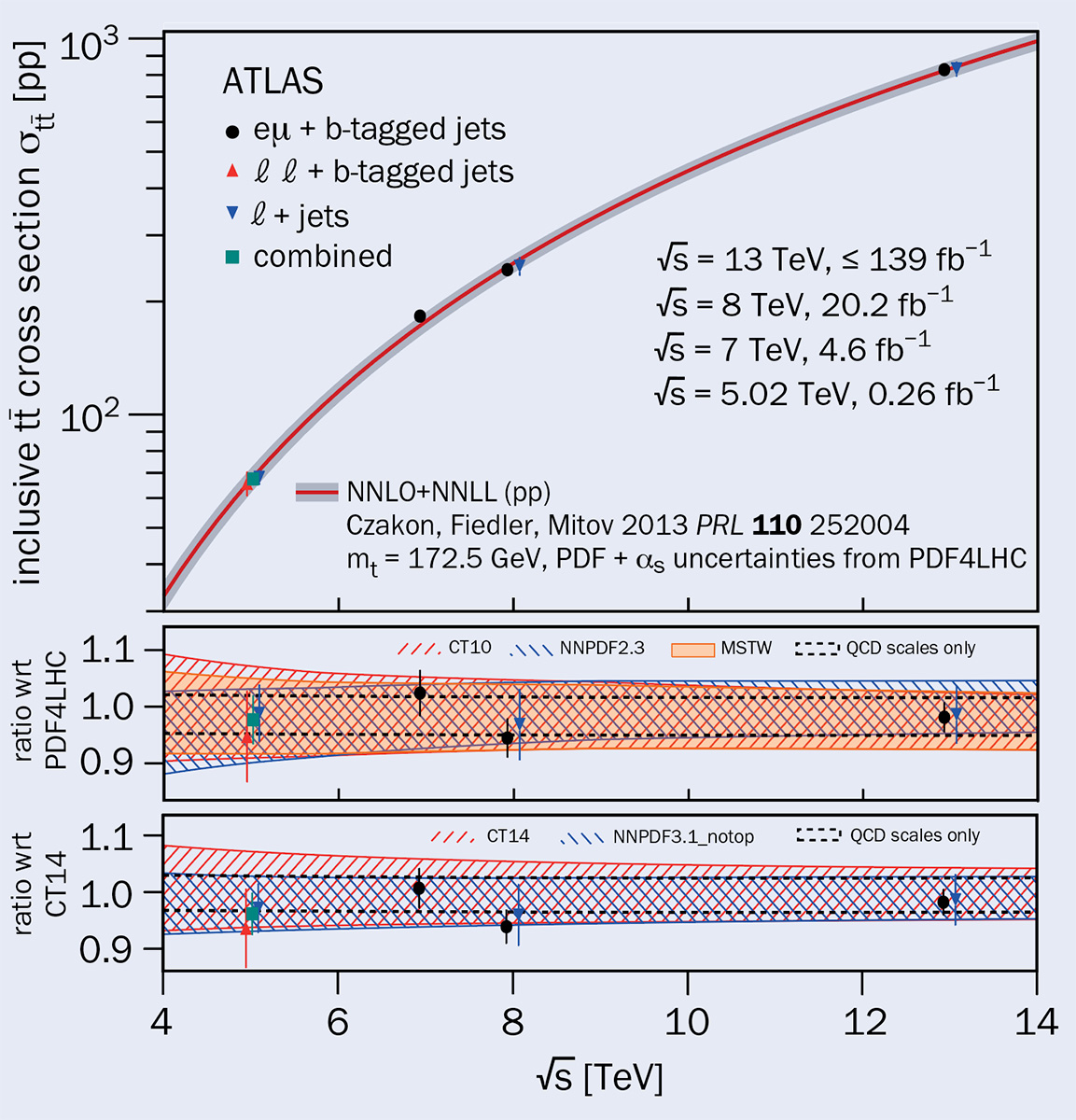
The new ATLAS result is consistent with the SM prediction and with a measurement by the CMS collaboration, though with a total uncertainty reduced by almost a factor of two. It thus improves our understanding of the top-quark production at different centre-of-mass energies and allows an important test of the compatibility with predictions from different PDF sets (see figure 1). The result also provides a new measurement of high-x proton structure and shows a 5% reduction in the gluon PDF uncertainty in the region around x = 0.1, which is relevant for Higgs-boson production. Moreover, the measurement paves the way for the study of top-quark production in collisions involving heavy ions.
For the past 60 years, the second has been defined in terms of atomic transitions between two hyperfine states of caesium-133. Such transitions, which correspond to radiation in the microwave regime, enable state-of-the art atomic clocks to keep time at the level of one second in more than 300 million years. A newer breed of optical clocks developed since the 2000s exploit frequencies that are about 105 times higher. While still under development, optical clocks based on aluminium ions are already reaching accuracies of about one second in 33 billion years, corresponding to a relative systematic frequency uncertainty below 1 × 10–18.
To further reduce these uncertainties, in 2003 Ekkehard Peik and Christian Tamm of Physikalisch-Technische Bundesanstalt in Germany proposed the use of a nuclear instead of atomic transition for time measurements. Due to the small nuclear moments (corresponding to the vastly different dimensions of atoms and nuclei), and thus the very weak coupling to perturbing electromagnetic fields, a “nuclear clock” is less vulnerable to external perturbations. In addition to enabling a more accurate timepiece, this offers the potential for nuclear clocks to be used as quantum sensors to test fundamental physics.
Clockwork
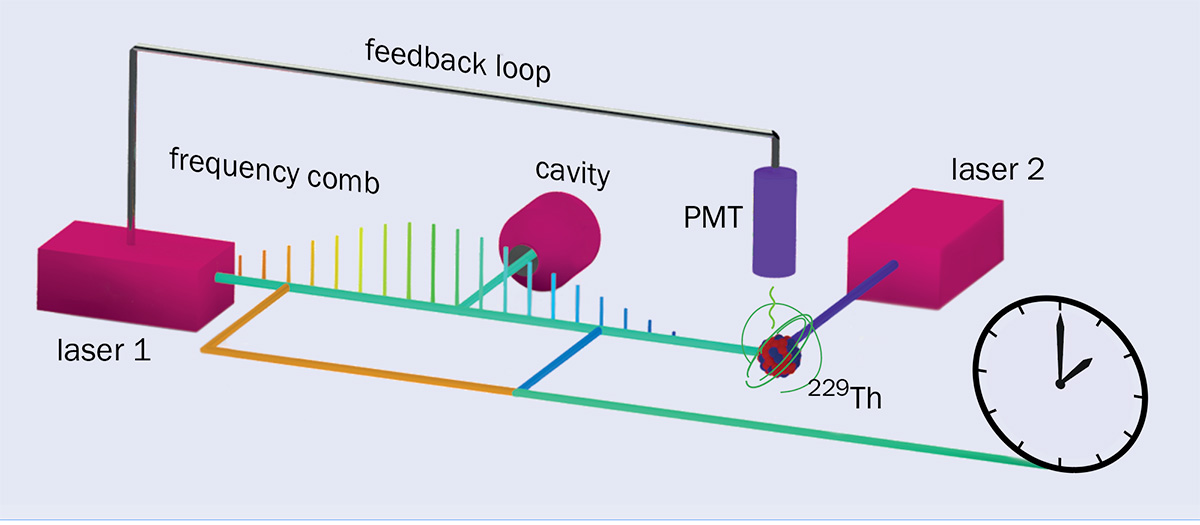
A clock typically consists of an oscillator and a frequency-counting device. In a nuclear clock (see “Nuclear clock schematic” figure), the oscillator is provided by the frequency of a transition between two nuclear states (in contrast to a transition between two states in the electronic shell in the case of an atomic clock). For the frequency-counting device, a narrow-band laser resonantly excites the nuclear-clock transition, while the corresponding oscillations of the laser light are counted using a frequency comb. This device (the invention of which was recognised by the 2005 Nobel Prize in Physics) is a laser source whose spectrum consists of a series of discrete, equally spaced frequency lines. After a certain number of oscillations, given by the frequency of the nuclear transition, one second has elapsed.
The need for direct laser excitation strongly constrains applicable nuclear-clock transitions: their energy has to be low enough to be accessible with existing laser technology, while simultaneously exhibiting a narrow linewidth. As the linewidth is determined by the lifetime of the excited nuclear state, the latter has to be long enough to allow for highly stable clock operation. So far, only the metastable (isomeric) first excited state of 229Th, denoted 229mTh, qualifies as a candidate for a nuclear clock, due to its exceptionally low excitation energy.
The existence of the isomeric state was conjectured in 1976 from gamma-ray spectroscopy of 229Th, and its excitation energy has only recently been determined to be 8.19 ± 0.12 eV (corresponding to a vacuum-ultraviolet wavelength of 151.4 ± 2.2 nm). Not only is it the lowest nuclear excitation among the roughly 184,000 excited states of the 3300 or so known nuclides, its expected lifetime is of the order of 1000 s, resulting in an extremely narrow relative linewidth (ΔE/E ~ 10–20) for its ground-state transition (see “Unique transition” figure). Besides high resilience against external perturbations, this represents another attractive property for a thorium nuclear clock.
Networks of ultra-precise synchronised nuclear clocks could enable a search for ultra light dark matter
Achieving optical control of the nuclear transition via a direct laser excitation would open a broad range of applications. A nuclear clock’s sensitivity to the gravitational redshift, which causes a clock’s relative frequency to change depending on its absolute height, could enable more accurate global positioning systems and high-sensitivity detections of fluctuations of Earth’s gravitational potential induced by seismic or tectonic activities. Furthermore, while the few-eV thorium transition emerges from a fortunate near-degeneracy of the two lowest nuclear-energy levels in 229Th, the Coulomb and strong-force contributions to these energies differ at the MeV level. This makes the nuclear-level structure of 229Th uniquely sensitive to variations of fundamental constants and ultralight dark matter. Many theories predict variations of the fine structure constant, for example, but on tiny yearly rates. The high sensitivity provided by the thorium isomer could allow such variations to be identified. Moreover, networks of ultra-precise synchronised clocks could enable a search for (ultra light) dark-matter signals.
Two different approaches have been proposed to realise a nuclear clock: one based on trapped ions and another using doped solid-state crystals. The first approach starts from individually trapped Th ions, which promises an unprecedented suppression of systematic clock-frequency shift and leads to an expected relative clock accuracy of about 1 × 10–19. The other approach relies on embedding 229Th atoms in a vacuum–ultraviolet (VUV) transparent crystal such as CaF2. This has the advantage of a large concentration (> 1015/cm3) of Th nuclei in the crystal, leading to a considerably higher signal-to-noise ratio and thus a greater clock stability.
Precise characterisation
A precise characterisation of the thorium isomer’s properties is a prerequisite for any kind of nuclear clock. In 2016 the present authors and colleagues made the
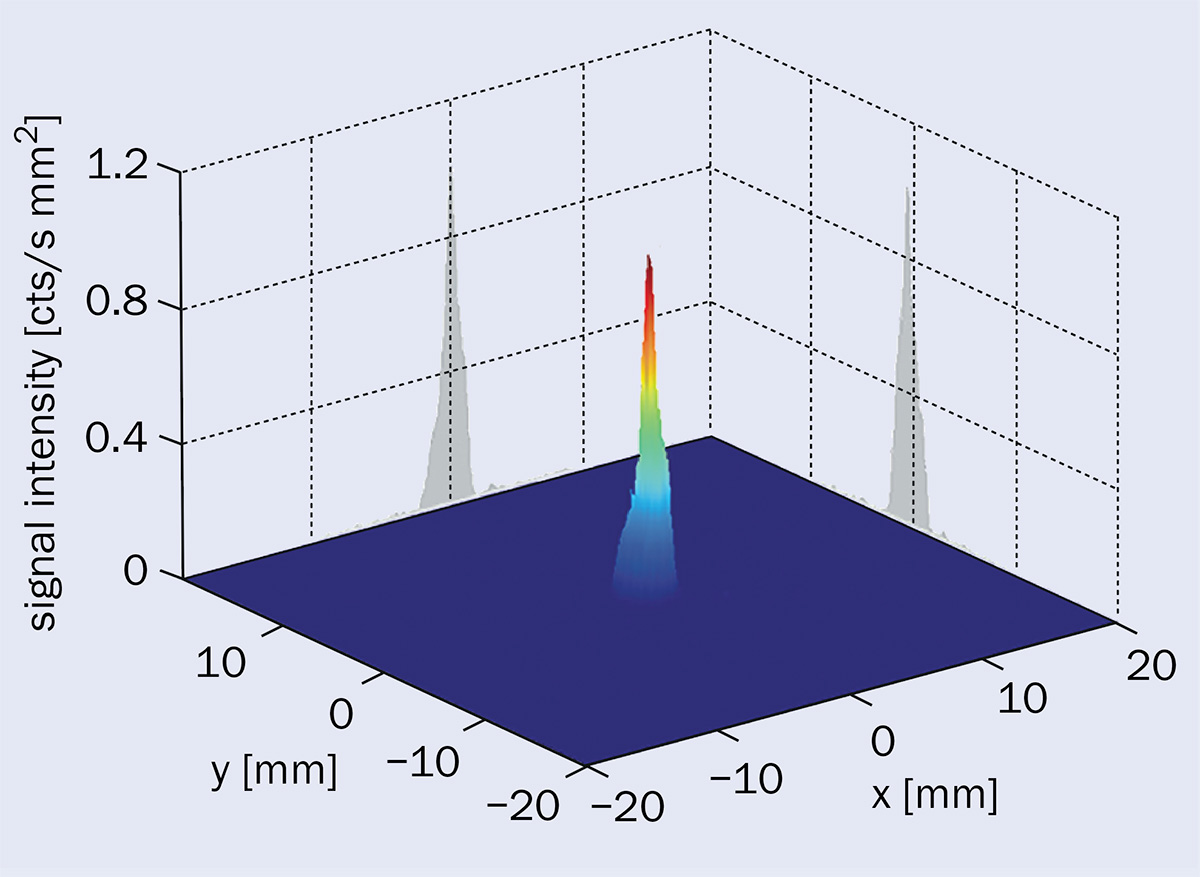
first direct identification of 229mTh by detecting electrons emitted from its dominant decay mode: internal-conversion (IC), whereby a nuclear excited state decays by the direct emission of one of its atomic electrons (see “Isomeric signal” figure). This brought the long-term objective of a nuclear clock into the focus of international research.
Currently, experimental access to 229mTh is possible only via radioactive decays of heavier isotopes or by X-ray pumping from higher-lying rotational nuclear levels, as shown by Takahiko Masuda and co-workers in 2019. The former, based on the alpha decay of 233U (2% branching ratio), is the most commonly used approach. Very recently, however, a promising new experiment exploiting β– decay from 229Ac was performed at CERN’s ISOLDE facility led by a team at KU Leuven. Here, 229Ac is online-produced and mass-separated before being implanted into a large-bandgap VUV-transparent crystal. In both population schemes, either photons or conversion electrons emitted during the isomeric decay are detected.
In the IC-based approach, a positively charged 229mTh ion beam is generated from alpha-decay daughter products recoiling off a 233U source placed inside a buffer-gas stopping cell. The decay products are thermalised, guided by electrical fields towards an exit nozzle, extracted into a longitudinally 15-fold segmented radiofrequency quadrupole (RFQ) that acts as an ion guide, phase-space cooler and optionally a beam buncher, followed by a quadrupole mass separator for beam purification. In charged thorium isomers, the otherwise dominant IC decay branch is energetically forbidden, leading to a prolongation of the lifetime by up to nine orders of magnitude.
Operating the segmented RFQ as a linear Paul trap to generate sharp ion pulses enables the half-life of the thorium isomer to be determined. In work performed by the present authors in 2017, pulsed ions from the RFQ were collected and neutralised on a metal surface, triggering their IC decay. Since the long ionic lifetime was inaccessible due to the limited ion-storage time imposed by the trap’s vacuum conditions, the drastically reduced lifetime of neutral isomers was targeted. Time-resolved detection of the low-energy conversion electrons determined the lifetime to be 7 ± 1 μs.
Excitation energy
Recently, considerable progress has been made in determining the 229mTh excitation energy – a milestone en route to a nuclear clock. In general, experimental approaches to determine the excitation energy fall into three categories: indirect measurements via gamma-ray spectroscopy of energetically low-lying rotational transitions in 229Th; direct spectroscopy of fluorescence photons emitted in radiative decays; and via electrons emitted in the IC decay of neutral 229mTh. The first approach led to the conjecture of the isomer’s existence and finally, in 2007, to the long-accepted value of 7.6 ± 0.5 eV. The second approach tries to measure the energy of photons emitted directly in the ground-state decay of the thorium isomer.
The first direct measurement of the thorium isomer’s excitation energy was reported by the present authors and co-workers in 2019. Using a compact magnetic-bottle spectrometer equipped with a repulsive electrostatic potential, followed by a microchannel-plate detector, the kinetic energy of the IC electrons emitted after an in-flight neutralisation of Th ions emitted from a 233U source could be determined. The experiment provided a value for the excitation energy of the nuclear-clock transition of 8.28 ± 0.17 eV. At around the same time in Japan, Masuda and co-workers used synchrotron radiation to achieve the first population of the isomer via resonant X-ray pumping into the second excited nuclear state of 229Th at 29.19 keV, which decays predominantly into 229mTh. By combining their measurement with earlier published gamma-spectroscopic data, the team could constrain the isomeric excitation energy to the range 2.5–8.9 eV. More recently, led by teams at Heidelberg and Vienna, the excited isomers were implanted into the absorber of a custom-built cryogenic magnetic micro-calorimeter and the isomeric energy was measured by detecting the temperature-induced change of the magnetisation using SQUIDs. This produced a value of 8.10 ± 0.17 eV for the clock-transition energy, resulting in a world-average of 8.19 ± 0.12 eV.
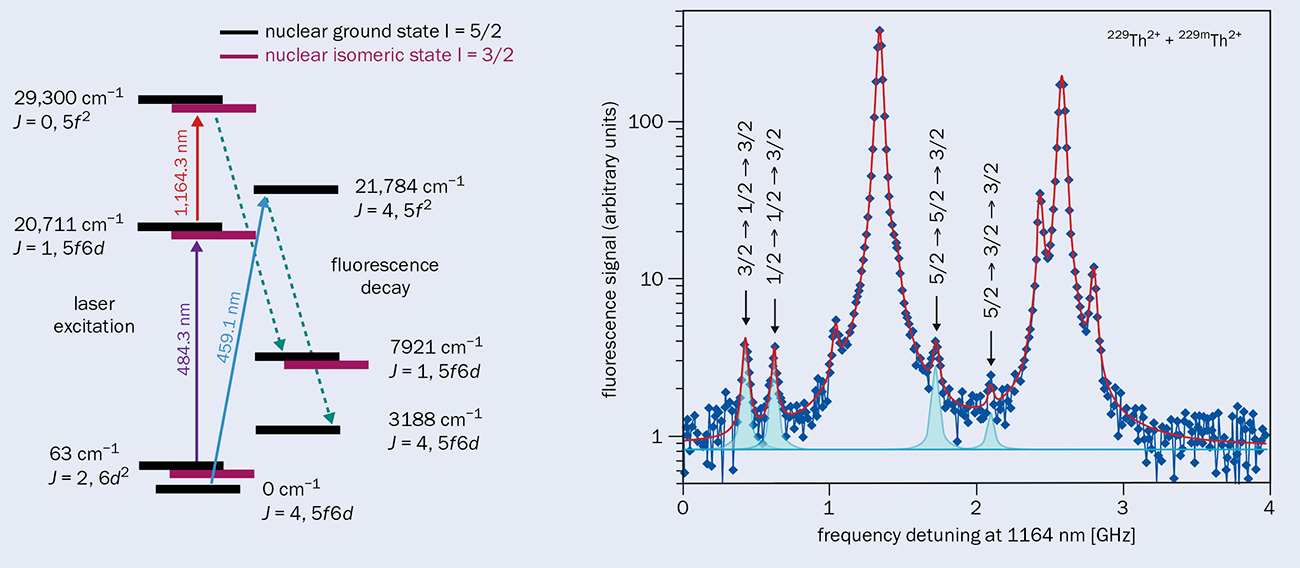
Besides precise knowledge of the excitation energy, another prerequisite for a nuclear clock is the possibility to monitor the nuclear excitation on short timescales. Peik and Tamm proposed a method to do this in 2003 based on the “double resonance” principle, which requires knowledge of the hyperfine structure of the thorium isomer. Therefore, in 2018, two different laser beams were collinearly superimposed on the 229Th ion beam, initiating a two-step excitation in the atomic shell of 229Th. By varying both laser frequencies, resonant excitations of hyperfine components both of the 229Th ground state and the 229mTh isomer could be identified and thus the hyperfine splitting signature of both states could be established by detecting their de-excitation (see “Hyperfine splitting” figure). The eventual observation of the 229mTh hyperfine structure in 2018 not only will in the future allow a non-destructive verification of the nuclear excitation, but enabled the isomer’s magnetic dipole and electrical quadrupole moments, and the mean-square charge radius, to be determined.
Roadmap towards a nuclear clock
So far, the identification and characterisation of the thorium isomer has largely been driven by nuclear physics, where techniques such as gamma spectroscopy, conversion-electron spectroscopy and radioactive decays offer a description in units of electron volts. Now the challenge is to refine our knowledge of the isomeric excitation energy with laser-spectroscopic precision to enable optical control of the nuclear-clock transition. This requires bridging a gap of about 12 orders of magnitude in the precision of the 229mTh excitation energy, from around 0.1 eV to the sub-kHz regime. In a first step, existing broad-band laser technology can be used to localise the nuclear resonance with an accuracy of about 1 GHz. In a second step, using VUV frequency-comb spectroscopy presently under development, it is envisaged to improve the accuracy into the (sub-)kHz range.
Another practical challenge when designing a high-precision ion-trap-based nuclear clock is the generation of thermally decoupled, ultra-cold 229Th ions via laser cooling. 229Th3+ is particularly suited due to its electronic level structure, with only one valence electron. Due to the high chemical reactivity of thorium, a cryogenic Paul trap is the ideal environment for laser cooling, since almost all residual gas atoms will freeze out at 4 K, increasing the trapping time into the region of a few hours. This will form the basis for direct laser excitation of 229mTh and will also enable a measurement of the not yet experimentally determined isomeric lifetime of 229Th ions. For the alternative development of a compact solid-state nuclear clock it will be necessary to suppress the 229mTh decay via internal conversion in a large band-gap, VUV transparent crystal and to detect the γ decay of the excited nuclear state. Proof-of-principle studies of this approach are currently ongoing at ISOLDE.
Laser-spectroscopy activities on the thorium isomer are also ongoing in the US, for example at JILA, NIST and UCLA
Many of the recent breakthroughs in understanding the 229Th clock transition emerged from the European Union project “nuClock”, which terminated in 2019. A subsequent project, ThoriumNuclearClock (ThNC), aims to demonstrate at least one nuclear clock by 2026. Laser-spectroscopy activities on the thorium isomer are also ongoing in the US, for example at JILA, NIST and UCLA.
In view of the large progress in recent years and ongoing worldwide efforts both experimentally and theoretically, the road is paved towards the first nuclear clock. It will complement highly precise optical atomic clocks, while in some areas, in the long run, nuclear clocks might even have the potential to replace them. Moreover, and beyond its superb timekeeping capabilities, a nuclear clock is a unique type of quantum sensor allowing for fundamental physics tests, from the variation of fundamental constants to searches for dark matter.
To provide the best experiences, we use technologies like cookies to store and/or access device information. Consenting to these technologies will allow us to process data such as browsing behavior or unique IDs on this site. Not consenting or withdrawing consent, may adversely affect certain features and functions.
Functional
Always active
The technical storage or access is strictly necessary for the legitimate purpose of enabling the use of a specific service explicitly requested by the subscriber or user, or for the sole purpose of carrying out the transmission of a communication over an electronic communications network.
Preferences
The technical storage or access is necessary for the legitimate purpose of storing preferences that are not requested by the subscriber or user.
Statistics
The technical storage or access that is used exclusively for statistical purposes.The technical storage or access that is used exclusively for anonymous statistical purposes. Without a subpoena, voluntary compliance on the part of your Internet Service Provider, or additional records from a third party, information stored or retrieved for this purpose alone cannot usually be used to identify you.
Marketing
The technical storage or access is required to create user profiles to send advertising, or to track the user on a website or across several websites for similar marketing purposes.