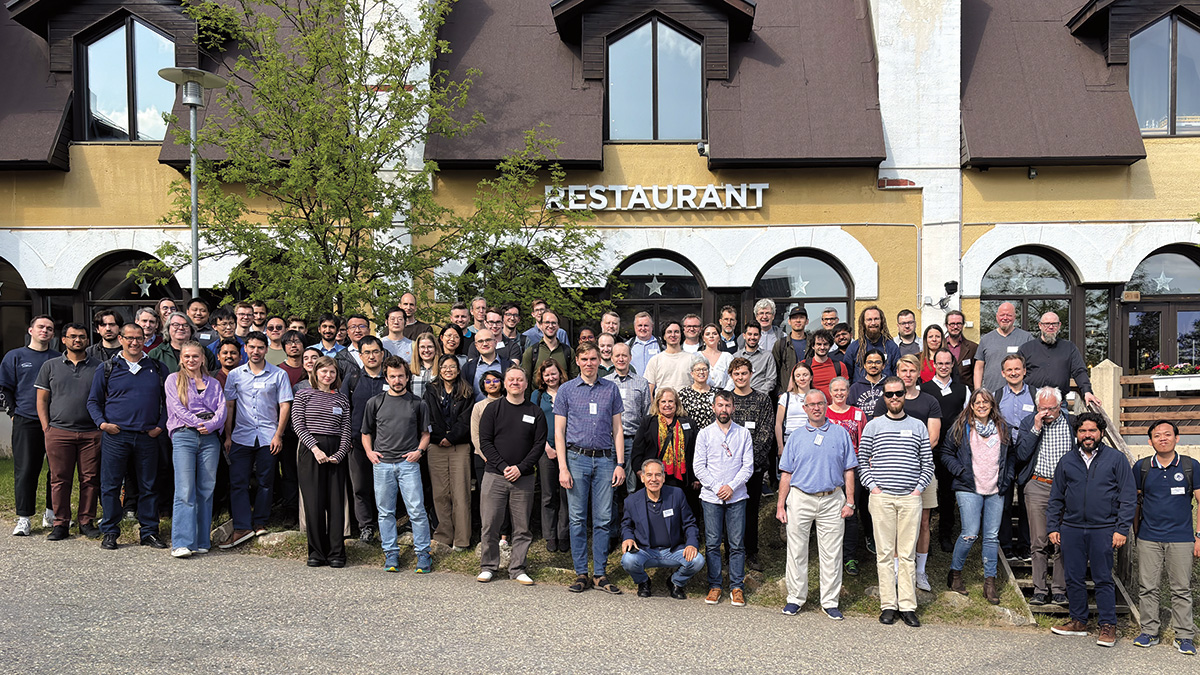
In June 2025, physicists met at Saariselkä, Finland to discuss recent progress in the field of ultra-peripheral collisions (UPCs). All the major LHC experiments measure UPCs – events where two colliding nuclei miss each other, but nevertheless interact via the mediation of photons that can propagate long distances. In a case of life imitating science, almost 100 delegates propagated to a distant location in one of the most popular hiking destinations in northern Lapland to experience 24-hour daylight and discuss UPCs in Finnish saunas.
UPC studies have expanded significantly since the first UPC workshop in Mexico in December 2023. The opportunity to study scattering processes in a clean photon–nucleus environment at collider energies has inspired experimentalists to examine both inclusive and exclusive scattering processes, and to look for signals of collectivity and even the formation of quark–gluon plasma (QGP) in this unique environment.
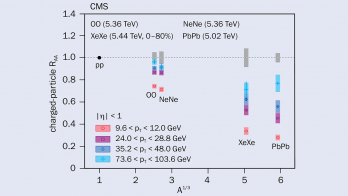
For many years, experimental activity in UPCs was mainly focused on exclusive processes and QED phenomena including photon–photon scattering. This year, fresh inclusive particle-production measurements gained significant attention, as well as various signatures of QGP-like behaviour observed by different experiments at RHIC and at the LHC. The importance of having complementing experiments to perform similar measurements was also highlighted. In particular, the ATLAS experiment joined the ongoing activities to measure exclusive vector–meson photoproduction, finding a cross section that disagrees with the previous ALICE measurements by almost 50%. After long and detailed discussions, it was agreed that different experimental groups need to work together closely to resolve this tension before the next UPC workshop.
Experimental and theoretical developments very effectively guide each other in the field of UPCs. This includes physics within and beyond the Standard Model (BSM), such as nuclear modifications to the partonic structure of protons and neutrons, gluon-saturation phenomena predicted by QCD (CERN Courier January/February 2025 p31), and precision tests for BSM physics in photon–photon collisions. The expanding activity in the field of UPCs, together with the construction of the Electron Ion Collider (EIC) at Brookhaven National Laboratory in the US, has also made it crucial to develop modern Monte Carlo event generators to the level where they can accurately describe various aspects of photon–photon and photon–nucleus scatterings.
As a photon collider, the LHC complements the EIC. While the centre-of-mass energy at the EIC will be lower, there is some overlap between the kinematic regions probed by these two very different collider projects thanks to the varying energy spectra of the photons. This allows the theoretical models needed for the EIC to be tested against UPC data, thereby reducing theoretical uncertainty on the predictions that guide the detector designs. This complementarity will enable precision studies of QCD phenomena and BSM physics in the 2030s.