If dark matter couples feebly enough to evade direct detection, it may still betray itself by stealing energy from a beam. Paolo Crivelli, Laura Molina-Bueno and Sergei Gninenko look back on 10 years of NA64, the CERN experiment that puts this principle to work.
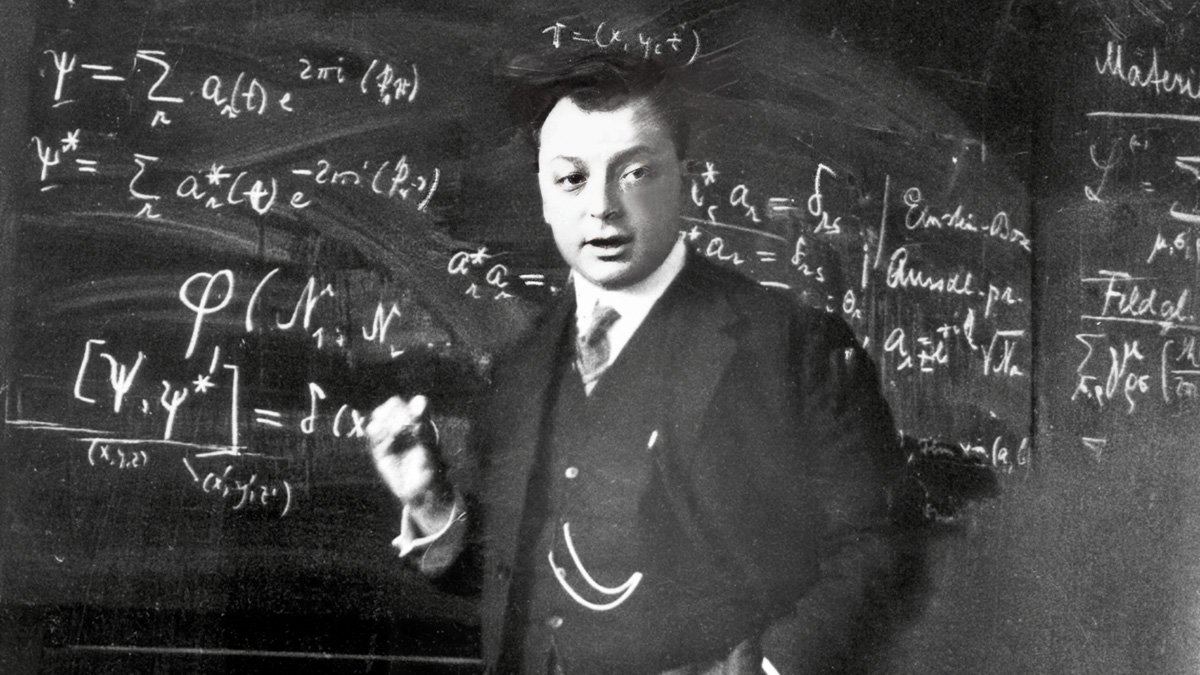
Missing energy has long served as a clue to unseen physics. In December 1930, Wolfgang Pauli suggested a “desperate remedy” to explain the continuous spectrum of beta-decay electrons: an undetected, neutral state that accompanied the electron, carrying off the rest of the energy and saving its conservation (see “A desperate remedy” image). The particle, named the neutrino by Enrico Fermi, interacted so weakly that Frederick Reines and Clyde Cowan observed it only a quarter of a century later
Missing transverse energy and momentum were also essential to the 1983 discovery of the W boson at the SPS proton–antiproton collider (see “When particles went global”). At LEP, the same principle was applied to events whose only visible trace was a single photon, with a neutrino pair recoiling against it and escaping with the rest of the energy. The rate of such events agreed with the existence of three light neutrino species, a count fixed far more precisely by the shape of the Z resonance.
The same observables have driven searches for supersymmetric particles and invisible Higgs decays at the LHC. Their application to fixed-target experiments is more recent, and at its forefront is CERN’s NA64 search for feebly interacting, dark-sector particles.
The case for such states has been building for half a century. Several astrophysical and cosmological observations point to a “dark” form of matter, whose presence is inferred only through gravity. Together with a pervasive and no-less-mysterious dark energy, it accounts for about 95% of the energy content of the universe. Despite its extraordinary precision, then, the Standard Model (SM) of particle physics does not provide a complete description of matter.
For many years, the dominant dark-matter candidate has been the weakly interacting massive particle (WIMP), a thermal relic in equilibrium in the early universe, whose present-day abundance is set by its annihilation rate. Remarkably, models with masses and interaction strengths characteristic of the electroweak scale, around 100 GeV, naturally reproduce the observed dark-matter density – a coincidence often referred to as the WIMP miracle. This expectation motivated searches at high-energy colliders such as the LHC, as well as direct- and indirect-detection experiments.
The dark sector
With these efforts yielding no clear signal, the case for looking elsewhere has grown. In particular, it has become clear that the thermal mechanism behind the WIMP can be realised for much lighter particles, provided their interactions with ordinary matter are sufficiently weak. This is most naturally achieved if new physics resides in a “dark sector”, comprising additional particles and interactions beyond those of the SM, with only a tenuous coupling between the two. Much like ordinary matter, the dark sector could possess its own intricate, internal dynamics, beyond the reach of direct observation.
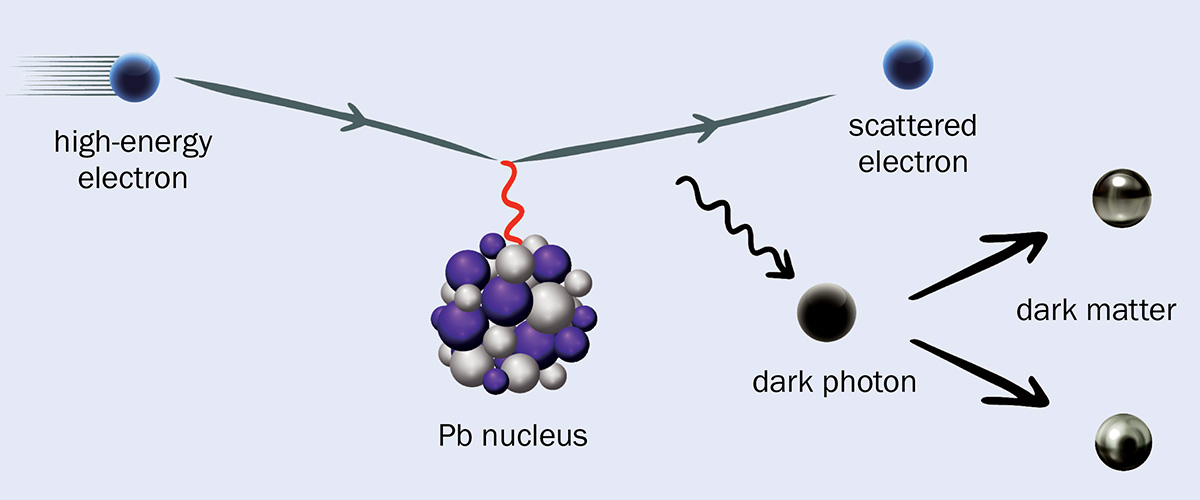
In addition to gravity, communication between the dark sector and ordinary matter may occur through a faint “portal” interaction, distinct from the known SM forces. The forms such a portal can take are tightly constrained, since the symmetries of the SM allow only a handful of ways for a hidden sector to couple to ordinary matter: a dark photon can mix with the ordinary one, a new scalar particle can couple to the Higgs boson and a hidden fermion can couple to neutrinos. In most scenarios, the dark sector lies at mass scales comparable to those of electrons and protons, with couplings tuned to set the relic abundance at the observed value. The portal coupling is typically so weak that dark-sector particles would be produced only rarely, so high-intensity beams are needed to reach detectable rates. Once made, they would traverse large volumes of ordinary matter almost unattenuated, making signatures hard to detect.
The success of NA64 has relied on the continuous support of the CERN accelerator and beams department
This feebleness limits the reach of traditional beam-dump experiments, such as CHARM at CERN and E137 at SLAC, which rely on producing a new particle in a target and observing its decay or interaction in a far, downstream detector. The signal rate is therefore suppressed twice by the small portal coupling: once in production and once in the subsequent decay or scattering. In the missing-energy approach, by contrast, a well-characterised particle is sent into a target, and the energy emerging from the interaction is measured with hermetic calorimetry (see “Portal, ajar” figure). Any deficit would point to a particle that escaped without interacting, with sensitivity suppressed only by the production probability. For a representative mixing parameter of order 10–5 between the photon and its hypothetical dark counterpart, the number of beam particles required to reach a given sensitivity can be reduced by up to 10 orders of magnitude. This brings well-motivated regions of parameter space associated with light thermal dark matter within reach of existing accelerator facilities.
This perspective has motivated a new generation of high-intensity experiments, designed to probe rare processes associated with extremely weakly interacting particles. Among these, NA64 has played a pioneering role.
NA64 was proposed in 2013 to employ the missing-energy technique at the CERN SPS, using the H4 high-energy electron beam impinging on an instrumented target. Early test measurements carried out in 2014 demonstrated the feasibility of the approach and helped validate the detector concept. Building on these results, the experiment was approved in 2016 as the 64th experiment in the North Area, from which it takes its name. It is part of CERN’s broader Physics Beyond Colliders (PBC) initiative, which coordinates efforts to explore new physics using high-intensity and precision experiments. The success of NA64 has also relied on the continuous support of the CERN accelerator and beams department, in particular in optimising the beamline and preparing a dedicated experimental area following Long Shutdown 2.
Pure heart
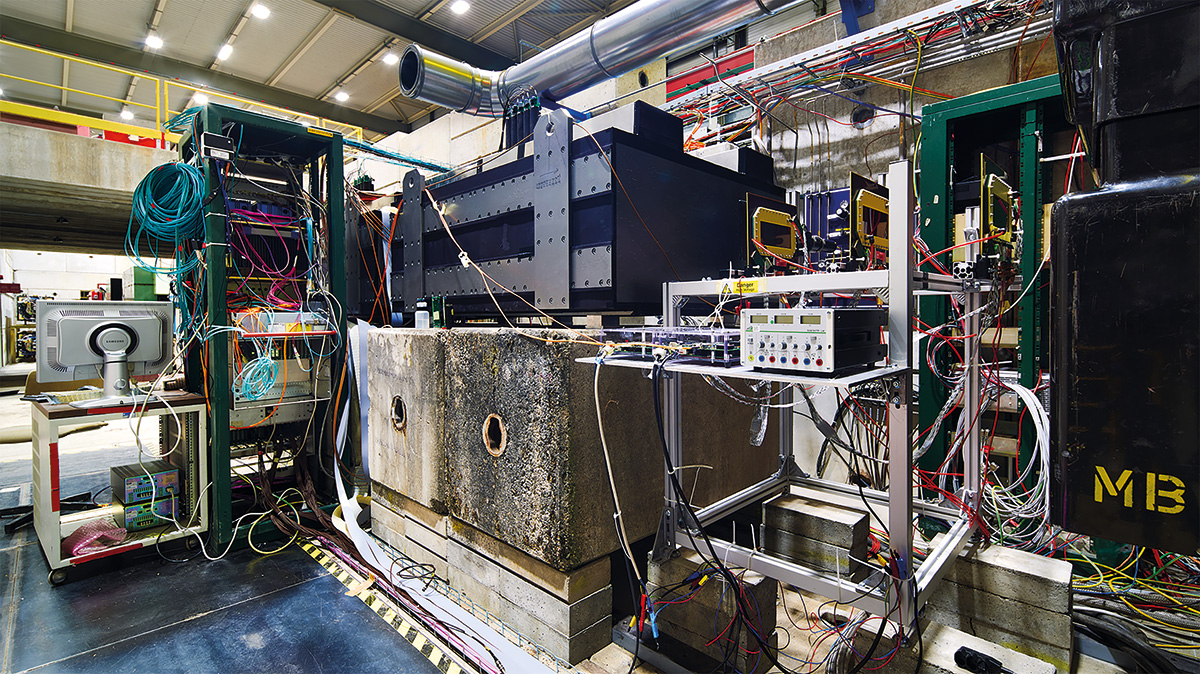
At the heart of the experiment, an electromagnetic calorimeter serves as an active target (see “Hermetic chain” figure). Incoming electrons are individually tagged and their energy precisely measured before entering the calorimeter, where they initiate an electromagnetic shower. The tagging system, based on the detection of synchrotron radiation emitted by beam particles in the dipole magnets of the spectrometer, provides a highly pure electron beam. Additional tracking and identification detectors upstream of the target reject contaminating particles, further improving the purity of the selected events, while hadronic calorimeters downstream provide a veto against escaping particles and ensure a hermetic measurement of the event.
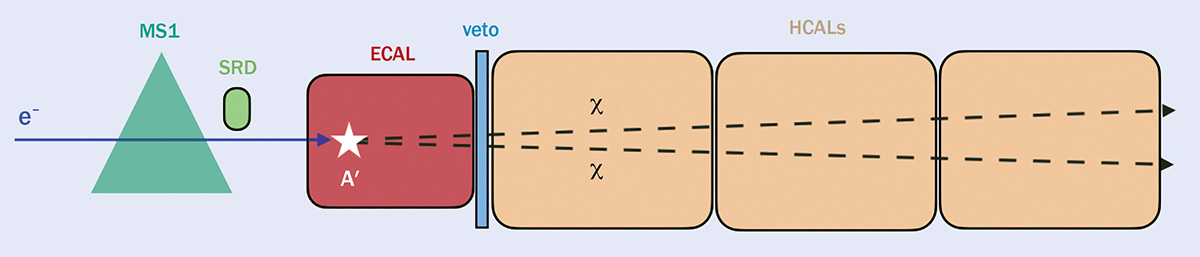
A candidate signal is an event in which the measured energy falls below a predefined threshold. SM processes can also give rise to missing energy, most notably through neutrinos produced in hadronic interactions in the target. These backgrounds are strongly suppressed and can be efficiently discriminated, as they are typically accompanied by significant energy deposition in either the electromagnetic or hadronic calorimeters. Detector effects such as energy leakage are likewise carefully controlled.
Over the past decade, NA64 has carried out a series of measurements using high-intensity electron beams, progressively improving its sensitivity to light, feebly coupled particles. The initial focus has been the search for dark photons that decay invisibly, a well-motivated benchmark scenario for dark-sector models. A dark photon was also considered a possible explanation for the muon g–2 anomaly (CERN Courier March/April 2025 p21), since it would contribute to the muon magnetic moment at one loop through kinetic mixing with the ordinary photon. In these searches, no significant excess of events with missing energy has been observed, allowing stringent constraints to be placed on the interaction strength between the dark sector and ordinary matter.
Long Shutdown 3 provides the opportunity to further extend the sensitivity of NA64 to increasingly rare processes
The NA64 programme has since expanded to a wider class of dark-sector mediators. The results are typically presented as exclusion regions in the plane defined by the mediator mass and its coupling to the SM. The collaboration has explored a broad range of masses in the MeV–GeV region, probing parameter space previously inaccessible to both collider searches and traditional beam-dump experiments.
Beyond electrons
Over time, the experimental programme has also expanded beyond the original electron-beam configuration. The use of positron beams enables the resonant production of dark photons through the annihilation of beam positrons with atomic electrons of the active target. In an electron beam, the same process is suppressed because it relies on secondary positrons produced in the electromagnetic shower. Complementary approaches using hadronic beams extend the reach to dark-sector particles coupled to quarks, while measurements with muon beams at the M2 beamline, based on the missing energy-momentum technique, probe portals that couple to second-generation leptons and reach higher mediator masses. Each beam targets a different region of the dark-sector model space, and the combined programme covers a far wider range than the original electron-beam design.
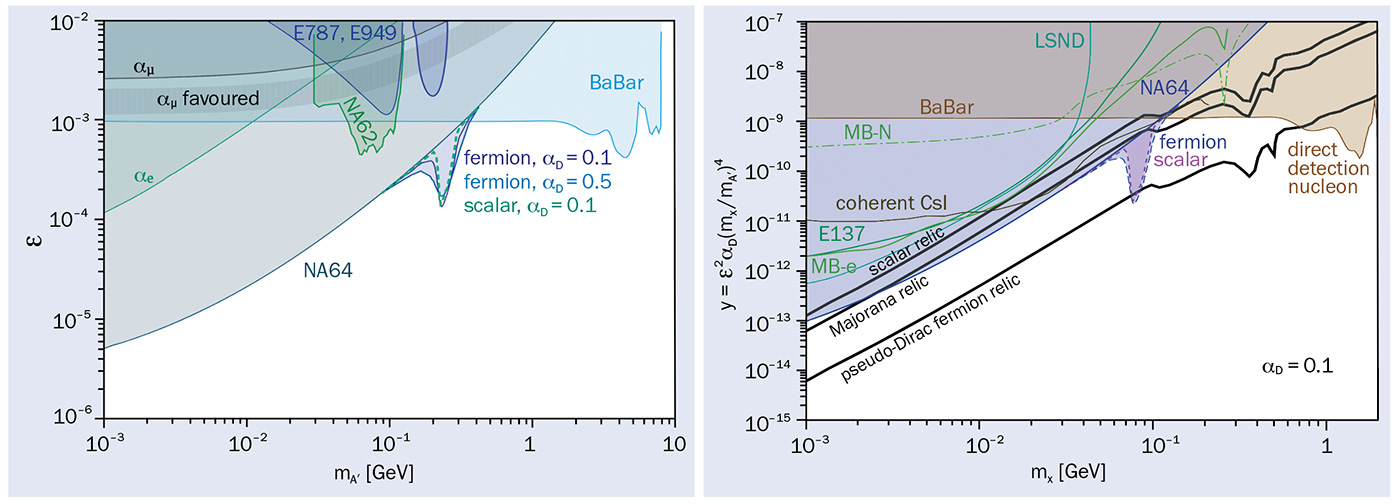
These constraints have important implications for models of light dark matter. In a number of well-defined scenarios, the parameter-space region consistent with the observed relic abundance can be directly tested, and NA64 has already excluded significant portions of it (see “A dark corner” figure).
Thanks to its high-energy beam and compact detector, NA64 is also sensitive to particles with much shorter lifetimes than those targeted by traditional beam-dump experiments, which would typically decay inside the dump or shielding and so escape detection. By looking for visible decay products close to the production point, NA64 reaches a regime intermediate between prompt collider signatures and long-lived beam-dump ones. This has enabled, for example, searches for axions and axion-like particles decaying into two photons.
The exploration of dark sectors at high intensities is still in its early stages, and the recently started CERN Long Shutdown 3 (LS3) provides the opportunity to further extend the sensitivity of NA64 to increasingly rare processes (see “The LHC completes its third run”). Planned detector upgrades aim to improve hermeticity and background rejection, ensuring that the missing-energy signature remains robust even at higher beam intensities. The integrated statistics will then grow by up to two orders of magnitude beyond present datasets (see “Reaching the relic” figure).
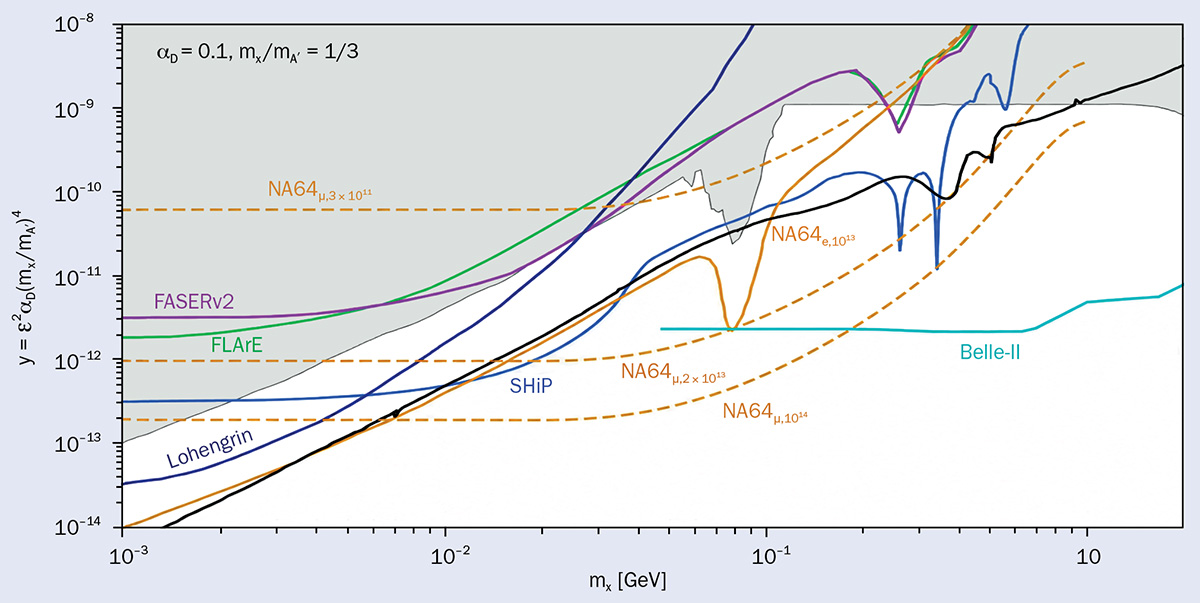
The combined electron, positron, muon and hadronic beam programmes, together with the post-LS3 increase in statistics, are projected to probe a large portion of the parameter space of leading thermal-relic models of sub-GeV dark matter. Inelastic, semi-visible and muon-philic mediators will be tested in parallel, alongside searches for axion-like particles and other weakly coupled states. Together with complementary searches at colliders, in other fixed-target experiments and in direct detection, NA64 will help test a broad range of dark-sector scenarios.