Former CERN Council President Eliezer Rabinovici reflects on the 4th International Symposium on the History of Particle Physics, and on the two decades in which discovery owed its successes to competition and cooperation alike.
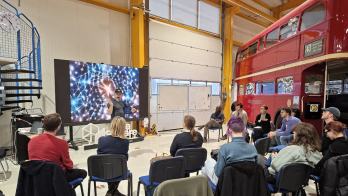
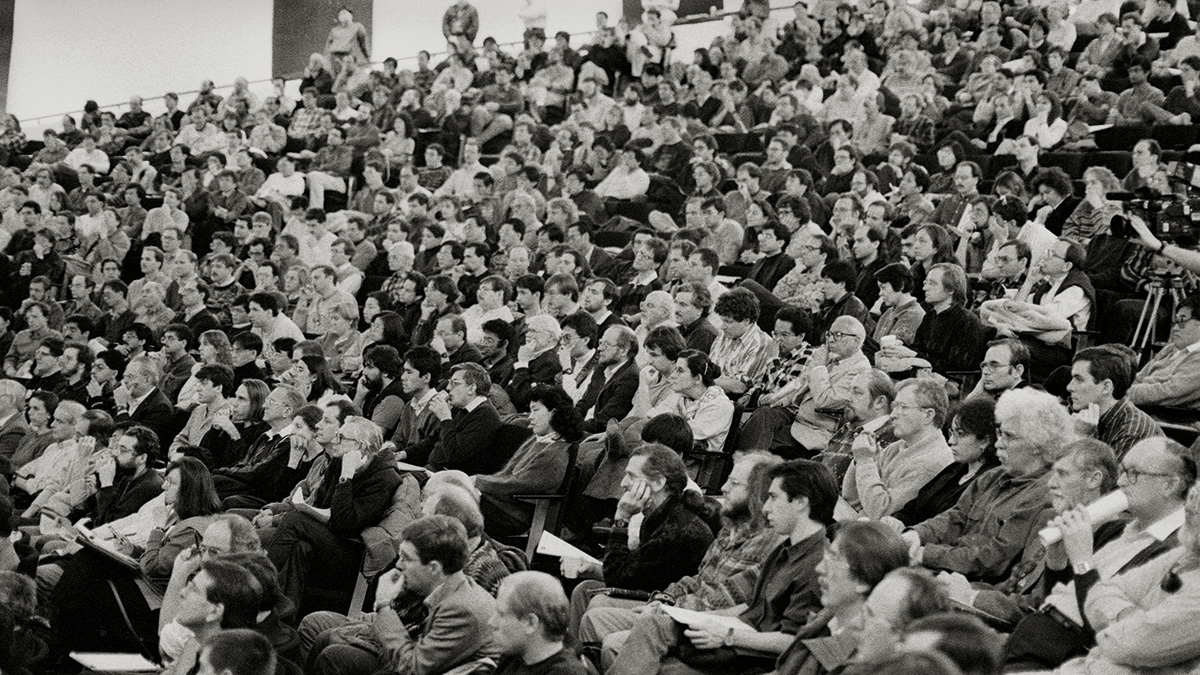
Once in a while, the particle-physics community takes stock of its own history. The latest such occasion was the 4th International Symposium on the History of Particle Physics, held at CERN from 10 to 13 November 2025.
The series began at Fermilab, with meetings in 1980 and 1985 that traced the field from its origins to the particle zoo of the 1950s. A third, at SLAC in 1992, took the story through the 1960s and 1970s, when much of the Standard Model (SM) fell into place. The 2025 edition brought together about 200 physicists and historians, with many more following online, to pick up where its predecessor left off, turning to the period from 1980 to 2000. With some 40 contributions across four days, the programme was far richer than any single report can convey. The symposium’s Indico page (indico.cern.ch/event/1480892) carries it in full, along with recordings of most of the talks.
Strong foundations
By the end of the 1970s, the foundations were laid. Quarks had been accepted as physical constituents of matter, neutral currents had validated the electroweak theory in its SU(2) × U(1) form – ruling out an alternative that contained no Z – and the proof that gauge theories yield finite predictions had given the SM its mathematical backbone. The talks painted a shiny and coherent image of what came next: fundamental discoveries of new particles, the stabilisation of the SM, outstanding – and sometimes revolutionary – progress in the construction of accelerators and detectors. These achievements were spread across laboratories worldwide, and made possible by two seemingly contradictory forces: fierce international, national and “intramural” competition, and close cooperation among thousands of dedicated scientists and engineers, on a scale unheard of in civilian industry. A unique and precious ecosystem, that of the high-energy physics community, had established this “coopetition” as its own modus operandi.
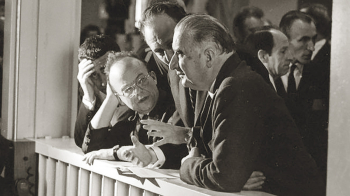
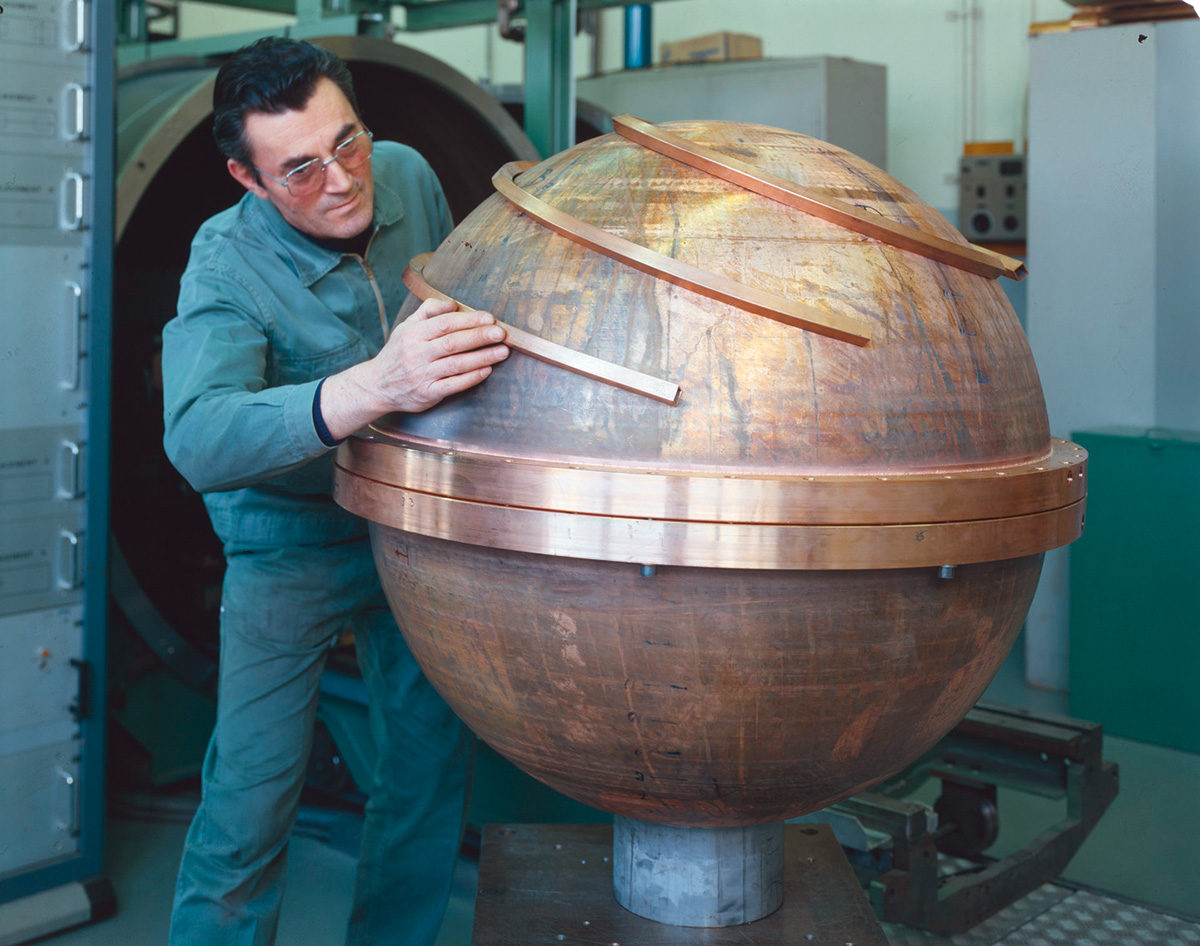
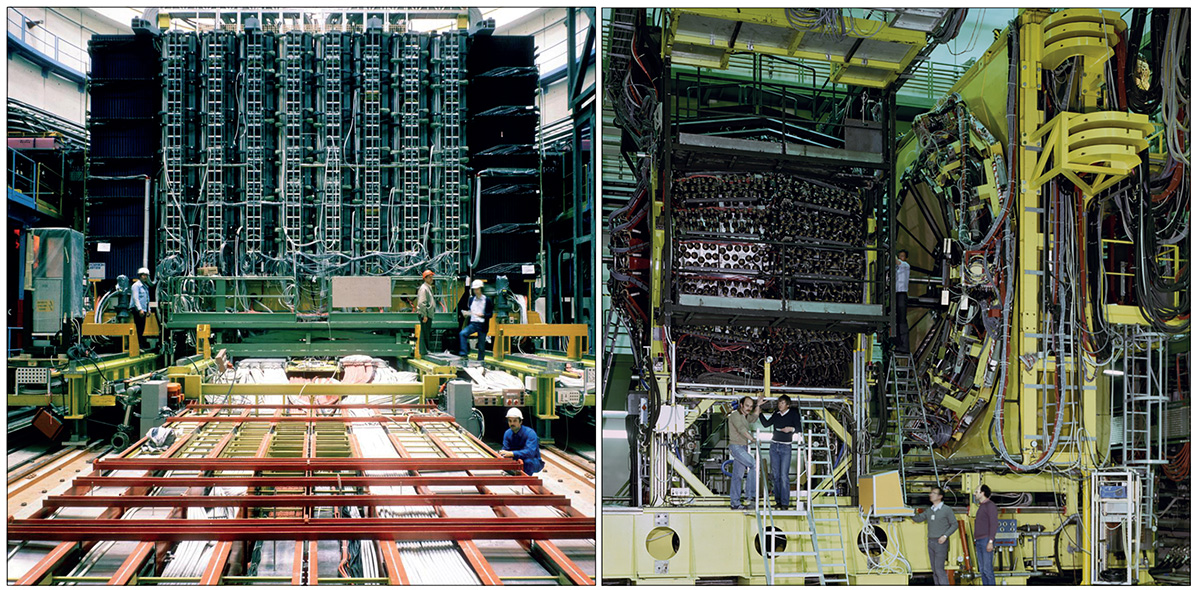
Starting from the early 1980s, discovery truly became a global endeavour, against a steady shift in experimental activity from the US to Europe. The W and Z bosons, massive carriers of the weak force, were found at CERN’s SPS (Super Proton Synchrotron) collider by the pioneering UA1 and UA2 experiments between 1982 and 1983 (see “The opening act” and “Sharing the ring” images). The top quark eluded a long search before being found at Fermilab in 1995, at the mass scale of the weak interaction. Its existence, required by anomaly cancellation, completed the third generation of quarks (see “Top, at last” image). Three years later, Super-Kamiokande caught neutrinos oscillating between flavours, building on a tradition of neutrino physics to which Soviet groups had made decisive contributions.
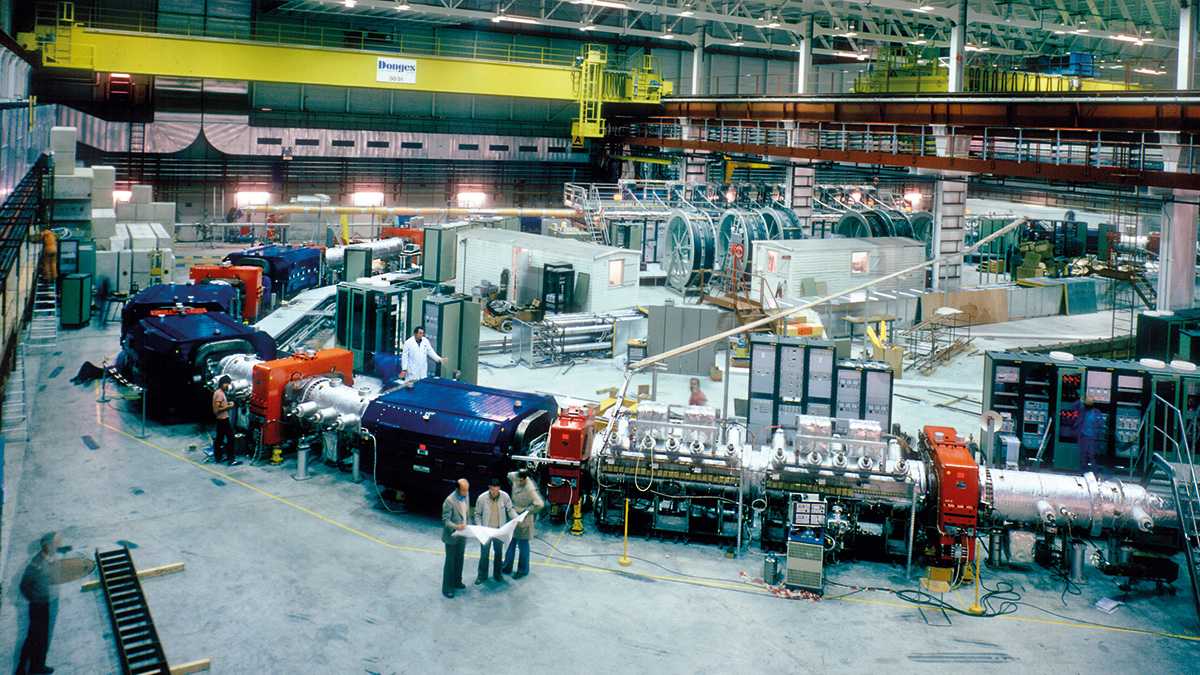
At both LEP (Large Electron–Positron collider) and the SLC (Stanford Linear Collider) at SLAC, the number of light neutrino species coupling to the Z was measured to be three, implying no more were left to find. Cornell’s CESR/CLEO explored the upsilon family and the physics of the b-quark, while ARGUS, at DESY’s DORIS storage ring, made the first observation of B-meson mixing in 1987. The B-factory programmes at KEK and SLAC then opened the door to the observation of charge–parity (CP) violation in B-meson decays. Not all searches bore fruit: no leptoquarks appeared at HERA and no supersymmetric particles at LEP. These null results, too, shaped the direction of the field.
Still, participants could revel in how one prediction of the SM after another found experimental confirmation, be it the nature of the particles discovered or the detailed structure of hadronic jets, the most direct way quarks and gluons can manifest themselves as constituents of hadrons in a detector far from the interaction region. The same holds for the deep-inelastic structure functions measured at HERA, which mapped the proton’s internal structure with unprecedented precision.
On the theoretical side, several talks described the laborious process of assembling the many pieces of the SM jigsaw, a striking example of a concise and predictive compendium of human knowledge. The Brout–Englert–Higgs mechanism received particular attention, along with the emergence of the concrete Higgs-hunting strategies that would ultimately lead to the 2012 discovery at the LHC (Large Hadron Collider). The solar neutrino problem, a persistent and puzzling shortfall in the detected flux of electron neutrinos from the Sun, found its resolution in the conjecture that neutrinos are massive and can oscillate between flavours, later confirmed experimentally. More broadly, the talks exposed the characteristic dissatisfaction of theorists with any present state of understanding, paired with a restless curiosity for finding in it clues to the next frontier.
The hunt for new physics
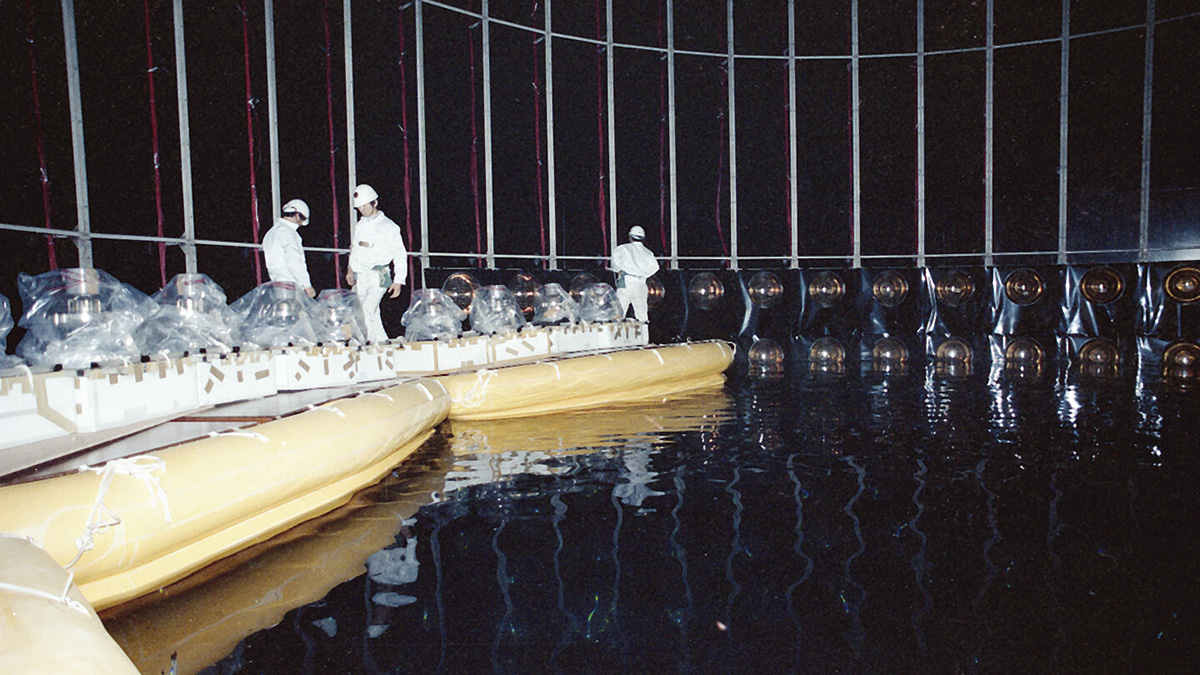
The Peccei–Quinn solution to the strong CP problem, proposed in 1977, was soon shown to imply a new pseudoscalar boson: the axion (CERN Courier January/February 2026 p21). By the 1980s, the idea was mature enough to start searching for it. Grand unified theories (GUTs) sought to merge the electroweak and strong forces at energies not far below the Planck scale, corresponding to the shortest distance our current physics allows us to contemplate, and at which quantum gravitational effects become unavoidable, but the early predictions for proton decay were soon contradicted at the Irvine–Michigan–Brookhaven (IMB) detector and Kamiokande (see “The proton stays” image). Supersymmetry offered a potential resolution of the naturalness problem, the puzzle of why the Higgs-boson mass is so much lighter than the Planck scale, and predicted a host of new particles. Its presence would soothe the nagging concern that a long energy desert might separate the electroweak scale from any new physics. Spoiler alert: at the time this article goes to press, no sign of supersymmetry has yet emerged.
The 1980s also witnessed the resuscitation of string theory, following a rather technical proof that specific string theories could be made free of quantum anomalies – a problem most theoretical physicists were unaware of anyway. The mid 1990s brought matrix models, the non-local objects called D-branes and the unifying vision of M-theory, drawing much of the theoretical community into the programme. Unexpected connections between gauge theory and gravitational physics followed, culminating in the AdS/CFT correspondence at the decade’s end. String theory, when combined with supersymmetry, provided a first candidate for a finite quantum theory of gravity, turning questions such as the number of flavour generations, their mass structure and even the number of spacetime dimensions from speculations suitable only for after-dinner talks into scientific ones. Finally, the period saw astrophysicists, cosmologists and particle physicists joining forces, giving rise to the new field of particle cosmology. The absence of the abundant monopoles predicted by GUTs was among the puzzles that led to inflation, the conjecture that the very early universe underwent a brief phase of exponential expansion.
Technology was celebrated in its own right. Talks traced the development of the superconducting magnets and cooling methods that made the great colliders possible. One could hear of the Rutherford cables wound into the superconducting coils of the Tevatron, HERA, RHIC and the LHC, with precision collars and yoke structures containing the enormous magnetic forces. Impressive advances in detector technology, data management, computing and analysis were also reviewed. It was made clear that without tight international collaboration and knowledge flow extending from KEK and Novosibirsk through Europe to the USA and down to Antarctica, among many competing groups, such progress would have been extremely unlikely. The lesson for those now planning future colliders like the FCC (Future Circular Collider) was explicit: even more than for the LHC, pull together the centres of excellence well in advance and concretely prepare what is needed for the construction of both the accelerators and the detectors.
Successes and setbacks
The 1980s and 1990s were good years for opening champagne bottles in accelerator labs. Insightful talks stressed the pioneering role of the ISR (Intersecting Storage Rings) and described how the SPS and the Tevatron were built. The challenges and successes of HERA, the first and only electron–proton collider so far, were described, as were the birth pains and rewarding growth of the SLC, which demonstrated that linear colliders could do precision physics. The triumphs all involved facing and overcoming substantial scientific, engineering and financial challenges. Side by side with the exhilarating successes were the setbacks. Perhaps it was less pleasant to dwell on failures, but studying them while planning future projects is as important as basking in the description of successes.
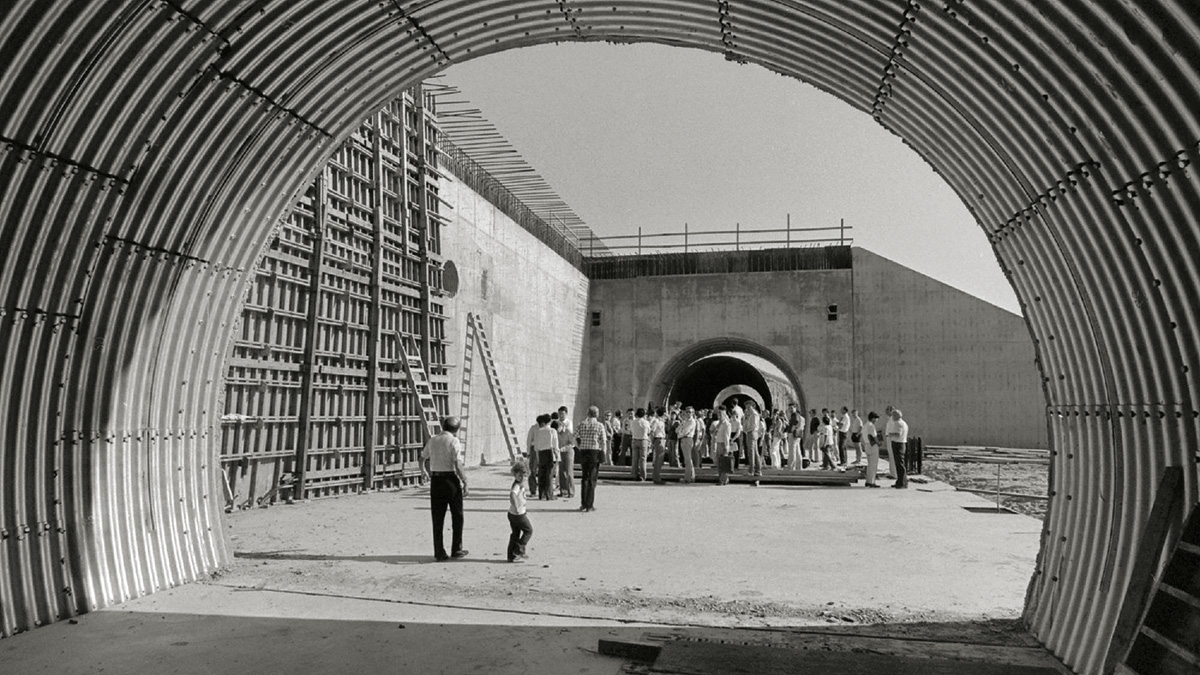
A very telling story was that of ISABELLE, a high-energy proton collider planned at Brookhaven National Laboratory that ran into magnet trouble in the early 1980s. A proposal to double the energy fared no better, especially after the discoveries of the W and Z at CERN made the original physics case less compelling. Yet its rebirth as RHIC, the Relativistic Heavy Ion Collider, opened a whole new field of research for the community (see “Second life” image), allowing physicists to recreate and study the quark–gluon plasma that filled the universe microseconds after the Big Bang. A case of snatching victory from the jaws of defeat, and an important trajectory to keep in mind for the future.
A different story was that of the Superconducting Super Collider (SSC), cancelled by the US Congress in 1993 after construction began in Texas. Understanding all the causes of this failure and appreciating its full impact on both the US and the CERN programmes is still fertile ground for historians, and should be required reading for those planning new frontier colliders.
The 1980s and 1990s were good years for opening champagne bottles in accelerator labs
The dissolution of the Soviet Union terminated the UNK programme, which envisaged a 3 + 3 TeV proton collider at IHEP Protvino. The impact on high-energy research in Russia was profound, yet the community showed remarkable resilience, sustaining the heavy-ion programme at JINR in Dubna and continuing neutrino experiments in politically challenging times. A silver lining was the international call for scientific solidarity that crossed geopolitical lines, helping keep Soviet colleagues part of the high-energy physics community.
The protagonists of the 1980s and 1990s fulfilled, with honour, their duty – passed down from generation to generation – to lay the groundwork for their successors. Many of them were in the room, recounting their own experience. All endeavours were extremely challenging. Some overcame the obstacles and reaped success, some had to reconcile themselves with descoping, and some failed. All left lessons for the future.
Free energy
As Winston Churchill himself put it in the House of Commons, it is “much better by all parties to leave the past to history, especially as I propose to write that history myself.” Inevitably, those who lived through the events are not always best placed to write the conclusive story. Future editions would benefit from a larger contribution by historians of science, offering independent analysis of the processes, credits and timelines to which the physicists themselves may be too close. Still, many words of wisdom emerged from the combined experience of the speakers. Among them, a remark redefined “free energy” as the small reserve of discretionary funds that a visionary director-general can deploy to test major breakthrough ideas, free from the scrutiny of funding agencies.
Various flavours of human behaviour in competition and in collaboration found expression throughout the talks: the intramural rivalry between UA1 and UA2 at CERN, the national competition between SLAC and Cornell, the international contests between LEP and the SLC, and between KEK and SLAC at the B-factories. All these stories contain lessons for the future. For me, none matters more than coopetition.
The symposium was dedicated to the memory of Herwig Schopper, who passed away in August 2025 at the age of 101 (CERN Courier November/December 2025 p32). He was CERN Director-General from 1981 to 1988, in the years of the SPS collider, of LEP’s approval and of the early conception of the LHC.