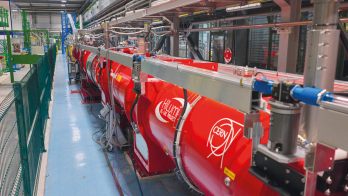
Heike Kamerlingh Onnes first observed superconductivity in a thread of frozen mercury. A century after his death, Lucio Rossi and Markus Zerlauth trace how his discovery came to drive CERN’s colliders.
Each main dipole of the Large Hadron Collider (LHC) sustains a current of about 12,000 amperes, confined to filaments of niobium–titanium (Nb–Ti) way finer than a human hair. For the collider’s high-luminosity upgrade (HL–LHC), flexible lines of magnesium diboride (MgB2) will carry 10 times as much. Currents of this intensity would melt any ordinary cable. Yet these filaments bear them unscathed, for their resistance is exactly zero. Much of the reach of particle colliders rests on this fragile, emergent phenomenon: superconductivity. The man who first observed it, Heike Kamerlingh Onnes, died 100 years ago, on 21 February 1926.
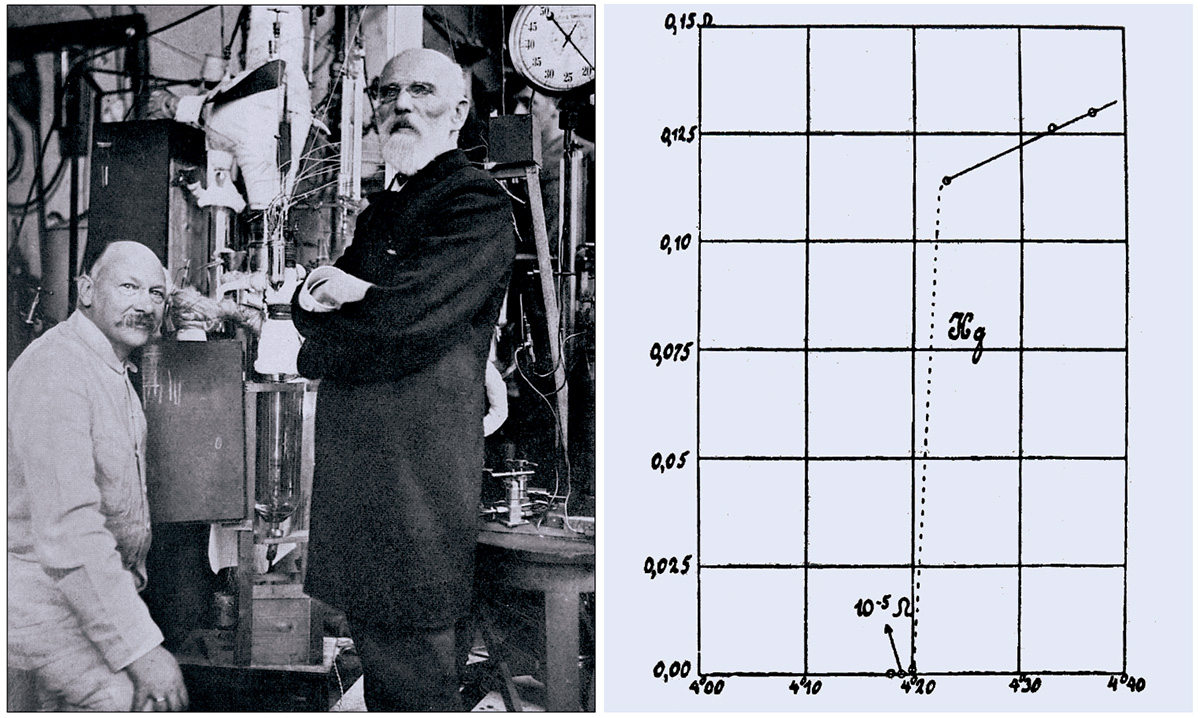
His discovery, made in Leiden in 1911, was not an isolated event (see “Practically zero” figure). It crowned a long and systematic programme aimed at reaching and mastering temperatures close to absolute zero. Behind it stood physicists, engineers and technicians working in concert towards common scientific goals, in a style that anticipated the research infrastructures on which laboratories such as CERN would later be founded. The liquefaction of helium in 1908 brought the lowest temperatures within reach, and Onnes turned to how metals conduct in that regime. In a wire of mercury below 4.2 K, he found a resistance smaller than anything his instruments could measure, a phenomenon he christened “supraconductivity”.
An explanation of the effect would wait another 46 years, until Bardeen, Cooper and Schrieffer showed that, below a critical temperature, conduction electrons bind into pairs and condense into a single collective state, through which current flows without loss. Still, Onnes rapidly grasped how such behaviour could transform magnet technology, and in 1913 envisaged superconducting coils producing 100,000 gauss, or 10 T – far beyond any electromagnet of the day. The discovery, in 1914, that superconductivity in the materials then available was destroyed by fields of a few hundred gauss made this objective unattainable for half a century. The deadlock broke only in 1961, at Bell Telephone Laboratories, where John Kunzler and his colleagues drove a very heavy current through niobium–tin (Nb3Sn) at 88,000 gauss.
At CERN, superconductivity eventually developed along two complementary paths. Superconducting magnets enable accelerators of practicable size to steer and focus ever more energetic beams, while superconducting radiofrequency (SRF) cavities provide high accelerating voltages at acceptable electrical and cryogenic costs. Together, the two technologies have progressively pushed the energy, luminosity and reach of the laboratory’s accelerator complex up to the LHC and its upcoming upgrade.
In 1913, Onnes envisaged superconducting coils producing 10 T – far beyond any electromagnet of the day
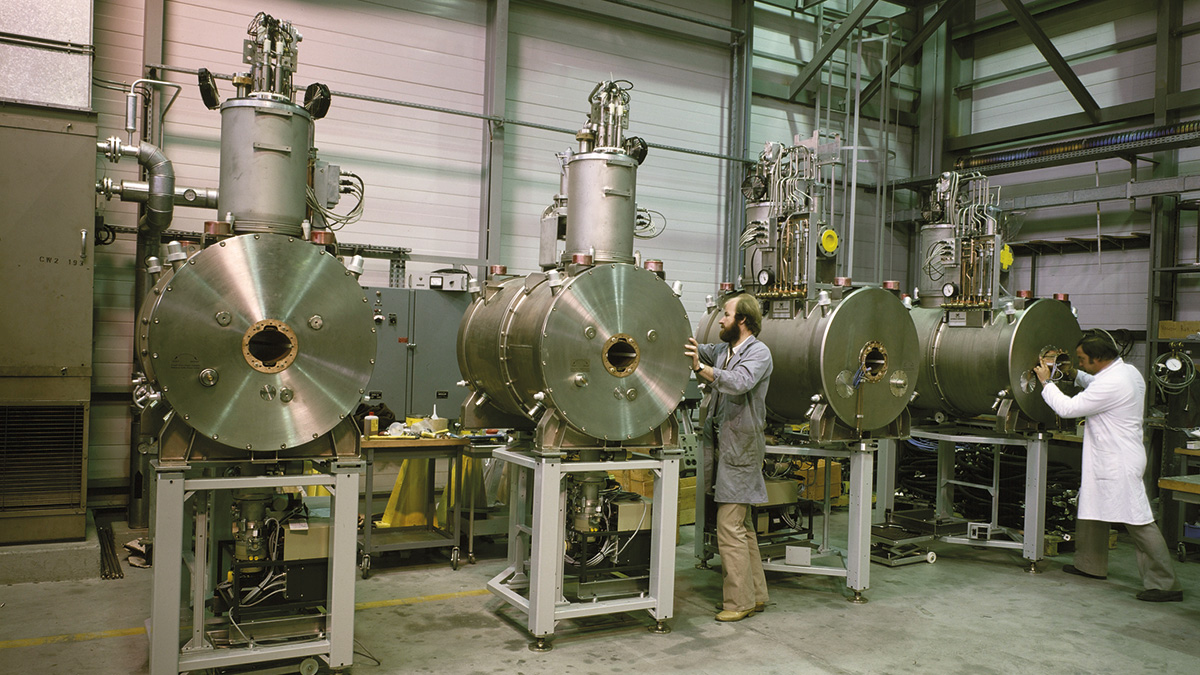
CERN’s first operational use of superconductivity in a collider’s magnet lattice came with the high-luminosity insertion of the Intersecting Storage Rings (ISR). Its eight superconducting quadrupoles, developed during the 1970s and brought into operation in 1980, focused the beams more tightly at one intersection, and were the first superconducting magnets routinely operated in an accelerator (see “Cold quartet” image). Their design introduced concepts that became central to accelerator-magnet technology, among them Romeo Perin’s “Roman arch” coil, in which electromagnetic forces are contained by compression. At the same time, their operation gave CERN direct experience of field quality, conductor stability, quench protection and cryogenics in an accelerator environment.
Feeling the squeeze
At the Large Electron–Positron collider (LEP), superconductivity entered the ALEPH and DELPHI detectors through their large solenoids, built at CEA–Saclay in France and the Rutherford Appleton Laboratory in the UK, respectively, and reached the beamline in the cold low-beta quadrupoles that squeezed the beams at all four experiments. More direct still was the impact of SRF technology, which came to shape the whole LEP programme. At the Z resonance, LEP operated at about 45.6 GeV per beam, with its original 128 copper cavities working at 352.2 MHz and supplying approximately 280 MV. Increasing the beam energy towards and beyond the W-pair threshold posed a fundamentally different problem: in a circular electron–positron collider, the energy lost to synchrotron radiation, which the cavities must restore on every turn, scales with the fourth power of the beam energy. The accelerating voltage, therefore, had to increase by more than one order of magnitude, which could not be achieved efficiently with a conventional copper system.
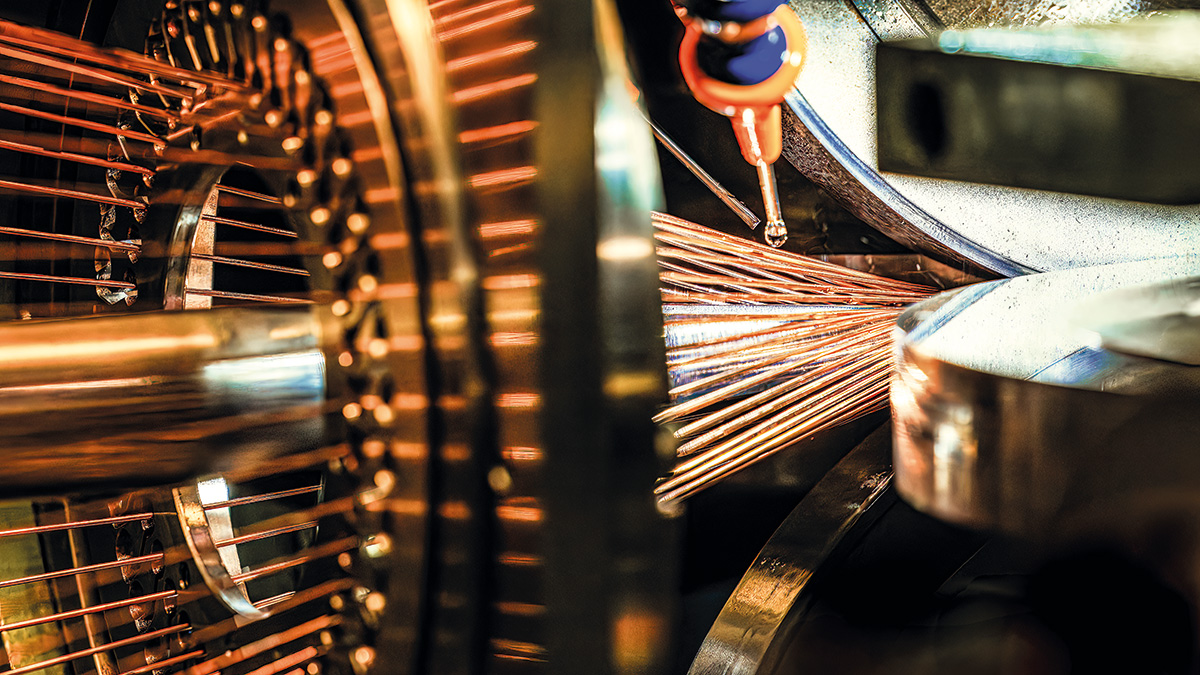
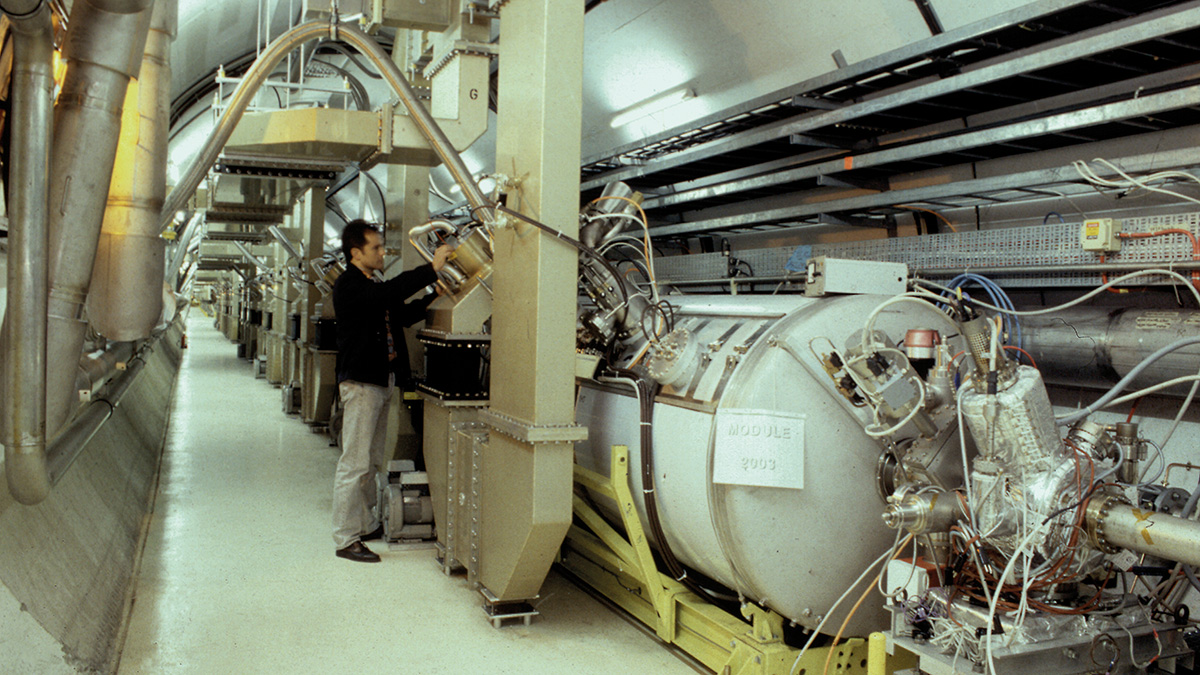
The LEP2 upgrade provided the answer. From the early 1990s, superconducting cavities were progressively installed, reaching a final system of 288 four-cell cavities powered by 36 klystrons. Most used a thin niobium film sputtered onto a copper substrate, a technology initiated and mastered at CERN by Cristoforo Benvenuti and subsequently transferred to industry, which combined a superconducting RF surface with the thermal stability of copper (see “Copper underneath” image). The system eventually supplied a total RF voltage of about 3.5 GV and enabled operation above 100 GeV per beam, opening the study of W-pair production, precision measurements of the W boson and searches for the Higgs boson and potential new particles.
Breaking out
With the LHC, superconductivity ceased to be a technology reserved for just a few cutting-edge components. The collider was to reuse the existing 27 km LEP tunnel, so its collision energy was tied to the fields of the bending dipoles. Conventional magnets were far too weak and energy-consuming, and even Nb–Ti, the most mature accelerator superconductor of the time, had to operate close to its practical limits.
The counter-rotating beams were accommodated in twin apertures within a common magnet structure, to fit the narrow tunnel and cut costs. The 1232 main dipoles were designed to operate at 8.33 T, with 392 main quadrupoles providing the arc focusing. On top of these came more than 7600 corrector magnets, together with the specialised quadrupoles and dipoles of the matching and interaction regions, bringing the total to nearly 10,000 superconducting magnets around the ring. To wring such fields from Nb–Ti with sufficient margin, the magnets were cooled by superfluid helium at 1.9 K. During Run 3, at a beam energy of 6.8 TeV and 8 T in the dipoles, the main-dipole system alone held nearly 8 GJ of magnetic energy. The LHC thus became both the largest superconducting magnet system in operation and the largest cryogenic installation ever built.
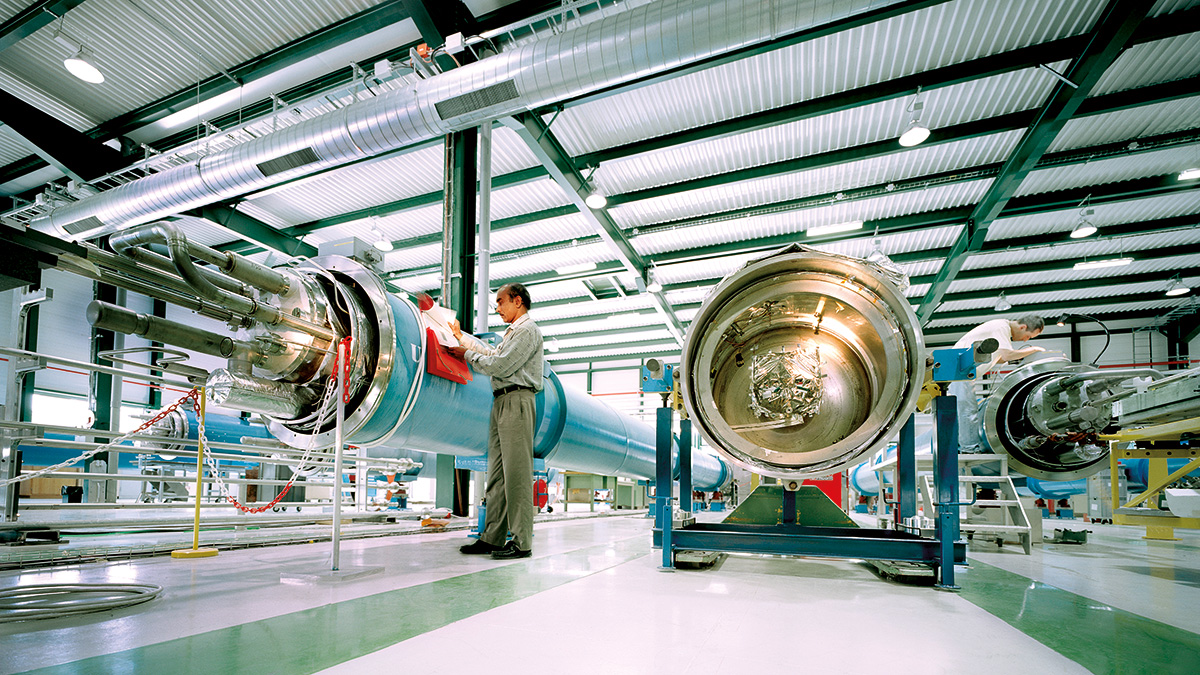
Working at such a scale transformed magnet development into an industrial enterprise (see “Mass production” image). Nearly 300,000 km of superconducting strand were produced, of which 250,000 km were assembled into Rutherford cables and wound into magnets manufactured by European industry under CERN coordination. As at the ISR and LEP, superconducting quadrupoles squeezed the beams at the interaction points, the final-focusing triplets coming through collaborations with the US laboratories, led by Fermilab, and with KEK in Japan. The large superconducting magnets of the CMS and ATLAS experiments, built with major contributions from laboratories around the world, extended the technology to the experiments.
Scaling up
Superconductivity also entered the LHC through its accelerating system. Each beam came to be served by eight single-cell cavities operating at 400 MHz and delivering a nominal voltage of 16 MV, built with the niobium-on-copper technology established for LEP2. Meanwhile, more than 1000 current leads – the components that feed the magnet circuits from room temperature – employ ceramic high-temperature superconductors (HTSs) of the kind discovered by J Georg Bednorz and K Alex Müller in 1986, whose high critical temperatures let them carry extreme currents without a liquid-helium bath. Their resistive upper sections can get cooled by helium gas at about 20 K, already used in other parts of the machine. This sharply reduces the heat reaching the liquid–helium level, and with it the refrigeration power. When it came online, the LHC was the first large-scale application of HTS materials.
Over the next four years, the machine will evolve into the HL-LHC, an even more efficient and powerful proton collider, extending its operation into the early 2040s and promising a tenfold increase in collected data over the initial design (CERN Courier July/August 2026 p8). Colliding much brighter, more intense beams, focused more strongly at the interaction points, requires a profound transformation of the regions around ATLAS and CMS.
A future hadron collider at the energy frontier would depend primarily on a new generation of high-field superconducting dipole magnets
Among the key technologies of the upgrade is a new generation of final-focusing quadrupoles built from Nb3Sn, never before used in an accelerator, with twice the mechanical aperture and up to a 50% higher peak field than their predecessors. The development of this technology began more than two decades ago, when the LHC itself was still under construction, as a joint effort between CERN and the US LHC Accelerator Research Program (LARP). The transition from the robust Nb–Ti to the far more brittle and strain-sensitive Nb3Sn required new mechanical structures, fabrication processes and protection strategies, developed and industrialised within an international collaboration in which the US Accelerator Upgrade Project (AUP), LARP’s successor, and CERN are each building half of the quadrupoles. In-kind contributions reach well beyond the Nb3Sn quadrupoles. The dipole orbit correctors are built by CIEMAT in Spain and IHEP in China, and the separation and recombination dipoles by KEK in Japan and INFN in Italy, which also provided nine types of higher-order correctors.
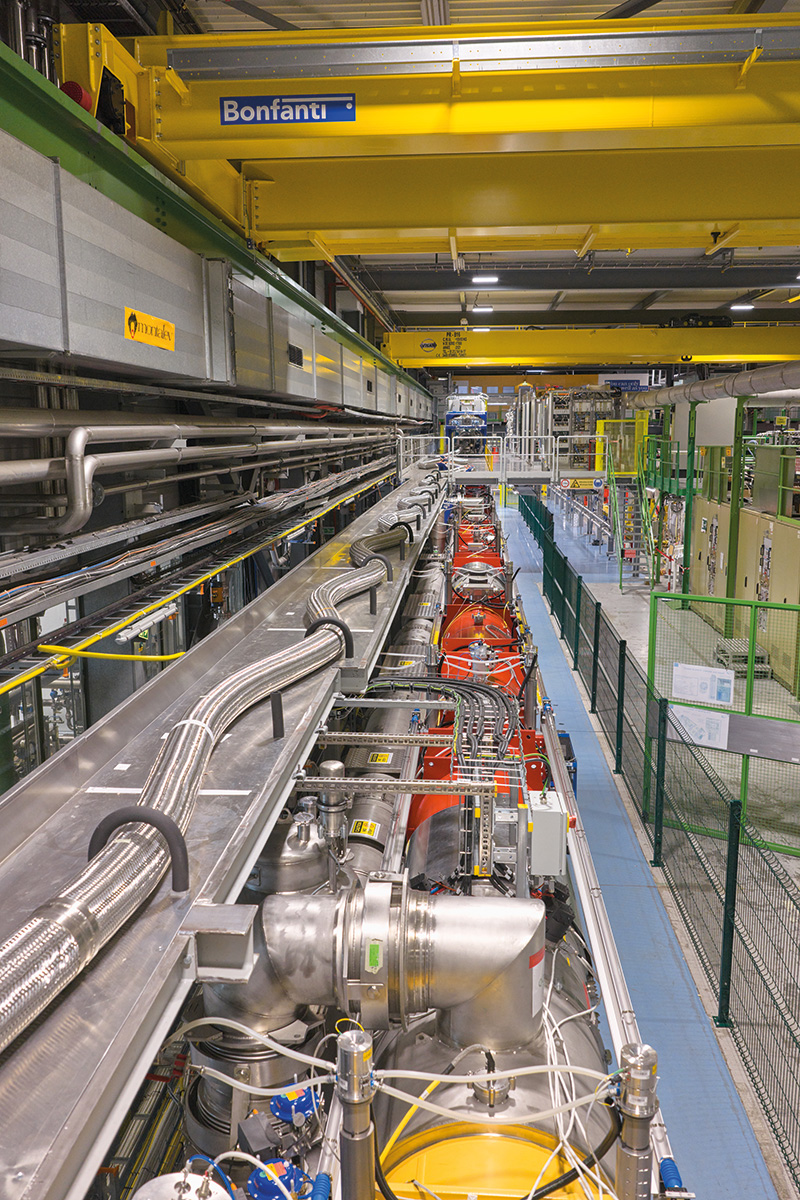
The upgrade will also make the first operational use of superconducting links based on MgB2. Eight such links, up to 140 m long and carrying up to 120 kA at temperatures of about 25 K, will conduct the high DC currents from the power converters, housed in new galleries shielded from the increased collision rates, down to the magnets on the beamline (see “Cold-blooded” image).
Peak energy
In parallel, CERN built its SRF expertise into High Intensity and Energy ISOLDE (HIE-ISOLDE), the superconducting post-accelerator that takes the exotic nuclei produced at the ISOLDE facility, which decay within seconds, and brings them to the energies of nuclear reactions. Its cavities carry a thin film of niobium on copper, like those of LEP2, and they came close to the performance of counterparts made entirely of niobium at 4.5 K, while keeping copper’s engineering advantages. The first radioactive beams came in 2015, and by 2018 the machine had reached 10 MeV per nucleon.
Superconductivity offers two complementary paths for increasing accelerator performance: higher magnetic fields for steering and focusing charged particles, and higher accelerating fields for efficiently increasing their energy. Any future flagship collider will need both, in proportions that depend on the machine’s design. Among the proposed facilities, a high-luminosity electron–positron collider such as the FCC-ee (CERN Courier May/June 2026 p41) would lean most heavily on SRF technology. Its accelerating system would have to compensate substantial synchrotron-radiation losses while serving operating points as different as the Z pole, with its large beam currents, and the top-quark threshold, with its high accelerating voltage. In addition, superconducting magnets, with Nb–Ti as the baseline and designs based on the HTS under consideration, would focus the beams at the interaction points and equip the detectors.
By contrast, a future hadron collider at the energy frontier would depend primarily on a new generation of high-field superconducting dipole magnets, reaching fields well beyond those deployed in today’s accelerators (CERN Courier March/April 2026 p30). Producing these magnets at industrial scale, and operating them reliably, would be among the main challenges of such a machine. High-field magnets would also open an alternative route to higher energy by reusing the existing LHC tunnel and infrastructure.
A century after Onnes’s death, the influence of his discovery on accelerator science continues to grow, and the two trajectories that emerged from it remain the principal paths along which superconductivity may extend the reach of particle accelerators. Dipole magnets developed within the scope of the HL-LHC project were designed to be the first in any collider to bend beams at the 100,000 gauss he imagined in 1913, while the High Field Magnet programme is exploring the territory beyond that dream.
Further reading
D van Delft and P Kes 2010 Physics Today 63 38.
O Brüning and L Rossi (eds.) 2024 The High Luminosity Large Hadron Collider 2nd edn (World Scientific).
L Rossi, A Yamamoto and H Padamsee 2025 Talks at the 4th International Symposium on the History of Particle Physics, CERN.
https://indico.cern.ch/event/1696285/.