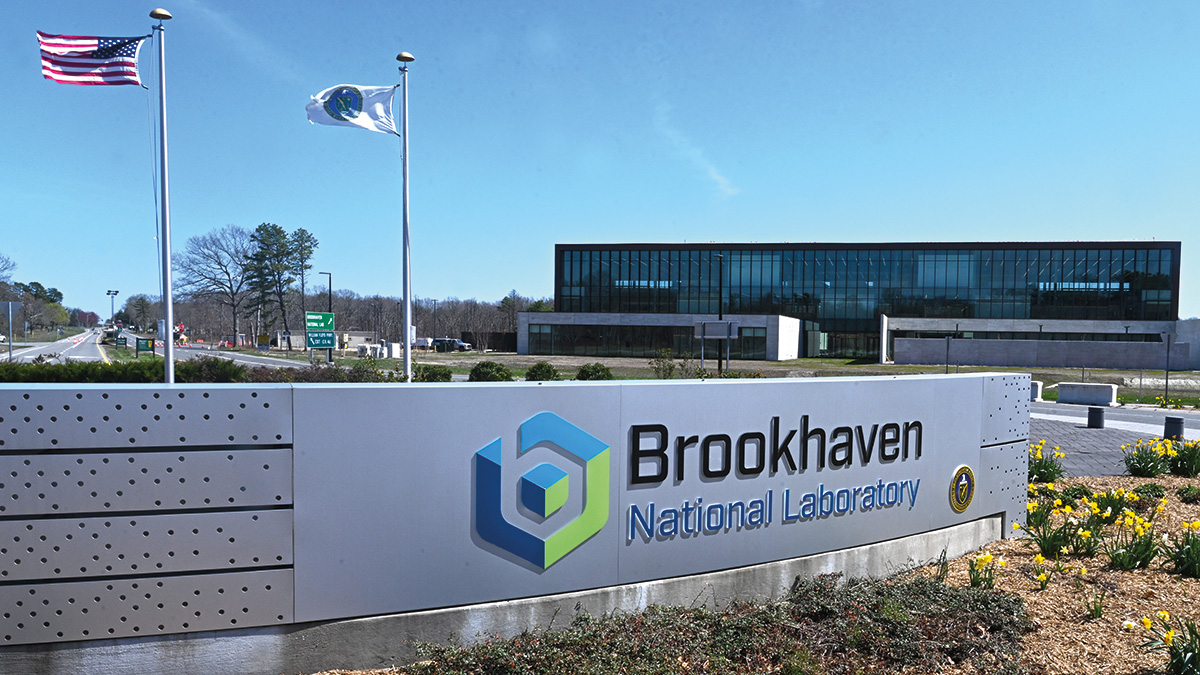
From 27 to 29 May 2026, LoopFest returned to Brookhaven National Laboratory, where the conference series started in 2002. Since then, LoopFest has been held each year across universities and national laboratories in the US and, more recently, Canada. With around 60 participants, this year’s edition provided a forum for discussing the latest results in precision quantum field theory (QFT), along with their applications to interpreting current experimental results and anticipating the precision reach of future experiments, primarily in collider physics. Its cousin event, the Loops and Legs symposium, was hosted last April in Bayreuth, Germany.
Talks highlighted impressive developments in multi-loop and multi-leg calculations, in matching fixed-order higher-order calculations with multi-purpose parton-shower event generators, and in the evaluation of parton distribution functions for precision measurements. Areas central to the precision-physics programme of the LHC, such as differential measurements of Higgs-boson and top-quark processes, received particular attention, while dedicated talks turned to future e+e– machines. There, the main challenge will be for theory to equal the extreme experimental accuracy expected for electroweak precision observables.
Exquisite control
Matching the precision of the High-Luminosity LHC and future e+e– colliders is vital for future discoveries. This endeavour will require exquisite control of theoretical predictions, at the (sub)percent and permille level, respectively, and already poses issues that are both technical and conceptual. Most importantly, aiming for extreme precision could not only enable the indirect discovery of new physics, but also lead to new insights into the fundamental structures of quantum field theory. Several talks stressed this point, some reviewing cutting-edge studies of amplitudes in N = 4 super Yang–Mills theories, others the impact of recent advances in quantum amplitudes for gravitational waves from black-hole scattering.
If anomalies emerge from precision studies, their interpretation will be equally challenging. Multiple contributions traced the state of the art of Standard Model effective field theory (SMEFT) calculations. SMEFT extends the Standard Model with a series of higher-dimensional operators built from its own fields, so that the imprint of unknown heavy particles is captured by small shifts in couplings. It is a common way to explore physics beyond the Standard Model under very general assumptions.
A dedicated effort to provide the dimension-6 SMEFT Lagrangian at the first non-trivial order of quantum corrections is reaching completion and will become a fundamental building block for future studies. Results from a global fit of the SMEFT Lagrangian – including, for the first time, a broad spectrum of electroweak, Higgs-boson, top-quark, Drell-Yan, di-boson and flavour observables – were presented as a proof of concept of how the SMEFT could help explore models of new physics.
New ways to apply artificial intelligence/machine learning and quantum information science have opened up
Finally, the focus shifted to how the groundbreaking ideas that have transformed the theoretical calculation of scattering amplitudes have also opened new ways to apply artificial intelligence/machine learning (AI/ML) and quantum information (QI) science. This is creating new opportunities to rethink how loop calculations are performed, potentially overcoming longstanding computational bottlenecks and enabling qualitatively new approaches and conceptual frameworks. For instance, recent work has explored the application of reinforcement learning, supervised regression and self-supervised learning to some of these problems.
At the same time, generative models – including normalising flows and diffusion-inspired methods – have already demonstrated impressive gains in Monte Carlo integration and importance sampling, the random-sampling methods used to evaluate the high-dimensional integrals underlying cross-section predictions. Since precision QFT calculations are quantum-mechanical at heart, a genuinely quantum computation of precision scattering opens the door to synergies with QI studies of collider processes. Some talks asked how far a future quantum computer could help study QFT processes from a QI perspective, to best exploit the precision data produced by colliders like the LHC.
Extended reach
Overall, LoopFest conveyed the impressive theoretical progress achieved in recent years, enabling the exploration of new physics through precision measurements at current and future experiments. Ground-breaking methods developed during the last two decades have progressed rapidly and are now entering a mature phase, providing a robust framework within which future technical and conceptual challenges can be identified and addressed. Combined with new emergent technologies such as AI/ML and QI, this could extend the reach of current precision-physics programmes far beyond expectations.