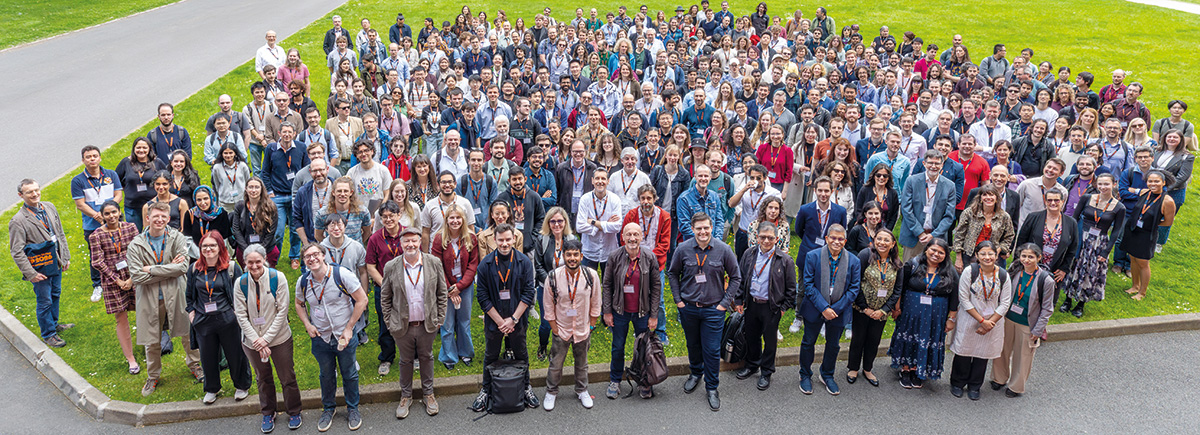
From 18 to 22 May, the 14th Large Hadron Collider Physics conference (LHCP 2026) brought 424 physicists to Sorbonne University’s Pierre and Marie Curie campus, in Paris. Over five days of plenary talks, parallel sessions and poster presentations, the ALICE, ATLAS, CMS and LHCb collaborations, and the theory community, presented a flurry of new results, alongside updates on detector upgrades for the High-Luminosity LHC (HL-LHC) phase. The picture that emerged was of a Standard Model (SM) holding up under ever-sharper scrutiny, with experimental uncertainties increasingly rivalling those from theory.
Direct implications
When ATLAS and CMS discovered the Higgs boson, in 2012, they did so with only about 10 fb–1 of data. Today, the field they opened is entering the era of precision measurements. The Higgs production rate measured across all channels after Run 2 of the LHC agrees with the SM prediction within 5%, and theory is now the dominant source of uncertainty. A preliminary combination of the four most precise ATLAS and CMS measurements using Run 1 and Run 2 data yields mH = 125.09 ± 0.07 GeV, a precision of 0.6‰ that places the Higgs mass among the best-known parameters of the SM, with direct implications for the stability of the electroweak vacuum.
Precision measurements of fundamental SM parameters continue to advance on multiple fronts. CMS and LHCb measured the W- and Z-boson masses to be 80360.2 ± 9.9 MeV and 91184.2 ± 9.3 MeV, respectively. Together with the ATLAS + CMS combined top-quark mass of 172.52 ± 0.33 GeV and the strong coupling αs (see How strong is the strong interaction?), determined by a wide range of experiments and methods, these results provide essential inputs to global electroweak fits. Vector-boson scattering, first observed during Run 2, has now also been established in Run-3 data in the WW, WZ and ZZ channels, and ATLAS and CMS presented first evidence for ZZγ production, the smallest cross-section yet measured at the LHC.
The picture that emerged was of a Standard Model holding up under ever-sharper scrutiny
The Higgs-boson mass tells us how sharply the Higgs potential curves at its minimum, but not its full shape. The self-coupling λ, which provides a first look beyond the minimum, bears on whether the electroweak vacuum is truly stable, and therefore on the ultimate fate of our universe (CERN Courier January/February 2026 p31). Directly accessing λ requires measuring Higgs pair production, a process roughly a thousand times rarer than single Higgs production and one of the most ambitious goals of the LHC and HL-LHC programme. Combining their Run-2 searches, ATLAS and CMS constrained κλ, the measured self-coupling divided by its SM value, to between –0.71 and 6.1 at 95% confidence level (CL). Newly presented HH analyses using Run-3 data in the HH → bbbb, HH → bbγγ and HH → bbWW channels significantly improved on the sensitivity of the Run-2 measurements, even with smaller datasets, thanks to refined analysis techniques. ATLAS also presented the first search for ttHH production, excluding cross-sections above 20 times the SM prediction at 95% CL.
Sharpening up
In the flavour sector, LHCb and CMS presented new precision results on the Cabibbo–Kobayashi–Maskawa matrix angles γ and β, with CMS measuring time-dependent CP violation in neutral B decays using the full Run-3 statistics. These measurements provide increasingly stringent tests of the unitarity triangle and sharpen the sensitivity to potential new-physics contributions.
Quantum chromodynamics (QCD) governs both the dominant and some of the least understood processes at the LHC. New results on the dead-cone effect, the suppression of gluon radiation close to the flight direction of a massive quark, confirm simulation predictions and reveal large differences between b and light quarks. The catalogue of bound states keeps growing as well, with new exotic ones from LHCb bringing the number of hadrons discovered at the LHC to 82 and toponium candidates coming from ATLAS and CMS (CERN Courier May/June 2026 p8). The first oxygen–oxygen and neon–neon collisions at the LHC, delivered in 2025, offered several different views of the quark–gluon plasma, from collective flow to nuclear geometry (CERN Courier November/December 2025 p8). Among them, the rates at which J/ψ and Υ mesons melt in the medium and re-form from it differ distinctly from those seen in lead–lead.
The most interesting years may still lie ahead
Some 90 theorists attended, with many young researchers presenting new ideas and precision calculations reaching next-to-next-to- and next-to-next-to-next-to-leading order accuracy for key benchmark processes. The SM effective-field-theory framework has become a central tool for interpreting precision data and probing new physics indirectly, while lattice QCD has matured into an indispensable tool for controlling flavour observables. Achieving consistent precision across perturbative calculations, parton distribution functions, parton showers and hadronisation remains a major challenge, and reliable uncertainty estimates are now as important as the higher perturbative orders themselves.
An extensive beyond-the-SM programme covered supersymmetry, dark matter, exotic Higgs decays and rare processes, with much emphasis on searches for long-lived particles. No discovery has emerged, but exclusion limits now reach multi-TeV scales, driven by new triggers, dedicated reconstruction and dramatic machine-learning improvements deployed at every stage of the analysis chain.
Bright lights
The LHC has delivered luminosity at an extraordinary rate. With more than 1 ab–1 of collisions provided to ATLAS and CMS, half of which in the last two and a half years, the field has firmly entered the attobarn era. Improved analysis techniques are now providing sensitivity gains that rival integrated luminosity itself, through better efficiencies and signal-to-background discrimination. The most interesting years may still lie ahead, with progress being driven by the ingenuity and creativity of the young community.