Comsol -leaderboard other pages

Topics

Superconducting magnets: an enabling technology for the discovery of the Higgs boson

By clicking the “Watch now” button you will be taken to our third-party webinar provider in order to register your details.

Want to learn more on this subject?

This webinar is focused on the technology of the superconducting magnets used in the LHC. After reviewing the equations for an electromagnet, we show how superconductivity enables much larger magnetic fields in very compact devices, thanks to the possibility of increasing the current density in the windings by more than two order of magnitudes with respect to resistive conductors. We then outline the development of superconducting accelerator magnets from the ISR quadrupoles, up to the LHC and beyond.

We conclude by describing the successive increases of LHC energy since 2008 up to the 6.8 TeV per beam recently achieved, and show how the control of field imperfections has been an essential element for reaching the ultimate luminosity.

Want to learn more on this subject?

Ezio Todesco was born in Bologna Italy, where he got a PhD in physics. In the 90’s, after a master thesis at CERN, he worked at the Italian national institute of nuclear physics (INFN) on topics related to nonlinear dynamics of particle accelerators, and long-term stability in the planned Large Hadron Collider. He joined the magnet group at CERN in 1998, and has been in charge of the field quality follow-up of the LHC main dipoles and quadrupole during the five-year-long magnet production. After the completion of the production phase, he has been in charge of the magnetic field model of the LHC, following the initial commissioning and the successive energy increases up to 13 TeV centre of mass. Then, he has been involved in the studies of the LHC luminosity upgrade, and he leads the interaction region magnets for HL-LHC since the beginning of the project in 2015.


RF technology for LHC and HL-LHC

By clicking the “Watch now” button you will be taken to our third-party webinar provider in order to register your details.

Want to learn more on this subject?

This webinar, presented by Frank Gerigk, will provide an overview of the LHC RF system, its superconducting cavities and RF power system. It also introduce the changes, which will be implemented to accelerate the high-intensity beams of the HL-LHC era.

Join this webinar to:
• Learn about the technology that accelerates LHC protons from 450 GeV to 7 TeV.
• Appreciate the development of the superconducting cavities used in the LHC.
• Understand how the LHC system will be modified for HL-LHC and how crab cavities will increase the number of collisions.

Want to learn more on this subject?

Frank Gerigk is the leader of the Radio Frequency (RF) Group at CERN. After graduating at the Technical University Berlin in 1999, he came to CERN as a fellow to work on RF and beam dynamics for linear accelerators. In 2002, he became staff member at the Rutherford Appleton Laboratory in the UK, continuing with beam dynamics and focussing on halo development in hadron beams. After his return to CERN in 2005, Frank joined the RF group and soon became responsible for the Linac4 RF cavities. He became section leader for Linac RF in 2012, and then for Superconducting RF in 2018. Since 2020 he has been leading the RF group in the new Systems Department.


Council decides new measures for Russia and Belarus

Open meeting of the June Council

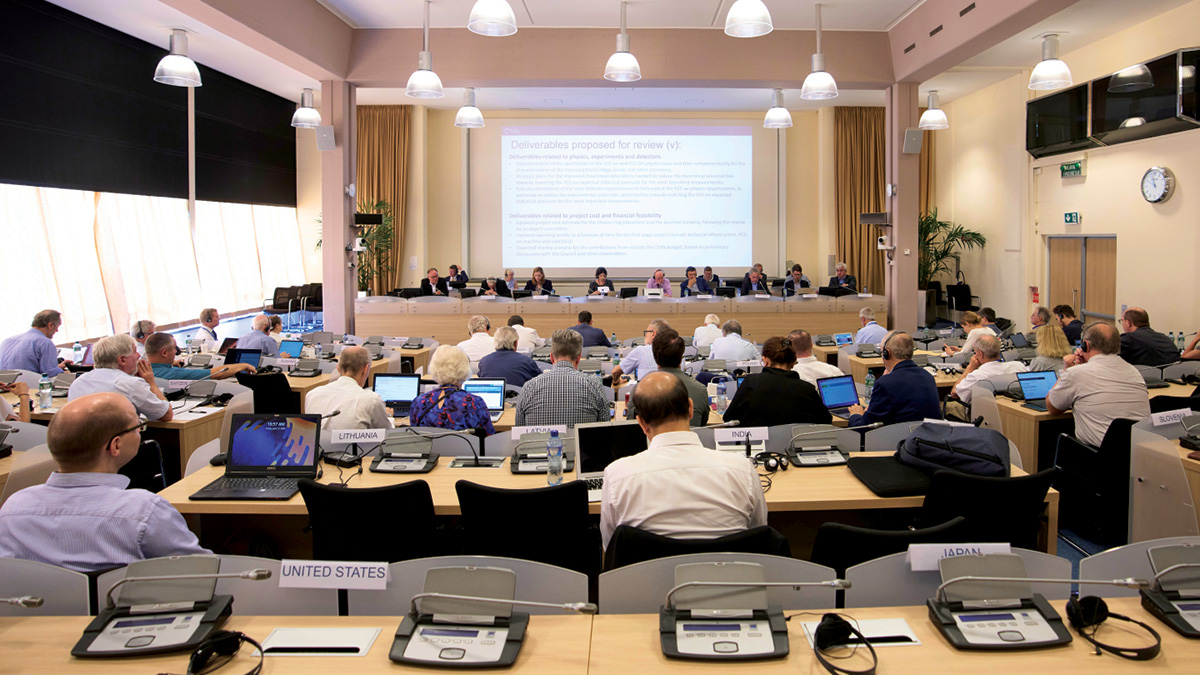
At its 208th meeting on 16 June, the CERN Council announced further measures in response to the continuing illegal military invasion of Ukraine by the Russian Federation with the involvement of the Republic of Belarus. The Council declared that it intends to terminate CERN’s International Cooperation Agreements (ICAs) with both countries at their expiration dates in 2024. However, the situation will continue to be monitored carefully and the Council stands ready to take any further decision in the light of developments in Ukraine.

CERN’s ICAs normally run for five years and are tacitly renewed for the same period unless a written notice of termination is provided by one party to the other at least six months prior to the renewal date. The ICA with the Russian Federation expires in December 2024, and that with the Republic of Belarus in June 2024.

The latest measures follow those already adopted at an extraordinary meeting of the Council on 8 March, and at the Council’s regular session on 25 March. In addition to the promotion of initiatives to support Ukrainian collaborators and Ukrainian scientific activity in high-energy physics, these measures included the suspension of Russia’s Observer status and the decision not to engage in new collaborations with Russia and its institutions until further notice (CERN Courier May/June 2022 p7). 

The Council also decided in June to review CERN’s future cooperation with the Joint Institute for Nuclear Research (JINR) well in advance of the expiration of the current ICA in January 2025. This follows measures adopted at the previous Council sessions to suspend the Observer status of JINR and the participation of CERN scientists in all JINR scientific committees, and vice versa, until further notice. The Council reaffirmed that all decisions taken to date, along with the actions undertaken by the CERN management, which have had a marked impact on the involvement of the Russian Federation and the Republic of Belarus in the scientific programme of the organisation, remain in force. 

Ukraine joined CERN as an Associate Member State in 2016 and Ukrainian scientists have long been active in many of the laboratory’s activities. Russian scientists also have a long and distinguished involvement with CERN, and Russia was granted Observer status in recognition of its contributions to the construction of the LHC. At the June Council meeting, the Member States reiterated their denunciation of the continuing illegal military invasion, recalling that the core values of CERN (CERN Courier September/October 2022 p49) have always been based upon scientific collaboration across borders as a driver for peace, and stressing that the aggression of one country against another runs counter to these values.

Tour de QCD and beyond

The 56th Rencontres de Moriond on QCD and High Energy Interactions took place at the Italian resort of La Thuile from 19 to 26 March. More than 100 participants, almost equally split between experimentalists and theorists, were treated to an exciting scientific programme and many in-person interactions, which were especially appreciated after two years of pandemic isolation.

Keeping with the tradition of Moriond, several new experimental results were presented by major experimental collaborations, with participants enjoying ample opportunities to debate cases where measurements and theoretical predictions do not agree. Held 10 years after the Higgs discovery, the conference started with a review of how the Higgs boson came of age – from early exploration to a precision era. An exciting mix of new precision results and interesting observations in Higgs physics were presented, including the first measurement of the Higgs-charm coupling as well as studies of off-shell Higgs production and di-Higgs production by the ATLAS and CMS collaborations.

The first observation of tqγ production by ATLAS as well as many measurements in top-quark physics, including a mass measurement based on single top quarks by CMS, were discussed. Many recent studies of Z and W bosons and their interactions were reported, including a new CMS result that resolved an earlier mild LEP tension in the decay rates of W bosons to leptons, and the observation of triple-W production at the LHC by ATLAS. The LHCb collaboration presented its first measurement of the W mass, while CMS discussed the first observation of WW and triple-J/ψ production in double-parton scattering.

Several sessions were devoted to flavour measurements and anomalies, including possible lepton-flavour universality violations in B-meson decays. LHCb presented the most precise value of the CKM matrix angle γ measured in a single experiment, as well as the most precise measurement of the charm-mixing parameter yCP. New results on lepton-flavour universality attracted a lot of attention. Among them are LHCb’s measurement of the ratio of Br(B+ → K+μ+μ–) to Br(B+ → K+e+e–), which is 3.1σ away from the SM, new LHCb limits on rare B0 decays, and the CMS measurement of the Drell–Yan forward–backward asymmetry difference between di-muons and di-electrons. The status of selected Standard Model (SM) calculations was described with the conclusion that the predictions are robust and therefore possible deficiencies of the SM a very unlikely source of the flavour anomalies. A number of talks demonstrated that there are many ways to accommodate the flavour anomalies into a consistent physics picture, which predicts subtle signals at the LHC that could have easily evaded detection so far.

Several speakers emphasised the importance of new creative analysis concepts

Continuing the topic of searches for new physics, several speakers emphasised the importance of new creative analysis concepts, including searching for anomalous energy losses, non-pointing tracks, delayed photons, displaced jets, displaced collimated leptons and tagging missing mass with forward detectors. Among the results of many interesting searches presented at Moriond, a 3σ excess in the number of highly ionising particles reported by the ATLAS collaboration caused some excitement and discussion, indicating that further studies (and statistics!) are very much needed.

Several talks presented theoretical predictions at high orders of perturbative QCD for basic SM processes at the LHC and future lepton colliders, such as the Drell–Yan and jet-production processes. These tour de force computations, representing cutting-edge applications of quantum field theory to collider physics, force us to think about how such advances in the theory of hard hadron collisions can be used to search for physics beyond the SM. Several talks addressed this issue by considering specific physics examples pointing towards new, exciting opportunities during LHC Run 3.

Emphasising the need for a refined knowledge of the fundamental input parameters used to describe hadron collisions, four new extractions of the strong coupling constant were reported, based on HERA, CDF, LEP and CMS data. The role of precision deep-inelastic scattering (HERA) and W/Z (ATLAS/CMS) data in constraining parton distribution functions was clearly elucidated.

An element of nonperturbative QCD that keeps theorists on their toes is hadronic spectroscopy

Turning towards the non-perturbative sector of QCD, a measurement of Λc production down to zero transverse momentum allowed the ALICE collaboration to extract the total charm cross-section in pp collisions. Interestingly, the fraction of Λc is significantly above the e+e– baseline. Jet substructure measurements presented by ALICE and CMS allow a detailed comparison to Monte Carlo event generators. Furthermore, the first direct observation of the dead-cone effect, a suppression of forward gluon radiation in case of a massive emitter, was presented by the ALICE collaboration using charm-tagged jets.

An element of non-perturbative QCD that keeps theorists on their toes is hadronic spectroscopy. This trend continued at Moriond where the discoveries of several new states were presented, including the same-sign doubly charmed T+cc (c–c–u–d) (LHCb) and the Z–cs (c–c–s–u) (BES III). The exploration of the χc1, earlier known as X(3872), with the hope of revealing its molecular or tetraquark nature, continues in pp as well as in PbPb collisions.

The best constraint of the charm diffusion coefficient in the quark–gluon plasma (ALICE), jet quenching studies with Z-hadron correlations (CMS) and surprising results on ridge structures in γp and γPb collisions (ATLAS) were presented during a dedicated heavy-ion session. Interestingly, by studying the abundant nuclei produced in heavy-ion collisions, the ALICE collaboration ruled out simple coalescence models for antideuteron production in PbPb collisions.

Finally, the current status of the muon anomalous magnetic moment was reviewed. The experimental value presented last year by the Fermilab g-2 collaboration shows a 1.5–4.2σ discrepancy with the SM prediction, depending on the theoretical baseline. An interesting comparison between continuum and lattice computations of the hadronic vacuum polarisation contributions was presented, and a new lattice result on hadronic light-by-light scattering was described, indicating that this “troublemaking” contribution is being brought under theoretical control.

Exciting experimental results and developments in the theory of QCD and high-energy interactions that, perhaps, remained somewhat hidden during the pandemic years, were on full display at Moriond, making the 56th edition of this conference a resounding success.

Sylvie Rosier-Lees 1961–2022

Sylvie Rosier-Lees left us on 14 March 2022 following a long illness, which she endured with immense courage. Following her studies at the Ecole normale supérieure de Fontenay-Saint-Cloud, Sylvie began her research career in 1985 with a thesis on the L3 experiment at LEP. There were several of us – new to the Laboratoire d’Annecy de Physique des Particules (LAPP) at the time – with the idea of strengthening the existing L3 team, and Sylvie was our first student. Her inquisitive mind, tenacity and ability to face experimental problems – in particular concerning the calibration of the BGO crystals – quickly made her stand out within the collaboration. 

Before becoming a highly regarded specialist in supersymmetry, she studied the identification of B mesons produced in Z decays, which made it possible to contribute to the first measurements of the B°–B° mixing parameter as well as the forward–backward asymmetry. Supersymmetry and the search for the neutralino set Sylvie on the quest for dark matter, to which she subsequently dedicated her entire career. In 2000 she joined the Alpha Magnetic Spectrometer (AMS) collaboration – a particle-physics detector installed on the International Space Station to identify and measure fluxes of cosmic rays. She took over responsibility for the readout electronics of the electromagnetic calorimeter, introducing independent rapid triggering based solely on calorimetry. Resistance to radiation, extended temperature range, low power consumption and operation in vacuum were all technical challenges that were met thanks to Sylvie’s scientific rigour and exceptional human qualities. She had an enthusiasm and leadership that motivated and led to the success of everyone in her team. More than 15 years after its completion in 2005 and more than 10 years after its first signal on 19 May 2011, the calorimeter’s electronics are still smoothly providing data. With AMS, she searched for dark matter via deformations of antiparticle fluxes, for example in the fraction of positrons detected, one of the first AMS publications 

In 2005 Sylvie created a HESS group at LAPP. The Namibia-based gamma-ray telescope had entered its second phase with the construction of the fifth telescope, the largest with a focal length of 36 m. Sylvie took up the challenge of an ambitious mechanical project to load and unload the camera – a cube 2.5 m high and weighing 2.6 tonnes – from its data-taking position 5 m from the ground to a shelter at ground level. She then explored the potential of the facility for dark-matter searches, since its size allowed the detection threshold of photons to be lowered to 50 GeV.  

Throughout her career, Sylvie maintained close ties with phenomenologists and theorists. This collaboration began at LEP within the framework of a national supersymmetry group, where she coordinated an influential working group on the Minimal Supersymmetric Standard Model. Subsequently, with theorists, she obtained a lower bound on the mass of the lightest neutralino, a candidate for dark matter, by combining astrophysical, cosmological and collider observables. She also notably contributed to the development of an extension of the still widely used micrOMEGAs code, making it possible to calculate the spectrum of positrons and antiprotons coming from the annihilation of dark-matter particles in the galaxy.  

Always positive with students, Sylvie supervised or co-supervised around 10 theses. All these elements earned her the 2017 Joliot-Curie Prize awarded by the French Physical Society. Her enthusiasm, energy and good humour are sorely missed. We are thinking of Jean-Pierre, her husband, and her sons Edouard and Arthur. 

It all starts in the workshop

Florian Hofmann

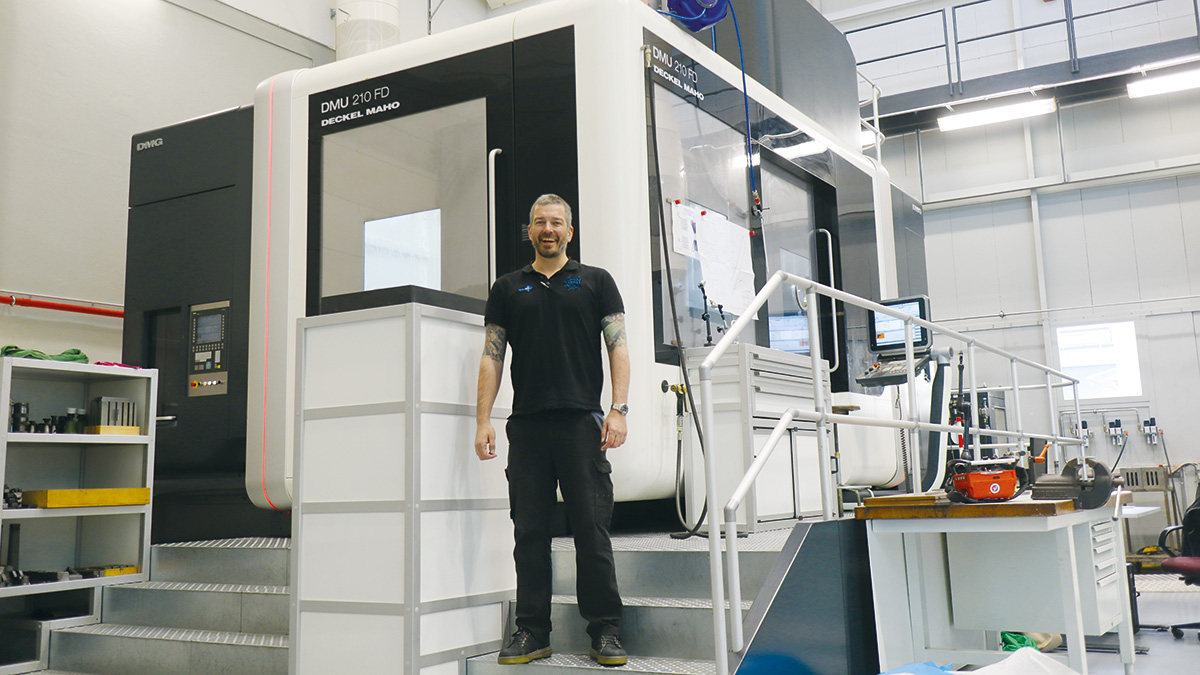
State-of-the-art particle accelerators and detectors cannot be bought off the shelf. They come to life in workshops staffed by teams of highly skilled engineers and technicians – such as heavy-machinist Florian Hofmann from Austria, who joined CERN in October 2019.

Florian is one of several hundred engineers and technicians employed by CERN to develop, build and test equipment, and keep it in good working order. He works in the machining and maintenance workshop of the mechanical and materials engineering (MME) group, which acts as a partner to many projects and experiments at CERN. “We tightly collaborate with all CERN colleagues and we offer our production facility and knowledge to meet their needs,” he explains. “Sometimes the engineers, the project leaders or even the scientists come to see how the parts of their work come together. It is a nice and humbling experience for me because I know they have been conceiving components for a very long time. Our doors are open and you don’t need special permission – everyone can come round!”

Before joining CERN, Florian began studying atmospheric physics at the University of Innsbruck. After two semesters, he realised that even though he liked science he preferred not to practise it, so decided to change to engineering and programming. After completing his studies and working in diverse fields such as automotive, tool making and water power plants, he joined CERN. Like many of his colleagues, his expertise and genuine curiosity for his work helps Florian to find tailor-made solutions for CERN’s challenging projects, every one of which is different, he explains. “Years ago the job used to be a traditional mechanics job, but today the cutting-edge technologies involved make this the Formula One of production.” 

Heavy metal 

Florian is currently working on aluminium joints for the vacuum tank of the kicker magnets for the Proton Synchrotron, a fundamental component on which the technicians collaborate with many other groups. The workshop is also contributing to numerous important projects such as the FRESCA2 cryostat, which is visible at the entry of the workshop, and the crab cavities for the High-Luminosity LHC upgrade. The radio-frequency quadrupole for Linac4, which now drives all proton production at CERN, was built here, as was the cryostat for the ICARUS neutrino detector now taking data at Fermilab and parts of the AMS-02 detector operating on the International Space Station. In the 1960s, the workshop was responsible for the construction of the Big European Bubble Chamber, now an exhibit in the CERN Microcosm.

Today, the cutting-edge technologies involved make this the Formula One of production

Before any heavy-machinery work begins, the machining team simulates the machining process to avoid failures or technical issues during fabrication. Although the software is highly reliable, Florian and his co-workers have to stand by to control and steer the machine, modifying commands when needed and ensuring that the activity is carried out as required. Every machine has one person in charge, the so-called technical referent, but the team receives basic training on multiple machines to allow them to jump onto a different one if necessary. The job stands out for its dynamism, Florian explains. “At the MME workshop, we perform many diverse manufacturing processes needed for accelerator technologies, not only milling and turning of the machine but also welding of exotic materials, among others. The possibilities are countless.”

Florian’s enthusiasm reflects the mindset of the MME workshop team, where everyone is aware of their contributions to the broader science goals of CERN. “This is a team sport. When you join a club you need it to have good management, and I think that here, because of our supervisors and our group responsibility, you are made to feel like everyone is pushing in the same direction.” Being curious, eager to learn and open-minded are important skills for CERN technicians, he adds.

“When you come to CERN you always leave with more than you can bring, because the experience of contributing to science, to bring nations together towards a better world, is really rewarding. I think everybody needs to ask themselves what they want and what kind of world they want to live in.”

Less, better, recover

Energy consumed and delivered

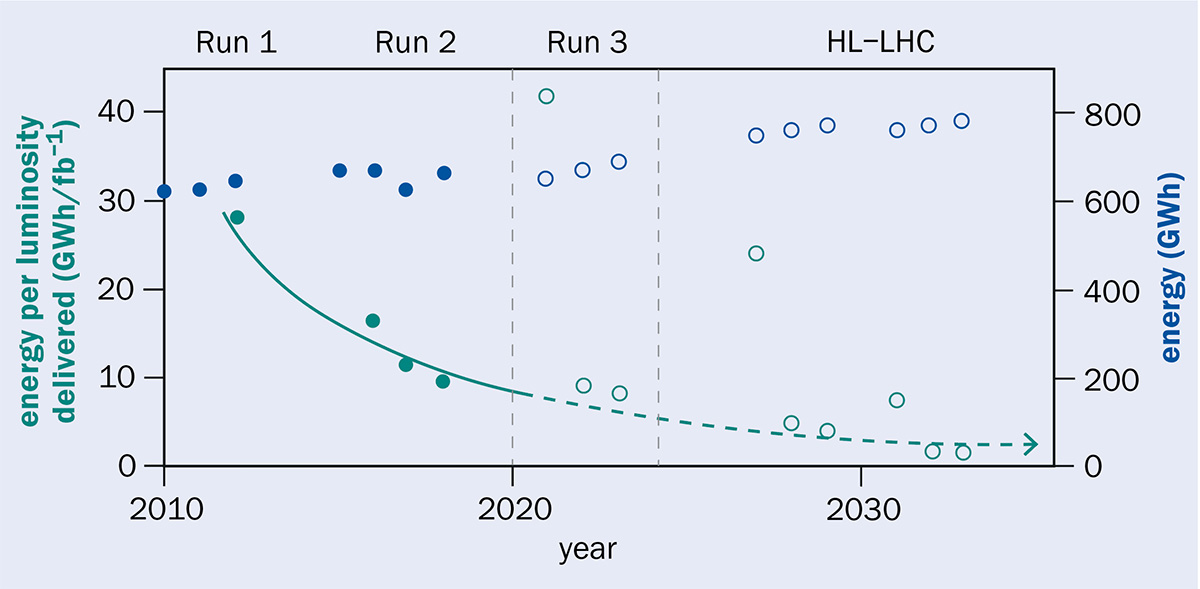
The famous “Livingston diagram”, first presented by cyclotron co-inventor Milton Stanley Livingston in 1954, depicts the rise in energy of particle accelerators as a function of time. To assess current and future facilities, however, we need complementary metrics suited to the 21st century. As the 2020 update of the European strategy for particle physics demonstrated, such metrics exist: instead of weighing up colliders solely on the basis of collision energy, they consider the capital cost or energy consumption with respect to the luminosity produced. 

Applying these metrics to the LHC shows that the energy used during the upcoming Run 3 will be around three times lower than it was during Run 1 for similar luminosity performance (see “Greener physics” figure). The High-Luminosity LHC (HL-LHC) will operate with even greater efficiency. In fact, CERN accelerators have drawn a similar power for a period of 40 years despite their vastly increased scientific output: from 1 TWh for LEP2 to 1.2 TWh for the LHC and possibly 1.4 TWh at the HL-LHC.

The GWh/fb–1 metric has now been adopted by CERN as a key performance indicator (KPI) for the LHC, as set out in CERN’s second environmental report published last year. It has also been used to weigh up the performance of various Higgs factories. In 2020, for example, studies showed that an electron–positron Future Circular Collider is the most energy efficient of all proposed Higgs factories in the energy range of interest. But this KPI is only part of a larger energy-management effort in which the whole community has an increasingly important role to play. 

In 2011, with the aim to share best practices amongst scientific facilities, CERN was at the origin of the Energy for Sustainable Science at Research Infrastructures workshop series. A few years later, prompted by the need for CERN to move from protected-tariff to market-based electricity contracts, the CERN energy management panel was created to establish solid forecasts and robust monitoring tools. Each year since 2017, we send virtual “electricity bills” to all group leaders, department heads and directors, which has contributed to a change of culture in the way CERN views energy management. 

Best practice

Along with the market-based energy contract, energy suppliers have a duty by law (with tax-incentive mechanisms) to help their clients consume less. A review of energy consumption and upgrades conducted between CERN and its electricity supplier EDF in 2017 highlighted best practices for operation and refurbishment, leading to the launch of the LHC-P8 (LHCb) heat-recovery project for the new city area of Ferney-Voltaire. Similar actions were proposed for LHC-P1 (ATLAS) to boost the heating plant at CERN’s Meyrin site, and heat recovery has been considered as a design and adjudication parameter for the new Prevessin Computer Centre. Besides an attractive 5–10 year payback time, such programmes make an important contribution to reducing CERN’s carbon footprint.

Serge Claudet

Energy efficiency and savings are an increasingly important element in each CERN accelerator infrastructure. Completed during Long Shutdown 2, the East Area renovation project led to an extraordinary 90% reduction in energy consumption, while the LHC Injectors Upgrade project also offered an opportunity to improve the injectors’ environmental credentials. Energy economy was also the primary motivation for CERN to adopt new regenerative power converters for its transfer lines. These efforts build on energy savings of up to 100 GWh/y since 2010, for example by introducing free cooling and air-flow optimisation in the CERN Computer Centre, and operating the SPS and the LHC cryogenics with the minimum of necessary machines. CERN buildings are also aligning with energy- efficiency standards, with the renovation of up to two buildings per year planned over the next 10 years. 

There will be no future large-scale science projects without major energy-efficiency and recovery objectives

This year, a dedicated team at CERN is being put together concerning alignment with the ISO50001 energy-management standard, which could bring significant subsidies. A preliminary evaluation was conducted in November 2021, demonstrating that 54% of ISO expectations is already in place and a further 15% is easily within reach. 

The mantra of CERN’s energy-management panel is “less, better, recover”. We also have to add “credible” to this list, as there will be no future large-scale science projects without major energy-efficiency and recovery objectives. Today and in the future, we must therefore all work to ensure that every MWh of energy consumed brings demonstrable scientific advances.

Claude Bouchiat 1932–2021

Claude Bouchiat

Theoretical physicist Claude Bouchiat, who was born in Saint-Matré (southern France) on 16 May 1932, passed away in Paris on 25 November. He was a frequent visitor to the CERN theory group. 

Bouchiat studied at the École Polytechnique in 1953–1955, and discovered theoretical high-energy physics after listening to a seminar by the late Louis Michel. In 1957, having been impressed by a conference talk given by C N Yang during a short visit to Paris, he decided to extend Michel’s results on the electron spectrum in muon decays to include the effects of parity violation. This work led to the Bouchiat–Michel formula. He then joined the theoretical physics laboratory (newly created by Maurice Lévy) at the University of Orsay where, together with Philippe Meyer, he founded a very active group in theoretical particle physics. In the 1960s, during several visits to CERN, he collaborated with Jacques Prentki. In 1974 Bouchiat and Meyer moved to Paris and established the theoretical physics laboratory at the École Normale Supérieure (ENS). 

Bouchiat’s research covered a large domain that extended beyond particle physics. With Prentki and one of us (JI) he studied the leading divergences of the weak interactions, which was a precursor to the introduction of charm, and with Daniele Amati and Jean-Loup Gervais showed how to build dual diagrams satisfying the unitarity constraints. The trio also extended the anomaly equations in the divergence of the axial current to non-abelian theories. In the early 1970s, Bouchiat and collaborators used quantum field theory in the infinite momentum frame to shed light on the parton model. In 1972, with Meyer and JI, he formulated the anomaly cancellation condition for the Standard Model, establishing the vanishing sum of electric charges for quarks and leptons as essential for the mathematical consistency of the theory.

Probably his most influential contribution, carried out with his wife Marie-Anne Bouchiat, was the precise computation of parity-violation effects resulting from virtual Z-boson exchange between electrons and nuclei. They pointed out an enhancement in heavy atoms that rendered the tiny effect amenable to observation. This work opened a new domain of experimental research, starting first at ENS, which played an important role alongside the high-energy experiments at SLAC in confirming the structure of the weak neutral current. Examples of Bouchiat’s contributions outside particle physics include his studies of the elasticity properties of DNA molecules and of the geometrical phases generated by non-trivial space topology in various atomic and solid-state physics systems. 

During his 60-year-long career, Claude Bouchiat had a profound influence on the development of French theoretical high-energy physics. He helped nurture generations of young theorists, and many of his former students are well-known physicists today. 

The LHC experience up close

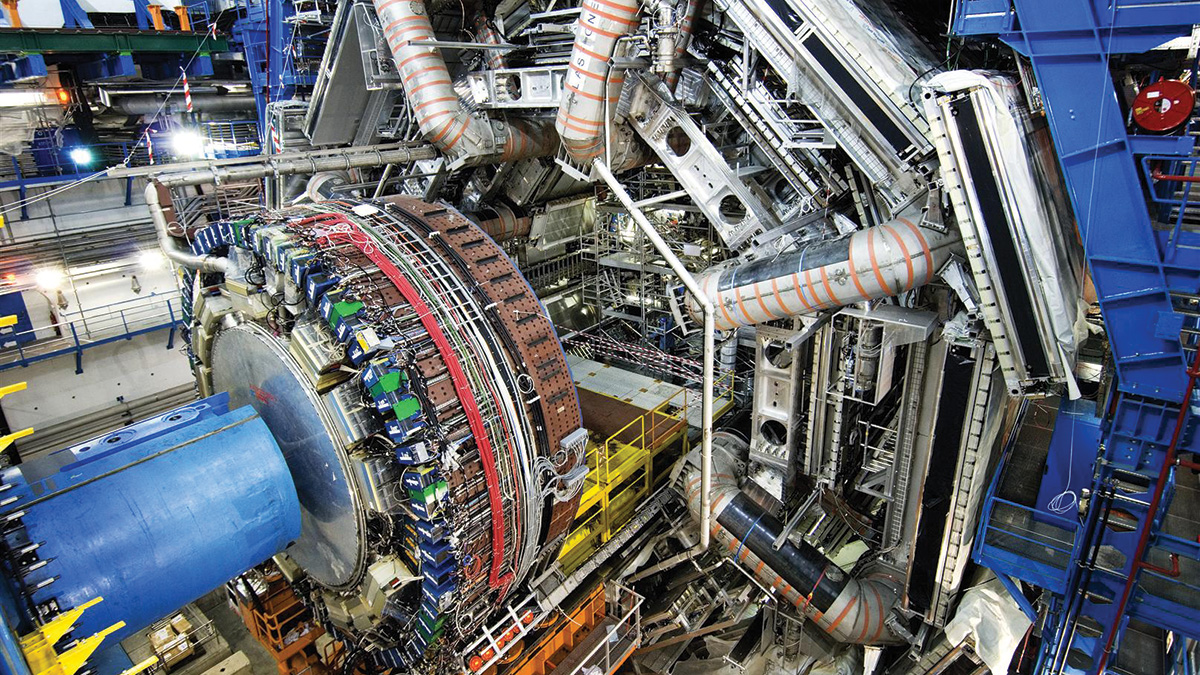
ATLAS end-cap calorimeter and toroidal magnet

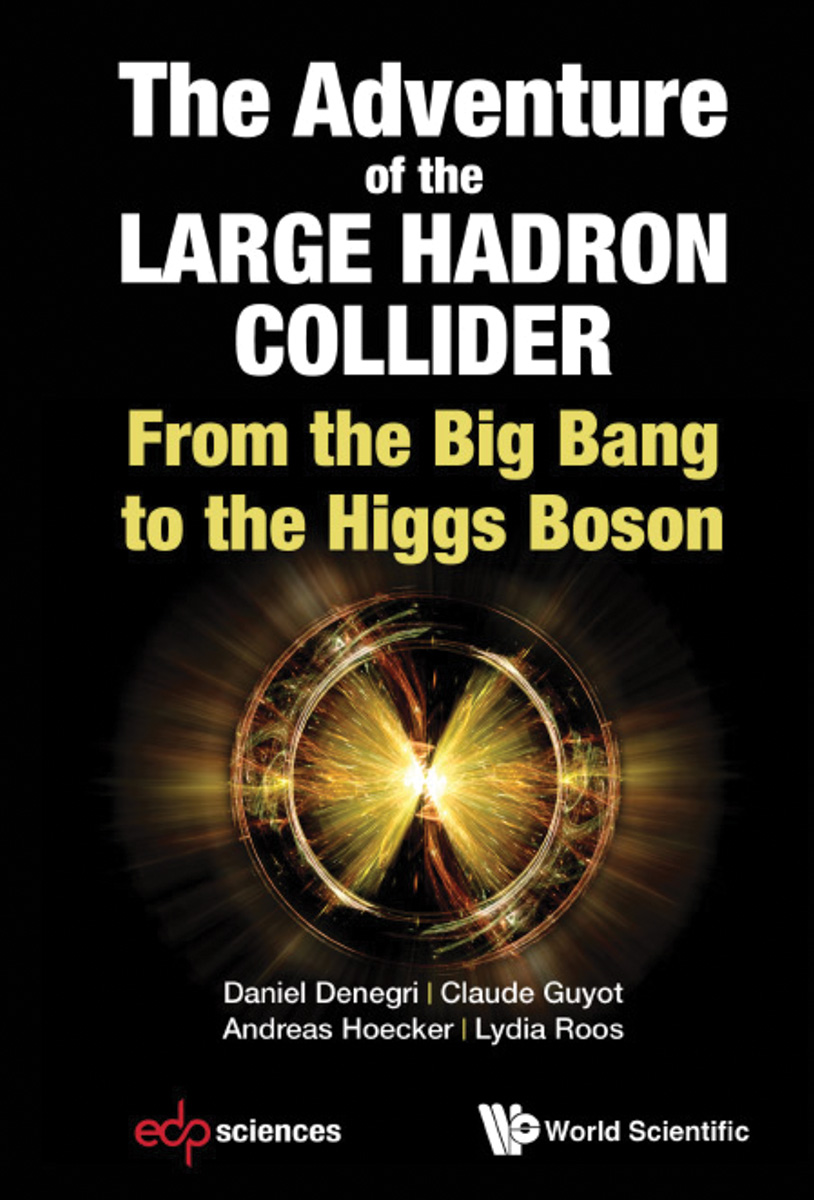
With this ambitious book, the authors have produced a unique and excellent account of particle physics that goes way beyond a description of the LHC project. Its 600 pages are a very pleasant, although tough in places, read. The book serves as a highly valuable refresher of modern concepts of particle physics, recalling theoretical ideas as well as explaining advanced detector technologies and analy­sis methods that set the stage for the LHC experiments and the Higgs-boson discovery. Even though the focus converges on the Higgs boson, the full LHC project and its rich physics playground are well covered, and furthermore embedded in the broader context of particle physics and cosmology, as the subtitle indicates.

In a way, it is a multi-layered book, which makes it appealing for the selective reader. Each layer is in itself of great value and highly recommendable. The overarching presentation is attractive, with great photos, nicely prepared graphics and diagrams, and a clear structure guiding readers through the many chapters. Quite unique are the more than 50 inserted text boxes, typically one to three pages long, which explain in a concise way the concepts used in the main text. Experts may wish to skip some of them, but they are very educational (at least as a refresher) for most readers, as they were for me. The text boxes are ideal for students and science enthusiasts of all ages, although some are more demanding than others. 

To start, the authors take the reader off into a substantial 170-page introduction to particle physics in general, and to the Standard Model (SM) in particular. Its theoretical ideas and their mathematical formulations, as well as its key experimental foundation, are clearly presented. The authors also explore with a broad view what the SM cannot explain. Some material in these introductory chapters are the most demanding parts of the book. The theoretical text boxes are a good opportunity for physics students to recall previously-acquired mathematical notions, but they are clearly not meant for non-experts, who can readily skip them and concentrate more on the very nicely documented historical accounts. A short and accessible chapter “Back to the Big Bang” concludes the introductions by embedding particle physics into the broader picture of cosmology.

The Adventure of the Large Hadron Collider

Next, the LHC and the ATLAS and CMS experiments enter the stage. The LHC project and its history is introduced with a brief reminder of previous hadron colliders (ISR, Spp–S and Tevatron). The presentation of the two general-purpose detectors comes with a short refresher on particle detection and collider experiments. Salient technical features, and collaboration aspects including some historical anecdotes, are covered for ATLAS and CMS. The book continues with the start-up of the machine, including the scary episode of the September 2008 incident, followed by the breathtaking LHC performance after the restart in November 2009 with Runs 1 and 2, until Long Shutdown 2, which began in 2019.

The story of the Higgs-boson discovery is set within a comprehensive framework of the basics of modern analysis tools and methods, a chapter again of special value for students. Ten years later, it is a pleasure to read from insiders how the discovery unfolded, illustrated with plenty of original physics plots and photographs conveying the excitement of the 4 July 2012 announcement. A detailed description of the rich physics harvest testing the Higgs sector as well as challenging the SM in general provides an up-to-date collection of results from the LHC’s first 10 years of physics operations. 

A significant chapter “Quest for new physics” follows, giving the reader a good impression of the many searches hunting for physics beyond the SM. Their relations to, and motivations from, theoretical speculations and astroparticle-physics experiments are explained in an accessible and attractive way. 

A book about the LHC wouldn’t be complete without an excursion to the physics and detectors of flavour and hot and dense matter. With the dedicated experiments LHCb and ALICE, respectively, the LHC has opened exciting new frontiers for both fields. The authors cover these well in a lean chapter introducing the physics and commenting on the highlights so far. 

A look ahead and conclusion round off this impressive document about the LHC’s main mission, the search for the Higgs boson. Much more SM physics has since been extracted, as is amply documented. However, as the last chapter indicates, the journey to find directions to new physics beyond the SM must go on, first with the high-luminosity upgrades of the LHC and its experiments, and then preparing for future colliders reaching either much higher precision on the Higgs-boson properties or higher energies for exploring higher mass particles. Current ideas for such projects that could follow the LHC are briefly introduced. 

The authors are not science historians, but central actors as experimental physicists fully immersed in the LHC adventure. They deliver lively first-hand and personal accounts, all while carefully respecting the historical facts. Furthermore, the book is preceded by a bonus track: the reader can enjoy an inspiring and substantial foreword by Carlo Rubbia, founding father and tireless promoter for the LHC project in the 1980s and early 1990s.

I can only enthusiastically recommend this book, which expands significantly on the French version published in 2014, to all interested in the adventure of the LHC.

Picture a scientist

Picture a scientist

“If you had to picture a scientist, what would it look like?” That is the question driving the documentary film Picture a Scientist, first released in April 2020 and screened on 10 February this year at the CERN Globe of Science and Innovation. Directed by Emmy-nominated Sharon Shattuck and Ian Cheney, whose previous productions include From This Day Forward (2016) and The Long Coast (2020), respectively, the 97 minute film tackles the difficulties faced by women in STEM careers. It is centered on the experiences of three US researchers – molecular biologist Nancy Hopkins (MIT), chemist Raychelle Burks (St. Edward’s University) and geologist Jane Willenbring (UC San Diego) – among others who have faced various forms of discrimination during their careers.

Hopkins talks about the difficulties she faced as a student in the 1950s and 1960s, when the education system didn’t offer many maths and science lessons to girls, and shares an experience of sexual harassment involving a famous biologist during a lab visit. Willenbring also experienced various mistreatments, including inappropriate nicknames and harassment from a colleague during a 1999 field trip in Antarctica. The film describes how these two anecdotes are just the tip of the iceberg of discrimination that has historically affected female scientists and is still present today. Less visible examples include being ignored in meetings, being treated as a trainee, receiving inappropriate emails and not getting proper credit for work.

Burks, who is Black, explains how the situation is even worse for women of different ethnic groups, as they are even more underrepresented in science. During her childhood, she recalls, most female Black scientists were fictional, such as Star Trek’s communications officer Nyota Uhura.

Being a scientist does not rely on race or gender but only on the love for science

The film highlights the importance of female scientists speaking out to help people see beyond the tip of the iceberg and allow them to act. Hopkins recounts how she once wrote a letter to the president of MIT in which she described systemic and invisible discrimination such as office space being larger for men than for women. Supported and encouraged by female colleagues, it led to a request to the dean of MIT for greater equality. Another example ultimately led the president of Boston University to dismiss the male researcher who had bullied Willenbring, after receiving many reports of gender harassment. 

However, even though progress has been made, the film makes it clear – for example through graphs showing the considerable underrepresentation of women in science – that there is still much to do. “By its own nature science itself should be always evolving,” says Burks: we should be able to identify the idea of a scientist as someone fascinated about research rather than based on its stereotype.

Videos recreating scenes of the bullying described and footage from old TV shows showing the historical mistreatment of women complement candid accounts from those who have experienced discrimination, allowing the viewer to understand their experiences in an impactful way. Some scenes are hard to watch, but are necessary to understand the problem and therefore take steps to increase the recognition of women in STEM careers.

This film raises the often silenced voice of female scientists who have been discriminated against, and makes it clear that being a scientist does not rely on race or gender but only on the love for science. “If you believe that passion and ability for science is evenly distributed among the sexes, then if you don’t have women, you have lost half of the best people,” states Hopkins. “Can we really afford to lose those top scientists?”

bright-rec iop pub iop-science physcis connect