Comsol -leaderboard other pages

Topics

From dreams to beams: SESAME’s 30 year-long journey in science diplomacy

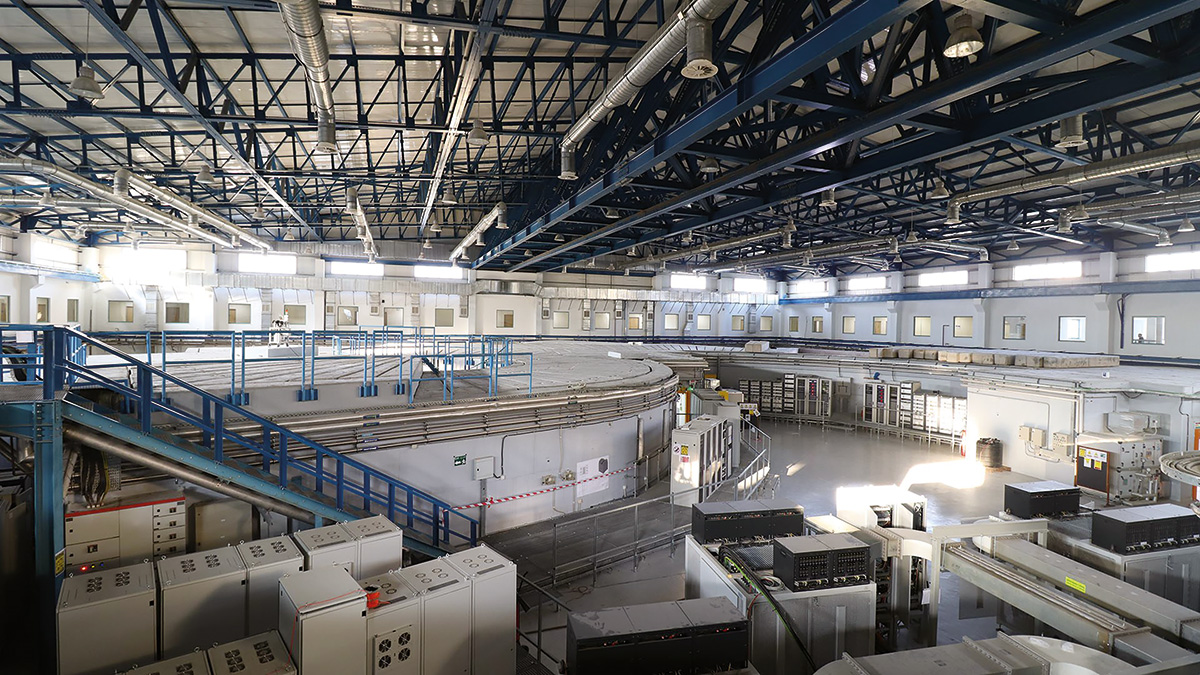
The SESAME booster and storage ring

SESAME (Synchrotron-light for Experimental Science and Applications in the Middle East) is the Middle East’s first major international research centre. It is a regional third-generation synchrotron X-ray source situated in Allan, Jordan, which broke ground on 6 January 2003 and officially opened on 16 May 2017. The current members of SESAME are Cyprus, Egypt, Iran, Israel, Jordan, Pakistan, Palestine and Turkey. Active current observers include, among others: the European Union, France, Germany, Greece, Italy, Japan, Kuwait, Portugal, Spain, Sweden, Switzerland, the UK and the US. The common vision driving SESAME is the belief that human beings can work together for a cause that furthers the interests of their own nations and that of humanity as a whole. 

The story of SESAME started at CERN 30 years ago. One day in 1993, shortly after the signature of the Oslo Accords by Israel and the Palestine Liberation Organization, the late Sergio Fubini, an outstanding scientist and a close friend and collaborator, approached me in the corridor of the CERN theory group. He told me that now was the time to test what he called “your idealism”, referring to future joint Arab–Israeli scientific projects. 

CERN is a very appropriate venue for the inception of such a project. It was built after World War II to help heal Europe and European science in particular. Abdus Salam, as far back as the 1950s, identified the light source as a tool that could help thrust what were then considered “third-world” countries directly to the forefront of scientific research. The very same Salam joined our efforts in 1993 as a member of the Middle Eastern Science Committee (MESC), founded by Sergio, myself and many others to forge meaningful scientific contacts in the region. By joining our scientific committee, Salam made public his belief in the value of Arab–Israeli scientific collaborations, something the Nobel laureate had expressed several times in private.

Participants of the SESAME users’ meeting

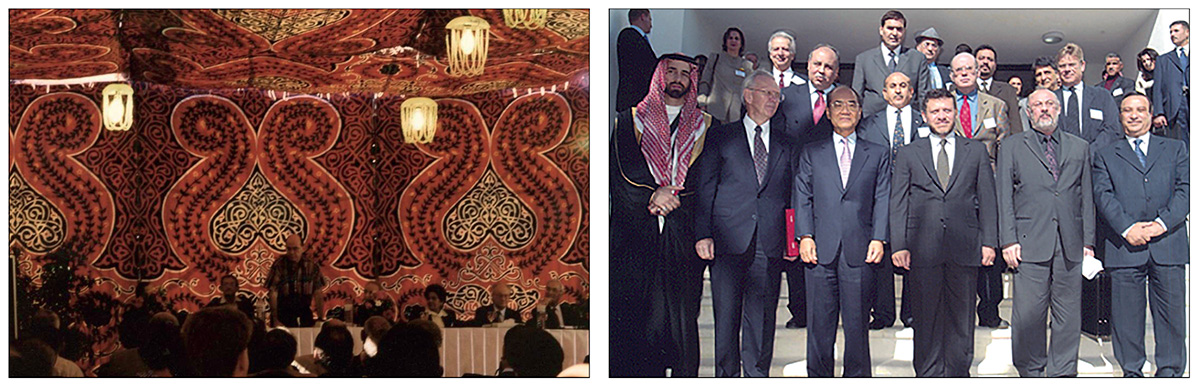
To focus our vision, that year I gave a talk on the status of Arab–Israeli collaborations at a meeting in Torino held on the occasion of Sergio’s 65th birthday. Afterwards we travelled to Cairo to meet Venice Gouda, the Egyptian minister for higher education, and other Egyptian officials. At that stage we were just self-appointed entrepreneurs. We were told that president Hosni Mubarak had made a decision to take politics out of scientific collaborations with Israel, so together we organized a high-quality scientific meeting in Dahab, in the Sinai desert. The meeting, held in a large Bedouin tent on 19-26 November 1995, brought together about 100 young and senior scientists from the region and beyond. It took place in the weeks after the murder of the Israeli prime minister Yitzhak Rabin, for whom, at the request of Venice Gouda, all of us stood for a moment of silence in respect. The silence echoes in my ears to this day. The first day of the meeting was attended by Jacob Ziv, president of the Israeli Academy of Sciences and Humanities, which had been supporting such efforts in general. It was thanks to the additional financial help of Miguel Virasoro, director-general of ICTP at the time, and also Daniele Amati, director of SISSA, that the meeting was held. All three decisions of support were made at watershed moments and on the spur of the moment. The meeting was followed by a very successful effort to identify concrete projects in which Arab–Israeli collaboration could be beneficial to both sides. 

But attempts to continue the project were blocked by a turn for the worse in the political situation. MESC decided to retreat to Torino, where, during a meeting in November 1996, there was a session devoted to studying the possibilities of cooperation via experimental activities in high-energy physics and light-source science. During that session, the late German scientist Gus Voss suggested (on behalf of himself and Hermann Winnick from SLAC) to bring the parts of a German light source situated in Berlin, called BESSY, which was about to be dismantled, to the Middle East. Former Director-General of CERN Herwig Schopper also attended the workshop. MESC had built sufficient trust among the parties to provide an appropriate infrastructure to turn such an idea into something concrete. 

Targeting excellent science 

A light source was very attractive thanks to the rich diversity of fields that can make use of such a facility, from biology through chemistry, physics and many more to archaeology and environmental sciences. Such a diversity would also allow the formation of a critical mass of real users in the region. The major drawback of the BESSY-based proposal was that there was no way a reconstructed dismantled “old” machine would be able to attract first-class scientists and science. 

Around that time, Fubini asked Schopper, who had a rich experience in managing complex experimental projects, to take a leadership position. The focus of possible collaborations was narrowed down to the construction of a large light source, and it was decided to use the German machine as a nucleus around which to build the administrative structure of the project. The non-relations among several of the members presented a serious challenge. At the suggestion of Schopper, following the example of the way CERN was assembled in the 1950s, the impasse was overcome by using the auspices of UNESCO to deposit the instruments for joining the project. The statutes of SESAME were to a large extent copied from those of CERN. A band of self-appointed entrepreneurs had evolved into a self-declared interim Council of SESAME, with Schopper as its president. The next major challenge was to choose a site.
SESAME beginnings

On 15 March 2000 I flew to Amman for a meeting on the subject. I met Khaled Toukan (the current director-general of SESAME) and, after studying a map sold at the hotel where we met, we discussed which site Israel would support. We also asked that a Palestinian be the director general. Due to various developments, none of which depended on Israel, this was not to happen. The decision on the site venue was taken at a meeting at CERN on 11 April 2000. Jordan, which had and has diplomatic relations with all the parties involved, was selected as the host state. BESSY was dismantled by Russian scientists, placed in boxes and shipped with assembly instructions to the Jordanian desert to be kept until the appropriate moment would arise. This was made possible thanks to a direct contribution by Koichiro Matsuura, director-general of UNESCO at the time, and to the efforts of Khaled Toukan who has served in several ministerial capacities in Jordan. 

With the administrative structure in place, it was time to address the engineering and scientific aspects of the project. Technical committees had designed a totally new machine, with BESSY serving as a boosting component. Many scientists in the region were introduced via workshops to the scientific possibilities that SESAME could offer. Scientific committees considered appropriate “day-one” beamlines, yet that day seemed very far in the future. Technical and scientific directors from abroad helped define the parameters of a new machine and identified appropriate beamlines to be constructed. Administrators and civil servants from the members started meeting regularly in the finance committee. Jordan began to build the facility to host the light source and made major additional financial contributions. 

Transformative agreements

At this stage it was time for the SESAME interim council to transform into a permanent body and in the process cut its umbilical cord from UNESCO. This transformation presented new hurdles because it was required of every member that wished to become a member of the permanent council that its head of state, or someone authorised by the head of state, sign an official document sent to UNESCO stating this wish. 

By 2008 the host building had been constructed. But it remained essentially empty. SESAME had received support from leading light-source labs all over the world – a spiritual source of strength to members to continue with the project. However, attempts to get significant funding failed time and again. It was agreed that the running costs of the project should be borne by the members, but the one-time large cost needed to construct a new machine was outside the budget parameters of most of the members, many of whom did not have a tradition of significant support for basic science. The European Union (EU) supported us in that stage only through its bilateral agreement with Jordan. In the end, several million Euros from those projects did find their way to SESAME, but the coffers of SESAME and its infrastructure remained skeletal.

Changing perceptions

In 2008 Herwig Schopper was succeeded by Chris Llewellyn Smith, another former Director-General of CERN, as president of the SESAME Council. His main challenge was to get the funding needed to construct a new light source and to remove from SESAME the perception that it was simply a reassembled old light source of little potential attraction to top scientists. In addition to searching for sources of significant financial support, there was an enormous amount of work still to be done in formulating detailed and realistic plans for the following years. A grinding systematic effort began to endow SESAME with the structure needed for a modern working accelerator, and to create associated information materials.

Llewellyn Smith, like his predecessor, also needed to deal with political issues. For the most part the meetings of the SESAME Council were totally devoid of politics. In fact, they felt to me like a parallel universe where administrators and scientists from the region get to work together in a common project, each bringing her or his own scars and prejudices and each willing to learn. That said, there were moments when politics did contaminate the spirit forming in SESAME. In some cases, this was isolated and removed from the agenda and in others a bitter taste remains. But these are just at the very margins of the main thrust of SESAME. 
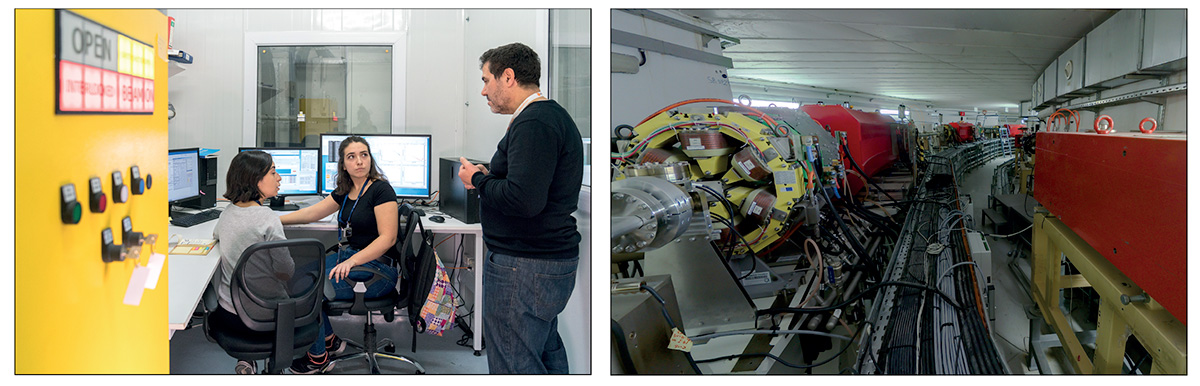
Students, beamline scientists and magnets

The empty SESAME building started to be filled with radiation shields, giving the appearance of a full building. But the absence of the light-source itself created a void. The morale of the local staff was in steady decline, and it seemed to me that the project was in some danger. I decided to approach the ministry of finance in Israel. When I asked if Israel would make a voluntary contribution to SESAME of $5 million, I was not shown the door. Instead they requested to come and see SESAME, after which they discussed the proposal with Israel’s budget and planning committee and agreed to contribute the requested funds on the condition that others join them. 

Each member of the unlikely coalition – consisting of Iran, Israel, Jordan and Turkey – pledged an extra $5 million for the project in an agreement signed in Amman. Since then, Israel, Jordan and Turkey have stood up to their commitment, and Iran claims that it recognises its commitment but is obstructed by sanctions. The support from members encouraged the EU to dedicate $5 million to the project, in addition to the approximately $3 million directed earlier from a bilateral EU–Jordan agreement. In 2015 the INFN, under director Fernando Ferroni, gave almost $2 million. This made it possible to build a hostel, as offered by most light sources, which was named appropriately after Sergio Fubini. Many leading world labs, in a heartwarming expression of support, have donated equipment for future beam lines as well as fellowships for the training of young people.

Point of no return

With their help, SESAME crossed the point of no return. The undefined stuff dreams are made of turned into magnets and girdles made of real hard steel, which I was able to touch as they were being assembled at CERN. The pace of events had finally accelerated, and a star-studded inauguration including attendance by the king of Jordan took place on 16 May 2017. During the ceremony, amazingly, the political delegates of different member states listened to each other without leaving the room (as is the standard practice in other international organisations). Even more unique was that each member-state delegate taking the podium gave essentially the same speech: “We are trying here to achieve understanding via collaboration.”

At that moment the SESAME Council presidency passed from Chris Llewellyn Smith to a third former CERN Director-General, Rolf Heuer. The high-quality 2.5 GeV electron storage ring at the heart of SESAME started operation later that year, driving two X-ray beamlines: one dedicated to X-ray absorption fine structure/X-ray fluorescence (XAFS/XRF) spectroscopy, and another to infrared spectro-microscopy. A third powder-diffraction beamline is presently being added, while a soft X-ray beamline “HESEB” designed and constructed by five Helmholtz research centres is being commissioned. In 2023 the BEAmline for Tomography at SESAME (BEATS) will also be completed, with the construction and commissioning of a beamline for hard X-ray full-field tomography. 

The unique SESAME facility started operating with uncanny normality. Well over 100 proposals for experiments were submitted and refereed, and beam time was allocated to the chosen experiments. Data was gathered, analysed and the results were and are being published in first-rate journals. Given the richness of archaeological and cultural heritage in the region, SESAME’s beamlines offer a highly versatile tool for researchers, conservators and cultural-heritage specialists to work together on common projects. The first SESAME Cultural Heritage Day took place online on 16 February 2022 with more than 240 registrants in 39 countries (CERN Courier July/August 2022 p19). 

Powered by renewable energy

Thanks to the help of the EU, SESAME has also become the world’s first “green” light source, its energy entirely generated by solar power, which also has the bonus of stabilising the energy bill of the machine. There is, however, concern that the only component used from BESSY, the “Microtron” radio-frequency system, may eventually break down, thus endangering the operation of the whole machine. 

SESAME continues to operate on a shoe-string budget. The current approved 2022 budget is about $5.3 million, much smaller than that of any modern light source. I marvel at the ingenuity of the SESAME staff allowing the facility to operate, and am sad to sense indifference to the budget among many of the parties involved. The world’s media has been less indifferent: the BBC, The New York Times, Le Monde, The Washington Post, Brussels Libre, The Arab Weekly, as well as regional newspapers and TV stations, have all covered various aspects of SESAME. In 2019 the AAAS highlighted the significance of SESAME by awarding five of its founders (Chris Llewellyn Smith, Eliezer Rabinovici, Zehra Sayers, Herwig Schopper and Khaled Toukan) with its 2019 Award for Science Diplomacy. 

SESAME was inspired by CERN, yet it was a much more challenging task to construct. CERN was built after the Second World War was over, and it was clear who had won and who had lost. In the Middle East the conflicts are not over, and there are different narratives on who is winning and who is losing, as well as what win or lose means. For CERN it took less than 10 years to set up the original construct; for SESAME it took about 25 years. Thus, SESAME now should be thought of as CERN was in around 1960.

On a personal note, it brings immense happiness that for the first time ever, Israeli scientists have carried out high-quality research at a facility established on the soil of an Arab country, Jordan. Many in the region and beyond have taken their people to a place their governments most likely never dreamt of or planned to reach. It is impossible to give due credit to the many people without whom SESAME would not be the success it is today. 

The non-relations among several of the members presented a serious challenge

In many ways SESAME is a very special child of CERN, and often our children can teach us important lessons. As president of the CERN Council, I can say that the way in which the member states of SESAME conducted themselves during the decades of storms that affect our region serves as a benchmark for how to keep bridges for understanding under the most trying of circumstances. The SESAME spirit has so far been a lighthouse even to the CERN Council, in particular in light of the invasion of Ukraine (an associate member state of CERN) by the Russian Federation. Maintaining this attitude in a stormy political environment is very difficult. 

However SESAME’s story ends, we have proved that the people of the Middle East have within them the capability to work together for a common cause. Thus, the very process of building SESAME has become a beacon of hope to many in our region. The responsibility of SESAME in the next years is to match this achievement with high-quality scientific research, but it requires appropriate funding and help. SESAME is continuing very successfully with its mission to train hundreds of engineers and scientists in the region. Requests for beam time continue to rise, as do the number of publications in top journals. 

If one wants to embark on a scientific project to promote peaceful understanding, SESAME offers at least three important lessons: it should be one to which every country can contribute, learn and profit significantly from; its science should be of the highest quality; and it requires an unbounded optimism and an infinite amount of enthusiasm. My dream is that in the not-so-distant future, people will be able to point to a significant discovery and say “this happened at SESAME”.
Radiotherapy debut for proton linac

Hadron therapy, to which particle and accelerator physicists have contributed significantly during the past decades, has treated more than 300,000 patients to date. As collaborations and projects have grown over time, new methods aimed at improving and democratising this type of cancer treatment have emerged. Among them, therapy with proton beams from circular accelerators stands out as a particularly effective treatment: protons can obliterate tumours, sparing the surrounding healthy tissues at higher rates than conventional electron or photon therapy. Unfortunately, present proton- and ion-therapy centres are large and very demanding on the design of buildings, accelerators and gantry systems.

A novel proton accelerator for cancer treatment based on CERN technology is preparing to receive its first patients in the UK. Advanced Oncotherapy (AVO), based in London, has developed a proton-therapy system called LIGHT (Linac Image-Guided Hadron Technology) – the result of more than 20 years of work at CERN and spin-off company ADAM, founded in 2007 to build and test linacs for medical purposes and now AVO’s Geneva-based subsidiary. LIGHT provides a proton beam that allows the delivery of ultra-high dose rates to deep-seated tumours. The initial acceleration to 5 MeV is based on radio-frequency quadrupole (RFQ) technology developed at CERN and supported by CERN’s knowledge transfer group. LIGHT reached the maximum treatment energy of 230 MeV at the STFC Daresbury site on 26 September. Four years after the first 16 m-long prototype was built and tested at LHC Point 2, this novel oncological linac will treat its first patients in collaboration with University Hospital Birmingham at Daresbury during the second half of 2023, marking the first time a proton linear accelerator is used for cancer therapy.

LIGHT operates with components and designs developed by CERN, ENEA, the TERA Foundation and ADAM. Components of note include LIGHT’s RFQ, which contributes to its compact design, as well as 19 radio-frequency modules composed of four side-coupled drift-tube accelerating cavities based on a TERA Foundation design and 15 coupled accelerating cavities with industrial design by ADAM. Each module is controlled to vary the beam energy electronically, 200 times per second, depending on the depth of the tumour layer. This obviates the need for absorbers (or degraders), which greatly reduce the throughput of protons and produce large unwanted radiation, therefore reducing the volume of shielding material required. This design allows the linear accelerator to generate an extremely focused beam of 70 to 230 MeV and to target tumours in three dimensions, by varying the depth at which the radiation dose is delivered much faster than existing circular accelerators.

“Our mission is simple: democratise proton therapy,” says Nicolas Serandour, CEO of AVO. “The only way to fulfill this goal is through the development of a different particle accelerator and this is what we have achieved with the successful testing of the first-ever proton linear accelerator for medical purposes. Importantly, the excitement comes from the fact that cost reduction can be accompanied with better medical outcomes due to the quality of the LIGHT beam, particularly for cancers that still have a low prognosis. I cannot over-emphasise the importance that CERN and ADAM played in making this project a tangible reality for millions of cancer patients.” 

Moving from big science into big tech

The latest edition of the CERN Alumni Network’s “Moving out of academia” series, held on 21 October, focused on how to successfully manage a transition from academia to the big- tech industry. Six panellists who have started working in companies such as Google, Microsoft, Apple and Meta shared their advice and experience on how to successfully start a career in a large multinational company after having worked at large scale-research infrastructures such as CERN.  

In addition to describing the nature of their work and the skills acquired at CERN that have helped them make the transition, the panellists explained which new skills they had to develop after CERN for a successful career move. The around 180 participants who attended the online event received tips for interviews and CV-writing and heard personal stories about how a PhD prepares you for a career outside academia. 

The panellists agreed that metrics used in academia to qualify a person’s success, such as a PhD, the h-index, or the number of published papers, do not necessarily apply to roles outside of academia, except for research positions. “You don’t need to have a PhD or a certificate to demonstrate that you are a good problem solver or a good programmer – you should do a PhD because you are interested in the field,” said Cristina Bahamonde, who used to work in accelerator operations at CERN and now oversees and unblocks all Google’s network deployments as regional leader for its global network delivery team in Europe, the Middle East and Africa. She considers her project-management and communication skills, which she acquired during her time at CERN while designing solution and mitigation strategies for operational changes in the LHC, essential for her current role. 

General skills needed for big-tech companies include the ability to learn and adapt fast, project and product-management skills, as well as communicating effectively to technical and non-technical audiences. Some participants were unaware that skills that they sharpened intuitively throughout their academic career are vital for a career outside.

“CERN taught me how to be a generalist,” says James Casey, now a group programme manager at Microsoft. “I was not working as a product manager at CERN, but you do very similar work at CERN because you write documents, build customer relationships and need to communicate your work in an understandable way as well as to communicate the work that needs to be done.” At CERN in 1994, Casey worked as a summer student alongside the original team that developed the web. After having worked in start-ups, he returned to CERN for a while and then moved back to industry in 2011.

Finding the narrative

Finding your own narrative and presenting it in the right way on a resumé is not always easy. “When I write my resumé, it looks really straight forward,” said Mariana Rihl, former LHCb experimentalist and now Meta’s product-system validation lead for verifying and validating Oculus VR products. “But only after a certain time, I realised that a common theme emerged — testing hardware and understanding users’ needs.” Working on the LHCb beam-gas vertex detector and especially ensuring the functionality of detector hardware prepared her well, she said. 

Former CERN openlab intern Ritika Kanade, who now works as a software engineer at Apple, shared her experience of interviewing people applying for software engineering roles. “What I like to see during an interview is how the applicant approaches the tasks and how he or she interacts with me. It’s ok if someone needs help. That’s normal in our job,” she adds. “Time management is one thing I see many candidates struggle with.” Other skills needed in industry as well as in academia are tenacity and persistence. Often, candidates need to apply more than three times to land a job at their favourite company. “I applied six or seven times before I was invited for an interview at Google,” emphasised Bahamonde.

The Moving out of academia series provides a rich source of advice for those seeking to make a career change, with the latest event following  others dedicated to careers in finance, industrial engineering, big data, entrepreneurship, the environment and medical technologies. “This CERN Alumni event demonstrated once more the impact of high-energy physics on society and that people transitioning from academia to industry bring fresh insights from another field,” said Rachel Bray, head of CERN Alumni relations.

Volker Soergel 1931–2022

Experimentalist Volker Soergel passed away on 5 October at the age of 91. Born in Breslau in March 1931, Soergel was a brilliant experimental physicist and an outstanding leader, shaping particle physics for many years. 

Receiving a doctorate from the University of Freiburg in 1956 under the tutelage of Wolfgang Gentner, Soergel remained at Freiburg until 1961, with a year at Caltech in 1957–1958. He then joined CERN as a research associate, working with Joachim Heintze on the beta decay of elementary particles, especially very rare decays of mesons and hyperons. Their results became milestones in the development of the Standard Model, resulting in the award of the German Physical Society’s highest honour in 1963.

In 1965 Soergel became a professor at the University of Heidelberg. He continued his research at CERN while taking on important roles at the university: as director of the Institute of Physics, as dean and as a member of the university’s administrative council. With vision and skill, he played a major role in shaping the university.

Important tasks outside Heidelberg followed. From 1976–1979 he chaired the DESY Scientific Council through a period that saw work begin on the electron–positron collider, PETRA. Under his leadership, the council played an important role in DESY’s transition from national to international laboratory. In 1979 and 1980 he served as research director at CERN, helping pave the way for the collider experiments of the 1980s.

From 1981–1993 Soergel headed DESY, overseeing construction of the electron–proton storage ring, HERA, together with Björn Wiik and Gustav-Adolph Voss. HERA and its experiments benefited from large international contributions, mainly in the form of components and manpower: an approach that became known as the HERA model. Soergel’s powers of persuasion, his reputation, and his negotiating skills led to support from institutes in Western Europe, Israel and Canada, as well as from Poland, Russia and China. From 1996–2000 he headed the Max Planck Institute for Physics in Munich. Under his guidance, photon science became an important pillar of DESY research, first as a by-product of accelerators used for particle physics, then, with the inauguration of HASYLAB in 1981 and the conversion of DORIS, as an established research field that continues strongly to this day. 

Soergel’s time at DESY coincided with German reunification. He enabled the merger of the Institute for High Energy Physics in Zeuthen, near Berlin, with DESY and, together with Paul Söding, made Zeuthen a centre for astroparticle physics. Even before the Iron Curtain fell, Soergel personally ensured that Zeuthen scientists could work at DESY.

Volker Soergel received many honours. He was awarded the Federal Cross of Merit, 1st class, and honorary doctorates from the universities of Glasgow and Hamburg. He has left a lasting legacy. His love for physics was similar in intensity to his love for music. A gifted violin and viola player, he enjoyed making music with his wife and children, friends and colleagues. All who worked with him remain grateful for all they learned from him and will not forget his support and guidance. 

Nicola Najib Khuri 1933–2022

Renowned high-energy theorist Nicola Najib Khuri died on 4 August 2022 in New York City. Born in 1933 in Beirut, Lebanon he was the eldest of four siblings and a precocious student. He graduated from the American University of Beirut (AUB) in 1952 at the age of 19, then travelled to the US for his graduate studies in physics. He received his MA and PhD from Princeton University and was a fellow of Princeton’s Institute for Advanced Study. While in graduate school, he met Elizabeth Tyson, the love of his life and wife of over 60 years. Upon receiving his doctorate in 1957, Nicola returned to Lebanon and joined the faculty at AUB. In 1964 he went back to the US and accepted a position at The Rockefeller University, New York, where he founded a lab and remained for the rest of his career.

Nicola was a leading authority on the use of mathematics in high-energy theoretical physics. At Rockefeller, his research focused on the mathematical description of elementary-particle collisions. Among his most notable achievements were the introduction of a new method to study the Riemann hypothesis, one of the last unsolved problems in mathematics, and the foundation of the field of potential scattering theory, which led to the development of important concepts such as Regge poles and strings. 

In addition to his post at Rockefeller, he held visiting appointments and consulting roles at CERN, Stanford University, Columbia University, Lawrence Livermore National Laboratory, Brookhaven National Laboratory and Los Alamos National Laboratory. He was also a member of the panel on national security and arms control of the Carnegie Endowment for International Peace and a fellow of the American Physical Society.

Nicola and Liz, along with their two children, built a beautiful life in New York. Their homes had a revolving door for friends, family, colleagues and mentees who came from far and wide to hear Nicola’s remarkable stories, take in his sage advice, and enjoy his timeless, occasionally risqué jokes. A true cosmopolitan, he relished the vibrancy and possibility of New York. When not at home, he could be found ordering mezze for the table at one of his favourite Lebanese restaurants, exploring his interest in international politics at the Council on Foreign Relations, or making a toast at the Century Association. He retained an enduring love for, and a fundamental commitment to, Lebanon. He was a passionate supporter of his alma mater, a mentor to generations of young scientists from the Middle East, and was instrumental in establishing the university’s Center for Advanced Mathematical Sciences, among many other contributions.

There are many things we will miss about Nicola: his character; the way he commanded a room; his childlike sense of humour; the happy gleam in his eye when he told a story from his adventurous life; and his sneaky determination in old age to satisfy a lifelong appetite for good wine, good cheese and excellent chocolate over the protests of doctors, caregivers and his daughter, Suzanne. Above all, we will miss the way he treated others. 

Valery Rubakov 1955–2022

Valery Rubakov

Valery Rubakov, who pioneered groundbreaking ideas and methods in many domains of particle physics and cosmology, passed away suddenly on 19 October at the age of 67. 

Born in Moscow in 1955, Valery studied physics at Moscow State University from 1972–1978. He started doing research in his third year of studies, publishing his first paper at the age of 21 on the topic of quantum gravity. Valery joined the Institute for Nuclear Research (INR) of the Russian Academy of Sciences in 1978, defending his PhD on the non-perturbative aspects of gauge theories in 1981. At the age of 26, Rubakov had already made his name in global high-energy physics. He discovered that the ’t Hooft–Polyakov super-heavy magnetic monopoles that exist in grand-unified theories “catalyse” proton decay – a beautiful and subtle non-perturbative effect that provides alternative experimental signatures in the search of monopoles. 

Valery was one of the first physicists to realise the importance of inflationary theory, his 1982 work with Mikhail Sazhin and Alexey Veryaskin on the primordial production of gravitational waves establishing important constraints on the energy scale of the de-Sitter stage of inflation. In 1983 Rubakov (together with Mikhail Shaposhnikov) proposed alternatives to Kaluza–Klein compactification in theories with more than four space–time dimensions – one of which is now known as the brane-world scenario, where the particles of our world live on a four-dimensional defect embedded in a higher-dimensional universe. 

He produced key contributions towards the understanding of the baryon asymmetry of the universe. His paper in 1985 with Vadim Kuzmin and Shaposhnikov revealed that non-perturbative processes can drive a rapid violation of baryon- and lepton-number conservation in the early universe – the basic ingredient of thermal leptogenesis. In 1998, together with Evgeny Akhmedov and Alexey Smirnov, he suggested how to produce the baryon asymmetry by relatively light right-handed neutrinos – an alternative to so-called Fukigita–Yanagida leptogenesis, which opened a unique possibility for experimental verification. 

In a series of remarkable articles from 1987–1988, Valery, together with his PhD students George Lavrelashvili and Peter Tinyakov, discussed the physical impact of topology change in quantum gravity, analysing deep conceptual issues such as quantum coherence. In 1990–1991, together with Sergei Khlebnikov and Peter Tinyakov, he attacked the challenging problem of how to compute the probability of anomalous processes with baryon number non-conservation in very high-energy collisions above tens of TeV. He returned to this problem together with Fedor Bezrukov, Dmitry Levkov and Claudio Rebbi, in 2003, demonstrating that these reactions are exponentially suppressed, thus removing hopes of experimental verification of this phenomenon. 

Valery made imprints in virtually all areas of particle physics and cosmology: supersymmetry phenomenology; the strong CP-problem; dark matter and dark energy; non-commutative field theories; classical and quantum gravity; and alternatives to inflation, to name a few. His very last article, written with Christof Wetterich, was devoted to a physical concept of time for the beginning stage of the universe.

Valery was also an outstanding and passionate teacher, creating the “Rubakov School” of theo­retical physics and cosmology in Moscow, and a successful scientific manager. As a research director of INR from 1987 to 1994, for example, he was responsible for the construction and operation of the Baksan neutrino observatory and the Baikal deep underwater neutrino telescope. Valery was a member of the CERN Scientific Policy Committee from 2014 to 2019 and served on the ICTP Scientific Council from 2010 to 2020. He was the recipient of numerous prizes, awards and distinctions and wrote several excellent textbooks, including Classical Theory of Gauge Fields (Princeton 2002).

Valery Rubakov was an exceptional person. He defended scientific thinking, the freedom of mind and fruitful collaboration between scientists from different countries. He will always be remembered for his kindness, sharp and inventive mind, charisma, honesty and integrity.

SACLA and SPring-8: a roadmap towards sustainable science

Sometimes, it seems, mere proximity is the engine-room of opportunity. That’s certainly the case for two of Japan’s flagship large-scale research centres – the SPring-8 (Super Photon Ring 8 GeV) synchrotron facility and SACLA (the SPring-8 Angstrom Compact free-electron LAser) – which are co-located adjacent to each other on the main campus of Harima Science Park City in Hyogo Prefecture. 

It’s now two years since a joint research group from SPring-8 Center, which is managed by Japan’s premier research agency RIKEN, and the Japan Synchrotron Radiation Research Institute (JASRI), responsible for promoting the use of SPring-8, succeeded in utilising the linear accelerator of the SACLA X-ray free-electron laser (XFEL) facility as an injector for the SPring-8 storage ring. 

The upsides were immediate, impressive and – crucially – sustained. For starters, the 25-year-old injector of SPring-8, which hitherto was used exclusively for beam injection, has been superseded by the SACLA linear accelerator – reducing the electricity consumption needed to support SPring-8 operation by roughly 20%. Equally significant, the quality of the electron beam injected into the storage ring has been enhanced markedly – a breakthrough that will underpin the upgrade plan of SPring-8 to a fourth-generation light source (SPring-8-II) capable of generating X-ray beams hundreds of times brighter than the current facility. 

Legacy problems, creative solutions

By way of context, the previous, dedicated injector for the SPring-8 storage ring consisted of a 1 GeV linear accelerator and an 8 GeV synchrotron booster. The emittance of the resulting injection beam was about 200 nm-rad, which is far larger than the specification of the future SPring-8-II (at 10 nm-rad). There were legacy technology issues as well: both injector accelerators were more than 25 years old, while the associated (and somewhat decrepit) high-voltage power substation was itself in need of a root-and-branch overhaul. 

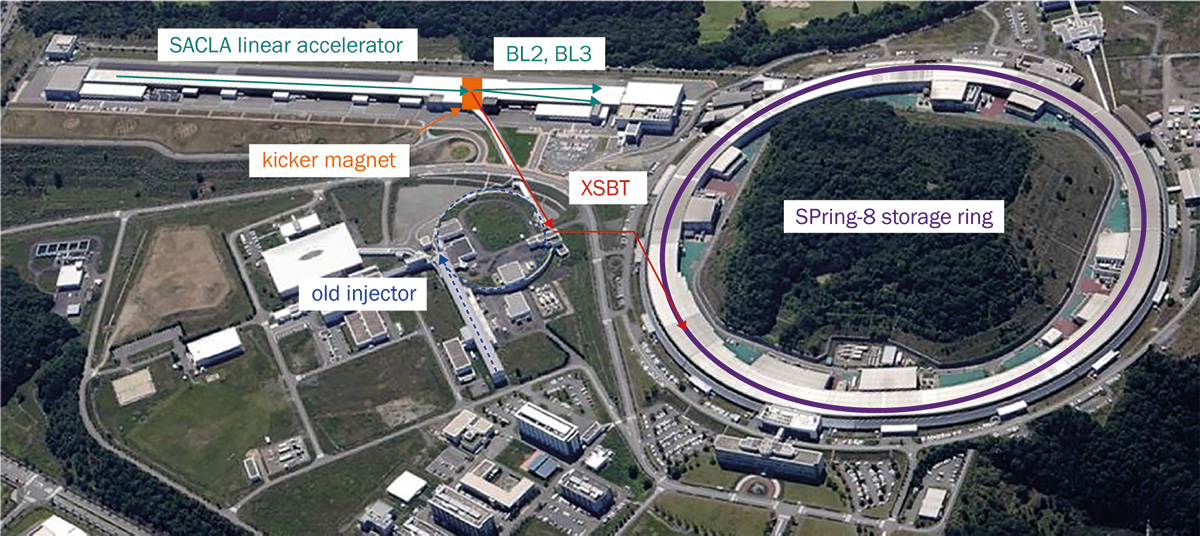
The SACLA XFEL and SPring-8 synchrotron radiation facilities

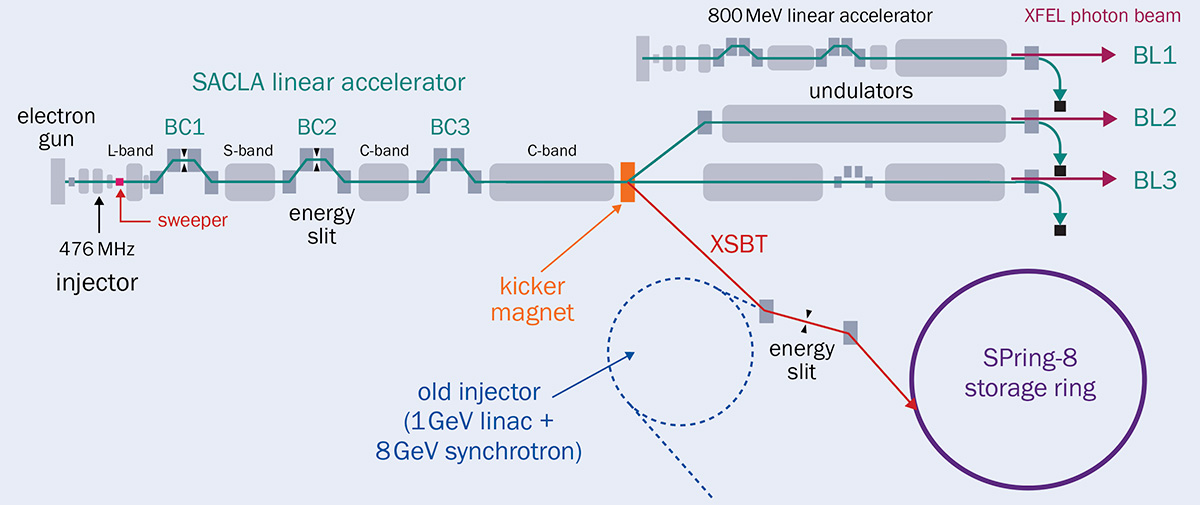
Cue some creative thinking and the game-changing idea of deploying SACLA’s low-emittance electron beam for SPring-8 beam injection (and in parallel to its core function as a source of XFEL photon beams for front-line research). Herein an engineering win-win began to take shape: on the one hand, the opportunity to decommission (rather than renovate) the high-voltage substation; on the other, to simultaneously reduce SPring-8’s electricity consumption significantly by shutting down the old injector accelerators (which were always maintained in operational mode despite the only intermittent requirement for beam injection). Underpinning it all is the fact that the SACLA linear accelerator is always online for the XFEL research users, so no additional cost or energy consumption accrues when sending a small number of electron-beam pulses from SACLA to the SPring-8 storage ring.

In the early design phase of SACLA (around 2008), and with engineers anticipating the future possibility of beam injection to SPring-8, the nominal beam energy of SACLA was set at 8 GeV to match the SPring-8 storage ring. The direction of the SACLA electron beam was also fixed towards SPring-8 to facilitate the envisaged beam-injection
scenario. To join things up, the two accelerators are linked by a beam transport line – the XFEL to Storage ring Beam Transport (XSBT) – which was constructed at the same time as the SACLA facility (see images “Better together” and “Joined up”). 

When it comes to the technical specifics, the SACLA beam repetition rate is set at 60 Hz, with the electron-beam pulses distributed on a pulse-by-pulse basis in three directions with the help of a “kicker” magnet: along two XFEL beamlines (BL2 and BL3) and down the XSBT beamline. What’s more, the electron-beam energies for XFEL user experiments are often adjusted in a range between 5 and 8 GeV depending on laser wavelengths, while the energy needs to be fixed at 8 GeV for the beam injection. It is therefore essential to control the electron-beam parameters pulse-by-pulse to allow XFEL user experiments and the SPring-8 beam injection to proceed in parallel. 

Synchronisation is nothing without control

Operationally, the preparation of the SACLA beam-injection scheme took about two years in design, planning and commissioning. The first task for the project team was to synchronise the two accelerators, given that they run on different reference clock frequencies (238 MHz for SACLA; 508 MHz for SPring-8). Since the two frequencies do not have a harmonic relation, the injection timing naturally goes off with respect to the target RF bucket of SPring-8 by a maximum ±2.1 ns. A novel timing system was subsequently developed to provide the necessary synchronisation. 

Electron beam sizes

In top-up injection mode, which keeps a constant stored current within the storage ring, SPring-8 sends a beam request to SACLA when the stored current decreases under a certain threshold. Once SACLA receives the request, the timing system first searches out a point where the timing difference is at a minimum. By delaying the beam injection up to 197 µs, there should be a point where the timing difference becomes smaller than 105 ps. In a second step, a slight frequency modulation is applied to the SACLA 238 MHz reference clock, such that SACLA and SPring-8 are finally synchronised to within 3.8 ps (RMS).

Another significant piece of work involved retrofitting the accelerator control system. To change the accelerator parameters pulse-by-pulse, it is necessary for accelerator components to “know” the destination of the next beam pulse. That granular data (at the level of an individual pulse) is therefore sent through a “reflective memory network” to key components and subsystems – for example, RF sources and magnet power supplies – such that these devices can then operate with prestored parameters corresponding to the relevant beam destination. 

Meanwhile, all diagnostic data are saved in a database with a pulse tag number so that the measured data, such as beam trajectories and charges, can be distinguished among the three beam destinations (BL2, BL3 and XSBT). It is like there are three accelerators independently running with different beam energies and parameters. In day-to-day operation, three operators adjust and tune the accelerators by looking at the monitor and control panels for the three beams versus the respective destinations. Using the pulse tag number, XFEL users are also able to see which pulses were used for the beam injection, so that these pulses can be eliminated from their experimental data. 

A final core deliverable for the project team was to ensure the bulletproof reliability of SACLA – since the storage ring cannot operate without beam injection. In short, if the linear accelerator of SACLA fails to provide electron beams, close to 60 experiments on the SPring-8 beamlines are at risk of grinding to a halt. Redundancy is the key here: to promptly recover from unexpected troubles, the team installed back-up components for crucial accelerator devices, such as the electron gun, kicker magnet and RF sources.  

Going live

During the early-stage evaluation of the new beam-injection scheme, two other issues came into play: electron bunch purity and magnetic hysteresis of the kicker magnet. The electron bunch purity is a ratio of electron charges contained in an electron-injected RF bucket and an empty bucket on the storage ring. 

It is an important figure of merit – not least for ensuring low background noise in time-resolved experiments. A bunch purity of between 10–8 and 10–10 is typically required at SPring-8, while the electron bunch charge of SACLA is around 200 pC – i.e. even a single electron outside the beam pulse could degrade the bunch purity. 

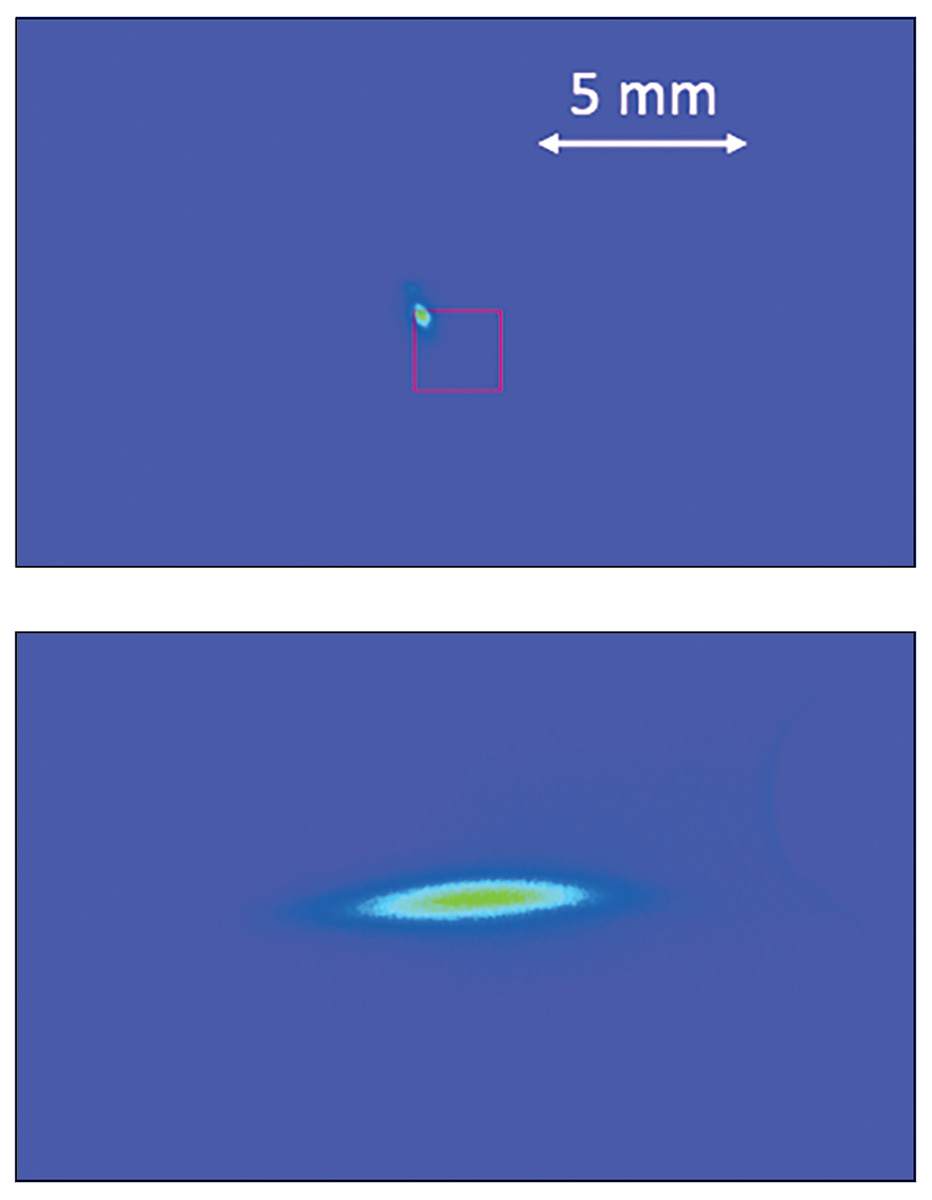
Electron beam pulses from SACLA

It turned out, however, that a small number of electrons were detected 18 ns after the main beam pulse during the initial experimental runs. After detailed investigation, the project team found that these electrons were slipping out from the main pulse and making a round trip between two RF cavities at the injector section of SACLA. Consequently, they were delayed by 18 ns and being injected into unexpected RF buckets on the storage ring. The solution: remove the delayed electrons using an electric sweeper and an RF knockout system – a breakthrough that, in turn, yielded the required bunch purity of 10–10. 

At the far-end of SACLA’s linear accelerator, electron-beam pulses are deflected horizontally in three directions by a kicker magnet. The polarity of the kicker current is negative for BL2, zero for BL3 and positive for XSBT. As a consequence, the beam orbits of the pulses just after the beam injection (i.e. two to three times a minute) deviate from the optimum trajectory inside the XFEL undulators – seriously degrading pointing stability and laser power within the SACLA beamlines. To overcome this issue, the excitation pattern of the kicker magnet is modified slightly after the beam injection, such that the hysteresis effect is now suppressed within an angular deviation of 1 µrad (i.e. less than 10 % of the laser spot size). 

With those “issues arising” addressed successfully by the project team, it’s instructive to look at the high-level operational performance of the new beam-injection arrangement. To fill up the storage ring with a nominal stored current of 100 mA, the electron beam is injected at 10 Hz from SACLA. The process takes about 10 minutes – roughly twice as fast as the old injector. Once the storage ring is filled, top-up injection gets underway to keep the stored current at a constant level. In top-up mode, the electron beam is injected typically 2–3 times every minute. Measuring the transverse beam sizes at the injection point of SPring-8 shows that the size of the electron beam from SACLA is significantly narrower versus that from the old injector, with the beam quality represented by emittance improving from 200 nm-rad to 1 nm-rad – more than satisfying the criteria for the future SPring-8-II.

Green machines

Alongside those sustained performance improvements, there are other notable wins to report for the SACLA beam-injection arrangement. After a probation period of six months, the old SPring-8 injector and its power station were shut down in April 2021, yielding a 5 MW saving in electricity consumption and an impressive 20% reduction in the SPring-8 power bill (i.e. versus current SPring-8 plus the old injector).

SACLA’s C-band accelerators

Further operational efficiencies are in the works for SPring-8-II given the global surge in energy prices and the shared commitment (with SACLA) towards carbon neutrality by 2050. By using cutting-edge, short-period, in-vacuum undulator technologies in SPring-8-II, for example, the electron-beam energy will be reduced from 8 GeV to 6 GeV without changing the X-ray radiation energy range. Replacing accelerator electromagnets with permanent magnets will enable additional reductions in power consumption. The ultimate goal of SPring-8-II, and with user operation pencilled in to begin no later than 2030, is a 50% reduction in power consumption versus the current SPring-8.

The ultimate goal is a 50% reduction in power consumption for SPring-8-II versus the current SPring-8

Similarly ambitious plans are taking shape for the SACLA-II upgrade, which will take place after the completion of SPring-8-II. The end-game: a 1 kHz repetition rate using conventional (rather than superconducting RF) accelerator technologies. With traditional RF acceleration, of course, more than 99.99 % of the input power is dissipated as heat – rather than accelerating the electron beam – so the challenge for SACLA-II is to boost this extremely low conversion efficiency, thereby increasing the repetition rate without increasing the power consumption. 

While none of this will be straightforward, it’s evident that the path to a “greener” and more sustainable accelerator complex is rapidly coming into view.

India sets its sights on linac innovation

The estimated annual global incidence of new cancer cases was upwards of 19 million in 2020, with more than 70% of people suffering from the disease resident in low- and middle-income countries (JCO Global Oncology 2022 8 e2100358). What’s more, according to forecasts from the International Atomic Energy Agency published on World Cancer Day in February 2022, the total number of cancer deaths worldwide is forecast to rise by 60% over the next two decades – to 16 million people a year – with those same low- and middle-income countries suffering the brunt of the escalation. India finds itself in the eye of this healthcare storm, with the domestic burden of cancer cases projected at between 1.9 and 2 million in 2022 – a burden, moreover, that’s also projected to increase over time.

Fundamentally, this is a question of supply (high-quality cancer treatment) versus demand (rising cancer incidence) for India – not least when it comes to the challenges associated with rolling out accessible and affordable radiation therapy facilities at the national level. Right now, there are around 545 clinical radiotherapy units across India (180 60Co-based teletherapy systems and 365 electron linacs). Most of the e-linacs are supplied by commercial manufacturers, with 50% of these systems located in private hospitals – and therefore beyond the reach of the majority of Indian citizens. 

To drive down the cost of radiotherapy treatment, while simultaneously opening up access to more cancer patients, the Society for Applied Microwave Electronics Engineering and Research (SAMEER) in Mumbai has been prioritising technology innovation in e-linacs for several decades (with financial support from the central government’s Ministry of Electronics and Information Technology, also known as MeitY). 

Accessibility, affordability, availability 

A case study in this regard is the medical electronics division of SAMEER, which initiated an R&D programme for a 4 MeV e-linac for cancer therapy in the late 1980s. The initial outcome: an S-band, side-coupled linac (operating at π/2 mode at 2.998 GHz) developed for electron acceleration. The SAMEER development team later integrated the linac with other core subsystems in collaboration with the Central Scientific Instruments Organisation, Chandigarh, and the Post Graduate Institute of Medical Education and Research (PGIMER), Chandigarh, with the completed linac commissioned at PGIMER in 1991. 

This original machine was called Jeevan Jyoti-I. SAMEER engineers went on to build three more e-linac variations on the Jeevan Jyoti-I theme, with all units duly commissioned and operating in hospitals. Subsequently, under the Indian government’s Jai Vigyan initiative, SAMEER built six more radiotherapy units (with an increased energy of 6 MV) and installed these systems in hospitals. One more machine is being commissioned in 2022 – initially using commercial microwave sources from SAMEER (though these will eventually be replaced with a domestically developed 2.6 MW magnetron).

Multipurpose proton accelerators

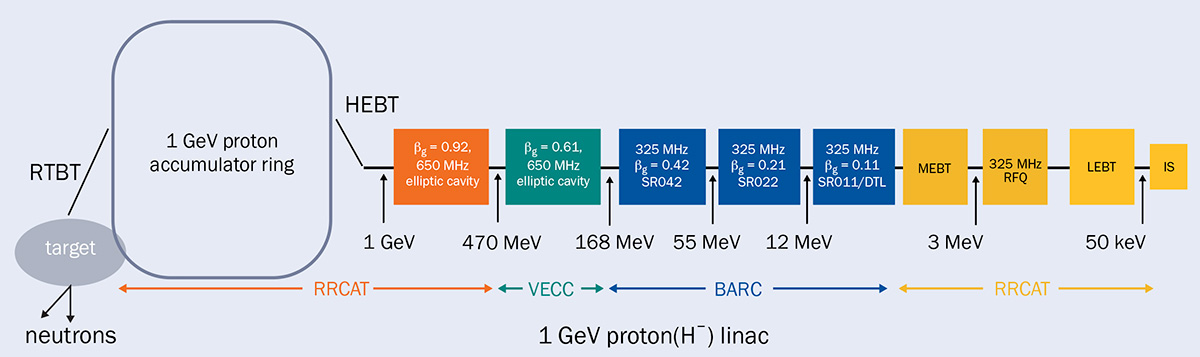
India’s work-in-progress 1 GeV proton linac

India’s Department of Atomic Energy (DAE) plans to exploit the country’s rich natural sources of thorium to bolster the domestic nuclear energy programme, simultaneously exploring new methods for dealing with high-level nuclear waste as well as the at-scale production of medical radioisotopes for the diagnosis and treatment of cancer.

Consider the so-called accelerator-driven subcritical reactor (ADSR), a next-generation nuclear reactor design formed by coupling a substantially subcritical nuclear reactor core (using thorium as fuel) with a high-intensity, high-energy proton accelerator. The latter generates a copious beam of spallation neutrons to sustain the fission process – activating the thorium without needing to make the reactor critical (i.e. turning off the proton beam results in immediate and safe shut-down of the reactor). Another benefit of the ADSR scheme is the relatively short half-lives of the waste products.

Within this context, DAE’s R&D laboratories have started work on a high-current 1 GeV proton accelerator (see “Collective endeavour” figure). In the first phase of construction of a 20 MeV normal-conducting linac at Bhabha Atomic Research Centre (BARC), scientists accelerated a 2 mA proton beam from an ion source using a four-vane RF quadrupole (generating a 3 MeV proton beam with 65% transmission). Earlier this year, the BARC team boosted the proton energy to 6.8 MeV through the first drift-tube linac (with a peak beam current of 2.5 mA and an average beam current of 1 μA with 93% transmission). At Raja Ramanna Centre for Advanced Technology (RRCAT), meanwhile, several warm-front-end ion sources and associated subsystems are under construction (including low-energy beam transport, RF quadrupoles, medium-energy beam transport and a drift-tube linac). 

Operationally, collaboration is a defining theme of India’s R&D effort on proton accelerators – not least through its scientists’ direct participation in the Proton Improvement Plan II (PIP-II), an essential upgrade and ambitious reimagining of the Fermilab accelerator complex in the US. Several Indian institutions are front-and-centre in the PIP-II initiative, designing and developing room-temperature and superconducting magnets, superconducting RF cavities, cryomodules and RF amplifiers for the PIP-II project team. 

BARC and the Inter-University Accelerator Centre (IUAC) in New Delhi, for example, initially supplied two single-spoke-resonator cavities for testing at Fermilab, while end-to-end infrastructure for niobium-cavity fabrication and testing has been established at RRCAT. Several niobium superconducting cavities – required in both the PIP-II project and the Indian proton accelerator programme – have since been fabricatedand tested successfully.

Innovation pathways

One thing is clear: India’s e-linac R&D effort continues to gather momentum. The next step is to enhance the technology for dual photon energies (6 and 15 MeV) from the same linac, along with multiple electron energies (from 6 to 18 MeV) for treatment. A prototype of a novel dual-energy linac has already been put through its paces, delivering beam-on-target at SAMEER. The energy is varied by introducing a plunger in the coupling cavity in the acceleration section. Industry partners are being sought as the system undergoes final quality assurance and control checks.  

Parallel technology programmes – covering both e-linacs and proton cyclotrons – are also underway to support domestic production of medical radioisotopes used in the diagnosis and treatment of cancer. For example, a 30 MeV, 5–10 kW linac project (incorporating two 15 MeV sections) is being lined up for the production of 99mTc from 99Mo (the former being required in a nuclear imaging procedure called single-photon-emission computerised tomography, commonly known as SPECT). The 99Mo will be produced from 100Mo using Bremsstrahlung photons, with the latter emitted after accelerated electrons are incident on a target. Tests of the first accelerating structure (15 MeV) are in progress and the full energy of 30 MeV is expected to come online next year. 

India and CERN: a win–win partnership

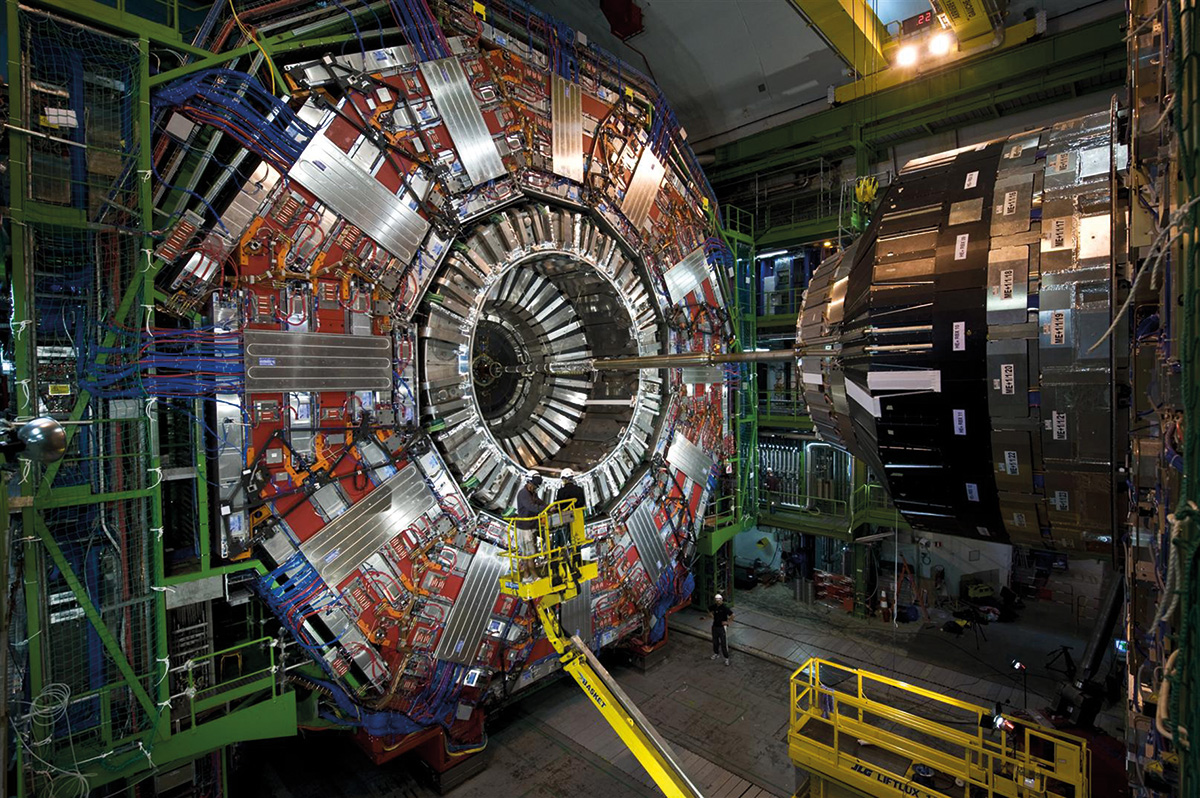
The CMS experiment

Following India’s associate membership at CERN from 2017, the country’s scientists and engineers continue to build on a rich and diverse legacy of contributions spanning core accelerator technologies and participation in front-line high-energy physics experiments. This is a legacy that extends across more than 50 years of collaboration. In the 1990s, for example, the RRCAT contributed to LEP, while the Indian High-Energy Heavy Ion Physics Team contributed to the WA93 experiment at the CERN-SPS. An international cooperation agreement between India’s Department of Atomic Energy (DAE) and CERN was signed in 1992 to deepen ties and extend the scientific and technical cooperation between India and CERN. Those developments, in turn, paved the way for the decision (in 1996) of India’s Atomic Energy Commission to take part in the construction of the LHC – specifically, to contribute to the development of the CMS and ALICE detectors. India became a CERN Observer State in 2002, and the success of the DAE–CERN partnership on the LHC led to a new cooperation on novel accelerator technologies, shaping DAE’s participation in CERN’s Linac4, SPL and CTF3 projects. 

Elsewhere, the Variable Energy Cyclotron Centre (VECC) in Kolkata is leading a project to build an 18 MeV medical cyclotron – a machine that will reduce the cost of production for positron-emitting radioisotopes. In terms of operational specifics: the system will accelerate negative hydrogen ions (H–) from an external, multicusp volume ion source, while a carbon stripper foil will alter the charge state of the ions from negative to positive ahead of extraction. Progress to date is encouraging: engineering design of the main magnet is complete and a 1 mA current has been extracted from the H– ion source. 

Further technology innovation is evident in the field of hadron therapy, which uses proton or ion beams to deliver precision tumour targeting with zero exit dose – a capability that clinicians estimate could improve therapeutic outcomes in 15–20% of cancer patients who receive radiotherapy. Recognising the potential here, Indian clinics have recently purchased and installed two 230 MeV proton cyclotrons, supplied by Belgian equipment maker IBA, in a pivot towards next-generation cancer treatments. 

Further progress has been reported by a collaboration between SAMEER and KEK, Japan’s High-Energy Accelerator Research Organisation. Jointly, the two partners have completed conceptual design studies for a multi-ion therapy machine based on a novel digital accelerator concept. The system is basically a fast-cycling induction synchrotron with a specialised beam-handling capability. (For context, the accelerating devices of a conventional synchrotron, such as RF cavities, are replaced with induction devices in an induction synchrotron.) It is possible, for example, to inject particles at nearly 200 kV DC directly into the main ring and, as such, the induction synchrotron does not need a separate injector. 

In a related initiative, the Tata Memorial Centre Mumbai, and Raja Ramanna Centre for Advanced Technology (RRCAT), Indore, have come up with a preliminary design for a 2 MeV injector and a 70–250 MeV proton synchrotron that may also be suitable for variable-energy beam delivery and other ion-beam therapies.

QUP emphasises its KEK connections

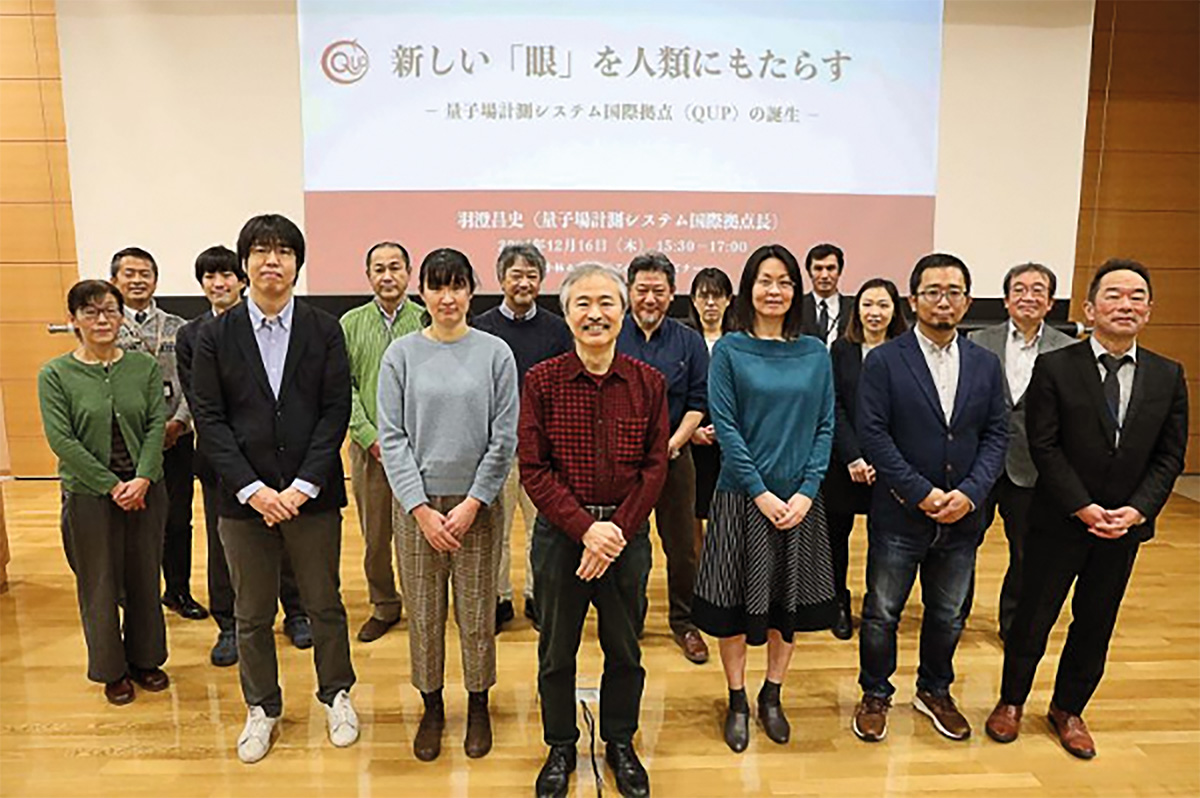
QUP interdisciplinary research team

It’s 12 months since the International Center for Quantum-field Measurement Systems for Studies of the Universe and Particles (or QUP for short) was unveiled as the latest addition to the World Premier International Research Center Initiative (WPI) run by Japan’s Ministry of Education, Culture, Sports, Science and Technology (MEXT). Based in Tsukuba City, 60 km north-east of Tokyo, the new centre represents a high-profile addition to the scientific powerhouse that is KEK, Japan’s High Energy Accelerator Research Organisation. 

Within KEK, QUP has since assumed its place alongside the organisation’s other flagship research laboratories – among them the Institute of Particle and Nuclear Studies (IPNS), the Accelerator Laboratory (ACCL) and the Japan Proton Accelerator Research Complex (J-PARC) – in order to ensure that the outcomes of its ambitious research endeavours dovetail with, and reinforce, KEK’s core discovery programme in elementary particle physics. Here QUP director Masashi Hazumi tells CERN Courier about the centre’s progress to date and the opportunities for talented early-career scientists prepared to take risks and look beyond the comfort zone of their core disciplinary specialisms.

How would you pitch QUP to a talented postdoc thinking about the next big career move?

QUP’s mission is to “bring new eyes to humanity” by inventing advanced measurement systems – novel electronic and quantum detectors that will unlock exciting discoveries in cosmology and particle physics. Examples include superconducting detectors to study cosmic inflation (for the LiteBIRD space mission) and low-temperature quasiparticle detection systems to search for “light dark matter”. We are also keen on applying our unique capabilities to broader academic fields and industrial and societal applications – a case in point being our close engagement with Toyota Central R&D Laboratories. 

Masaya Hasegawa

In this way, QUP will return to the essence of physics, conducting interdisciplinary research to develop new methodologies while integrating particle physics, astrophysics, condensed-matter physics, measurement science, and systems science. QUP’s inventions and innovations will exploit the most fundamental object in nature – the quantum field – and thereby open up a new era in measurement science: quantum-field measurement systemology.

What sets the QUP approach apart from other quantum measurement centres? 

QUP’s strength lies in the breadth of technologies covered and the ability to transition seamlessly between studies of fundamental physics to the execution of large-scale projects on next-generation scientific instruments and quantum technologies. The aim is simple: to create a cross-disciplinary “melting pot” that encourages a fusion of ideas across diverse fields of science, technology and engineering. As such, we’re recruiting a team of “multidisciplinarians” – scientists who can apply their domain knowledge and expertise creatively and flexibly across subject boundaries. 

A good example is the quantum diamond sensor – an enabling technology that exploits so-called NV defects in the carbon lattice – which QUP is developing to support precise temperature measurements of instrumentation (down to the 1 mK level at room temperature) in future studies of the cosmic microwave background (CMB). Notably, that same quantum sensing technology is also attracting early-stage interest from our colleagues at Toyota, with QUP particle physicists and industrial scientists openly sharing ideas. Unanticipated connections like this can create intriguing opportunities for young scientists, opening up new research pathways and long-term career opportunities. 

How important is QUP’s positioning as part of the KEK research organisation? 

QUP is unique among Japan’s WPI programmes because it is the only centre focused on measurement systems, while the integration within KEK means collaboration is hard-wired into our working model. We are already establishing networks to link QUP scientists with researchers across KEK’s accelerator facilities and laboratories. An early success story is the QUP/KEK machine-learning research cluster, which is exploiting AI in a range of high-energy physics contexts and industrial applications (e.g. autonomous vehicles). 

Presumably that collaborative, open mindset extends beyond KEK? 

Correct. We are in the process of establishing three satellite sites for QUP – at Toyota Central R&D Laboratories in Aichi; the Japan Aerospace Exploration Agency (JAXA) Institute of Space and Astronautical Science (ISAS) in Kanagawa; and the University of California, Berkeley, in the US. These activities are already bearing fruit: Hideo Iizuka, a senior scientist at Toyota and one of our principal investigators at QUP, is developing applications of the Casimir effect (the attractive force between two surfaces in a vacuum), with a long-term goal of demonstrating a zero-friction shaft bearing for energy-efficient vehicles. 

You highlighted the LiteBIRD space mission earlier. What is QUP’s role in LiteBIRD?  

One of QUP’s flagship projects centres around the contribution we’re making to the JAXA LiteBIRD space mission, which will study aspects of primordial cosmology and fundamental physics. I am one of the founders of LiteBIRD, an international, large-class mission with an expected launch date in the late 2020s using JAXA’s H3 rocket. When deployed, LiteBIRD will orbit the Sun–Earth Lagrangian point L2, where it will map CMB polarisation over the entire sky for three years. The primary scientific objective is to search for the signal from cosmic inflation, either making a discovery or ruling out well-motivated inflationary models of the universe. LiteBIRD will also provide insights into the quantum nature of gravity and new physics beyond the standard models of particle physics and cosmology. The focus of QUP’s contribution is development of the superconducting detector subsystem for LiteBIRD’s low-frequency telescope.

Project Q is another of QUP’s flagship initiatives. What is it?

Project Q is still a work-in-progress. Essentially, we are putting together a framework to invent and develop a novel system for the measurement of a new quantum field. Last month, as part of the requirements-gathering exercise, QUP and the KEK Theory Center jointly organised a dedicated workshop called “Toward Project Q”. The hybrid event attracted 91 participants – a mix of QUP staff and international colleagues – who shared a range of ideas on potential lines of enquiry for Project Q, including cryogenic measurements, space missions, accelerator and non-accelerator experiments, as well as the use of novel quantum sensors. Watch this space.

What are your near-term priorities as director of QUP?

My number-one priority is to hire the best researchers and position QUP for long-term scientific success. The open nature of Project Q represents a useful conversation-starter in this regard. We have 27 scientists on the staff just now and the plan is to grow the research team to about 70 people by early 2024 – a cohort that will ultimately comprise around 15 principal investigators supported by a team of research professors and postdocs (and with WPI guidelines stating that 30% or more of the QUP team should eventually come from abroad). When it comes to recruitment, I’m looking for scientists who are enterprising, creative and not afraid to take risks – there may well be some candidates who fit the profile among the CERN Courier readership! I like that sort of spirit. If you go big, the success rate may not be high, but unexpected insights and opportunities will often emerge. 

QUP in brief

QUP is the fourteenth, and latest, addition to Japan’s WPI programme, a long-running, government-backed initiative to attract the “brightest and best” scientific talent from around the world, creating a network of highly visible research centres focused on grand challenges in the physical sciences, life sciences and applied R&D. Other WPI research centres specialising in the physical sciences include: the Kavli Institute for the Physics and Mathematics of the Universe (University of Tokyo); the Advanced Institute for Materials Research (Tohoku University); and the International Center for Materials Nanoarchitectonics (part of the National Institute for Materials Science). 

Right now, QUP’s research priorities cover the following themes:

  • Development and implementation of the superconducting detector array for the LiteBIRD CMB space mission.
  • The invention of methods (e.g. those using quasiparticles) for measuring novel quantum fields (e.g. axions); also the proposal and promotion of new projects based on these methods (Project Q).
  • The invention of a new generation of low-temperature detectors, quantum detectors and radiation-hard detectors.
  • Pioneering the most efficient means for large-scale projects in basic science (e.g. automated ASIC design) and modelling these approaches based on current/idealised best practice (establishing “systemology”).
  • Applications with industrial and societal implications (e.g. autonomous driving and smart cities).

RAON’s rare-isotope ambitions

With the worst of the supply-chain disruption from the COVID-19 pandemic receding, work is moving at pace on the preparation and systems commissioning of the Rare isotope Accelerator complex for ONline experiments (better known as RAON), the flagship heavy-ion accelerator facility that forms part of the Rare Isotope Science Project (RISP) within South Korea’s Institute for Basic Science. 

RAON is big science writ large. By accessing exotic and as-yet-undiscovered radioisotopes, RAON will address a broad-scope research roadmap when it comes online for initial user experiments in two years’ time. By extension, the laboratory will generate a wealth of data to advance physicists’ fundamental understanding of the nucleus; provide novel insights about the origins of the chemical elements in the universe; and enable experiments to explore physics beyond the Standard Model. Equally significant, RAON will produce research quantities of rare isotopes to underpin diverse applied R&D efforts spanning, for example, the diagnosis and treatment of cancer, safe disposal of spent nuclear fuels, and the lossless storage of electrical energy. 

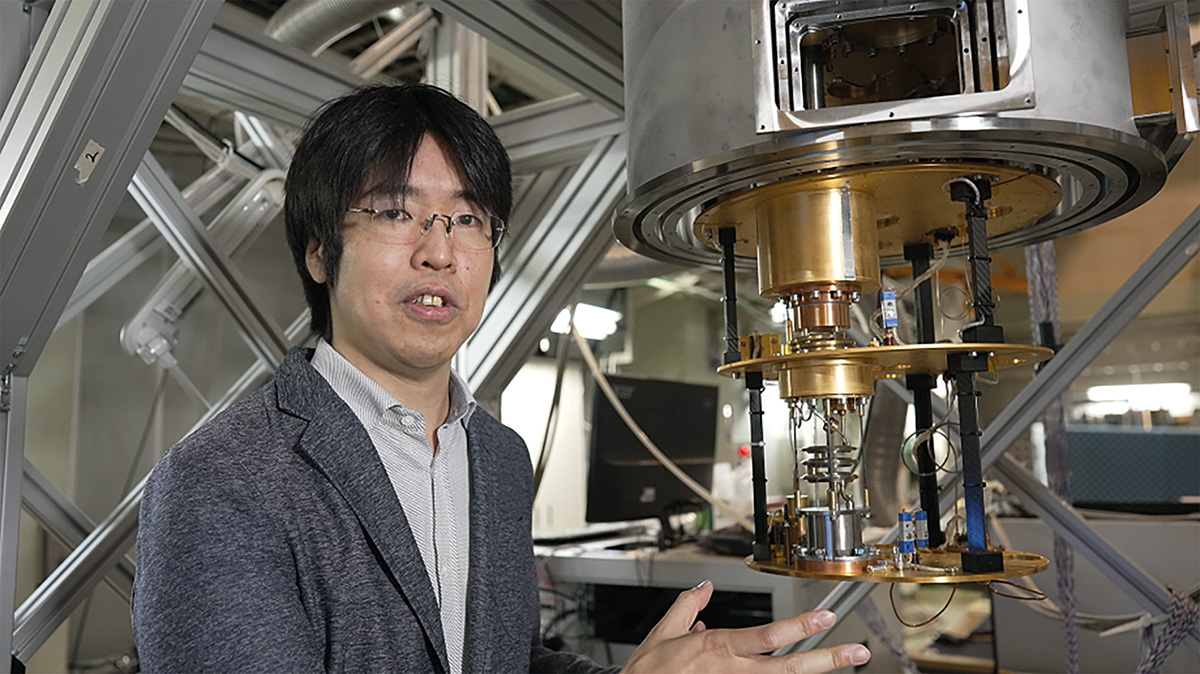
Myeun Kwon

It’s RAON’s combined production scheme, however, that sets it apart from other heavy-ion accelerator laboratories. Specifically, a twin-track approach that exploits – separately as well as in tandem – two methods for producing rare isotopes: isotope separation online (ISOL) and in-flight fragmentation (IF). For context, ISOL involves the acceleration of light ions (e.g. protons) and their collision with a heavy-element target (e.g. uranium), with a large abundance of rare (and high-purity) isotopes extracted following fragmentation of the target. With IF, on the other hand, accelerated heavy ions (e.g. uranium) collide with a light-element target (e.g. carbon), with strong magnets extracting rare isotopes of interest from many kinds of very fast-moving, fragmented heavy-ion beams.  

RAON is, by some way, South Korea’s biggest big science endeavour to date

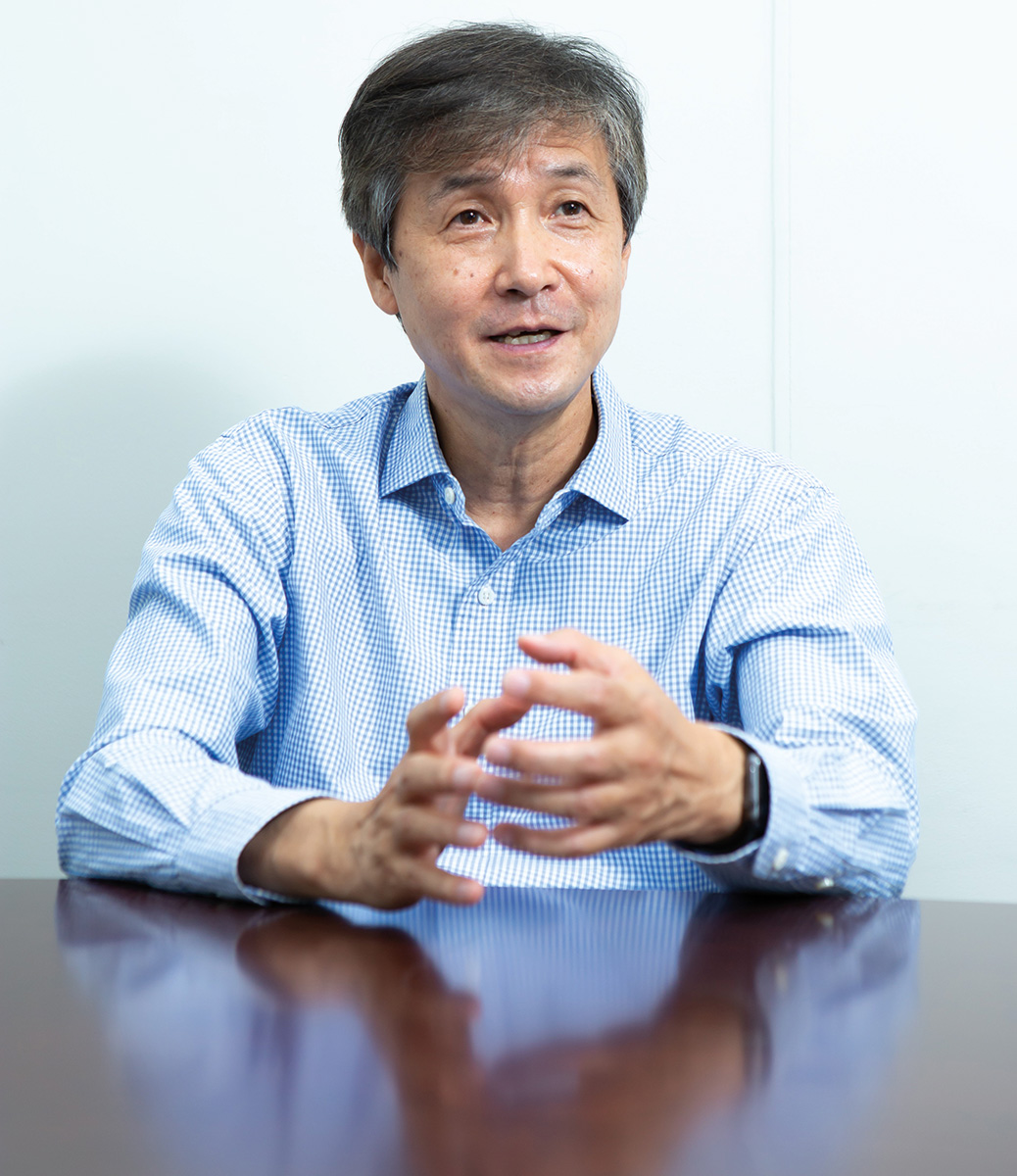
Myeun Kwon, director of RISP and RAON

Here Myeun Kwon, director of RISP and RAON, tells CERN Courier how the new facility is taking shape with help from a network of partnerships across the scientific community and industry. 

What differentiates RAON’s scientific mission from other heavy-ion accelerator facilities?

We are developing RAON, first and foremost, to access the unexplored regions of the nuclear landscape. Upon completion, RAON will provide a first-of-its-kind production facility, combining ISOL as a first step and IF systems in a second step to produce and study the more exotic radioisotope beams – in fact, up to 80% of all the isotopes predicted to exist for elements below uranium. There are a number of studies – theoretical and experimental – which suggest that such a two-step process will expand the horizon for radioisotope production dramatically. 

While other heavy-ion accelerators rely exclusively on either ISOL or IF, RAON will be the first to exploit a combined ISOLIF production scheme – while simultaneously making ISOL and IF available to users as stand-alone processes. As such, RAON is expected to increase the rate of discovery of rare isotopes, whilst producing them in larger quantities and in greater variety.

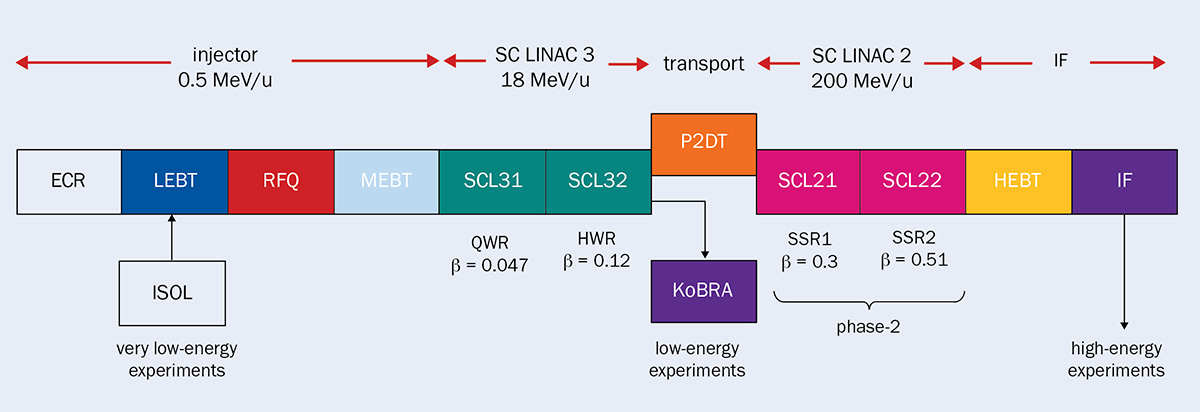
Building blocks: the RAON accelerator facility

The RAON heavy-ion accelerator system

Upon completion, the RAON accelerator will generate heavy and light ion beams at a wide range of momenta – up to 200 MeV/nucleon for uranium and 600 MeV for protons (and with a beam current range from 8.3 pμA for uranium and 660 pμA for protons). 

In terms of the core building blocks, RAON comprises an injector system and three discrete superconducting linac sections, the superconducting cavities of which are phased independently and operated at three different frequencies (81.25, 162.5 and 325 MHz).

The low-energy superconducting linac section (SCL3) and the high-energy superconducting linac (SCL2) are connected by a post-accelerator driver linac (P2DT), which consists of a charge-stripper, two rebunchers and a 180° bending system. 

The injector system accelerates a heavy-ion beam to 500 keV/nucleon and creates the desired bunch structure for injection into the SCL3 linac. 

The injector comprises two electron cyclotron ion sources (ECR-IS), a low-energy beam transport section (LEBT), an RF quadrupole (RFQ) and a medium-energy beam transport system (MEBT).

The LEBT is designed to transport and match ion beams extracted from the ECR-IS to the RFQ; electrostatic quadrupoles are chosen for transport and focusing because these are more suitable for the LEBT’s low-velocity beams.

The RFQ (approx. 5 m long with a four-vane structure) is designed to accelerate ion beams from 10 keV/nucleon to 500 keV/nucleon at 81.25 MHz of the resonance frequency. 

The MEBT comprises 11 room-temperature quadrupole magnets to transport and focus the ion beams, with four bunching cavities (operating at 81.25 MHz of resonance frequency) arranged to match the longitudinal beam size to SCL3.

Phase II of the accelerator roll-out (due for completion in 2025) involves the construction and commissioning of the high-energy superconducting linac (SCL2).

Completion of Phase II of RAON will see the launch of a co-located laboratory to evaluate next-generation radiotherapy modalities for the treatment of cancer – for example, the combined use of 11C particle beams for localised radiotherapy and in situ gamma-ray imaging of solid tumours (so-called theranostics). 

How important are partnerships – domestic and international – for the successful delivery of the RAON initiative? 

RAON is, by some way, South Korea’s biggest big science endeavour to date. Put simply, the project would not be possible without our extensive R&D partnerships, supporting us with the co-development of core enabling technologies for the accelerator facility and the experimental systems for RAON’s front-line research programme. We have a network of Korean universities and research institutes, for example, working on accelerator design and development, as well as the manufacture and testing of superconducting components and subsystems. 

RAON building and support facilities

International collaboration is front-and-centre as well, with diverse technology contributions from the likes of TRIUMF (Canada), RIKEN and KEK (both Japan), the Institute of High Energy Physics (IHEP, China), the Institute for Nuclear Physics (INFN, Italy) and the European Spallation Source (ESS, Sweden). At a more strategic level, we rely on broad engagement and oversight from a network of scientific and engineering experts represented on our international/technical supervisory committees.

What does RAON’s engagement with industry look like? 

We’re pursuing a mixed model with industry – using off-the-shelf technologies when appropriate to manage our capital outlay, but also co-developing unique breakthrough technologies that can subsequently be transferred and exploited more widely by industry. A good example of the latter is Vitzro Tech, a domestic manufacturer that we engaged on bespoke development and manufacture of a portfolio of niobium superconducting RF cavities, cryomodules and cryogenic distribution lines for key legs of the accelerator facility. Vitzro Tech’s inputs are fundamental to the project’s long-term success and the expectation is that the technologies the company developed for RAON will, in time, be offered commercially to other big science facilities – a case study in downstream innovation. 

Presumably, you need to forge close links with equipment manufacturers at home and abroad?

Correct. Big science is all about collaboration, so the priority, from the off, is to have tight communication with your industry vendors. We have domestic manufacturers, for example, that have supplied us with a range of commercially available accelerator technologies – advanced magnets, vacuum systems and associated instrumentation – while international manufacturers also feature prominently in the project supply chain. The RAON cryoplant is a case in a point – a turnkey system developed specifically for RAON by our technology partner Air Liquide of France. 

How has the project timeline been affected by the COVID-19 pandemic? 

RAON depends on equipment deliveries from regional and international technology partners, so some supply-chain disruption was inevitable as a result of the pandemic. Notwithstanding the logistical obstacles, we have registered significant progress along many coordinates over the past three years. The construction of all buildings and supporting facilities was completed in 2021, while the low-energy linac – which includes two types of superconducting RF cavities – and its associated cryoplant, ISOL facilities (with cyclotron) and experimental systems (seven in all) are also complete. 

HWR cryomodules

A significant commissioning milestone was reached in October 2022 with the first argon-ion beams accelerated by the low-energy superconducting linac, with all the linac subsystems – including quarter-wave and half-wave resonator cavities – cooled down to cryogenic temperatures (see “Building blocks: the RAON accelerator facility”). The mechanical installation and commissioning of the associated cryoplant (4.2 kW cooling capacity as the equivalent heat load at 4.5 K) was completed back in August 2022, with the “cold box” connected to the main helium distribution line.

What are the next steps for RAON? 

We are now in the middle of commissioning the low-energy superconducting linac and aim to complete that process early next year. We envisage a similar commissioning timeline for the ISOL facility (with 70 MeV proton cyclotron) and the low-energy experimental facilities such as KoBRA (Korea Broad acceptance Recoil Spectrometer and Apparatus). In the middle of 2023, we will combine all of these building blocks for initial radioisotope production, with preparations for the first round of user experiments (at low energies) taking another year or so through to autumn 2024. Phase two of the RAON installation involves the construction and commissioning of the high-energy superconducting linac. 

bright-rec iop pub iop-science physcis connect