Comsol -leaderboard other pages

Topics

Expanding the senses

Blind visitors test a tactile exhibit

Whether it is grasping the intricate workings of the Higgs mechanism, catching a glimpse of how gravitational waves propagate or contemplating the profound interconnectedness of these phenomena, fundamental physics awakes excitement in scientists and non-scientists alike. Curiosity and the endeavour to fulfil it transcends the constraints of physical, neurological and cultural boundaries, uniting us all in the pursuit of knowledge.

Yet, physics is inherently abstract, and the complex series of interconnected cause-and-effect reasoning is often not straightforward to grasp. The challenge becomes even more daunting when the audience does not share the visual or neurological setup typical to the majority. The main bottleneck is the traditional mode of visual physics communication, which relies mostly on 2D descriptions. We are all familiar with such examples: screens or slides full of overwhelming text with occasional images and graphs. Clearly, such descriptions are not accessible to the visually impaired. Moreover, they usually fall short of creating intuitive understanding, even in people with regular visual perception.

Tangible representations

The key to unlock accessibility is to broaden the number of dimensions and directions through which physics is communicated. Tactile models are the foremost example. They transform abstract concepts into tangible representations, offering a hands-on, immersive and engaging learning experience. The structures of complex entities such as an atom, a gravitational wave, an LHC detector and how particles interact with it are best “visualised” by “feeling” their 3D models. Yet, these are relatively concrete concepts that are straightforward to model. Much more fascinating is to extend this idea and build models to represent the workings of more abstract phenomena. For example: how are the LHC magnets cooled? How does wakefield acceleration work? How are particles reconstructed in a detector? And how does a data analysis searching for new particles progress? 

Designing models for these concepts requires more than simply adding an extra dimension to a visual representation. It involves discerning the core aspects of the physical concept that hold the most significance, simplifying them without diluting their essence, and weaving them into a tangible story – a story that takes into account the perception spectrum of the intended audience and aligns with their lived experiences. We can all share a part in this process: physicists, educators, accessibility experts and the target audience itself. Thanks to amazing improvements in 3D printing, realising the models is now much easier, which gives us the freedom to imagine and build with boundless creativity. 

Fresh perspectives

It is highly worthwhile for all of us to attempt this expansion of expression in what we are experts at. In the realm of accessibility initiatives, what proves beneficial for one audience usually translates into advantages for all. For instance, tactile content originally tailored for the visually impaired resonates with children who possess an innate curiosity for tactile experiences. Enhancing access to captivating physics, as is done by the informal science-learning encounters at CERN Science Gateway, can make a great impact. Another pioneering example, specifically designed for the visually impaired, is Tactile Collider, an immersive workshop developed by particle physicists in the UK that allows participants to explore the science of particle accelerators and the Higgs boson through touch, sound and embodied learning techniques (CERN Courier January/February 2020 p33).

The thorough internalisation and fresh perspectives brought whilst sculpting a tangible 3D story out of a physics theme and seeking connections to familiar daily concepts can also amplify our own intuition. Most rewarding would be to share our models in festivals of 3D learning wherever curiosity dwells, from classrooms to exhibitions and public scientific discussions, to inspire and encourage brilliant ideas born through “feeling physics”.

The power of objects

The bottle Peter Higgs drank from

One of the key challenges of communicating particle physics – particularly when preserving and presenting tangible artefacts – is the sheer scale of the endeavour. The infrastructure of particle physics has frequently been likened to cathedrals: great vaulted caverns built by the hands of many in search of truths about our universe. And even the major facilities are only one part in the international network of particle physics. Museums, which are also often likened to cathedrals, weren’t typically designed with gigantic and internationally distributed artefacts in mind. And that’s before we consider the objects of study: you can’t display a particle in a glass case. So how can we find tangible ways to represent abstract physical phenomena? What does it mean to represent the work of the thousands of people involved in today’s particle-physics projects? And is it possible to capture a fleeting moment of discovery for posterity?

Sometimes, those fleeting moments are best captured by ephemeral objects. Something that might seem mundane or throwaway can provide eloquent insights into the real life of physics. The announcement of the discovery of the Higgs Boson at CERN on 4 July 2012 was recorded in several formats, notably the film footage of Peter Higgs wiping away a tear in CERN’s main auditorium as the ATLAS and CMS teams announced the discovery of the particle whose existence he, François Englert and Robert Brout had predicted decades before.

A material memorial of the Higgs-boson discovery is the champagne bottle emptied by Higgs and John Ellis the night before the announcement. In fact, the quiet and modest Higgs usually prefers London Pride beer; unfortunately, the can that he drank on his flight home from Geneva after the announcement was not saved for posterity. But the champagne bottle also speaks to a common practice at CERN: around the site, particularly in the CERN Control Centre, there are arrays of empty bottles, opened in celebration of events including the LHC start-up, first physics collisions, major publications and other milestones.

Familiar yet unexpected objects such as the champagne bottle in the context of a display about physics can pique visitors’ interest and encourage them to move on to more complex-looking displays that they might otherwise pass by. As such, Higgs’ champagne bottle featured in the Collider exhibition (see above picture) produced by the London Science Museum in 2013 and another bottle is part of CERN’s heritage collection – a curated assortment of more than 200 objects that encapsulate CERN’s history.

Magic moments

Connecting to newsworthy moments or well-known people is usually a successful draw for visitors. Capitalising on the global success of the movie Oppenheimer, this year the Bradbury Science Museum at Los Alamos developed  an exhibition of Oppenheimer-related artefacts, including his own copy of the Bhagavad Gita. At CERN Science Gateway, Tim Berners-Lee’s NeXT computer – used to host the first website – creates an immediate talking point for visitors who can barely imagine life without the web, despite the object itself being literally a black box.

Tim Berners-Lee’s NeXT machine

That said, it is rare for a scientific or technological artefact to be a “show piece” that would attract visitors in its own right, in the same way that they would queue to see a famous artwork. The Antikythera mechanism at the National Archaeological Museum in Athens, Galileo’s telescopes at the Museo Galileo in Florence, or the Apollo 11 command module at the National Air and Space Museum in Washington are not representative of the types of material generally found in science heritage collections. Most science-related objects are not that easy for non-specialists to engage with; to the uninitiated eye the tools of particle physics mostly look like wiring and plumbing. Exhibition developers therefore usually adopt the “key pieces” approach advocated by Dutch curator Ad Maas: setting objects in the context of an overall narrative and a rich array of materials including photographs, documents, film, audio and personal testimony brings them to life and allows developers to layer information for different audience tastes and interest levels. Thanks to CERN’s archives and heritage collection, there is a wide range of material to draw from.

Using the key-pieces approach, a single small part can be revealing of a much larger whole: for example, by following the “life story” of a lead tungstate crystal used in the CMS electromagnetic calorimeter – which was also featured at the Collider exhibition – we gain insights into the decades-long design and planning process for the CMS detector, and an adventure in production and testing that takes us on a journey via Moscow, Shanghai and Rome (with a detour to the UBS bank vaults in Zurich). The physical nature of the object itself reflects its design and production history, while also illustrating the phenomena of particle decay and scintillation. At CERN, you’ll find displays of crystals like these around the site, in public and private spaces.

Much of the scientific heritage of the 20th and 21st centuries was originally preserved by practitioners with a sixth sense of “this might be useful someday” rather than by professional curators. Today, CERN has detailed archival and heritage collection policies that offer guidance as to what kinds of material might be worth keeping for posterity. Of course it’s impossible to keep everything; we can’t predict for certain what avenues future historians might be interested in exploring, or what kinds of objects will be used to popularise science. But by preserving storehouses of memories, we might be keeping some building blocks for the cathedrals of a future age.

Going where the crowd is

Summer means holidays, beaches, long evenings outside and, for many, attending an outdoor festival. Music festivals in particular have expanded all over the world, and the competition to offer new experiences to curious festival goers has created opportunities to share CERN’s work and science with this untapped audience, many of whom never normally go to science events. Based on the success of CERN’s first Science Pavilion at Peter Gabriel’s world music festival WOMAD in 2016, the project has grown to become a highly successful outreach effort known as the CERN Festival Programme. The generally three-day programme offers a variety of shows, presentations, talks and hands-on workshops tailored to each country and demographic. The Pavilions are a real collaboration, a partnership between CERN, collaborating institutes in each country and the festival itself, each sharing costs and person power.

In 2019, four Science Pavilions were held in four different music and culture festivals in four different countries: the Big Bang Stage at the Ostrava festival in the Czech Republic, produced in partnership with Charles University and the Czech Technical University; the Magical Science Pavilion at the Pohoda Festival in Slovakia – an incredible space produced with Comenius University; the World of Physics at WOMAD in the UK, going strong year after year thanks to an enduring collaboration with Roger Jones of Lancaster University; and the Science Pavilion at the Roskilde Festival in Denmark, a highly successful relationship with Jørgen Beck Hansen at the Niels Bohr Institute in Copenhagen. More than 20,000 people came to the four spaces in 2019!

Workshops give people a chance to interact in a direct way with science and technology, as well as with physicists working on different experiments at CERN. They often can’t believe that these people who work for CERN have actually come to the festival to talk to them. A variety of topics are covered ranging from what’s new in physics to technological and scientific advances in the news that touch on people’s everyday lives, such as artificial intelligence. For 2023 we introduced a successful “scientific speed dating” with the young audience at Roskilde. A talk from CERN’s director for accelerators and technology Mike Lamont on physics and medicine and an informal “Chat with the AI experts” in the sunshine also proved incredibly popular at WOMAD this year. Between 4000 and 6000 people come to each Science Pavilion in each festival every year. Requests for new collaborations in other countries are coming in, and as a result there are currently ongoing discussions for Pavilions at festivals in the Netherlands and Spain. Physicists love the idea and their students are always an important asset to the event, with the most forward-thinking institutes keen to be part of the programme.

The feedback from visitors is clear: people love finding science at a music festival. The fact that the science is taken to them, where they are at their most comfortable, relaxed and receptive to new things, is key to the programme’s success. Comments range from “It’s a welcome break to sit in a cool space and learn something interesting and talk about stuff other than drinking and partying” to “I never liked science at school, I found it so boring and complicated, but here you make it fun and I’ve come back every year, I love it!”.

Recently, the Festival Programme was approved to be part of the CERN and Society Foundation. This means that an individual wishing to support this fantastic form of outreach and communication, or a company that understands the benefit of the programme and would like to have their logo at the festival next to ours, can now do so. It’s a great opportunity to reach new audiences, and especially to engage in those countries whose people are actually funding CERN.

Physicists go direct

As recently as 10 years ago, scientists had to work hard to convince conference organisers of the value of sessions on communication, education and outreach. Today, major conferences such as ICHEP, EPS-HEP and LHCP not only offer parallel sessions, but also plenary talks where the state of the art in the field is reviewed. Abstracts from around the world describe events organised in multiple contexts and languages, via formal and informal partnerships between scientists and local communities, artists, teachers and many others. Each of the major LHC experiments now has a dedicated outreach group that, with the help of a few professional communicators, develops material and shares best practice within the collaboration. Institutes and funding agencies are on board, and younger generations are increasingly encouraged to include outreach on their CVs. A fraction of this energy and creativity is captured in reports, such as the one presented each year to the CERN Council by the International Particle Physics Outreach Group (IPPOG) – a collaboration initiated by former CERN Director-General Chris Llewellyn-Smith in the early days of the LHC project, and that now counts 33 countries, seven experiments and three large laboratories.

Reaching out to the world

Workshops and hands-on activities have multiplied in recent years. Cloud-chamber building is one of the most popular, and is used by a growing number of institutes when they host students for a day. Created in 2005, the International Masterclasses programme brings another level of activity, offering guests the chance to analyse data from contemporary experiments with direct help from the physicists involved. Each year, more than 10,000 teachers and 15–19-year-old students have been given this opportunity. Initially organised in the EU time zone with a scientist at CERN, the programme now also runs in US and Japanese time zones. The range of analyses offered encompasses the four LHC experiments, Belle II, particle therapy, the Pierre Auger cosmic-ray detector and neutrino experiments in the US. During the pandemic, masterclasses were made available online, and the tools developed now help to reach people in countries and regions that do not yet have any high-energy physics institutes.

The large number of CERN visitors is proof of public interest in face-to-face interactions. But what about those who can’t come in person? What about teachers who want to inspire their students by inviting a scientist into their classrooms? Or institutes that would like to show a detector their teams have built and where the data come from? Pioneered by ATLAS in 2010, the LHC experiments virtual-visit programme breaks down geographical barriers. Thanks to a video conference tool, a scientist working on an experiment can walk audiences through underground installations or control rooms, the diversity of international-collaboration members offering a wide range of languages to let the public meet and engage with “one of theirs”. The most important part of the event is a lengthy Q&A session, which has allowed tens of thousands of children and adults to share the scientific experience.

Coming together

Organised by interactions.org, a network that groups the communications activities of the world’s particle-physics labs, Dark Matter Day offers a scientific twist to Halloween. Since 2017, more than 350 global, regional and local events have been held on and around 31 October. Institutions and individuals engage the public in discussions about what is known and what mysteries experiments are seeking to solve. International Cosmic Day, where students, teachers and scientists come together to talk and learn about cosmic rays, follows each November. Activities range from the construction of a detector to data analysis, and the coordination of such events is kept light, to let the primary actors – the scientists who proposed and built the 17 presently listed activities – be as creative and engaged as they are in everyday life. As with all community-driven outreach activities, that authenticity is hard to beat.

Empowering children to aspire to science

The new labs and exhibitions in Science Gateway offer children as young as five and eight, respectively, the opportunity to have fun with science. Why would CERN target such young audiences? And what CERN-related content could possibly be accessible to such an age group?

CERN has traditionally tailored education and outreach material predominantly towards high-school students, in particular those already expressing an interest in science.  For this age group, it is relatively easy to find overlaps between school curricula and work at CERN. Such visitors will continue to find engaging content in our exhibitions. However, if CERN is to connect to a broader section of the public and attract a more diverse cohort of future scientists, it needs to reach out beyond existing science fans, attracting younger audiences before stereotypes set in.

Positive contacts

Over the decades, communication best-practice has evolved from the idea that to inspire children to choose a career in science, you just need to make it sound interesting. Now, it is recognised that there are multiple factors influencing choice. The Aspires research project at University College London, for example, has highlighted the importance of “science capital”, a notion based on the variety of positive contacts with science that children experience. This includes knowing people who work in science, talking with family and friends, doing science-based activities outside school and there being a generally positive attitude towards science within the family setting.

At schools, careers information often comes once choices to drop science subjects have already been made. And without role models to identify with, or contact with science or science-related professions through family and friends, it can be extremely difficult for some students to imagine themselves as future scientists. Hence the drop in pupils expressing such aspirations from the end of primary education onwards that occurs in many countries. By offering younger students the opportunity to experiment and play in a scientific environment, Science Gateway seeks to counter this drop. In addition to the existing science-fan visitors, it aims to reach those with less science capital at home, so that children can discover new opportunities.

There is a slogan in the exhibitions world: “hands on, minds on”. A good exhibit creates memorable experiences that empower visitors to explore and engage, rather than simply transmitting knowledge in a unidirectional way. Science Gateway offers activities – such as designing a detector or collaborating to lower equipment into a cavern – where children are encouraged to think logically, and exhibits that encourage them to make their own deductions, helping them to become more confident that science is for them. Here the exhibition guides play a key role in encouraging interaction and play.

Sometimes in a hands-on science centre, one can have the impression that children are having so much fun racing from exhibit to exhibit that there is no valid experience. This is countered by research which shows that learning comes in a broad variety of forms. Informal learning experiences, such as those at Science Gateway, can have just as much impact as in-school learning.

The exhibitions offer a variety of different environments – playful areas and beautiful spaces, including artworks, that can be enjoyed by simply sitting back and reflecting.  The exhibitions team has also collaborated with community groups to develop tactile content and ensure the exhibits are accessible to wheelchair users. Not all exhibits will be accessible for younger children, or for the visually impaired, but throughout there is a spread of different experiences that give something for everyone to enjoy.

The ambition is for CERN to become a popular destination for a fun day out, attracting a broad section of the public, both those who might one day become scientists themselves and those who might never choose that path, but who are curious to explore the new buildings that have popped up in their local area. Successful outcomes can be as simple as visitors having fun in a scientific environment. This is a first step towards being open to scientific ideas and methods – a valid goal in today’s world of misinformation and distrust, where science is sometimes talked of as something you might or might not choose to believe in.

Hands on, minds on, goggles on!

In 1826, the Swiss pedagogue and educational reformer Johann Heinrich Pestalozzi advocated for a natural and meaningful education through a holistic learning approach that engaged “the hands, head and heart”. One prime example of such an approach is found in science education, where experiments allow learners to experience scientific phenomena while manipulating ideas about experiments in their minds. Experiments are also associated with high affective value, as school students generally enjoy practical tasks and often rank them as preferred learning activities in school. As a result, experiments have long been considered an essential part of teaching the nature of science, and only very few science educators have questioned their necessity.

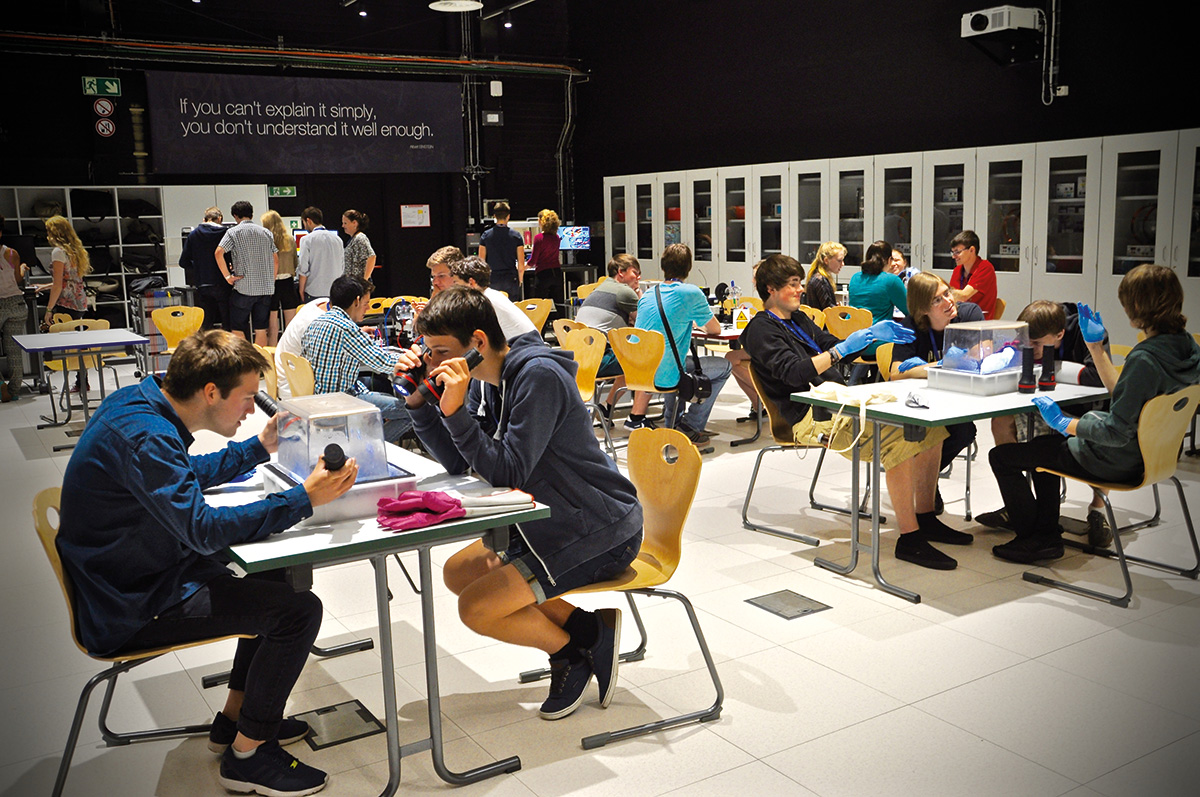
Consequently, it was long overdue for CERN to offer opportunities for visiting high-school students to get hands-on with particle physics. In 2014, CERN inaugurated its first particle-physics learning laboratory for high-school students. During its eight years of operations, “S’Cool LAB” gave nearly 40,000 visitors a unique opportunity to make discoveries independently, work scientifically and gain insight into modern science in the making.

A major factor in S’Cool LAB’s success was its connection to the latest thinking in physics education research. Interestingly, learning from hands-on experiments is (still) one of the central problems of physics education research. Even though students often enjoy doing experiments, various factors influence what and how much students learn from the exercise. To address this research gap, educational activities at S’Cool LAB were continually developed and improved through accompanying physics education research projects. For example, experimental tasks were designed to challenge scientifically inaccurate mental models (such as bar magnets having electrically charged poles) by allowing students to compare their predictions with surprising observations and thus foster conceptual understanding. Moreover, empirical research carried out based on questionnaires from students before and after taking part in lab workshops confirmed significant positive effects on high-school students’ interest in physics and their beliefs in their physics-related capabilities, and a surprisingly high correlation between these affective outcomes and students’ perceived level of cognitive activation. Remarkably, girls benefited more from S’Cool LAB with respect to their interest and self-beliefs. Consequently, the initial gender gap (with girls reporting slightly lower interest and self-beliefs than boys) was closed.

New incarnation

On 12 January 2023, excavators arrived to dismantle S’Cool LAB to make space for the new educational labs at CERN Science Gateway. Several considerations went into the design of the new labs. Firstly, they have a broader scope, catering not only to high-school students and their teachers but also to school students as young as five, as well as the general public. Indeed, Science Gateway offers regular workshops open to individual visitors, tourists and families. Moreover, workshops are adapted to different age groups and cover many different topics such as engineering challenges, different technologies, detection principles, or medical applications of particle physics. This diversity allows for better adaptation to the needs of students and teachers, who often prefer workshops that can be easily integrated into their science curriculum.

Observing cloud chambers at S’Cool LAB

When designing labs for young learners, a critical choice involves balancing the level of openness and guidance. While open exploration is considered to be the ideal form of experimentation, young students can feel overwhelmed by the choices involved in developing research questions, experiment design and the interpretation of evidence. At the same time, giving students a choice in their learning can foster a sense of ownership and autonomy, leading to increased engagement and motivation to explore topics of personal interest. Providing the right level of guidance and support is therefore crucial to meaningful experimentation and a key element of the education labs at Science Gateway. It helps students enjoy hands-on activities while freeing up mental capacity to process new information effectively. To help teachers prepare their students for the new lab workshops, they now receive detailed information about its planned content and suggestions on how to integrate their experience at CERN into their classroom practice.

The impact of volunteers on students’ interest and self-beliefs was a striking result from physics education research at S’Cool LAB

Despite the variety of lab workshops offered, all activities are anchored in authentic CERN contexts and can even be linked to real objects and authentic equipment in the interactive exhibitions at Science Gateway. This approach helps foster students’ interest in science and provides them with an accurate image of science and scientists. For instance, one lab workshop for students aged 8–15 – the “Power of Air” – allows students to use 3D-printed components and toy balloons to investigate balloon hovercrafts on different surfaces, drawing connections with how engineers at CERN move massive slices of the LHC detectors via air pads.

Community input

To enhance the authenticity of lab workshops, volunteers from CERN’s scientific community accompany students during their learning process and engage in discussions about their findings. The impact of volunteers on students’ interest and self-beliefs was a striking result from physics education research at S’Cool LAB. Students were inspired by the enthusiasm displayed by their guides and appreciated the opportunity to ask questions in an enjoyable learning atmosphere. Therefore, the education labs at Science Gateway will continue to rely on volunteers to facilitate workshops and inspire the next generation of engineers and scientists. To address new challenges related to groups of very young learners, heterogeneous audiences, the diverse collection of lab workshops and the high volume of workshops held each year, a team of professional science educators provides continuous support and guidance to volunteers.

In conclusion, the educational labs at CERN Science Gateway have been designed to provide a wide range of hands-on learning experiences for learners of all ages. These labs aim to not only promote scientific understanding but also foster curiosity, interest and positive self-beliefs in students, empowering them to explore the world of science by demonstrating that science is for everyone.

Antinuclei production in pp collisions

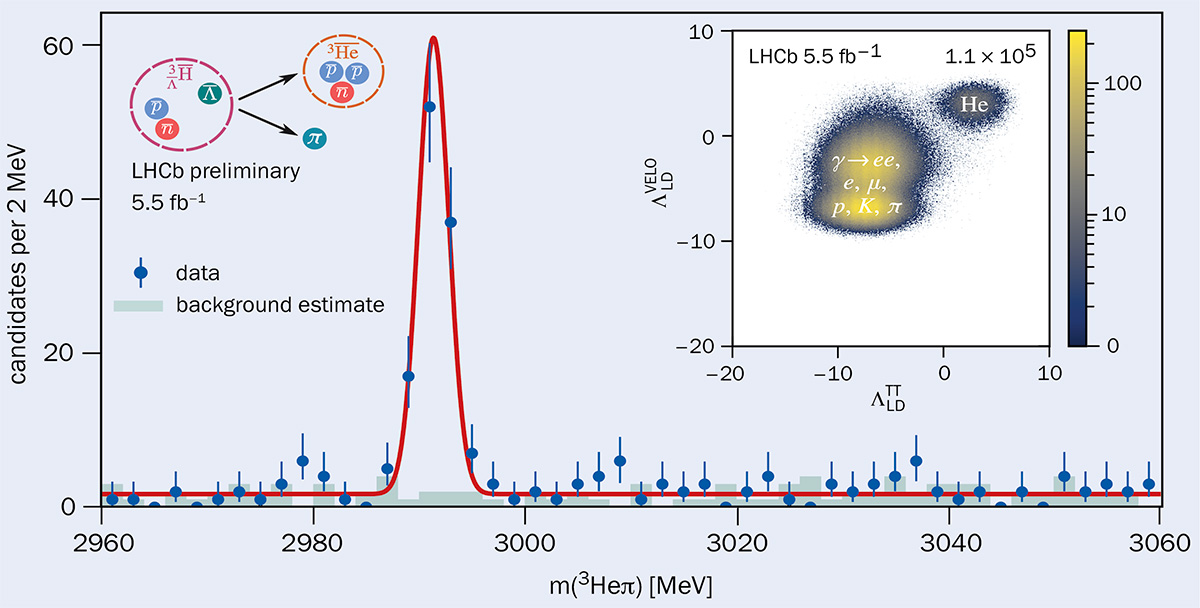
LHCb figure 1

At the European Physical Society Conference on High Energy Physics, held in Hamburg in August, the LHCb collaboration announced first results on the production of antihelium and antihypertriton nuclei in proton–proton (pp) collisions at the LHC. These promising results open a new research field, that up to now has been pioneered by ground-breaking work from the ALICE collaboration on the central rapidity interval |y| < 0.5. By extending the measurements into the so-far unexplored forward region 1.0 < y < 4.0, the LHCb results provide new experimental input to derive the production cross sections of antimatter particles formed in pp collisions, which are not calculable from first principles.

LHCb’s newly developed helium-identification technique mainly exploits information from energy losses through ionisation in the silicon sensors upstream (VELO and TT stations) and downstream (Inner Tracker) of the LHCb magnet. The amplitude measurements from up to ~50 silicon layers are combined for each subdetector into a log-likelihood estimator. In addition, timing information from the Outer Tracker and velocity measurements from the RICH detectors are used to improve the separation power between heavy helium nuclei (with charge Z = 2) and lighter, singly charged particles (mostly charged pions). With a signal efficiency of about 50%, a nearly background-free sample of 1.1 × 105 helium and antihelium nuclei is identified in the data collected during LHC Run 2 from 2016 to 2018 (see figure, inset).

The helium identification method proves the feasibility of new research fields at LHCb

As a first step towards a light-nuclei physics programme in LHCb, hypertritons are reconstructed via their two-body decay into a now-identified helium nucleus and a charged pion. Hypertriton (3ΛH) is a bound state of a proton, a neutron and a Λ hyperon that can be produced via coalescence in pp collisions. These states provide experimental access to the hyperon–nucleon interaction through the measurement of their lifetime and of their binding energy. Hyperon–nucleon interactions have significant implications for the understanding of astrophysical objects such as neutron stars. For example, the presence of hypernuclei in the dense inner core can significantly suppress the formation of high-mass neutron stars. As a result, there is some tension between the observation of neutron stars heavier than two solar masses and corresponding hypertriton results from the STAR collaboration at Brookhaven. ALICE seems to have resolved the tension between hypertriton measurements at colliders and neutron stars. An independent confirmation of the ALICE result has up to now been missing, and can be provided by LHCb.

The invariant-mass distribution of hypertriton and antihypertriton candidates is shown in figure 1. More than 100 signal decays are reconstructed, with a statistical uncertainty on the mass of 0.16 MeV, similar to that of STAR. In a next step, corrections for efficiencies and acceptance obtained from simulation, as well as systematic uncertainties on the mass scale and lifetime measurement, will be derived.

The new helium identification method from LHCb summarised here proves the feasibility of a rich programme of measurements in QCD and astrophysics involving light antinuclei in the coming years. The collaboration also plans to apply the method to other LHCb Run 2 datasets, such as proton–ion, ion–ion and SMOG collision data.

Getting to the bottom of muon g-2

Muon g-2 Theory Initiative

About 90 physicists attended the sixth plenary workshop of the Muon g-2 Theory Initiative, held in Bern from 4 to 8 September, to discuss the status and strategies for future improvements of the Standard Model (SM) prediction for the anomalous magnetic moment of the muon. The meeting was particularly timely given the recent announcement of the results from runs two and three of the Fermilab g-2 experiment (Muon g-2 update sets up showdown with theory), which reduced the uncertainty of the world average to 0.19 ppm, in dire need of a SM prediction at commensurate precision. The main topics of the workshop were the two hadronic contributions to g-2, hadronic vacuum polarisation (HVP) and hadronic light-by-light scattering (HLbL), evaluated either with a lattice–QCD or data-driven approach.

Hadronic vacuum polarisation

The first one-and-a-half days were devoted to the evaluation of HVP – the largest QCD contribution to g-2, whereby a virtual photon briefly transforms into a hadronic “blob” before being reabsorbed – from e+e– data. The session started with a talk from the CMD-3 collaboration at the VEPP-2000 collider, whose recent measurement of the e+e– → π+π– cross section generated shock waves earlier this year by disagreeing (at the level of 2.5–5σ) with all previous measurements used in the Theory Initiative’s 2020 white paper. The programme also featured a comparison with results from the earlier CMD-2 experiment, and a report from seminars and panel discussions organised by the Theory Initiative in March and July on the details of the CMD-3 result. While concerns remain regarding the estimate of certain systematic effects, no major shortcomings could be identified.

Further presentations from BaBar, Belle II, BESIII, KLOE and SND detailed their plans for new measurements of the 2π channel, which in the case of BaBar and KLOE involve large data samples never analysed before for this measurement. Emphasis was put on the role of radiative corrections, including a recent paper by BaBar on additional radiation in initial-state-radiation events and, in general, the development of higher-order Monte Carlo generators. Intensive discussions reflected a broad programme to clarify the extent to which tensions among the experiments can be due to higher-order radiative effects and structure-dependent corrections. Finally, updated combined fits were presented for the 2π and 3π channels, for the former assessing the level of discrepancy among datasets, and for the latter showing improved determinations of isospin-breaking contributions.

CMD-3 generated shock waves by disagreeing with all previous measurements at the level of 2.5-5σ

Six lattice collaborations (BMW, ETMC, Fermilab/HPQCD/MILC, Mainz, RBC/UKQCD, RC*) presented updates on the status of their respective HVP programmes. For the intermediate-window quantity (the contribution of the region of Euclidean time between about 0.4–1.0 fm, making up about one third of the total), a consensus has emerged that differs from e+e–-based evaluations (prior to CMD-3) by about 4σ, while the short-distance window comes out in agreement. Plans for improved evaluations of the long-distance window and isospin-breaking corrections were presented, leading to the expectation of new, full computations for the total HVP contribution in addition to the BMW result in 2024. Several talks addressed detailed comparisons between lattice-QCD and data-driven evaluations, which will allow physicists to better isolate the origin of the differences once more results from each method become available. A presentation on possible beyond-SM effects in the context of the HVP contribution showed that it seems quite unlikely that new physics can be invoked to solve the puzzles.

Light-by-light scattering

The fourth day of the workshop was devoted to the HLbL contribution, whereby the interaction of the muon with the magnetic field is mediated by a hadronic blob connected to three virtual photons. In contrast to HVP, here the data-driven and lattice-QCD evaluations agree. However, reducing the uncertainty by a further factor of two is required in view of the final precision expected from the Fermilab experiment. A number of talks discussed the various contributions that feed into improved phenomenological evaluations, including sub-leading contributions such as axial-vector intermediate states as well as short-distance constraints and their implementation. Updates on HLbL from lattice QCD were presented by the Mainz and RBC/UKQCD groups, as were results on the pseudoscalar transition form factor by ETMC and BMW. The latter in particular allow cross checks of the numerically dominant pseudoscalar- pole contributions between lattice QCD and data-driven evaluations.

It is critical that the Theory Initiative work continues beyond the lifespan of the Fermilab experiment

On the final day, the status of alternative methods to determine the HVP contribution were discussed, first from the MUonE experiment at CERN, then from τ data (by Belle, CLEOc, ALEPH and other LEP experiments). First MUonE results could become available at few-percent precision with data taken in 2025, while a competitive measurement would proceed after Long Shutdown 3. For the τ data, new input is expected from the Belle II experiment, but the critical concern continues to be control over isospin-breaking corrections. Progress in this direction from lattice QCD was presented by the RBC/UKQCD collaboration, together with a roadmap showing how, potentially in combination with data-driven methods, τ data could lead to a robust, complementary determination of the HVP contribution.

The workshop concluded with a discussion on how to converge on a recommendation for the SM prediction in time for the final Fermilab result, expected in 2025, including new information expected from lattice QCD, the BaBar 2π analysis and radiative corrections. A final decision for the procedure for an update of the 2020 white paper is planned to be taken at the next plenary meeting in Japan in September 2024. In view of the long-term developments discussed at the workshop – not least the J-PARC Muon g-2/EDM experiment, due to start taking data in 2028 – it is critical that the work by the Theory Initiative continues beyond the lifespan of the Fermilab experiment, to maximise the amount of information on physics beyond the SM that can be inferred from precision measurements of the anomalous magnetic moment of the muon.

Collectivity in small systems produced at the LHC

ALICE figure 1

High-energy heavy-ion collisions at the LHC exhibit strong collective flow effects in the azimuthal angle distribution of final-state particles. Since these effects are governed by the initial collision geometry of the two colliding nuclei and the hydrodynamic evolution of the collision, the study of anisotropic flow is a powerful way to characterise the production of the quark–gluon plasma (QGP) – an extreme state of matter expected to have existed in the early universe.

To their surprise, researchers on the ALICE experiment have now revealed similar flow signatures in small systems encompassing proton–proton (pp) and proton–lead (pPb) collisions, where QGP formation was previously assumed not to occur. The origin of the flow signals in small systems (and in particular whether the mechanisms behind these correlations in small systems share commonalities with heavy-ion collisions) are not yet fully understood. To better interpret these results, and thus to understand the limit of the system size that exhibits fluid-like behaviour, it is important to carefully single out possible scenarios that can mimic the effect of collective flow. 

Anisotropic-flow measurements become more difficult in small systems because non-flow effects, such as the presence of jets, become more dominant. Thus, it is important to examine methods where non-flow effects are properly subtracted first. One of the methods, the so-called low-multiplicity template fit, has been widely used in several experiments to determine and subtract the non-flow elements.

The origin of the flow signals in small systems is not yet fully understood

The ALICE collaboration studied long-range angular correlations for pairs of charged particles produced in pp and pPb collisions at centre-of-mass energies of 13 TeV and 5.02 TeV, respectively. Flow coefficients were extracted from these correlations using the template-fit method in samples of events with different charged-particle multiplicities. This method considers that the yield of jet fragments increases as a function of particle multiplicity and allows physicists to examine assumptions made in the low-multiplicity template fit for the first time – demonstrating their validity, including a possible jet-shape modification.

Figure 1 shows the measurement of two components of anisotropic flow – elliptic (v2) and triangular (v3) – as a function of charged-particle multiplicity at midrapidity (Nch). The data show decreasing trends towards lower multiplicities. In pp collisions, the results suggest that the v2 signal disappears below Nch = 10. The results are then compared with hydrodynamic models. To accurately describe the data, especially for events with low multiplicities, a better understanding of initial conditions is needed.

These results can help to constrain the modelling of initial-state simulations, as the significance of initial-state effects increases for collisions resulting in low multiplicities. The measurements with larger statistics from Run 3 data will push down this multiplicity limit and reduce the associated uncertainties.

Measuring energy correlators inside jets

CMS figure 1

Quarks and gluons are the only known elementary particles that cannot be seen in isolation. Once produced, they immediately start a cascade of radiation (the parton shower), followed by confinement, when the partons bind into (colour-neutral) hadrons. These hadrons form the jets that we observe in detectors. The different phases of jet formation can help physicists understand various aspects of quantum chromodynamics (QCD), from parton interactions to hadron interactions – including the confinement transition leading to hadron formation, which is particularly difficult to model. However, jet formation cannot be directly observed. Recently, theorists proposed that the footprints of jet formation are encoded in the energy and angular correlations of the final particles, which can be probed through a set of observables called energy correlators. These observables record the largest angular distance between N particles within a jet (xL), weighted by the product of their energy fractions.

The CMS collaboration recently reported a measurement of the energy correlators between two (E2C) and three (E3C) particles inside a jet, using jets with pT in the 0.1–1.8 TeV range. Figure 1 (top) shows the measured E2C distribution. In each jet pT range, three scaling regions can be seen, corresponding to three stages in jet-formation evolution: parton shower, colour confinement and free hadrons (from right to left). The opposite E2C trends in the low and high xL regions indicate that the interactions between partons and those between hadrons are rather different; the intermediate region reflects the confinement transition from partons to hadrons.

Theorists have recently calculated the dynamics of the parton shower with unprecedented precision. Given the high precision of the calculations and of the measurements, the CMS team used the E3C over E2C ratio, shown in figure 1 (bottom), to evaluate the strong coupling constant αS. The ratio reduces the theoretical and experimental uncertainties, and therefore minimises the challenge of distinguishing the effects of αS variations from those of changes in quark–gluon composition. Since αS depends on the energy scale of the process under consideration, the measured value is given for the Z-boson mass: αS = 0.1229 with an uncertainty of 4%, dominated by theory uncertainties and by the jet-constituent energy-scale uncertainty. This value, which is consistent with the world average, represents the most precise measurement of αS using a method based on jet evolution.

bright-rec iop pub iop-science physcis connect