Comsol -leaderboard other pages

Topics

Inside pentaquarks and tetraquarks

Strange pentaquarks

Breakthroughs are like London buses. You wait a long time, and three turn up at once. In 1963 and 1964, Murray Gell-Mann, André Peterman and George Zweig independently developed the concept of quarks (q) and antiquarks (q) as the fundamental constituents of the observed bestiary of mesons (qq) and baryons (qqq).

But other states were allowed too. Additional qq pairs could be added at will, to create tetraquarks (qqqq), pentaquarks (qqqqq) and other states besides. In the
1970s, Robert L Jaffe carried out the first explicit calculations of multiquark states, based on the framework of the MIT bag model. Under the auspices of the new theory of quantum chromodynamics (QCD), this computationally simplified model ignored gluon interactions and considered quarks to be free, though confined in a bag with a steep potential at its boundary. These and other early theoretical efforts triggered many experimental searches, but no clear-cut results.

New regimes

Evidence for such states took nearly two decades to emerge. The essential precursors were the discovery of the charm quark (c) at SLAC and BNL in the November Revolution of 1974, some 50 years ago (p41), and the discovery of the bottom quark (b) at Fermilab three years later. The masses and lifetimes of these heavy quarks allowed experiments to probe new regimes in parameter space where otherwise inexplicable bumps in energy spectra could be resolved (see “Heavy breakthroughs” panel).

Heavy breakthroughs

Double hidden charm

With the benefit of hindsight, it is clear why early experimental efforts did not find irrefutable evidence for multiquark states. For a multiquark state to be clearly identifiable, it is not enough to form a multiquark colour-singlet (a mixture of colourless red–green–blue, red–antired, green–antigreen and blue–antiblue components). Such a state also needs to be narrow and long-lived enough to stand out on top of the experimental background, and has to have distinct decay modes that cannot be explained by the decay of a conventional hadron. Multiquark states containing only light quarks (up, down and strange) typically have many open decay channels, with a large phase space, so they tend to be wide and short-lived. Moreover, they share these decay channels with excited states of conventional hadrons and mix with them, so they are extremely difficult to pin down.

Multiquark states with at least one heavy quark are very different. Once hadrons are “dressed” by gluons, they acquire effective masses of the order of several hundred MeV, with all quarks coupling in the same way to gluons. For light quarks, the bare quark masses are negligible compared to the effective mass, and can be neglected to zeroth order. But for heavy quarks (c or b), the ratio of the bare quark masses to the effective mass of the hadron dramatically affects the dynamics and the experimental situation, creating narrow multiquark states that stand out. These states were not seen in the early searches simply because the relevant production cross sections are very small and particle identification requires very high spatial resolution. These features became accessible only with the advent of the huge luminosity and the superb spatial resolution provided by vertex detectors in bottom and charm factories such as BaBar, Belle, BESIII and LHCb.

The attraction between two heavy quarks scales like α2s mq, where αs is the strong coupling constant and mq is the mass of the quarks. This is because the Coulomb-like part of the QCD potential dominates, scaling as –αs/r as a function of distance r, and yielding an analogue of the Bohr radius ~1/(αsmq). Thus, the interaction grows approximately linearly with the heavy quark mass. In at least one case (discussed below), the highly anticipated but as yet undiscovered bbud. tetraquark Tbb is expected to result in a state with a mass that is below the two-meson threshold, and therefore stable under strong interactions.

Exclusively heavy states are also possible. In 2020 and in 2024, respectively, LHCb and CMS discovered exotic states Tcccc(6900) and Tcccc(6600), which both decay into two J/ψ particles, implying a quark content (cccc). J/ψ does not couple to light quarks, so these states are unlikely to be hadronic molecules bound by light meson exchange. Though they are too heavy to be the ground state of a (cccc) compact tetraquark, they might perhaps be its excitations. Measuring their spin and parity would be very helpful in distinguishing between the various alternatives that have been proposed.

The first unambiguously exotic hadron, the X(3872) (dubbed χc1(3872) in the LHCb collaboration’s new taxonomy; see “What’s in a name?” panel), was discovered at the Belle experiment at KEK in Japan in 2003. Subsequently confirmed by many other experiments, its nature is still controversial. (More of that later.) Since then, there has been a rapidly growing body of experimental evidence for the existence of exotic multiquark hadrons. New states have been discovered at Belle, at the BaBar experiment at SLAC in the US, at the BESIII experiment at IHEP in China, and at the CMS and LHCb experiments at CERN (see “A bestiary of exotic hadrons“). In all cases with robust evidence, the exotic new states contain at least one heavy charm or bottom quark. The majority include two.

The key theoretical question is how the quarks are organised inside these multiquark states. Are they hadronic molecules, with two heavy hadrons bound by the exchange of light mesons? Or are they compact objects with all quarks located within a single confinement volume?

Compact candidate

The compact and molecular interpretations each provide a natural explanation for part of the data, but neither explains all. Both kinds of structures appear in nature, and certain states may be superpositions of compact and molecular states.

In the molecular case the deuteron is a good mental image. (As a bound state of a proton and a neutron, it is technically a molecular hexaquark.) In the compact interpretation, the diquark – an entangled pair of quarks with well-defined spin, colour and flavour quantum numbers – may play a crucial role. Diquarks have curious properties, whereby, for example, a strongly correlated red–green pair of quarks can behave like a blue antiquark, opening up intriguing possibilities for the interpretation of qqqq and qqqqq states.

Compact states

A clearcut example of a compact structure is the Tbb tetraquark with quark content bbud. Tbb has not yet been observed experimentally, but its existence is supported by robust theoretical evidence from several complementary approaches. As for any ground-state hadron, its mass is given to a good approximation by the sum of its constituent quark masses and their (negative) binding energy. The constituent masses implied here are effective masses that also include the quarks’ kinetic energies. The binding energy is negative as it was released when the compact state formed.

In the case of Tbb, the binding energy is expected to be so large that its mass is below all two-meson decay channels: it can only decay weakly, and must be stable with respect to the strong interaction. No such exotic hadron has yet been discovered, making Tbb a highly prized target for experimentalists. Such a large binding energy cannot be generated by meson exchange and must be due to colour forces between the very heavy b quarks. Tbb is an iso­scalar with JP = 1+. Its charmed analogue, Tcc = (ccud), also known as Tcc(3875)+, was observed by LHCb in 2021 to be a whisker away from stability, with a very small binding energy and width less than 1 MeV (CERN Courier September/October 2021 p7). The big difference between the binding energies of Tbb and Tcc, which make the former stable and the latter unstable, is due to the substantially greater mass of the b quark than the c quark, as discussed in the panel above. An intermediate case, Tbc = (bcud), is very likely also below threshold for strong decay and therefore stable. It is also easier to produce and detect than Tbb and therefore extremely tempting experimentally.

Molecular pentaquarks

At the other extreme, we have states that are most probably pure hadronic molecules. The most conspicuous examples are the Pc(4312), Pc(4440) and Pc(4457) pentaquarks discovered by LHCb in 2019, and labelled according to the convention adopted by the Particle Data Group as Pcc(4312)+, Pcc(4440)+ and Pcc(4457)+. All three have quark content (ccuud) and decay into J/ψp, with an energy release of order 300 MeV. Yet, despite having such a large phase space, all three have anomalously narrow widths less than about 10 MeV. Put more simply, the pentaquarks decay remarkably slowly, given how much energy stands to be released.

But why should long life count against the pentaquarks being tightly bound and compact? In a compact (ccuud) state there is nothing to prevent the charm quark from binding with the anticharm quark, hadronising as J/ψ and leaving behind a (uud) proton. It would decay immediately with a large width.

Anomalously narrow

On the other hand, hadronic molecules such as ΣcD and ΣcD* automatically provide a decay-suppression mechanism. Hadronic molecules are typically large, so the c quark inside the Σc baryon is typically far from the c quark inside the D or D* meson. Because of this, the formation of J/ψ = (c c) has a low probability, resulting in a long lifetime and a narrow width. (Unstable particles decay randomly within fixed half-lives. According to Heisenberg’s uncertainty principle, this uncertainty on their lifetime yields a reciprocal uncertainty on their energy, which may be directly observed as the width of the peak in the spectrum of their measured masses when they are created in particle collisions. Long-lived particles exhibit sharply spiked peaks, and short-lived particles exhibit broad peaks. Though the lifetimes of strongly interacting particle are usually not measurable directly, they may be inferred from these “widths”, which are measured in units of energy.)

Additional evidence in favour of their molecular nature comes from the mass of Pc(4312) being just below the ΣcD production threshold, and the masses of Pc(4440) and Pc(4457) being just below the ΣcD* production threshold. This is perfectly natural. Hadronic molecules are weakly bound, so they typically only form an S-wave bound state, with no orbital angular momentum. So ΣcD, which combines a spin-1/2 baryon and a spin-0 negative-parity meson, can only form a single state with JP = 1/2–. By contrast, ΣcD*, which combines a spin-1/2 baryon and spin-1 negative-parity meson, can form two closely-spaced states with JP = 1/2– and 3/2–, with a small splitting coming from a spin–spin interaction.

An example of a possible mixture of a compact state and a hadronic molecule is provided by the X(3872) meson

The robust prediction of the JP quantum numbers makes it very straightforward in principle to kill this physical picture, if one were to measure JP values different from these. Conversely, measuring the predicted values of JP would provide a strong confirmation (see “The 23 exotic hadrons discovered at the LHC table”).

These predictions have already received substantial indirect support from the strange-pentaquark sector. The spin-parity of the Pccs(4338), which also has a narrow width below 10 MeV, has been determined by LHCb to be 1/2–, exactly as expected for a Ξc D molecule (see “Strange pentaquark” figure).

The mysterious X(3872)

An example of a possible mixture of a compact state and a hadronic molecule is provided by the already mentioned X(3872) meson. Its mass is so close to the sum of the masses of a D0 meson and a D*0 meson that no difference has yet been established with statistical significance, but it is known to be less than about 1 MeV. It can decay to J/ψπ+π– with a branching ratio (3.5 ± 0.9)%, releasing almost 500 MeV of energy. Yet its width is only of order 1 MeV. This is an even more striking case of relative stability in the face of naively expected instability than for the pentaquarks. At first sight, then, it is tempting to identify X(3872) as a clearcut D0D*0 hadronic molecule.

Particle precision

The situation is not that simple, however. If X(3872) is just a weakly-bound hadronic molecule, it is expected to be very large, of the scale of a few fermi (10–15 m). So it should be very difficult to produce it in hard reactions, requiring a large momentum transfer. Yet this is not the case. A possible resolution might come from X(3872) being a mixture of a D0D*0molecular state and χc1(2P), a conventional radial excitation of P-wave charmonium, which is much more compact and is expected to have a similar mass and the same JPC = 1++ quantum numbers. Additional evidence in favour of such a mixing comes from comparing the rates of the radiative decays X(3872) → J/ψγ and X(3872) → ψ(2S)γ.

The question associated with exotic mesons and baryons can be posed crisply: is an observed state a molecule, a compact multiquark system or something in between? We have given examples of each. Definitive compact-multiquark behaviour can be confirmed if a state’s flavour-SU(3) partners are identified. This is because compact states are bound by colour forces, which are only weakly sensitive to flavour-SU(3) rotations. (Such rotations exchange up, down and strange quarks, and to a good approximation the strong force treats these light flavours equally at the energies of charmed and beautiful exotic hadrons.) For example, if X(3872) should in fact prove to be a compact tetraquark, it should have charged isospin partners that have not yet been observed.

On the experimental front, the sensitivity of LHCb, Belle II, BESIII, CMS and ATLAS have continued to reap great benefits to hadron spectroscopy. Together with the proposed super τ-charm factory in China, they are virtually guaranteed to discover additional exotic hadrons, expanding our understanding of QCD in its strongly interacting regime.

Data analysis in the age of AI

Experts in data analysis, statistics and machine learning for physics came together from 9 to 12 September at Imperial College London for PHYSTAT’s Statistics meets Machine Learning workshop. The goal of the meeting, which is part of the PHYSTAT series, was to discuss recent developments in machine learning (ML) and their impact on the statistical data-analysis techniques used in particle physics and astronomy.

Particle-physics experiments typically produce large amounts of highly complex data. Extracting information about the properties of fundamental physics interactions from these data is a non-trivial task. The general availability of simulation frameworks makes it relatively straightforward to model the forward process of data analysis: to go from an analytically formulated theory of nature to a sample of simulated events that describe the observation of that theory for a given particle collider and detector in minute detail. The inverse process – to infer from a set of observed data what is learned about a theory – is much harder as the predictions at the detector level are only available as “point clouds” of simulated events, rather than as the analytically formulated distributions that are needed by most statistical-inference methods.

Traditionally, statistical techniques have found a variety of ways to deal with this problem, mostly centered on simplifying the data via summary statistics that can be modelled empirically in an analytical form. A wide range of ML algorithms, ranging from neural networks to boosted decision trees trained to classify events as signal- or background-like, have been used in the past 25 years to construct such summary statistics.

The broader field of ML has experienced a very rapid development in recent years, moving from relatively straightforward models capable of describing a handful of observable quantities, to neural models with advanced architectures such as normalising flows, diffusion models and transformers. These boast millions to billions of parameters that are potentially capable of describing hundreds to thousands of observables – and can now extract features from the data with an order-of-magnitude better performance than traditional approaches. 

New generation

These advances are driven by newly available computation strategies that not only calculate the learned functions, but also their analytical derivatives with respect to all model parameters, greatly speeding up training times, in particular in combination with modern computing hardware with graphics processing units (GPUs) that facilitate massively parallel calculations. This new generation of ML models offers great potential for novel uses in physics data analyses, but have not yet found their way to the mainstream of published physics results on a large scale. Nevertheless, significant progress has been made in the particle-physics community in learning the technology needed, and many new developments using this technology were shown at the workshop.

This new generation of machine-learning models offers great potential for novel uses in physics data analyses

Many of these ML developments showcase the ability of modern ML architectures to learn multidimensional distributions from point-cloud training samples to a very good approximation, even when the number of dimensions is large, for example between 20 and 100. 

A prime use-case of such ML models is an emerging statistical analysis strategy known as simulation-based inference (SBI), where learned approximations of the probability density of signal and background over the full high-dimensional observables space are used, dispensing with the notion of summary statistics to simplify the data. Many examples were shown at the workshop, with applications ranging from particle physics to astronomy, pointing to significant improvements in sensitivity. Work is ongoing on procedures to model systematic uncertainties, and no published results in particle physics exist to date. Examples from astronomy showed that SBI can give results of comparable precision to the default Markov chain Monte Carlo approach for Bayesian computations, but with orders of magnitude faster computation times.

Beyond binning

A commonly used alternative approach to the full-fledged theory parameter inference from observed data is known as deconvolution or unfolding. Here the goal is publishing intermediate results in a form where the detector response has been taken out, but stopping short of interpreting this result in a particular theory framework. The classical approach to unfolding requires estimating a response matrix that captures the smearing effect of the detector on a particular observable, and applying the inverse of that to obtain an estimate of a theory-level distribution – however, this approach is challenging and limited in scope, as the inversion is numerically unstable, and requires a low dimensionality binning of the data. Results on several ML-based approaches were presented, which either learn the response matrix from modelling distributions outright (the generative approach) or learn classifiers that reweight simulated samples (the discriminative approach). Both approaches show very promising results that do not have the limitations on the binning and dimensionality of the distribution of the classical response-inversion approach.

A third domain where ML is facilitating great progress is that of anomaly searches, where an anomaly can either be a single observation that doesn’t fit the distribution (mostly in astronomy), or a collection of events that together don’t fit the distribution (mostly in particle physics). Several analyses highlighted both the power of ML models in such searches and the bounds from statistical theory: it is impossible to optimise sensitivity for single-event anomalies without knowing the outlier distribution, and unsupervised anomaly detectors require a semi-supervised statistical model to interpret ensembles of outliers.

A final application of machine-learned distributions that was much discussed is data augmentation – sampling a new, larger data sample from a learned distribution. If the synthetic data is significantly larger than the training sample, its statistical power will be greater, but will derive this statistical power from the smooth interpolation of the model, potentially generating so-called inductive bias. The validity of the assumed smoothness depends on its realism in a particular setting, for which there is no generic validation strategy. The use of a generative model amounts to a tradeoff between bias and variance.

Interpretable and explainable

Beyond the various novel applications of ML, there were lively discussions on the more fundamental aspects of artificial intelligence (AI), notably on the notion of and need for AI to be interpretable or explainable. Explainable AI aims to elucidate what input information was used, and its relative importance, but this goal has no unambiguous definition. The discussion on the need for explainability centres to a large extent on trust: would you trust a discovery if it is unclear what information the model used and how it was used? Can you convince peers of the validity of your result? The notion of interpretable AI goes beyond that. It is an often-desired quality by scientists, as human knowledge resulting from AI-based science is generally desired to be interpretable, for example in the form of theories based on symmetries, or structures that are simple, or “low-rank”. However, interpretability has no formal criteria, which makes it an impractical requirement. Beyond practicality, there is also a fundamental point: why should nature be simple? Why should models that describe it be restricted to being interpretable? The almost philosophical nature of this question made the discussion on interpretability one of the liveliest ones in the workshop, but for now without conclusion.

Human knowledge resulting from AI-based science is generally desired to be interpretable

For the longer-term future there are several interesting developments in the pipeline. In the design and training of new neural models, two techniques were shown to have great promise. The first one is the concept of foundation models, which are very large models that are pre-trained by very large datasets to learn generic features of the data. When these pre-trained generic models are retrained to perform a specific task, they are shown to outperform purpose-trained models for that same task. The second is on encoding domain knowledge in the network. Networks that have known symmetry principles encoded in the model can significantly outperform models that are generically trained on the same data.

The evaluation of systematic effects is still mostly taken care of in the statistical post-processing step. Future ML techniques may more fully integrate systematic uncertainties, for example by reducing the sensitivity to these uncertainties through adversarial training or pivoting methods. Beyond that, future methods may also integrate the currently separate step of propagating systematic uncertainties (“learning the profiling”) into the training of the procedure. A truly global end-to-end optimisation of the full analysis chain may ultimately become feasible and computationally tractable for models that provide analytical derivatives.

Inside pyramids, underneath glaciers

Muon radiography – muography for short – uses cosmic-ray muons to probe and image large, dense objects. Coordinated by editors Paola Scampoli and Akitaka Ariga of the University of Bern, the authors of this book provide an invaluable snapshot of this booming research area. From muon detectors, which differ significantly from those used in fundamental physics research, to applications of muography in scientific, cultural, industrial and societal scenarios, a broad cross section of experts describe the physical principles that underpin modern muography.

Hiroyuki Tanaka of the University of Tokyo begins the book with historical developments and perspectives. He guides readers from the first documented use of cosmic-ray muons in 1955 for rock overburden estimation, to current studies of the sea-level dynamics in Tokyo Bay using muon detectors laid on the seafloor and visionary ideas to bring muography to other planets using teleguided rovers.

Scattering methods

Tanaka limits his discussion to the muon-absorption approach to muography, which images an object by comparing the muon flux before and after – or with and without – an object. The muon-scattering approach, which was invented two decades ago, instead exploits the deflection of muons passing through matter that is due to electromagnetic interactions with nuclei. The interested reader will find several examples of the application of muon scattering in other chapters, particularly that on civil and industrial applications by Davide Pagano (Pavia) and Altea Lorenzon (Padova). Scattering methods have an edge in these fields thanks to their sensitivity to the atomic number of the materials under investigation.

Cosmic Ray Muography

Peter Grieder (Bern), who sadly passed away shortly before the publication of the book, gives an excellent and concise introduction to the physics of cosmic rays, which Paolo Checchia (Padova) expands on, delving into the physics of interactions between muons and matter. Akira Nishio (Nagoya University) describes the history and physical principles of nuclear emulsions. These detectors played an important role in the history of particle physics, but are not very popular now as they cannot provide real-time information. Though modern detectors are a more common choice today, nuclear emulsions still find a niche in muography thanks to their portability. The large accumulation of data from muography experiments requires automatic analysis, for which dedicated scanning systems have been developed. Nishio includes a long and insightful discussion on how the nuclear-emulsions community reacted to supply-chain evolution. The transition from analogue to digital cameras meant that most film-producing firms changed their core business or simply disappeared, and researchers had to take a large part of the production process into their own hands.

Fabio Ambrosino and Giulio Saracino of INFN Napoli next take on the task of providing an overview of the much broader and more popular category of real-time detectors, such as those commonly used in experiments at particle colliders. Elaborating on the requirements set by the cosmic rate and environmental factors, their
chapter explains why scintillator and gas-based tracking devices are the most popular options in muography. They also touch on more exotic detector options, including Cherenkov telescopes and cylindrical tracking detectors that fit in boreholes.

In spite of their superficial similarity, methods that are common in X-ray imaging need quite a lot of ingenuity to be adapted to the context of muography. For example, the source cannot be controlled in muography, and is not mono­chromatic. Both energy and direction are random and have a very broad distribution, and one cannot afford to take data from more than a few viewpoints. Shogo Nagahara and Seigo Miyamoto of the University of Tokyo provide a specialised but intriguing insight into 3D image reconstruction using filtered back-projection.

A broad cross section of experts describe the physical principles that underpin modern muography

Geoscience is among the most mature applications of muography. While Jacques Marteau (Claude Bernard University Lyon 1) provides a broad overview of decades of activities spanning from volcano studies to the exploration of natural caves, Ryuichi Nishiyama (Tokyo) explores recent studies where muography provided unique data on the shape of the bedrock underneath two major glaciers in the Swiss Alps.

One of the greatest successes of muography is the study of pyramids, which is given ample space in the chapter on archaeology by Kunihiro Morishima (Nagoya). In 1971, Nobel-laureate Luis Alvarez’s team pioneered the use of muography in archaeology during an investigation at the pyramid of Khafre in Giza, Egypt, motivated by his hunch that an unknown large chamber could be hiding in the pyramid. Their data convincingly excluded that possibility, but the attempt can be regarded as launching modern muography (CERN Courier May/June 2023 p32). Half a century later, muography was reintroduced to the exploration of Egyptian pyramids thanks to ScanPyramids – an international project led by particle-physics teams in France and Japan under the supervision of the Heritage Innovation and Preservation Institute. ScanPyramids aims at systematically surveying all of the main pyramids in the Giza complex, and recently made headlines by finding a previously unknown corridor-shaped cavity in Khufu’s Great Pyramid, which is the second largest pyramid in the world. To support the claim, which was initially based on muography alone, the finding was cross-checked with the more traditional surveying method based on ground penetrating radar, and finally confirmed via visual inspection through an endoscope.

Pedagogical focus

This book is a precious resource for anyone approaching muography, from students to senior scientists, and potential practitioners from both academic and industrial communities. There are some other excellent books that have already been published on the same topic, and that have showcased original research, but Cosmic Ray Muography’s pedagogical focus, which prioritises the explanation of timeless first principles, will not become outdated any time soon. Given each chapter was written independently, there is a certain degree of overlap and some incoherence in terminology, but this gives the reader valuable exposure to different perspectives about what matters most in this type of research.

A rich harvest of results in Prague

The 42nd international conference on high-energy physics (ICHEP) attracted almost 1400 participants to Prague in July. Expectations were high, with the field on the threshold of a defining moment, and ICHEP did not disappoint. A wealth of new results showed significant progress across all areas of high-energy physics.

With the long shutdown on the horizon, the third run of the LHC is progressing in earnest. Its high-availability operation and mastery of operational risks were highly praised. Run 3 data is of immense importance as it will be the dataset that experiments will work with for the next decade. With the newly collected data at 13.6 TeV, the LHC experiments showed new measurements of Higgs and di-electroweak-boson production, though of course most of the LHC results were based on the Run 2 (2014 to 2018) dataset, which is by now impeccably well calibrated and understood. This also allowed ATLAS and CMS to bring in-depth improvements to reconstruction algorithms.

AI algorithms

A highlight of the conference was the improvements brought by state-of-the-art artificial-intelligence algorithms such as graph neural networks, both at the trigger and reconstruction level. A striking example of this is the ATLAS and CMS flavour-tagging algorithms, which have improved their rejection of light jets by a factor of up to four. This has important consequences. Two outstanding examples are: di-Higgs-boson production, which is fundamental for the measurement of the Higgs boson self-coupling (CERN Courier July/August 2024 p7); and the Higgs boson’s Yukawa coupling to charm quarks. Di-Higgs-boson production should be independently observable by both general-purpose experiments at the HL-LHC, and an observation of the Higgs boson’s coupling to charm quarks is getting closer to being within reach.

The LHC experiments continue to push the limits of precision at hadron colliders. CMS and LHCb presented new measurements of the weak mixing angle. The per-mille precision reached is close to that of LEP and SLD measurements (CERN Courier September/October 2024 p29). ATLAS presented the most precise measurement to date (0.8%) of the strong coupling constant extracted from the measurement of the transverse momentum differential cross section of Drell–Yan Z-boson production. LHCb provided a comprehensive analysis of the B0 → K0* μ+μ– angular distributions, which had previously presented discrepancies at the level of 3σ. Taking into account long-distance contributions significantly weakens the tension down to 2.1σ.

Pioneering the highest luminosities ever reached at colliders (setting a record at 4.7 × 1034 cm–2 s–1), SuperKEKB has been facing challenging conditions with repeated sudden beam losses. This is currently an obstacle to further progress to higher luminosities. Possible causes have been identified and are currently under investigation. Meanwhile, with the already substantial data set collected so far, the Belle II experiment has produced a host of new results. In addition to improved CKM angle measurements (alongside LHCb), in particular of the γ angle, Belle II (alongside BaBar) presented interesting new insights in the long standing |Vcb| and |Vub| inclusive versus exclusive measurements puzzle (CERN Courier July/August 2024 p30), with new |Vcb| exclusive measurements that significantly reduce the previous 3σ tension.

Maurizio Pierini

ATLAS and CMS furthered their systematic journey in the search for new phenomena to leave no stone unturned at the energy frontier, with 20 new results presented at the conference. This landmark outcome of the LHC puts further pressure on the naturalness paradigm.

A highlight of the conference was the overall progress in neutrino physics. Accelerator-based experiments NOvA and T2K presented a first combined measurement of the mass difference, neutrino mixing and CP parameters. Neutrino telescopes IceCube with DeepCore and KM3NeT with ORCA (Oscillation Research with Cosmics in the Abyss) also presented results with impressive precision. Neutrino physics is now at the dawn of a bright new era of precision with the next-generation accelerator-based long baseline experiments DUNE and Hyper Kamiokande, the upgrade of DeepCore, the completion of ORCA and the medium baseline JUNO experiment. These experiments will bring definitive conclusions on the measurement of the CP phase in the neutrino sector and the neutrino mass hierarchy – two of the outstanding goals in the field.

The KATRIN experiment presented a new upper limit on the effective electron–anti-neutrino mass of 0.45 eV, well en route towards their ultimate sensitivity of 0.2 eV. Neutrinoless double-beta-decay search experiments KamLAND-Zen and LEGEND-200 presented limits on the effective neutrino mass of approximately 100 meV; the sensitivity of the next-generation experiments LEGEND-1T, KamLAND-Zen-1T and nEXO should reach 20 meV and either fully exclude the inverted ordering hypothesis or discover this long-sought process. Progress on the reactor neutrino anomaly was reported, with recent fission data suggesting that the fluxes are overestimated, thus weakening the significance of the anti-neutrino deficits.

Neutrinos were also a highlight for direct-dark-matter experiments as Xenon announced the observation of nuclear recoil events from8B solar neutrino coherent elastic scattering on nuclei, thus signalling that experiments are now reaching the neutrino fog. The conference also highlighted the considerable progress across the board on the roadmap laid out by Kathryn Zurek at the conference to search for dark matter in an extraordinarily large range of possibilities, spanning 89 orders of magnitude in mass from 10–23 eV to 1057 GeV. The roadmap includes cosmological and astrophysical observations, broad searches at the energy and intensity frontier, direct searches at low masses to cover relic abundance motivated scenarios, building a suite of axion searches, and pursuing indirect-detection experiments.

Lia Merminga and Fabiola Gianotti

Neutrinos also made the headlines in multi-messenger astrophysics experiments with the announcement by the KM3Net ARCA (Astroparticle Research with Cosmics in the Abyss) collaboration of a muon-neutrino event that could be the most energetic ever found. The energy of the muon from the interaction of the neutrino is compatible with having an energy of approximately 100 PeV, thus opening a fascinating window on astrophysical processes at energies well beyond the reach of colliders. The conference showed that we are now well within the era of multi-messenger astrophysics, via beautiful neutrinos, gamma rays and gravitational-wave results.

The conference saw new bridges across fields being built. The birth of collider-neutrino physics with the beautiful results from FASERν and SND fill the missing gap in neutrino–nucleon cross sections between accelerator neutrinos and neutrino astronomy. ALICE and LHCb presented new results on He3 production that complement the AMS results. Astrophysical He3 could signal the annihilation of dark matter. ALICE also presented a broad, comprehensive review of the progress in understanding strongly interacting matter at extreme energy densities.

The highlight in the field of observational cosmology was the recent data from DESI, the Dark Energy Spectroscopic Instrument in operation since 2021, which bring splendid new data on baryon acoustic oscillation measurements. These precious new data agree with previous indirect measurements of the Hubble constant, keeping the tension with direct measurements in excess of 2.5σ. In combination with CMB measurements, the DESI measurements also set an upper limit on the sum of neutrino masses at 0.072 eV, in tension with the inverted ordering of neutrino masses hypothesis. This limit is dependent on the cosmological model.

In everyone’s mind at the conference, and indeed across the domain of high-energy physics, it is clear that the field is at a defining moment in its history: we will soon have to decide what new flagship project to build. To this end, the conference organised a thrilling panel discussion featuring the directors of all the major laboratories in the world. “We need to continue to be bold and ambitious and dream big,” said Fermilab’s Lia Merminga, summarising the spirit of the discussion.

“As we have seen at this conference, the field is extremely vibrant and exciting,” said CERN’s Fabiola Gianotti at the conclusion of the panel. In these defining times for the future of our field, ICHEP 2024 was an important success. The progress in all areas is remarkable and manifest through the outstanding number of beautiful new results shown at the conference.

An obligation to engage

Science is for everyone, and everyone depends on science, so why not bring more of it to society? That was the idea behind the CERN & Society Foundation, established 10 years ago.

The longer I work in science, and the more people I talk to about science, the more I become convinced that everyone is interested in science whether they realise it or not. Many have emerged from their school education with a belief that science is hard and not for them, but they nevertheless ask the very same questions that those at the cutting edge of fundamental physics research ask, and that people have been asking since time immemorial: what is the universe made of, where did we come from and where are we going? Such curiosity is part of what it is to be human. On a more prosaic level, science and technology play an ever-growing role in modern society, and it is incumbent on all of us to understand its consequences and engage on the debate about its uses.

The power to inspire

When I tell people about CERN, more often than not their eyes light up with excitement and they want to know more. Experiences like this show that the scientific community needs to do all it can to engage with society at large in a fast-changing world. We need to bring people closer to an understanding of science, of how science works and why critical evidence-based thinking is vital in every walk of life, not only in science.

Laboratories like CERN are extraordinary places where people from all over the world come together to explore nature’s mysteries. I believe that when we come together like this, we have the power to inspire and an obligation to use this power to address the critical challenge of public engagement in science and technology. CERN has always taken this responsibility seriously. Ten years ago, it added a new string to its bow in the form of the CERN & Society Foundation. Through philanthropy, the foundation spreads CERN’s spirit of scientific curiosity.

Rolf-Dieter Heuer

The CERN & Society Foundation helps the laboratory to deepen its impact beyond the core mission of fundamental physics research. Projects supported by the foundation encourage talented young people from around the globe to follow STEM careers, catalyse innovation for the benefit of all, and inspire wide and diverse audiences. From training high-school teachers to producing medical isotopes, donors’ generosity brings research excellence to all corners of society.

The foundation’s work rests on three pillars: education and outreach, innovation and knowledge exchange, and culture and creativity. Allow me to highlight one example from each pillar that I particularly like.

One of the flagships of the education and outreach pillar is the Beamline for Schools (BL4S) competition. Launched in 2014, BL4S invites groups of high-school students from around the world to submit a proposal for an experiment at CERN. The winning teams are invited to come to CERN to carry out their experiment under expert supervision from CERN scientists. More recently, the DESY laboratory has joined the programme and also welcomes high-school groups to work on a beamline there. Project proposals have ranged from fundamental physics to projects aimed at enabling cosmic-ray tomography of the pyramids by measuring muon transmission through limestone (see “Inside pyramids, underneath glaciers“). To date, some 20,000 students have taken part in the competition, with 25 winning teams coming to CERN or DESY to carry out their experiments (see “From blackboard to beamline“).

Zenodo is a great example of the innovation and knowledge-exchange pillar. It provides a repository for free and easy access to research results, data and analy­sis code, thereby promoting the ideal of open science, which is at the very heart of scientific progress. Zenodo taps into CERN’s long-standing tradition and know-how in sharing and preserving scientific knowledge for the benefit of all. The scientific community can now store data in a non-commercial environment, freely available for society at large. Zenodo goes far beyond high-energy physics and played an important role during the COVID-19 pandemic.

Mutual inspiration

Our flagship culture-and-creativity initiative is the world-leading Arts at CERN programme, which recognises the creativity inherent in both the arts and the sciences, and harnesses them to generate benefits for both. Participating artists and scientists find mutual inspiration, going on to inspire audiences around the world.

“In an era where society needs science more than ever, inspiring new generations to believe in their dreams and giving them the tools and space to change the world is essential,” said one donor recently. It is encouraging to hear such sentiments, and there’s no doubt that the CERN & Society Foundation should feel satisfied with its first decade. Through the examples I have cited above, and many more that I have not mentioned, the foundation has made a tangible difference. It is, however, but one voice. Scientists and scientific organisations in prominent positions should take inspiration from the foundation: the world needs more ambassadors for science. On that note, all that remains is for me to say happy birthday, CERN & Society Foundation.

Combining clues from the Higgs boson

CMS figure 1

Following the discovery of the Higgs boson in 2012, the CMS collaboration has been exploring its properties with ever-increasing precision. Data recorded during LHC Run 2 have been used to measure differential production cross-sections of the Higgs boson in different decay channels – a pair of photons, two Z bosons, two W bosons and two tau leptons – and as functions of different observables. These results have now been combined to provide measurements of spectra at the ultimate achievable precision.

Differential cross-section measurements provide the most model-independent way to study Higgs-boson production at the LHC, for which theoretical predictions exist up to next-to-next-to-next-to-leading order in perturbative QCD. One of the most important obser­vables is the transverse momentum (figure 1). This distribution is particularly sensitive both to modelling issues in Standard Model (SM) predictions and possible contributions from physics-beyond-the-SM (BSM).

In the new CMS result, two frameworks are used to test for hints of BSM: the κ-formalism and effective field theories.

The κ-formalism assumes that new physics effects would only affect the couplings between the Higgs boson and other particles. These new physics effects are then parameterised in terms of coefficients, κ. Using this approach, two-dimensional constraints are set on κc (the coupling coefficient of the Higgs boson to the charm quark), κb (Higgs to bottom) and κt (Higgs to top). None show significant deviations from the SM at present.

CMS figure 2

Effective field theories parametrise deviations from the SM by supplementing the Lagrangian with higher-dimensional operators and their associated Wilson coefficients (WCs). The effect of the operators is suppressed by powers of the putative new-physics energy scale, Λ. Measurements of WCs that differ from zero may hint at BSM physics.

The CMS differential cross-section measurements are parametrised, and constraints are derived on the WCs from a simultaneous fit. In the most challenging case, a set of 31 WCs is used as input to a principal-component analysis procedure in which the most sensitive directions in the data are identified. These directions (expressed as linear combinations of the WCs) are then constrained in a simultaneous fit (figure 2). In the upper panel, the limits on the WCs are converted to lower limits on the new physics scale. The results agree with SM predictions, with a moderate 2σ tension present in one of the directions (EV5). Here the major contribution is provided by the cHq3 coefficient, which mostly affects vector-boson fusion, VH production at high Higgs-boson transverse momenta (V = W, Z) and W-boson decays.

The combined results not only provide highly precise measurements of Higgs-boson production, but also place stringent constraints on possible deviations from the SM, deepening our understanding while leaving open the possibility of new physics at higher precision or energy scales.

Dignitaries mark CERN’s 70th anniversary

On 1 October a high-level ceremony at CERN marked 70 years of science, innovation and collaboration. In attendance were 38 national delegations, including eight heads of state or government and 13 ministers, along with many scientific, political and economic leaders who demonstrated strong support for CERN’s mission and future ambition. “CERN has become a global hub because it rallied Europe, and this is even more crucial today,” said president of the European Commission Ursula von der Leyen. “China is planning a 100 km collider to challenge CERN’s global leadership. Therefore, I am proud that we have financed the feasibility study for CERN’s Future Circular Collider. As the global science race is on, I want Europe to switch gear.” CERN’s year-long 70th anniversary programme has seen more than 100 events organised in 63 cities in 28 countries, bringing together thousands of people to discuss the wonders and applications of particle physics. “I am very honoured to welcome representatives from our Member and Associate Member States, our Observers and our partners from all over the world on this very special day,” said CERN Director-General Fabiola Gianotti. “CERN is a great success for Europe and its global partners, and our founders would be very proud to see what CERN has accomplished over the seven decades of its life.”

NA62 observes its golden decay

In a game of snakes and ladders, players move methodically up the board, occasionally encountering opportunities to climb a ladder. The NA62 experiment at CERN is one such opportunity. Searching for ultra-rare decays at colliders and fixed- target experiments like NA62 can offer a glimpse at energy scales an order of magnitude higher than is directly accessible when creating particles in a frontier machine.

The trick is to study hadron decays that are highly suppressed by the GIM mechanism (see “Charming clues for existence“). Should massive particles beyond the Standard Model (SM) exist at the right energy scale, they could disrupt the delicate cancellations expected in the SM by making brief virtual appearances according to the limits imposed by Heisenberg’s uncertainty principle. In a recent featured article, Andrzej Buras (Technical University Munich) identified the six most promising rare decays where new physics might be discovered before the end of the decade (CERN Courier July/August 2024 p30). Among them is K+ → π+νν, the ultra-rare decay sought by NA62. In the SM, fewer than one K+in 10 billion decays this way, requiring the team to exercise meticulous attention to detail in excluding backgrounds. The collaboration has now announced that it has observed the process with 5σ significance.

“This observation is the culmination of a project that started more than a decade ago,” says spokesperson Giuseppe Ruggiero of INFN and the University of Florence. “Looking for effects in nature that have probabilities of happening of the order of 10–11 is both fascinating and challenging. After rigorous and painstaking work, we have finally seen the process NA62 was designed and built to observe.”

In the NA62 experiment, kaons are produced by colliding a high-intensity proton beam from CERN’s Super Proton Synchrotron into a stationary beryllium target. Almost a billion secondary particles are produced each second. Of these, about 6% are positively charged kaons that are tagged and matched with positively charged pions from the decay K+ → π+νν, with the neutrinos escaping undetected. Upgrades to NA62 during Long Shutdown 2 increased the experiment’s signal efficiency while maintaining its sample purity, allowing the collaboration to double the expected signal of their previous measurement using new data collected between 2021 and 2022. A total of 51 events pass the stringent selection criteria, over an expected background of 18+3–2, definitely establishing the existence of this decay for the first time.

NA62 measures the branching ratio for K+ → π+νν to be 13.0+3.3–2.9 × 10–11 – the most precise measurement to date and about 50% higher than the SM prediction, though compatible with it within 1.7σ at the current level of precision. NA62’s full data set will be required to test the validity of the SM in this decay. Data taking is ongoing.

Using U-spin to squeeze CP violation

LHCb figure 1

The LHCb collaboration has undertaken a new study of B → DD decays using data from LHC Run 2. In the case of B0 → D+D– decays, the analysis excludes CP-symmetry at a confidence level greater than six standard deviations – a first in the analysis of a single decay mode.

The study of differences between matter and antimatter (CP violation) is a core aspect of the physics programme at LHCb. Measurements of CP violation in decays of neutral B0 mesons play a crucial role in the search for physics beyond the Standard Model thanks to the ability of the B0 meson to oscillate into its antiparticle, the B0 meson. Given increases in experimental precision, improved control over the magnitude of hadronic effects becomes important, which is a major challenge in most decay modes. In this measurement, a neutral B meson decays to two charm D mesons – an interesting topology that offers a method to control these high-order hadronic contributions from the Standard Model via the concept of U-spin symmetry.

In the new analysis, B0 → D+D– and Bs0 → Ds+Ds– are studied simultaneously. U-spin symmetry exchanges the spectator down quarks in the first decay with strange quarks to form the second decay. A joint analysis therefore strongly constrains uncertainties related to hadronic matrix elements by relating CP-violation and branching-fraction measurements in the two decay channels.

In both decays, the same final state is accessible to both matter and antimatter states of the B0 or Bs0 meson, enabling interference between two decay paths: the direct decay of the meson to the final state; and a decay after the meson has oscillated into its antiparticle counterpart. The time-dependent decay rate of each flavour (matter or antimatter) of the meson depends on CP-violating effects and is parameterised in terms dependent on the fundamental properties of the B mesons and the fundamental CP-violating weak phases β and βs, in the case of B0 and Bs0 decays, respectively. The tree-level and exchange Feynman diagrams participating to this decay process, which in turn depend on specific values of the terms in the Cabibbo–Kobayashi–Maskawa quark-mixing matrix, determine the expected value of the β(s) phases. This matrix encodes our best understanding of the CP-violating effects within the Standard Model, and testing its expected properties is a crucial means to fully exploit closure tests of this theoretical framework.

The study of differences between matter and antimatter is a core aspect of the physics programme at LHCb

The analysis uses flavour tagging to identify the matter or antimatter flavour of the neutral B meson at its production and thus allows the determination of the decay path – a key task in time- dependent measurements of CP violation. The flavour-tagging algorithms exploit the fact that b and b quarks are almost exclusively produced in pairs in pp collisions. When the b quark forms a B meson (and similarly for its antimatter equivalent), additional particles are produced in the fragmentation process of the pp collision. From the charges and species of these particles, the flavour of the signal B meson at production can be inferred. This information is combined with the reconstructed position of the decay vertex of the meson, allowing the flavour-tagged decay-time distribution of each analysed flavour to be measured.

Figure 1 shows the asymmetry between the decay-time distributions of the B0 and the B0 mesons for the B0 → D+D–decay mode. Alongside the Bs0 → Ds+Ds– data, these results represent the most precise single measurements of the CP-violation parameters in their respective channels. Results from the two decay modes are used in combination with other B → DD measurements to precisely determine Standard Model parameters.

From blackboard to beamline

BL4S alumni

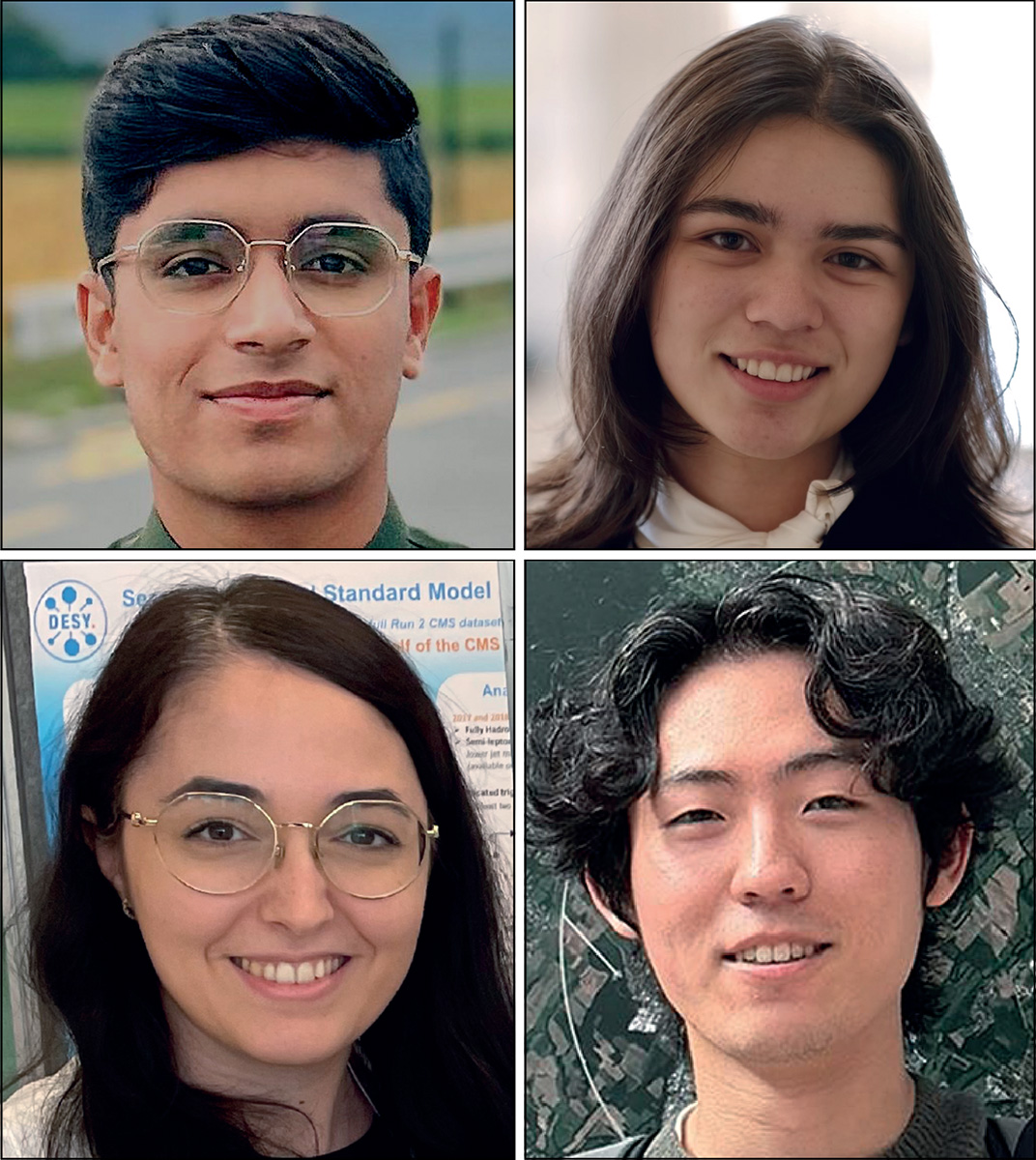
High-school physics curricula don’t include much particle physics. The Beamline for Schools (BL4S) competition seeks to remedy this by offering high-school students the chance to turn CERN or DESY into their own laboratory. Since 2014, more than 20,000 students from 2750 teams in 108 countries have competed in BL4S, with 25 winning teams coming to the labs to perform experiments they planned from blackboard to beamline. Though, at 10 years old, the competition is still young, multiple career trajectories have already been influenced, with the impact radiating out into participants’ communities of origin.

For Hiroki Kozuki, a member of a winning team from Switzerland in 2020, learning the fundamentals of particle physics while constructing his team’s project proposal was what first sparked his interest in the subject.

“Our mentor gave us after-school classes on particle physics, fundamentals, quantum mechanics and special relativity,” says Kozuki. “I really felt as though there was so much more depth to physics. I still remember this one lecture where he taught us about the fundamental forces and quarks… It’s like he just pulled the tablecloth out from under my feet. I thought: nature is so much more beautiful when I see all these mechanisms underneath it that I didn’t know existed. That’s the moment where I got hooked on particle physics.” Kozuki will soon graduate from Imperial College London, and hopes to pursue a career in research.

Sabrina Giorgetti, from an Italian team, tells a similar story. “I can say confidently that the reason I chose physics for my bachelor’s, master’s and PhD was because of this experience.” One of the competition’s earliest winners from back in 2015, Giorgetti is now working on the CMS experiment for her PhD. One of her most memorable experiences from BL4S was getting to know the other winning team, who were from South Africa. This solidified her decision to pursue a career in academia.

“You really feel like you can reach out and collaborate with people all over the world, which is something I find truly amazing,” she says. “Now it’s even more international than it was nine years ago. I learnt at BL4S that if you’re interested in research at a place like CERN, it’s not only about physics. It may look like that from the outside, but it’s also engineering, IT and science communication – it’s a very broad world.”

The power of collaboration

As well as getting hands-on with the equipment, one of the primary aims of BL4S is to encourage students to collaborate in a way they wouldn’t in a typical high-school context. While physics experiments in school are usually conducted in pairs, BL4S allows students to work in larger teams, as is common in professional and research environments. The competition provides the chance to explore uncharted territory, rather than repeating timeworn experiments in school.

2023 winner Isabella Vesely from the US is now majoring in physics, electrical engineering and computer science at MIT. Alongside trying to fix their experiment prior to running it on the beamline, her most impactful memories involve collaborating with the other winning team from Pakistan. “We overcame so many challenges with collaboration,” explains Vesely. “They were from a completely different background to us, and it was very cool to talk to them about the experiment, our shared interest in physics and get to know each other personally. I’m still in touch with them now.”

One fellow 2023 winner is just down the road at Harvard. Zohaib Abbas, a member of the winning Pakistan team that year, is now majoring in physics. “In Pakistan, there weren’t any physical laboratories, so nothing was hands-on and all the physics was theoretical,” he says, recalling his shock at the US team’s technical skills, which included 3D printing and coding. After his education, Abbas wants to bring some of this knowledge back to Pakistan in the hopes of growing the physics community in his hometown. “After I got into BL4S, there have been hundreds of people in Pakistan who have been reaching out to me because they didn’t know about this opportunity. I think that BL4S is doing a really great job at exposing people to particle physics.”

All of the students recalled the significant challenge of ensuring the functionality of their instruments across one of CERN’s or DESY’s beamlines. While the project seemed a daunting task at first, the participants enjoyed following the process from start to finish, from the initial idea through to the data collection and analysis.

“It was really exciting to see the whole process in such a short timescale,” said Vesely. “It’s pretty complicated seeing all the work that’s already been done at these experiments, so it’s really cool to contribute a small piece of data and integrate that with everything else.”

Kozuki concurs. Though only he went on to study physics, with teammates branching off into subjects ranging from mathematics to law and medicine, they still plan to get together and take another crack at the data they compiled in 2020. “We want to take another look and see if we find anything we didn’t see before. These projects go on far beyond those two weeks, and the team that you worked with are forever connected.”

For Kozuki, it’s all about collaboration. “I want to be in a field where everyone shares this fundamental desire to crack open some mysteries about the universe. I think that this incremental contribution to science is a very noble motivation. It’s one I really felt when working at CERN. Everyone is genuinely so excited to do their work, and it’s such an encouraging environment. I learnt so much about particle physics, the accelerators and the detectors, but I think those are somewhat secondary compared to the interpersonal connections I developed at BL4S. These are the sorts of international collaborations that accelerate science, and it’s something I want to be a part of.”

bright-rec iop pub iop-science physcis connect