By Stephen Peggs and Todd Satogata
Cambridge University Press
This concise book provides an overview of accelerator physics, a field that has grown rapidly since its inception and is progressing in many directions. Particle accelerators are becoming more and more sophisticated and rely on diverse technologies, depending on their application.
With a pedagogical approach, the book presents both the physics of particle acceleration, collision and beam dynamics, and the engineering aspects and technologies that lay behind the effective construction and operation of these complex machines. After a few introductory theoretical chapters, the authors delve into the different components and types of accelerators: RF cavities, magnets, linear accelerators, etc. Throughout, they also show the connections between accelerator technology and the parallel development of computational capability.
This text is aimed at university students at graduate or late undergraduate level, as well as accelerator users and operators. An introduction to the field, rather than an exhaustive treatment of accelerator physics, the book is conceived to be self-contained (to a certain extent) and to provide a strong starting point for more advanced studies on the topic. The volume is completed by a selection of exercises at the end of each chapter and an appendix with important formulae for accelerator design.
Since the analysis of data from physics experiments is mainly based on statistics, all experimental physicists have to study this discipline at some point in their career. It is common, however, for students not to learn it in a specific advanced university course but in bits and pieces during their studies and subsequent career.
This textbook aims to present all of the basic statistics tools required for data analysis, not only in particle physics but also astronomy and any other area of the physical sciences. It is targeted towards graduate students and young scientists and, since it is not intended as a text for mathematicians or statisticians, detailed proofs of many of the theorems and results presented are left out.
After a philosophical introduction on the scientific method, the text is presented in three parts. In the first, the foundational concepts and methods of probability and statistics are provided, considering both the frequentist and Bayesian interpretations. The second part deals with the basic and most commonly used advanced techniques for measuring particle-production cross-sections, correlation functions and particle identification. Much attention is also given to the notions of statistical and systematic errors, as well as the methods used to unfold or correct data for the instrumental effects associated with measurements. Finally, in the third section, introductory techniques in Monte Carlo simulations are discussed, focusing on their application to experimental data interpretation.
In February 2016 the LIGO and Virgo collaborations announced the first detection of gravitational waves from the collision of two black holes. It was a splendid result for a quest that started about five decades ago with the design and construction of small prototypes of laser interferometers. Since this first discovery, at least five other binary black-hole mergers have been found and gravitational waves from two colliding neutron stars have also been detected. Gravitational-wave science is now booming, literally, and will continue to do so for a long time. The upcoming observational progress in this field will impact the development of astrophysics, cosmology and, perhaps, particle physics.
Govert Schilling is an award-winning science journalist with a special interest in astronomy and space science. In this book, he guides the reader through the development of gravitational-wave astronomy, from its very origin deep in the early days of general relativity up to the first LIGO discovery. He does so, not only by delving into the key moments of this wonderful piece of history, but also by explaining the main physical and engineering ideas that made it possible.
Moreover, Schilling does a very good job discussing the scientific context in which these events and ideas arose. Far from being a mere collection of events, the book offers the reader a journey that goes beyond its title, exploring and connecting topics such as the cosmic-microwave background and its polarisation, radioastronomy and pulsars, supernovae, primordial inflation, gamma-ray bursts and even dark energy. In addition, the last few chapters of the book discuss the science that may come next, when new interferometers will join LIGO and Virgo in this adventure, observing the sky from Earth (e.g. KAGRA) and space (LISA).
The book clearly aims to target a non-specialist readership and will surely be enjoyed by people lacking a prior knowledge of astrophysics, gravitational waves or cosmology. However, this does not mean that readers more well-versed in these topics will find the book uninspiring. Schilling addresses the reader in a direct, entertaining, almost colloquial manner, managing to explain complex concepts in a few paragraphs while keeping the science sound. Besides, the book gives an interesting (and sometimes surprising) glimpse into the lives, aspirations and mutual interactions of the scientific pioneers in the field of gravitational waves.
If an objection had to be found, it would be that in the first chapter the author belittles general relativity by introducing it as “the theory behind [the movie] Interstellar”. If this scares you, read on and fear nothing. As always happens, science outshines fiction, and the rest of the book proves why this is so.
This book aims to introduce readers to the study of complex systems with the help of simple computational models. After showing how difficult it is to define complexity, the author explains that complex systems are an idealisation of naturally occurring phenomena in which the macroscopic structures and patterns generated are not directly controlled by processes at the macroscopic level but arise instead from dynamical interactions at the microscopic level. This kind of behaviour characterises a range of natural phenomena, from avalanches to earthquakes, solar flares, epidemics and ant colonies.
In each chapter the author introduces a simple computer-based model for one such complex phenomenon. As the author himself states, such simplified models wouldn’t be able to reliably foresee the development of a real natural phenomenon, thus they are to be taken as complementary to conventional approaches for studying such systems.
Meant for undergraduate students, the book does not require previous experience in programming and each computational model is accompanied by Python code and full explanations. Nevertheless, students are expected to learn how to modify the code to tackle the problems included at the end of each chapter. Three appendices provide a review of Python programming, probability density functions and other useful mathematical tools.
The well-known mathematician and theoretical physicist Roger Penrose has produced another popular book, in which he gives a critical overview of contemporary fundamental physics. The main theme is that modern theoretical physics is afflicted by an overdose of fashion, faith and fantasy, which supposedly has led recent research astray.
There are three major parts of the book to which these three f-words relate, corresponding one-to-one with some of the most popular research areas in fundamental physics. The first part, labelled “fashion”, deals with string theory. “Faith” refers to the general belief in the correctness of quantum mechanics, while “fantasy” is the verdict for certain scenarios of modern cosmology.
The book starts with an overview of particle physics as a motivation for string theory and quickly focuses on its alleged shortcomings, most notably extra dimensions. Well-known criticisms, for instance linked to the multitude of solutions (“landscape of vacua”) of string theory or the postulate of supersymmetry, follow in due course. This material is mostly routine, but there are also previously unheard of concerns such as the notion of “too much functional freedom” or doubts about the decoupling of heavy string states (supposedly excitable, for example from the orbital kinetic energy of Earth).
Next the book turns to quantum mechanics and gives an enjoyable introduction to some of the key notions, such as superposition, spin, measurement and entanglement. The author emphasises, with great clarity, some subtle points such as how to understand the quantum mechanical superposition of space–times. In doing so, he raises some concerns and argues – quite unconventionally – that, to resolve them, it is necessary to modify quantum mechanics. In particular he asks that the postulate of linearity should be re-assessed in the presence of gravity.
The fantasy section gives an exposition of the key ideas of cosmology, in particular of all sorts of scenarios of inflation, big bang, cyclic universes and multiverses. This is all very rewarding to read, and particularly brilliant is the presentation of cosmological aspects of entropy, the second law of thermodynamics and the arrow of time. I consider this third section as the highlight of the book. The author does not hide his suspicion that many of these scenarios should not be trusted and dismisses them as crazy – while saying, as if with a twinkle in the eye: not crazy enough!
There is a brief, additional, final section that has a more personal and historical touch, and which tries to make a case for Penrose’s own pet theory: twistor theory. One cannot but feel that some of his resentment against string theory stems from a perceived under-appreciation of twistor theory. In particular, the author admits that his aversion to string theory comes almost entirely from its purported extra dimensions, whereas twistors work primarily in four dimensions.
This touches upon a weak point of the book: the author argues entirely from the direction of classical geometry, and so shares a fixation with extra dimensions in string theory with many other critics. What Penrose misses, however, is that these provide an elegant way to represent certain internal degrees of freedom (needed matter fields). But this is by no means generic – on the contrary, most string backgrounds are non-geometric. For example, some are better described by a bunch of Ising models with no identifiable classical geometry at all, so the agony of how to come to grips with such “compactified” dimensions turns into a non-issue. The point is that due to quantum dualities, there is, in general, no unambiguous objective reality of string “compactification” spaces, and criticism that does not take this “stringy quantum geometry” properly into account is moot.
Somewhat similar in spirit is the criticism of quantum mechanics, which according to Penrose should be modified due to an alleged incompatibility with gravity. Today most researchers would take the opposite point of view and consider quantum mechanics as fundamental, while gravity is a derived, emergent phenomenon. This viewpoint is strongly supported by the gauge-gravity duality and its recent offspring in terms of space–time geometry arising via quantum entanglement.
All-in-all, this book excels by covering a huge range of concepts from particle physics to quantum mechanics to cosmology, presented in a beautifully clear and coherent way (spiced up with many drawings), by an independent and truly deep-thinking master of the field. It also sports a considerable number of formulae and uses mathematical concepts (like complex analysis) that a general audience would probably find difficult to deal with; there are a number of helpful appendices for non-experts, though.
Thus, Fashion, Faith and Fantasy in the New Physics of the Universe seems to be suitable for both physics students and experienced physicists alike, and I believe that either group will profit from reading it, if taken with a pinch of salt. This is because the author criticises contemporary fundamental theories through his personal view as a classical relativist, and in doing so falls short when taking certain modern viewpoints into account.
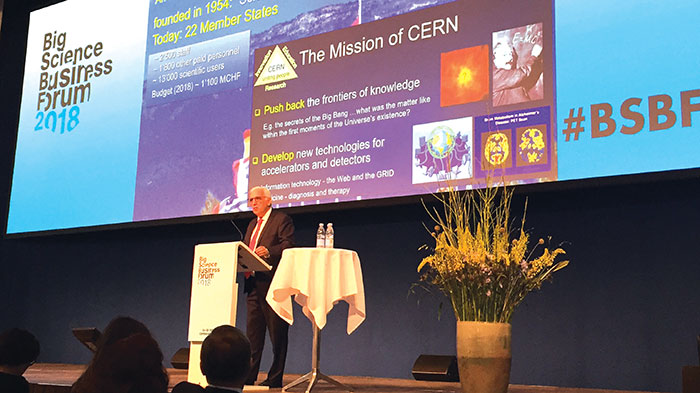
Big science equals big business, whether it is manufacturing giant superconducting magnets for particle colliders or perfecting mirror coatings for space telescopes. The Big Science Business Forum (BSBF), held in Copenhagen, Denmark, on 26–28 February, saw more than 1000 delegates from more than 500 companies and organisations spanning 30 countries discuss opportunities in the current big-science landscape.
Nine of the world’s largest research facilities – CERN, EMBL, ESA, ESO, ESRF, ESS, European XFEL, F4E and ILL – offered insights into procurement opportunities and orders totalling more than €12 billion for European companies in the coming years. These range from advisory engineering work and architectural tasks to advanced technical equipment, construction projects and radiation-resistant materials. A further nine organisations also joined the conference programme: ALBA, DESY, ELI-NP, ENEA, FAIR, MAX IV, SCK•CEN – MYRRHA, PSI and SKA, thereby gathering 18 of the world’s most advanced big-science organisations under one roof.
The big-science market is currently fragmented by the varying quality standards and procurement procedures of the different laboratories, delegates heard. BSBF aspired to offer a space to discuss the entry challenges for businesses and suppliers – including small- and medium-sized enterprises – who can be valuable business partners for big-science projects.
“The vision behind BSBF is to provide an important stepping stone towards establishing a stronger, more transparent and efficient big-science market in Europe and we hope that this will be the first of a series of BSBFs in different European cities,” said Agnete Gersing of the Danish ministry for higher education and science during the opening address.
Around 700 one-to-one business meetings took place, and delegates also visited the European Spallation Source and MAX IV facility just across the border in Lund, Sweden. Parallel sessions covered big science as a business area, addressing topics such as the investment potential and best practices of Europe’s big-science market.
“Much of the most advanced research takes place at big-science facilities, and their need for high-tech solutions provides great innovation and growth opportunities for private companies,” said Danish minister for higher education and science, Søren Pind.
The European strategy for particle physics, which is due to be updated by May 2020, will guide the direction of the field to the mid-2020s and beyond. To inform this vital process, the secretariat of the European Strategy Group (ESG) is calling upon the particle-physics community across universities, laboratories and national institutes to submit written input by 18 December 2018.
The update of the European strategy got under way in September when the CERN Council established a strategy secretariat (CERN Courier November 2017 p37). Chaired by Halina Abramowicz, former chair of the European Committee for Future Accelerators (ECFA), the secretariat includes Keith Ellis (chair of CERN’s Scientific Policy Committee), Jorgen D’Hondt (current ECFA chair) and Lenny Rivkin (chair of the European Laboratory Directors group).
The ESG secretariat, which has been assigned the task of organising the update process, proposes to broadly follow the steps of the previous two strategy processes concluded in 2006 and 2013. An open symposium, which in previous editions took place in Orsay (France) and Kraków (Poland), will take place in the second half of May 2019, in which the community will be invited to debate scientific input into the strategy update. With the event expected to attract around 500 participants, the secretariat proposes to hold it over a period of four days.
To prepare for the open symposium, the location of which is expected to be decided by the summer, ESG calls for written contributions towards the end of the year. Input should be submitted via a portal on the strategy-update website, which will be available from the beginning of October once the update has been formally launched by the CERN Council. The link will appear on the CERN Council’s web pages (https://council.web.cern.ch/en) and will be widely communicated closer to the time.
A “briefing book” based on the discussions will then be prepared by a physics preparatory group and submitted to the ESG for consideration during a five-day-long drafting session in the second half of January 2020. A special ECFA session on 14 July 2019 during the European Physical Society conference on high-energy physics in Ghent, Belgium, will provide another important opportunity for the community to feed into the ESG’s drafting session.
Global perspective
The European strategy update takes into account the worldwide particle-physics landscape and developments in related fields, and was initiated to coordinate activities across a large, international and fast-moving community. The third update comes as the scale of particle-physics facilities is leading to increased globalisation of the field and as its research direction evolves.
Understanding the properties of the Higgs boson (which was discovered at CERN just before the previous strategy update) remains a key focus of analysis at the LHC and future colliders, as are precision measurements of other Standard Model (SM) parameters and searches for new physics beyond the SM.
Neutrino physics is another key area of interest, with much experimental activity taking place since the last update. A “physics beyond colliders” programme has also been established by CERN to explore projects complementary to high-energy colliders and projects of national laboratories. The European astroparticle and nuclear-physics communities, meanwhile, recently launched their own strategies (CERN Courier September 2017 p6; March 2018 p7), which will also feed into the ESG update.
“After the discovery of the Higgs boson, the field is presented with a number of challenges and opportunities,” says Abramowicz. “Guided by the input from the community, the European strategy will determine which of these opportunities will be pursued.”
The TOTEM collaboration at CERN has uncovered possible evidence for a subatomic three-gluon compound called an odderon, first predicted in 1973. The result derives from precise measurements of the probability of proton–proton collisions at high energies, and has implications for our understanding of data produced by the LHC and future colliders.
In addition to probing the proton structure, TOTEM is designed to measure the total cross section of proton–proton collisions. Physically it is by far the longest experiment at the LHC, comprising two detectors located 220 m on either side of the CMS experiment. While most proton–proton interactions at the LHC cause the protons to break into their constituent quarks and gluons, TOTEM detects the roughly 25% of elastic collisions that leave the protons intact. Such collisions merely cause the path of the protons to deviate, by around a millimetre over a distance of 200 m.
Elastic scattering at low-momentum transfer and high energies has long been successfully explained by the exchange of a pomeron – a colour-neutral state made up of an even number of gluons – between the incoming protons. But TOTEM’s latest results seem to be incompatible with this traditional picture.
The discrepancy came to light via measurements of a parameter called ρ, which represents the ratio of the real and imaginary parts of the nuclear elastic-scattering amplitude when there is minimal gluon exchange between the colliding protons and thus almost no deviation in their trajectories (corresponding to a vanishing squared four-momentum transfer, t). TOTEM measured the differential elastic proton–proton scattering cross section down to t = 8 × 10⁻⁴ GeV2 at an energy of 13 TeV during a special LHC run involving “β∗ = 2.5 km” optics and, exploiting Coulomb–nuclear interference, determined ρ with unprecedented precision: 0.09 ± 0.01.
While conventional models based on various pomeron exchanges and related “even-under-crossing” scattering amplitudes can describe ρ and the total proton–proton cross-section in the energy range 0.01–8 TeV, none can describe simultaneously TOTEM’s latest ρ measurement (which is lower than predicted by conventional models) and TOTEM’s total cross-section measurements ranging from 2.76 to 13 TeV (see figure). Combining the two measurements, TOTEM finds better agreement with models that indicate the exchange of three aggregated gluons.
The odderon started out in the early 1970s as a purely a mathematical concept. After the advent of QCD, however, theorists showed that QCD not just allowed but required the existence of such a three-gluon compound.
Although the new data favour the existence of the odderon, the TOTEM collaboration prefers to emphasise all the possible meanings and consequences its results might have – in particular concerning the behaviour of the total proton–proton cross section at high energies. If it turns out that the odderon is not entirely responsible for the observed decrease in ρ at 13 TeV, then it could be the first observation that the proton–proton cross-section growth slows down at energies beyond this. Either way, claims the TOTEM team, the results would constitute an important discovery.
“The TOTEM result is in a reasonable agreement with what is expected within the QCD picture, and the inclusion of the odderon certainly improves our description of the existing data on the high-energy elastic proton–proton scattering,” says theorist and QCD expert Valery Khoze of Durham University in the UK. “Conservatively, I would say that this is a strong indication in favour of the experimental observation of a long-awaited but so far experimentally elusive object predicted by QCD.”
Basarab Nicolescu of Babes-Bolyai University in Romania – who co-invented the odderon with the late Leszek Lukaszuk – and Evgenij Martynov of the Bogolyubov Institute for Theoretical Physics in Ukraine go further. In a paper published shortly after the TOTEM result, they write that the new data “can be considered as the first experimental discovery of the odderon”.
TOTEM researchers say they will continue to refine their measurements of ρ and explore how this ratio of scattering amplitudes evolves as a function of the squared four-momentum transfer. A similar “forward” experiment at the LHC called ALFA, which is part of the ATLAS experiment, is also taking part in such t-channel studies of the proton–proton cross section.
However, if a three-gluon compound is being produced in proton–proton collisions, it should also appear in other scattering experiments via direct s-channel production. Such a signature of the odderon could be detected, for example, by the LHCb experiment and also the COMPASS experiment at CERN.
“The discovery of the odderon would signal another bright manifestation of the predictive power of the QCD theory and confirm again that perturbative QCD allows for quite fair predictions in the experimentally available domain,” says Khoze.
A project carried out at the Technische Universität (TU) Darmstadt in Germany, funded by the European Commission, aims to build a magnetic trap that allows antiprotons to be transported from one location to another. Launched in January, the ultimate goal of the PUMA (antiProton Unstable Matter Annihilation) project is to transfer antiprotons from CERN’s Antiproton Decelerator (AD) to the nearby ISOLDE facility to study exotic nuclear phenomena.
One of PUMA’s physics goals is to explore the occurrence of neutron halos and neutron skins in very neutron-rich radioactive nuclei. By measuring pions emitted after the capture of low-energy antiprotons by nuclei, researchers will be able to determine how often the antiprotons annihilate with the constituent nucleons and therefore deduce their relative densities at the surface of the nucleus. It would be the first time that such effects were investigated in medium-mass nuclei, contributing to a better understanding of the complex nature of nuclei and related astrophysical processes. In the future, PUMA might also allow the spectroscopy of single-particle states in heavy-nuclei with atomic numbers above 100, offering new insight into the unknown shell structure at the top of the nuclear landscape.
To make such studies possible, PUMA must trap antiprotons for long enough to be transported by truck for use in nuclear experiments at the ISOLDE facility, located a few hundred metres away from the AD. Keeping the antiprotons from annihilating with ordinary matter during this process is no easy task. The idea is to develop a double-zone trap inside a one-tonne superconducting solenoid magnet and keep it under an extremely high vacuum (10–17 mbar) and at a temperature of 4 K. One region of the trap will confine the antiprotons, while a second zone will host collisions between antiprotons and radioactive nuclei that are produced at ISOLDE but decay too rapidly to be transported and studied elsewhere.
PUMA will eventually trap a record one billion antiprotons at CERN’s GBAR experiment, which is currently being hooked up to the ELENA facility at the AD (CERN Courier December 2016 p16), and keep them for several weeks to allow the measurements to be made. The team plans to build and develop the solenoid, trap and detection apparatus in the next two years, targeting 2022 for first collisions at ISOLDE.
Today, CERN is the only place in the world where low-energy antiprotons are produced, but “this project might lead to the democratisation of the use of antimatter,” says project leader Alexandre Obertelli of TU Darmstadt, who was awarded a €2.55 million five-year grant from the European Research Council. Along with researchers from RIKEN in Japan, CEA Saclay and IPN Orsay in France, Obertelli has submitted a letter of intent to CERN’s experiment committee concerning the future ELENA and ISOLDE activities. The PUMA apparatus could also, at a later stage, provide antiprotons to experiments beyond CERN. “For example, to universities or nuclear-physics laboratories where specific nuclei can be produced, such as the new SPIRAL2 facilities in Caen, France,” says Obertelli.
Measurements of top-quark production at high rapidity in LHC proton–proton collisions provide a unique probe of the Standard Model of particle physics (SM). In this kinematic region, top-pair production is characterised by sizeable rates of quark–antiquark and quark–gluon scattering processes (in addition to gluon–gluon fusion), potentially enhancing sensitivity to physics beyond the SM. Precision measurements at high rapidity can also be used to probe the inner structure of the proton, constraining parton distribution functions at high “Bjorken-x” values and reducing uncertainties on the background process rates in other measurements. Such a “forward” region is uniquely covered with full instrumentation at the LHC by the LHCb detector.
LHCb has now made its first measurement of top quark production using Run-2 data collected in proton–proton collisions at the energy of 13 TeV. This is the third measurement from LHCb in the sector of top physics and is also the first from the collaboration to study the dilepton channel.
The measurement was performed by reconstructing dilepton decays of the top-pair system, looking for high-momentum electrons, muons and b-jets in the acceptance of the LHCb detector, using data recorded in 2015 and 2016. About 87% of selected events correspond to the signal process, making this the highest purity measurement of top physics at LHCb to date. Within the region covered by LHCb, the production cross-section of top-quark pairs (multiplied by the branching fraction to the measured final state) was determined to be 126 fb with a precision of about 20%, with the uncertainty dominated by statistical effects. The measurement is compatible with the SM predictions.
Such measurements are only now possible at LHCb owing to the increased proton collision energy (13 TeV) of LHC Run 2. While the overall cross section for top-pair production at the LHC has increased by roughly a factor of three with respect to the 8 TeV proton–proton collisions recorded in Run 1, the cross section within the forward coverage of LHCb has increased by about one order of magnitude.
LHCb expects to accumulate, by the end of Run 2, four times more data than that used in the present analysis. With future runs and the upcoming and planned detector upgrades, LHCb will enter a new era of precision studies of forward top physics.
To provide the best experiences, we use technologies like cookies to store and/or access device information. Consenting to these technologies will allow us to process data such as browsing behavior or unique IDs on this site. Not consenting or withdrawing consent, may adversely affect certain features and functions.
Functional
Always active
The technical storage or access is strictly necessary for the legitimate purpose of enabling the use of a specific service explicitly requested by the subscriber or user, or for the sole purpose of carrying out the transmission of a communication over an electronic communications network.
Preferences
The technical storage or access is necessary for the legitimate purpose of storing preferences that are not requested by the subscriber or user.
Statistics
The technical storage or access that is used exclusively for statistical purposes.The technical storage or access that is used exclusively for anonymous statistical purposes. Without a subpoena, voluntary compliance on the part of your Internet Service Provider, or additional records from a third party, information stored or retrieved for this purpose alone cannot usually be used to identify you.
Marketing
The technical storage or access is required to create user profiles to send advertising, or to track the user on a website or across several websites for similar marketing purposes.